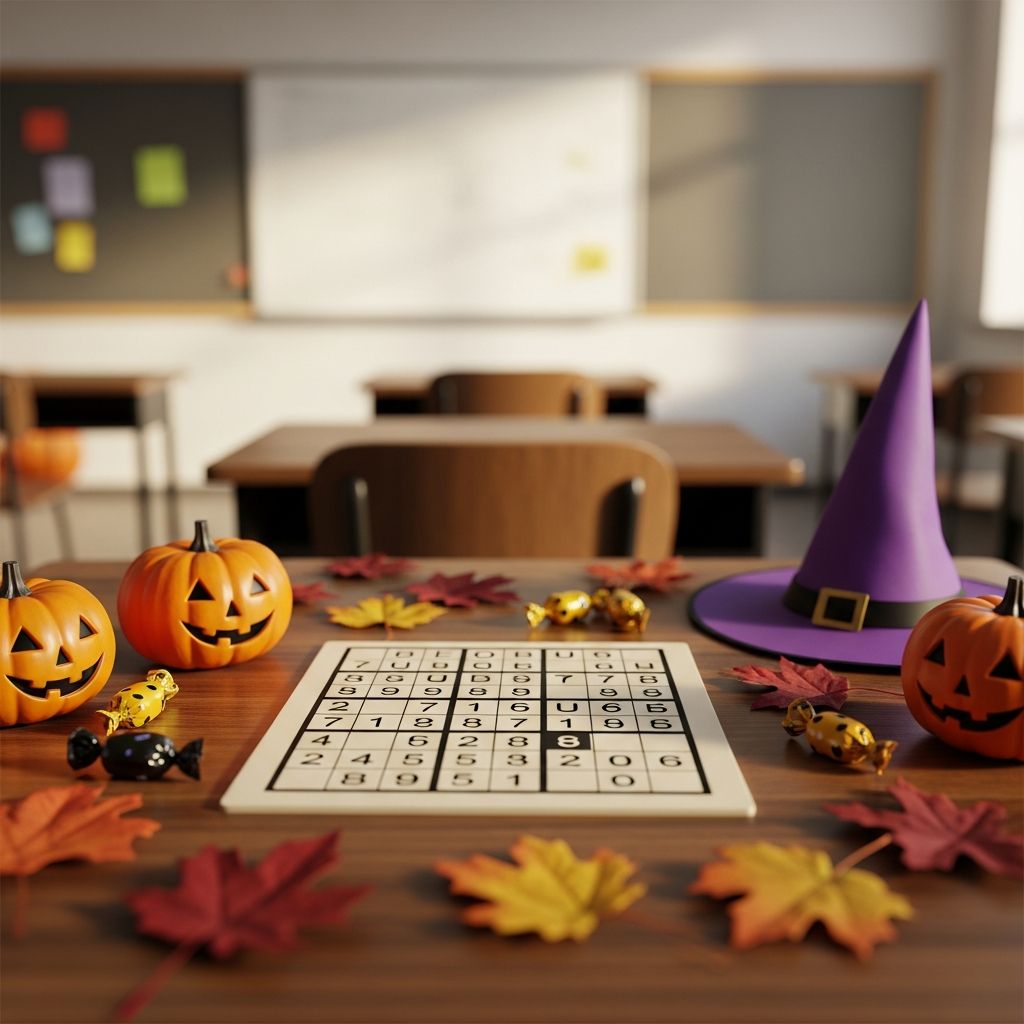
Halloween Sudoku puzzles are a fun way to add seasonal excitement to your math block while quietly building logic, reasoning, and problem-solving skills. This guide walks through how to use a Halloween-themed Sudoku puzzle in the classroom or at home, with practical tips, variations, and student-friendly explanations.
What Is a Halloween Sudoku Puzzle?
A Halloween Sudoku puzzle is a logic grid game that replaces traditional numbers with Halloween icons such as pumpkins, ghosts, bats, and black cats. Instead of filling each row and column with digits, students place each Halloween picture exactly once in every row, column, and sub-grid.
- The basic rule: no icon can repeat in any row or column.
- Every symbol must appear exactly once in each row and column of the puzzle.
- The theme and graphics make the puzzle feel like a game instead of a worksheet.
Because the symbols are visual rather than numerical, the puzzle is especially suitable for younger elementary students who may not be comfortable with higher numbers yet, but who can still use reasoning and pattern recognition.
Ideal Grade Levels and Learners
This type of Halloween Sudoku puzzle is designed primarily for elementary-age students. The picture-based format works especially well for early readers who can more easily track symbols than written numbers.
- Primary grades (K–2): Best for whole-class or small-group instruction with plenty of modeling and support.
- Upper elementary (3–5): Excellent as independent seatwork, an early finisher activity, or a logic center during October.
- Older students: Can use the puzzle as a light, seasonal brain break or warm-up that still reinforces logical thinking.
Because the puzzle does not rely on complex arithmetic, it is accessible for a wide range of learners, including English language learners and students who may struggle with computation but enjoy visual puzzles.
Learning Objectives and Skills
Although it feels like a holiday game, a well-designed Halloween Sudoku puzzle can target several important academic and cognitive goals. When planning to use this activity, consider how it supports your math and critical thinking standards.
- Develop logical reasoning by using clues to eliminate impossible options.
- Strengthen pattern recognition as students notice where icons can or cannot be placed.
- Practice perseverance and flexible thinking while working through a challenging puzzle.
- Reinforce positional vocabulary such as row, column, grid, and square.
The activity also encourages students to communicate mathematically as they explain why a particular icon belongs in a given square and why other choices will not work.
Key Components of the Puzzle
Most classroom-friendly Halloween Sudoku puzzles follow a consistent structure. Understanding each part will help you explain the activity clearly to your students.
| Component | Description | Classroom Tip |
|---|---|---|
| Main grid | A square grid (often 4×4 or 6×6 for younger students) partially filled with Halloween icons. | Project the grid on the board to model strategies with the whole class. |
| Icon set | Four or more Halloween-themed images such as bats, pumpkins, ghosts, and spiders. | Review the icons before starting so students can name and recognize each one. |
| Given clues | Pre-filled symbols that give enough information to make the puzzle solvable. | Use these clues to demonstrate process of elimination and logical deduction. |
| Answer key | A completed version of the grid showing one correct solution. | Keep the key for teacher use or self-checking stations after students attempt the puzzle. |
Whether the puzzle uses pictures, numbers, or letters, the core logic remains the same: every symbol must appear exactly once in each row and column without repetition.
Materials and Preparation
This Halloween Sudoku classroom activity is intentionally low-prep, which makes it ideal for busy weeks leading up to October celebrations. Most teachers can set it up in just a few minutes.
- Printable Halloween Sudoku puzzle sheets (one per student or pair of students).
- Pencils and erasers so students can revise their choices.
- Optional crayons or markers if students will color-code different icons.
- Projector or document camera to model the puzzle steps with the class.
Simply print the puzzle pages, decide whether you will work as a whole class or in small groups, and prepare a brief mini-lesson on the rules of Sudoku and the Halloween icons used on the page.
Introducing the Activity to Students
A clear introduction will help students feel confident instead of intimidated. Begin by connecting the activity to something familiar, such as simple patterns or matching games they already know.
- Show a completed row with each icon used once and ask what the students notice.
- Explain that the goal is to make every row and column look like that row: each symbol exactly one time, with no repeats.
- Highlight the Halloween theme, emphasizing that it is a seasonal game that also uses their math brains.
After the big-picture explanation, move into a short demonstration by solving one or two squares together before sending students off to work on their own copies.
Step-by-Step Classroom Procedure
To maximize understanding, structure the puzzle as a guided activity before transitioning to independent practice. The steps below work well for most elementary groups.
1. Whole-Class Modeling
Project the puzzle and walk the class through the first few moves. Think aloud so students hear the reasoning behind each choice:
- Point to a nearly completed row and ask which icon is missing.
- Model checking the column to ensure that icon does not already appear there.
- Write the symbol into the grid and restate the rule you just used.
This shared modeling stage builds a common strategy toolkit and gives you a chance to correct misunderstandings before they become habits.
2. Guided Practice in Pairs
Next, give each pair of students a puzzle sheet. Ask them to talk through each move instead of silently filling in boxes. This peer conversation encourages students to justify their thinking out loud.
- One partner suggests where an icon should go and explains why.
- The other partner double-checks rows and columns and either agrees or questions the choice.
- Partners switch roles after every few moves to keep both engaged.
Circulate during this time, listening for strong explanations to highlight later and gently redirecting students who try to guess randomly rather than use logic.
3. Independent or Small-Group Work
Once students show some confidence, invite them to complete the rest of the puzzle independently or in small groups. Set a reasonable time limit, but emphasize accuracy and perseverance rather than speed.
- Encourage students to lightly mark possible choices in each square before committing.
- Remind them to erase clearly if they change their minds.
To avoid frustration, you may choose to quietly check on struggling students and offer a hint, such as directing them to the row or column with the most clues already filled in.
Classroom Management and Timing
A single Halloween Sudoku puzzle typically fits into a short math block segment and can also be repeated on different days with new grids. Consider the following timing options.
- Warm-up: Use a brief version at the start of class to activate logical thinking.
- Math center: Place copies in a station for students to visit during rotations.
- Early finisher task: Offer the puzzle to students who finish other assignments early.
- Sub plan filler: Include the puzzle as a meaningful, low-prep activity for substitute teachers.
Because the puzzle is self-contained and requires only pencil and paper, it is easy to manage even when routines are less structured, such as on party days or the last day before a break.
Strategies for Supporting Struggling Students
Some students may find logic puzzles challenging at first. With targeted scaffolds, they can still experience success and build confidence. Try one or more of the supports below.
- Start with a smaller grid (for example, 4×4 instead of 6×6) for students who are new to Sudoku.
- Highlight one symbol at a time and help students hunt for that icon’s missing spaces on the grid.
- Allow students to work in pairs or small groups so they can talk through their choices.
- Offer a partially completed version with more starting clues.
You can also break the task into chunks by asking students to complete just the top half of the puzzle first, check their work, and then move on to the remaining rows.
Extension Ideas for Advanced Learners
For students who finish quickly or crave an extra challenge, turn the Halloween Sudoku into a springboard for higher-level tasks. These extensions keep the theme while deepening the thinking.
- Ask students to design their own Halloween Sudoku puzzle with a different set of icons.
- Invite them to write clear directions or a strategy guide for a younger student.
- Challenge them with a more complex grid size or additional symbols.
- Have them explain, in writing, why each row and column in the completed puzzle is correct.
By encouraging students to create puzzles or teach the rules to others, you reinforce their mastery and give them authentic ownership of the activity.
Using the Puzzle at Home or in Small Groups
Although originally designed for classroom use, a Halloween Sudoku puzzle works equally well in homes, tutoring sessions, and small-group settings. Families often appreciate a screen-free activity that still feels festive.
- Parents can print the puzzle as a quiet Halloween evening activity.
- Homeschoolers can use it as part of an October math unit or holiday theme week.
- After-school programs can include it as a brain game station or club challenge.
In more informal environments, you can relax the rules slightly, offer more hints, or allow multiple attempts without pressure, emphasizing fun and persistence over perfection.
Assessment and Reflection Opportunities
Even though this is a seasonal puzzle, you can still gather useful information about student understanding. Consider using short, low-stakes assessments linked to the activity.
- Have students explain in writing how they decided where to place one specific icon.
- Ask them to circle a mistake they found and describe how they corrected it.
- Use a quick exit ticket where students define terms such as row, column, or grid.
These reflections help students internalize the logic strategies they used and give you insight into which skills might need more direct instruction later.
Sample Classroom Uses by Scenario
The same Halloween Sudoku puzzle can play different roles depending on your schedule and goals. The table below shows a few sample scenarios.
| Scenario | How to Use the Puzzle | Primary Focus |
|---|---|---|
| Halloween party day | Set up a Sudoku station with copies, pencils, and Halloween stickers as small rewards. | Fun enrichment and calm during an otherwise energetic day. |
| Math centers | Include the puzzle as one of several rotation activities during your problem-solving block. | Independent logical reasoning and peer collaboration. |
| Morning work | Place the puzzle on student desks for a quiet start while you take attendance. | Settling routine plus warm-up of critical thinking. |
| Homework | Send home a single-page puzzle as a no-stress family math activity. | Home–school connection and informal practice. |
Having multiple options for using the same resource helps you get more value out of your preparation and ensures different groups of students can enjoy the activity.
Tips for Printing and Reuse
To save time and materials, consider a few practical printing and reuse strategies. These small adjustments can keep the activity ready for use year after year.
- Print puzzles on cardstock and slip them into dry-erase sleeves so students can use markers and then wipe them clean.
- Keep a class set in a labeled Halloween logic folder for easy access every October.
- If you differentiate by level, color-code the borders of each version so students know which one to choose.
Laminated or sleeved copies are especially helpful in centers, where many students will use the same materials throughout the season.
Frequently Asked Questions (FAQs)
How long does it take students to complete the Halloween Sudoku puzzle?
Completion time depends on the grid size and the students’ familiarity with Sudoku. Many elementary classes can finish a basic picture-based puzzle in 15–25 minutes, including modeling and sharing strategies.
Do students need to know how to play traditional Sudoku first?
No prior experience is necessary. A short mini-lesson that explains the idea of using each symbol once per row and column is usually enough, especially when you model the first few moves together.
Can this activity be graded?
It can be, but many teachers prefer to treat it as formative practice or enrichment. You might instead use a simple completion check or ask for a written explanation of one part of the puzzle as evidence of reasoning.
What if my students finish very quickly?
Offer a more challenging version of the puzzle, ask them to design their own grid, or invite them to become “Sudoku helpers” who coach classmates with questions rather than giving direct answers.
Is this activity appropriate for mixed-ability classrooms?
Yes. The picture-based format is accessible for younger and struggling learners, while variations in grid size and complexity, as well as optional extension tasks, provide adequate challenge for advanced students.
Final Thoughts
A Halloween Sudoku puzzle brings together festive fun and meaningful math practice in a single, simple resource. With minimal preparation, you can turn a themed worksheet into a rich problem-solving experience that strengthens logic, perseverance, and communication in your classroom or home.