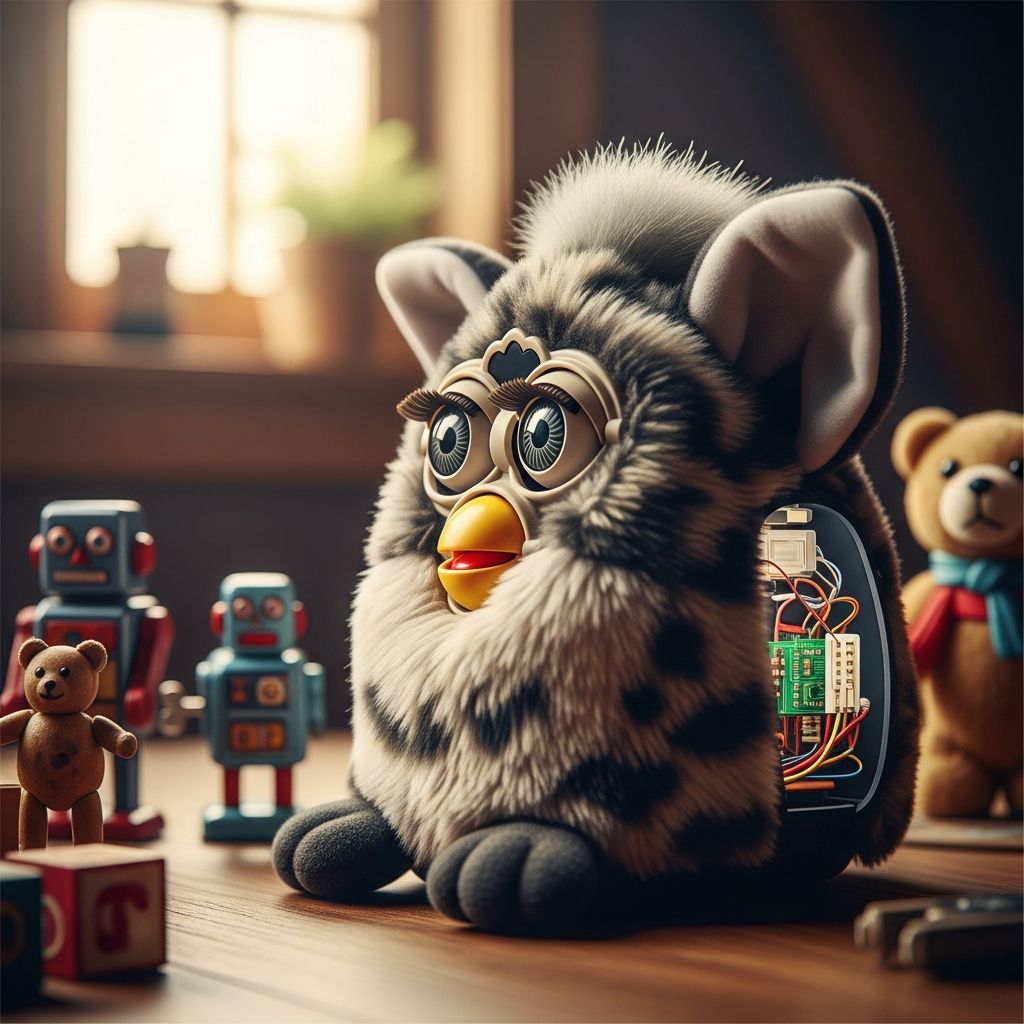
Furby was more than a furry gadget on the toy shelf; it was a turning point in how kids related to technology, blurring the boundary between stuffed animal, robot, and friend.
The Late-90s Toy Landscape
By the end of the 1990s, children were surrounded by screens, beeping gadgets, and early digital pets, yet most toys still behaved in simple, predictable ways. Furby arrived during this shift, promising something stranger and more personal: a creature that felt alive enough to surprise you.
- Game consoles and handhelds were becoming common in family living rooms.
- Virtual pets like Tamagotchi had made “caring” for digital creatures a mainstream idea.
- Parents were eager for toys that felt educational or cutting-edge, but still looked harmless and cute.
What Made Furby So Different?
At first glance, Furby looked like a mash-up of hamster, owl, and gremlin, but its appeal went far beyond its oversized eyes and moving beak. It responded to touch and sound, appeared to learn over time, and mixed nonsense syllables with familiar words to suggest a private, evolving language.
- Furby reacted to petting, tickling, and being turned upside down with distinct sounds and movements.
- Its speech pattern started with a fictional language and gradually folded in recognizable words to imitate learning.
- Multiple units seemed to interact with one another through sound, hinting at secret “conversations.”
Inside the Fuzzy Shell: How It Worked
Underneath the soft fur, Furby was a compact example of late-90s embedded design, combining a simple processor, sound sensors, and a clever mechanical system for movement. The toy’s programming allowed it to respond in ways that felt varied enough to seem spontaneous without requiring complex artificial intelligence.
| Feature | Function | Impact on Play |
|---|---|---|
| Sound sensor | Detected claps, voices, and other noises. | Made kids feel Furby was “listening” and reacting to them. |
| Touch triggers | Responded to petting, shaking, or flipping upside down. | Encouraged physical interaction like a real pet. |
| Motorized face and ears | Moved eyes, beak, and ears to show “emotions.” | Gave personality to otherwise simple audio responses. |
| Scripted language progression | Shifted from fictional words to more familiar language over time. | Created the illusion that Furby was learning from its owner. |
Furby as a 90s Status Symbol
When Furby hit store shelves, demand rapidly outpaced supply, and the toy became a holiday-season obsession in multiple countries. News stories covered parents lining up in the cold and paying inflated prices just to secure one of the chirping creatures for their kids.
- More than 40 million units sold in the first few years of the toy’s life.
- Scarcity turned it from a simple plaything into a marker of who was “lucky” or “left out.”
- Furby quickly appeared in TV shows and films as shorthand for late-90s consumer crazes.
The Emotional Hook: Why Kids Bonded with It
Furby’s design subtly encouraged kids to treat it like a living pet rather than an inert electronic device. The more attention children gave it, the more it seemed to respond, rewarding persistence with new reactions and sounds.
- Kids were invited to “teach” Furby words, deepening a sense of responsibility.
- Randomized responses made it difficult to predict exactly what it would do next, sustaining curiosity.
- The toy’s sleep and wake cycles mimicked a living creature that needed care and quiet.
When Cute Gets Creepy
For every child enchanted by Furby’s blinking eyes, there was another a bit unsettled by its sudden chatter in the middle of the night. Stories circulated of Furbies seemingly speaking on their own in empty rooms, cementing its place in both childhood nostalgia and mild horror.
- The toy could “wake up” if jostled or triggered by sound, even if kids thought it was off.
- Its synthetic voice and occasional garbled phrases invited imaginative interpretations, sometimes veering into the uncanny.
- Some families responded by banishing Furbies to closets, attics, or basements, which only heightened their legend.
Urban Legends and Real-World Restrictions
As Furby fever grew, so did rumors: tales that the toy could record conversations or leak secrets circulated widely among adults. Some organizations reportedly restricted the toy over privacy concerns, even though its design supported playback and reaction rather than true recording.
- Misunderstandings about how its sound detection worked fueled myths about constant surveillance.
- The controversy inadvertently boosted Furby’s mystique among kids, who were thrilled that their toy was treated like contraband in serious places.
Beyond the First Wave: Reboots and Reinventions
After the original craze cooled, Furby never fully disappeared; instead, it resurfaced in new forms that reflected each era’s technology. Later generations added features like more advanced speech, complex facial expressions, and app connectivity, positioning Furby as a bridge between analog toys and smartphone-based play.
- Subsequent versions experimented with LCD eyes, motion sensors, and richer sound libraries.
- Furby spin-offs, including baby-themed and special-edition variants, targeted both kids and emerging collectors.
- Modern incarnations leaned into connectivity, allowing Furbies to interact with apps and digital environments.
Collector Culture and DIY Creativity
What began as a mass-market toy slowly evolved into a niche collector scene, with enthusiasts hunting for rare colors, misprints, and limited editions. Online communities formed around trading, customizing, and restoring older Furbies, keeping the brand’s legacy alive long after its initial retail peak.
- Fans catalog different generations, eye styles, and fabric patterns with a level of detail more often associated with vintage fashion or sneakers.
- Customizers have repainted faces, swapped fur, and hacked internals to create one-of-a-kind art pieces.
- Some hobbyists disassemble and repair aging units, preserving them as artifacts of early consumer robotics.
Furby in Movies, Memes, and Internet Lore
As children who owned Furbies grew up, they brought the toy with them into online culture, turning it into a symbol of both sincere nostalgia and ironic humor. Long-bodied “cursed” customs, surreal memes, and film cameos reframed Furby from cutting-edge tech to a quirky emblem of a specific generation’s childhood.
- Film and television references often use Furby to instantly place a story in the late 1990s or early 2000s.
- Internet artists exaggerate its features or put it in absurd scenarios to highlight the toy’s already uncanny charm.
What Furby Taught the Toy Industry
Furby signaled that kids would eagerly embrace toys that felt responsive, surprising, and slightly mysterious, encouraging manufacturers to double down on interactive features. Its success proved that personality—conveyed through voice, motion, and unpredictability—could matter as much as graphics or raw processing power in children’s entertainment.
| Area | Furby’s Role | Seen Later In |
|---|---|---|
| Emotional interactivity | Showed that kids respond strongly to toys that “emote” and react. | Modern robotic pets and responsive dolls. |
| Embedded personality | Packaged a sense of character into simple, repeatable behaviors. | Smart speakers with kid-focused voices and scripts. |
| Collectibility | Used colors, variants, and limited runs to fuel demand. | Blind-box toys, seasonal editions, and app-linked unlockables. |
Furby and Today’s Smart Gadgets
Living with Furby in the late 1990s foreshadowed the experience of having smart devices scattered around the home that light up, listen, and talk back. Children who once whispered secrets to a furry robot now ask questions of voice assistants, negotiate with learning robots, and expect everyday objects to respond to them.
- Furby normalized the idea that machines could have moods and preferences, paving the way for more anthropomorphic tech.
- Parents gained early practice in balancing fascination with concerns about privacy and constant connectivity.
How Parents Can Use Furby’s Legacy Today
Even if Furby itself is no longer the hottest gift, its history offers a helpful reference point for talking to kids about interactive technology. By treating it as a case study, families can explore how design encourages empathy, dependence, curiosity, or skepticism toward machines.
- Discuss what made Furby feel “alive” and compare that to how modern smart toys and devices behave.
- Encourage kids to question how their gadgets process input and what information they share.
- Use retro toys like Furby to highlight how fast technology and expectations can change.
Frequently Asked Questions About Furby
Was Furby really the first interactive pet toy?
Furby was not the first digital or electronic pet, but it was one of the earliest toys to blend robotic motion, audio responses, and a simulated learning process in an accessible, plush-like form. Earlier digital pets existed primarily on screens, while Furby brought those ideas into three-dimensional, tactile play.
Did Furby actually understand what children were saying?
Furby could detect sound patterns and volume through a basic sensor, but it did not process language the way modern voice assistants do. Its responses followed preprogrammed sequences that created the illusion of understanding rather than genuine comprehension.
Why did people think Furby was spying on them?
Because Furby responded to voices and sometimes spoke at unexpected times, adults assumed it might be recording conversations, especially in sensitive environments. In reality, its design was oriented toward playback and reaction, not true recording or transmission of speech.
Are original Furbies valuable today?
Certain rare colors, limited editions, and boxed units can command notable prices among collectors, especially in online marketplaces. However, many common models are valued more for their nostalgia and customization potential than for high resale value.
What does Furby’s story tell us about future toys?
Furby illustrates that children gravitate toward toys that feel responsive, surprising, and emotionally present, even when the underlying technology is simple. Future toys will likely continue to build on that insight, adding more sophisticated sensing and learning while still emphasizing personality and playfulness.