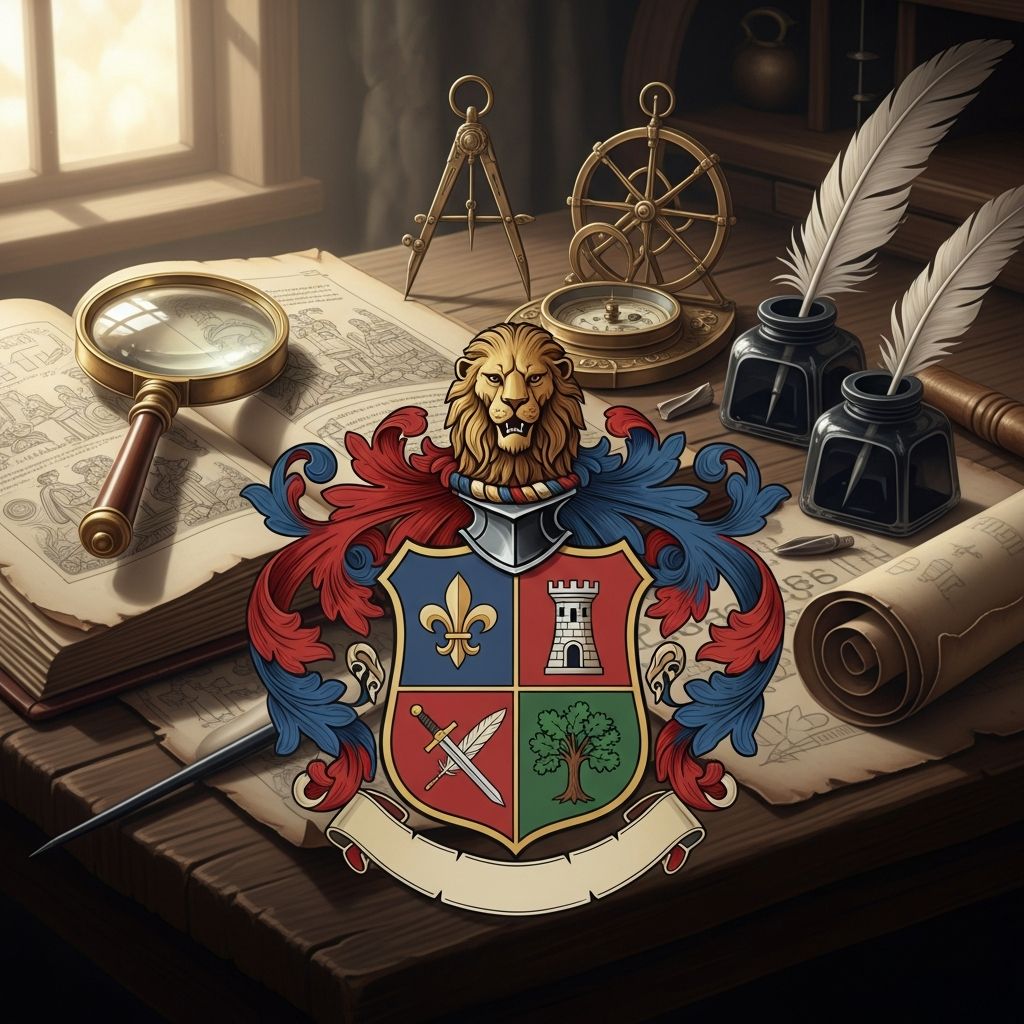
Many people feel drawn to the idea of a family crest or coat of arms because it seems to promise a direct link with ancestors, tradition, and identity. A carefully designed emblem can also become a unifying symbol for a modern family, even if there was never a historic coat of arms in the past.
This guide explains what crests and coats of arms are, how heraldry developed, what different parts of a coat of arms mean, and practical ways to either research an existing design or create your own meaningful family emblem.
What Is a Coat of Arms?
A coat of arms is a distinctive heraldic design traditionally displayed on a shield and sometimes repeated on clothing, banners, and official documents. It began as a way to identify individuals in battle or at tournaments, especially when armor and helmets hid the wearer’s face.
Over time, coats of arms became hereditary symbols connected with particular people, noble lines, or institutions. In some countries, using a historic coat of arms is still regulated, while in others it is largely a matter of custom and personal choice.
- The shield is the central element, carrying the main pattern and symbols.
- Additional components like helmet, crest, motto, and supporters can surround the shield in a full achievement of arms.
Family Crest vs. Coat of Arms
The terms “family crest” and “coat of arms” are often used as if they mean the same thing, but historically they referred to different parts of the design. In strict heraldic language, the crest is only one element, usually positioned above the helmet.
In everyday speech, people commonly say “family crest” when they actually mean the entire coat of arms or an emblem that represents the family in a broader sense. For most modern families designing something new, the precise technical distinction is less important than creating a symbol that genuinely reflects their shared story.
| Term | Strict Heraldic Meaning | Typical Modern Use |
|---|---|---|
| Crest | Object or figure above the helmet, part of the full achievement. | Any symbol said to represent a family (often the whole design). |
| Coat of arms | Complete heraldic design centered on the shield. | Family emblem used on documents, jewelry, or artwork. |
| Arms | The design on the shield itself. | Sometimes used as a shorter way to say coat of arms. |
Key Parts of a Coat of Arms
A traditional coat of arms can include many elements, though not all designs use every possible part. Understanding each piece helps you read historic arms and design your own with more confidence.
- Shield (Escutcheon): The main field, divided into colored sections and charged with animals, plants, tools, or geometric shapes.
- Helmet: Positioned above the shield, its style can hint at rank or historical period.
- Crest: The figure or object on top of the helmet, often a simplified personal or family symbol.
- Wreath and Mantling: A twisted band and flowing cloth surrounding the crest and helmet, originally representing the cloth that protected armor from heat and weather.
- Supporters: Figures placed on either side of the shield, such as animals or people, often reserved for higher ranks.
- Compartment: The base or landscape on which the supporters and shield stand.
- Motto: A short phrase, usually in Latin or the family’s main language, expressing a key value or aspiration.
Colors and Metals in Heraldry
Heraldry uses a limited set of traditional colors and metals, each of which is often associated with particular virtues or ideas. These meanings are not rigid rules, but they can inspire choices when you design or interpret a coat of arms.
- Gold (Or): Linked with generosity, wisdom, and high ideals.
- Silver/White (Argent): Associated with sincerity, peace, and clarity.
- Red (Gules): Commonly connected with courage, sacrifice, and strength.
- Blue (Azure): Often symbolizes loyalty, truth, and steadfastness.
- Green (Vert): Suggests hope, renewal, and connection to the land.
- Black (Sable): Can represent constancy, resilience, or sometimes mourning.
- Purple (Purpure): Traditionally associated with royalty, dignity, and justice.
When combining colors, heraldry has long-standing conventions that favor strong contrast: metals are usually placed on colors and colors on metals so the design remains clear at a distance.
Common Heraldic Symbols and Their Ideas
Animals, plants, tools, and shapes on a shield are called charges. They can allude to personal qualities, historic events, or puns on family names. Some symbols became widely used and developed traditional associations.
- Lion: Courage, leadership, and a willingness to defend others.
- Eagle: Vision, authority, and connection with high aspirations.
- Stag or Deer: Peacefulness combined with the ability to fight if threatened.
- Bear: Strength and protective instinct.
- Cross: Faith, heritage, or participation in religious causes.
- Tree: Family roots, growth, and endurance across generations.
- Castle or Tower: Protection, stability, and sometimes a reference to a particular place.
- Stars: Guidance, hope, or notable achievements.
Can a Family Use Any Historic Coat of Arms?
In many historical heraldic systems, a coat of arms was granted to a specific individual, not an entire surname. This means that a design linked with a particular name in a book or online database does not automatically belong to everyone with that surname.
Modern practice varies by country. Some places still regulate arms through official heraldic authorities, while others treat them as more symbolic and personal. If you hope to use a historic design, you may wish to check local laws, discuss your plans with relatives, and clearly explain to family members whether the emblem is historically documented or newly created.
Researching Whether Your Family Had Arms
Before designing something new, you might want to explore whether any branch of your extended family ever used a coat of arms. This kind of research can be a rewarding part of family history work, even if it ultimately reveals that no definite arms can be linked to your direct line.
- Gather basic genealogy: Record names, dates, and places for as many generations as you can, focusing on the main surname and regions where your ancestors lived.
- Consult heraldic references: Look at reputable heraldry books and institutional databases that catalog coats of arms by name and location, rather than relying only on commercial souvenir products.
- Verify connections: If you find a design matching your surname, evaluate whether the family described in the record matches your ancestors in time, place, and social status.
- Document sources: Keep notes about where each possible match came from so you can revisit or share the information with other relatives.
In many cases, research shows that there is no clear historical coat of arms tied to a specific modern family, or that arms were granted to a single distant individual with no proven link to present-day descendants. In such situations, some families prefer to create an original emblem instead.
Designing Your Own Family Crest or Coat of Arms
Creating a new design offers the chance to express your family’s story, values, and aspirations in a visual form. The process can also become a meaningful family project that brings generations together.
- Clarify your themes: Discuss what matters most to your family: shared values, important places, occupations, or stories that people want represented.
- Choose a shield layout: Decide whether the shield will be a single color, divided in half, quartered, or arranged in another simple pattern.
- Select colors and metals: Limit the palette to two or three main colors plus one or two metals to keep the design clear and harmonious.
- Pick a small number of charges: Focus on one to three symbols that can be drawn clearly and recognized at a glance.
- Consider a crest and motto: If you want a more complete design, choose a crest that echoes a main symbol and write a short motto that captures a key idea.
- Sketch and refine: Create rough drawings by hand or digitally, then simplify shapes until the arms still look distinctive when reduced in size.
Ideas for Modern Symbolism
While traditional heraldry provides a useful starting point, modern families often adapt symbols to match contemporary experiences. The goal is not strict historical accuracy but a coherent design that feels authentic to your story.
- Use animals that reflect admired traits, such as teamwork (wolves), creativity (foxes), or resilience (turtles).
- Incorporate tools linked to shared professions or crafts, like a carpenter’s square, book, or musical instrument.
- Represent important migrations or regions with mountains, waves, bridges, or local plants.
- Include abstract shapes such as chevrons, bars, or circles to balance more detailed figures.
Practical Uses for Your Crest or Arms
Once your family agrees on a design, there are many ways to incorporate it into daily life and special occasions. These uses help the emblem become a living symbol rather than a decorative image that is seldom seen.
- Print the design on stationery, invitations, or family newsletters.
- Engrave or embroider the crest on jewelry, clothing, or household items.
- Display a framed version in the home, perhaps with a brief explanation of the symbols.
- Use simplified versions of the shield or crest as icons for family websites or social media groups.
Ethical and Cultural Considerations
When borrowing elements from historic heraldry or other cultures, it is helpful to consider questions of respect and context. Some symbols may have particular significance or restrictions in certain traditions, while others have become widely shared over time.
Families can act responsibly by avoiding designs that mimic well-known arms of unrelated families, misappropriate sacred symbols, or falsely imply legal status or nobility. Clear communication among relatives and honest explanation of the emblem’s origins help prevent misunderstandings.
Simple Example Workflow
To see how the process might work in practice, imagine a family whose recent ancestors moved between two countries, value education, and often gather near the ocean. They might approach the design process like this:
- Select blue and silver to represent both the sea and ideals of truth and clarity.
- Divide the shield horizontally, with a wave pattern to suggest water and travel.
- Place an open book in the upper section to symbolize learning and shared stories.
- Choose a small bird in the crest to represent communication and close-knit relationships despite distance.
- Agree on a short motto about perseverance or curiosity.
The resulting arms would not copy any particular historic coat, yet it would still feel rooted in traditional heraldic ideas and genuinely connected to the family’s experience.
FAQs About Family Crests and Coats of Arms
Do all surnames have an official coat of arms?
No. Historic coats of arms were granted to specific individuals, not to entire surnames. Many modern families share a surname with someone who once had arms but have no proven connection to that original armiger.
Is it legal to design my own coat of arms?
In most places, creating a personal or family emblem is allowed as long as you do not infringe on trademarks, impersonate another family’s established arms, or claim titles you do not hold. Laws can differ by country, so checking local regulations is wise if you are unsure.
Can my family share a crest even if we are not related by blood?
Many families today include step-relatives, adopted children, and close friends who function as family in every meaningful way. A newly designed emblem can celebrate those real bonds regardless of genetics or traditional lines of inheritance.
How detailed should the design be?
Simpler designs tend to work better. A good test is whether the main elements are still recognizable when the image is reduced to the size of a small icon or printed in one color.
Can the design change over time?
Families sometimes update their arms to reflect new chapters in their story, such as major moves or new shared commitments. If changes are made, it helps to record the history of each version and explain why adjustments were introduced.