Making a Chinese New Year dragon mask is a playful way for children to explore color, storytelling, and cultural traditions while building fine motor skills. This guide walks you through how to design and decorate a bright dragon mask using simple supplies that are easy to find at home, in the classroom, or in a community group setting.
Why Make a Dragon Mask for Lunar New Year?
The dragon is a powerful symbol in many East Asian cultures, often associated with good fortune, strength, and rain for the fields. During Lunar New Year celebrations, dragon imagery appears in parades, decorations, and traditional dances to invite luck and drive away negativity. Crafting a dragon mask lets children participate in the spirit of the festival in a hands-on, imaginative way.
- Connects to culture: Kids can learn that in Chinese tradition, dragons are benevolent and bring blessings, unlike the scary dragons in many Western stories.
- Encourages creativity: Every dragon can look different—fiery, friendly, silly, or majestic.
- Supports motor skills: Tracing, cutting, gluing, and coloring strengthen coordination and hand control.
- Promotes group play: Finished masks can be used in pretend parades, mini dragon dances, or classroom performances.
Recommended Ages and Skill Levels
This dragon mask project can be adjusted for a wide range of ages. With small modifications, it works well at home, in early childhood programs, or in elementary classrooms.
| Age Group | Suggested Approach | Adult Help |
|---|---|---|
| 3–5 years | Pre-cut mask shapes, large decorations, thick crayons or markers | High: cutting, stapling, tying elastic |
| 6–8 years | Trace simple patterns, cut larger shapes, basic gluing and coloring | Moderate: eye holes, elastic, hot glue if used |
| 9–12+ years | Design their own dragon features, more detailed patterns and textures | Low: mainly supervision and safety reminders |
Materials: Simple Supplies, Big Impact
You can create a dragon mask with almost any sturdy paper base and colorful scraps. The list below is flexible—swap items based on what you already have.
Basic Mask Base
- 1 sheet of cardstock or thin cardboard (such as from a cereal box)
- Optional: a paper plate if you prefer a rounded mask base
Attachment Options
- Elastic cord or string
- Two wooden craft sticks (for a handheld mask)
- Masking tape or clear tape to reinforce attachment points
Decorative Details
- Colored paper or tissue paper (red, gold, green, yellow are popular New Year colors)
- Washable markers or crayons
- Glue stick or white school glue
- Child-safe scissors
- Bottle caps, lids, or small bowls for tracing circles
Optional Extras
- Glitter glue or metallic pens (for a festive shimmer)
- Crepe paper streamers or ribbon for whiskers and flames
- Pom-poms, sequins, or stickers for added texture
Designing the Dragon’s Face
Before cutting anything, encourage children to imagine what kind of dragon they want:
- Expression: Friendly, fierce, sleepy, excited, or silly
- Personality: A water dragon, sky dragon, forest dragon, or lucky New Year dragon
- Color story: Choose two or three main colors to repeat across the mask
For younger children, you can lightly sketch a simple dragon head shape on the cardstock for them to follow. Older kids can draw their own design freehand or use household objects to trace circles and curves.
Key Facial Features to Include
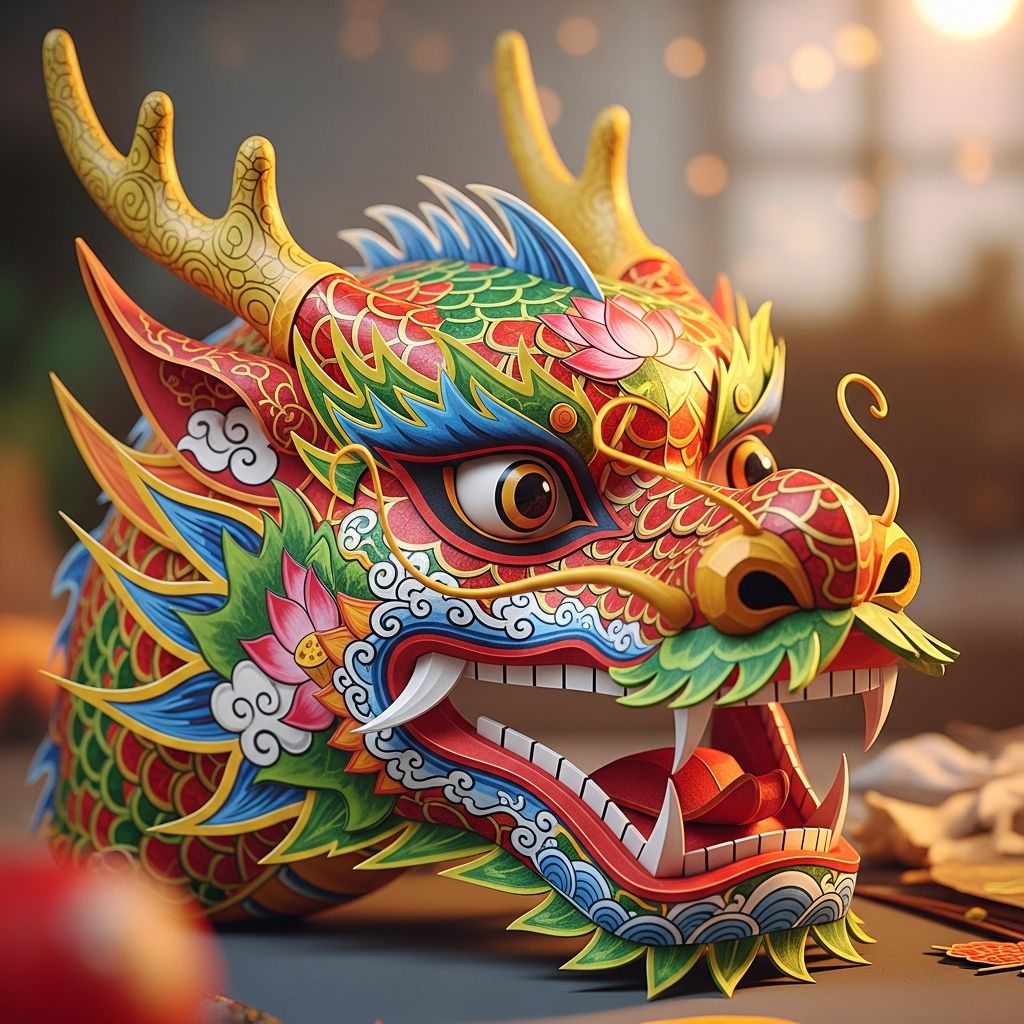
- Eyes: Large circles or ovals make the dragon look animated and expressive.
- Snout or muzzle: A long rectangle or rounded shape that extends from the lower half of the face.
- Nostrils: Simple circles or teardrops that can be outlined in a contrasting color.
- Horns or antlers: Curved triangles, branches, or wavy shapes on top of the mask.
- Whiskers and flames: Strips of tissue paper, ribbon, or thin paper for movement.
Step-by-Step: Building the Dragon Mask
These steps describe a straightforward, single-layer mask. You can add more layers or textures once the basic structure is complete.
1. Create the Base Shape
- Place the cardstock horizontally.
- Draw a wide oval or rounded rectangle that will cover the upper half of the face.
- Add gentle curves or points along the top edge to suggest horns or a crown-like ridge.
- Cut out the shape carefully. Adults should help with tight corners or thick cardboard.
2. Mark and Cut the Eye Openings
- Hold the blank mask shape loosely in front of the child’s face.
- Use a pencil to mark where their eyes roughly align.
- Remove the mask and draw two circles or ovals for eye holes around those marks.
- Fold the mask slightly and cut a small slit inside each eye shape, then cut around to remove the centers.
For safety, very young children can use the mask as a decoration instead of wearing it, avoiding eye holes altogether.
3. Add the Dragon’s Snout
- Cut a rectangle or rounded shape from a second piece of cardstock.
- Glue it along the bottom center of the mask so it extends downward to form a muzzle.
- Draw or glue on nostrils at the end of the snout.
4. Design Horns, Ears, and Eyebrows
- Cut out two horn shapes from colored paper—these can be spiky, curved, or cloud-like.
- Glue the horns behind the top edge of the mask so they stick up like a crown.
- Add ear or frill shapes on the sides for extra dimension.
- Cut thin, curved strips of paper for exaggerated eyebrow shapes and glue them above the eye holes.
5. Add Flames, Whiskers, and Fringe
- Cut narrow strips of red, orange, and yellow tissue paper or ribbon.
- Glue them to the underside of the snout to suggest flames coming from the dragon’s mouth.
- Add longer strips from the sides or bottom edge as flowing whiskers or a beard.
- For extra motion, attach longer streamers to the back so they flutter when the wearer moves.
6. Decorate and Detail
- Color the main sections of the face using markers, crayons, or paint.
- Outline features like nostrils, eyes, and scales with a darker color to make them stand out.
- Add patterns: zigzags, dots, waves, or cloud shapes are all common decorative motifs in traditional art from the region.
- Use shallow dots of glue to attach sequins, small paper circles, or stickers for extra sparkle.
7. Attach the Mask for Wearing
There are two main ways for children to use their finished mask: wearing it on the face or holding it in front of their face like a puppet.
Elastic or String (Wearable Mask)
- Reinforce the sides of the mask with a small piece of clear tape where the holes will go.
- Use a hole punch (or carefully twist a sharp pencil with adult supervision) to make a hole on each side.
- Cut a piece of elastic slightly shorter than the child’s head circumference so the mask fits snugly.
- Thread each end of the elastic through a hole and tie a secure knot.
Handheld Mask (Good for Younger Children)
- Glue or tape a craft stick to the bottom or side of the mask.
- Reinforce with a second layer of tape or a scrap of cardstock over the stick.
- Children can hold the mask in front of their face during storytelling or pretend parades.
Color Symbolism and Story Ideas
Color choices can be a simple introduction to symbolism in Chinese New Year traditions. Many families and communities highlight certain colors during the festival to represent good wishes for the year ahead.
| Color | Common Association in Chinese New Year | How to Use It on the Mask |
|---|---|---|
| Red | Good luck, joy, and celebration | Main face color, flames, or background |
| Gold/Yellow | Prosperity and brightness | Horns, eyebrows, or decorative patterns |
| Green | Growth and vitality | Whiskers, frills, or side details |
| Blue | Water, sky, calm | Water dragon forehead or scales |
You can invite children to invent a short story about their dragon:
- Where does the dragon live—mountains, sea, clouds, or city rooftops?
- What does the dragon bring for the New Year—rain, music, fireworks, or friendship?
- Does the dragon have a favorite food or treasure it guards for the community?
Adapting the Craft for Groups and Classrooms
Dragon masks work especially well in group settings such as classrooms, libraries, or community events. With a few adjustments, you can manage many children at once while keeping the activity organized.
Time-Saving Tips
- Pre-cut basic mask shapes and snouts for young groups.
- Prepare small bowls or trays with sorted decorations (paper strips, sequins, stickers).
- Label markers and glue sticks for each table to reduce crowding around supply areas.
Collaborative Options
- Create a class dragon parade where each child’s mask becomes part of a line of dancing dragons.
- Invite children to pair up and help each other attach elastic and check comfort and fit.
- Display finished masks on a bulletin board or wall, perhaps grouped by color theme or story type.
Safety and Accessibility Considerations
Art and craft activities can support child development, but they also require attention to basic safety, especially with younger children.
- Use age-appropriate tools: Provide blunt-tip, child-safe scissors and non-toxic glue and markers, and supervise closely when younger children are cutting.
- Avoid small choking hazards: For very young children, skip sequins and tiny beads in favor of larger paper shapes.
- Fit masks comfortably: Ensure elastic is not too tight and eye holes are large enough not to block vision.
- Offer alternatives: For children who dislike wearing masks, suggest handheld versions or turning the dragon face into a wall decoration or puppet instead.
Extending the Learning: Beyond the Craft Table
A dragon mask can be a starting point for exploring broader themes of culture, language, and art.
Connect with Stories and Music
- Read age-appropriate picture books about Lunar New Year and family traditions, paying attention to how dragons are shown and described.
- Play recordings of festival music and invite children to move or dance while wearing their masks.
- Encourage each child to tell a short story from the dragon’s point of view.
Link to Simple Geography and Calendars
- Show children a map and point out some countries where Lunar New Year is widely celebrated, such as China, Vietnam, and others in East and Southeast Asia.
- Explain that Lunar New Year is based on a lunar calendar, so the exact date changes each year.
- Mention that different years are associated with different zodiac animals, with the dragon being one of them.
Frequently Asked Questions (FAQs)
How long does it take to make a dragon mask?
For a simple version with pre-cut shapes, most children can finish in about 20–30 minutes. More detailed masks with layering, painting, and extra decorations may take 45–60 minutes or more.
What if I do not have cardstock?
You can reuse thin cardboard from food boxes, sturdy paper plates, or glue two sheets of regular printer paper together to make a thicker base.
Can this craft work for older kids and teens?
Yes. Older children can design more intricate horns, layered scales, or 3D features and may enjoy researching traditional dragon art styles for inspiration.
Is it okay to change the traditional colors?
Traditional New Year decorations often use red and gold, but for a creative craft, children are free to explore any colors they like. You can still discuss the cultural meanings of certain colors while encouraging individual expression.
How can we store the masks after the celebration?
Let all glue and paint dry completely, then hang the masks on a wall, slide them into large envelopes, or lay them flat in a shallow box so the decorations are not crushed.
References
- Chinese New Year — Hong Kong Tourism Board. 2024-01-15. https://www.discoverhongkong.com/eng/explore/festivals/chinese-new-year.html
- Traditional Chinese Dragon Imagery in Art — The Palace Museum, Beijing. 2020-06-10. https://en.dpm.org.cn/collections
- Art and Craft Safety Guide — U.S. Consumer Product Safety Commission. 2012-05-01. https://www.cpsc.gov/s3fs-public/5015.pdf
- Lunar New Year Celebrations — The Metropolitan Museum of Art, #MetKids. 2021-02-01. https://www.metmuseum.org/art/online-features/metkids/explore/lunar-new-year
- Chinese New Year — Encyclopaedia Britannica. 2023-01-19. https://www.britannica.com/topic/Chinese-New-Year