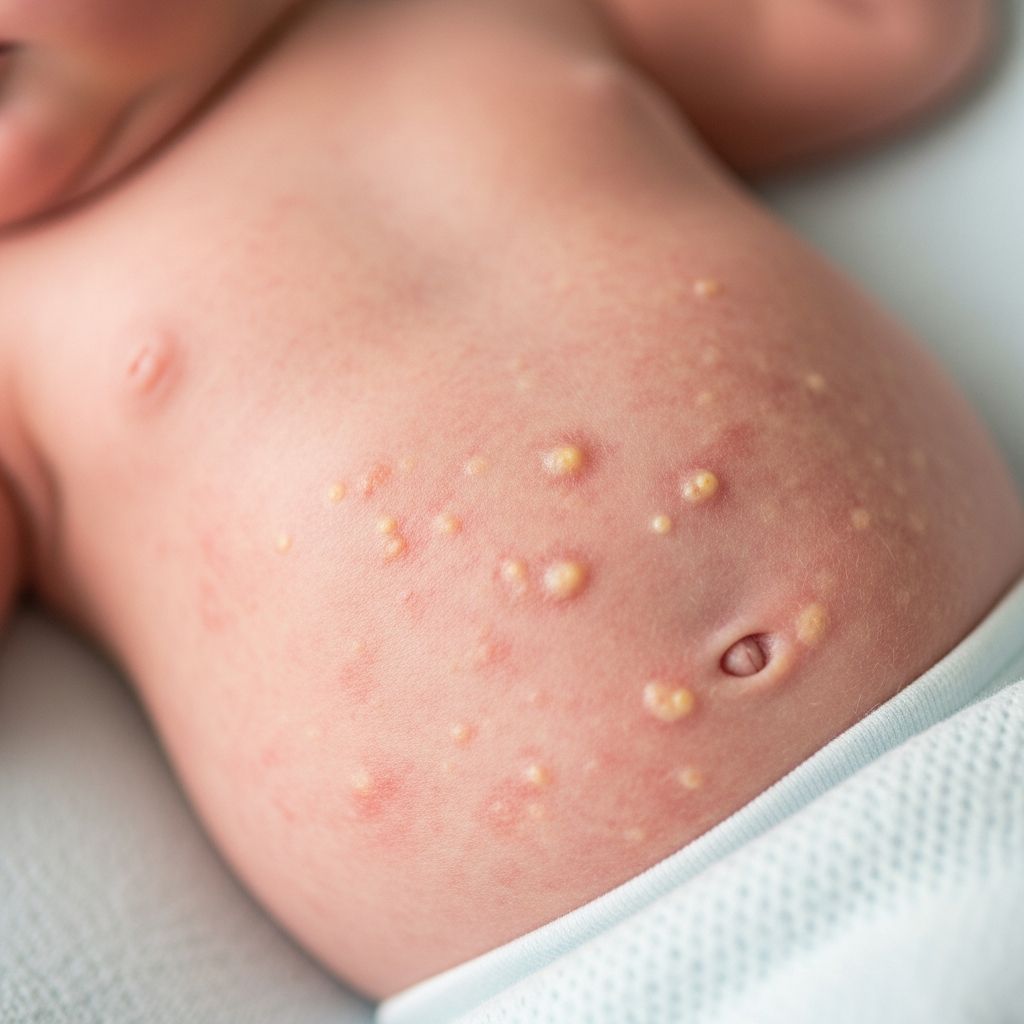
Affecting nearly half to three-quarters of full-term newborns, erythema toxicum neonatorum (ETN) is one of the most frequent skin conditions in the first weeks of life. This innocent eruption features red blotches often topped with small white or yellow pustules, sparking concern among new parents despite its harmless nature.
Recognizing the Signs of Erythema Toxicum in Infants
The hallmark of ETN is its distinctive appearance: irregular red patches, known as macules or wheals, scattered across the baby’s body. These may measure a few millimeters to centimeters and frequently bear a central firm papule or pustule filled not with bacteria but eosinophils—immune cells signaling an inflammatory response.
Lesions typically emerge between 24-48 hours post-birth, though some appear within hours or as late as two weeks. They favor the face (especially cheeks), trunk, thighs, and extremities but spare palms and soles, regions lacking hair follicles. Individual spots wax and wane dramatically, fading in hours or days while new ones arise nearby, creating a migratory pattern that resolves fully within 1-2 weeks, rarely recurring.
- Red blotchy areas with fuzzy edges, resembling hives.
- Central bumps: White-yellow pustules or firm papules, 1-3 mm wide.
- Variable spread: From sparse spots to widespread coverage.
- No itch or pain: Baby remains comfortable and thrives.
This evanescent quality distinguishes ETN; unlike persistent rashes, it shifts like a fleeting map on the skin.
Why Does This Rash Develop in Healthy Newborns?
The precise trigger for ETN remains elusive, but research points to the newborn’s maturing immune system encountering the outside world’s microbes. As skin bacteria colonize hair follicles shortly after birth, they provoke a localized inflammatory cascade, recruiting eosinophils around follicles.
Studies detect elevated cytokines like IL-1, IL-8, and eotaxin in lesions, driving redness and cell influx without systemic illness. Hypotheses include:
- Response to commensal bacteria entering follicles for the first time.
- Immature pilosebaceous units (hair and oil glands) reacting to stimuli.
- Possible thermal or mechanical factors from birth environment.
Preterm infants (<2500g) experience it less often, while term babies, especially vaginally delivered males in warmer climates, show higher incidence—up to 72% in some cohorts.
How Common Is Erythema Toxicum Among Newborns?
| Population Group | Prevalence | Source |
|---|---|---|
| Full-term infants | 48-72% | |
| Japanese neonates (study of 5387) | 40.8% | |
| Preterm (<2500g) | Rare | |
| Male newborns | Higher risk |
These figures underscore ETN’s ubiquity in healthy term neonates, peaking in the first week.
Differentiating ETN from Serious Newborn Skin Issues
ETN’s pustular look alarms parents and clinicians, mimicking infections. Key differentials include:
- Bacterial sepsis (Staph/Strep): Fever, lethargy, pus cultures positive; widespread symptoms.
- Candida: Thrush, diaper rash; affects palms/soles.
- Miliaria (heat rash): Clear vesicles tied to sweat ducts, no eosinophils.
- Viral exanthems: Systemic signs like irritability.
Diagnosis relies on clinical exam: thriving baby + classic distribution + Wright stain showing eosinophils confirm ETN. Biopsy, if done, reveals perifollicular eosinophilic pustules. No bloodwork needed for well infants.
Management: Reassurance Over Intervention
ETN requires no therapy—it’s self-resolving. Avoid squeezing pustules to prevent rare secondary infection. Gentle cleansing suffices; steroids or antibiotics are contraindicated.
Monitor for:
- Persistent rash beyond 2 weeks.
- Fever, poor feeding, or lethargy.
- New lesions with systemic signs.
Most fade unnoticed by month 1.
Parental Guidance: Easing Newborn Skin Worries
New parents often photograph rashes in panic. Educate on ETN’s benign course: “Your baby is well; this common pattern passes soon.” Track feeding/weight gain to affirm health.
Pro Tip: Keep a baby journal noting rash onset, spread, and fade to share confidently at checkups.
Insights from Medical Research on Neonatal Rashes
Histology shows subcorneal pustules with eosinophils/microabscesses around follicles, sans epidermal necrosis. Immunostaining reveals activated immune clusters early as day 1. No maternal cell graft-vs-host link proven.
Risk modifiers: Vaginal birth, powdered formula, high birthweight, summer births elevate odds.
Long-Term Outlook and Rare Concerns
ETN leaves no scars or sequelae. One study links it tenuously to later eosinophilic esophagitis, but causality unproven—mention history if esophageal issues arise. Preterms spared may reflect underdeveloped folliculitis response.
Frequently Asked Questions About Newborn Erythema Toxicum
Is erythema toxicum painful for my baby?
No, babies show no discomfort, itch, or distress from ETN lesions.
Can breastfeeding or formula cause this rash?
Not directly; powdered milk noted as risk, but immune response drives it.
How do I know it’s not an infection?
Well-appearing baby + eosinophils on smear + no palms/soles involvement rule out most.
Does ETN recur or affect older infants?
Rarely recurs; absent after 2-3 weeks, doesn’t impact toddlers.
Should I avoid baths during an ETN flare?
No, normal hygiene fine; pat dry gently.
Preventing Alarm: Empowering Parents with Knowledge
By framing ETN as a normal immune rite-of-passage, pediatricians reduce unnecessary visits. Visual aids like photos aid recognition. In diverse climates, educate on seasonal upticks.
This rash symbolizes adaptation: newborn skin learning to host its lifelong microbiome safely.
References
- Erythema toxicum neonatorum — Wikipedia. 2023-10-15. https://en.wikipedia.org/wiki/Erythema_toxicum_neonatorum
- Erythema Toxicum — StatPearls, NCBI Bookshelf. 2023-07-17. https://www.ncbi.nlm.nih.gov/books/NBK470222/
- Toxic erythema of the newborn — DermNet NZ. 2024-01-12. https://dermnetnz.org/topics/toxic-erythema-of-the-newborn
- All About Erythema Toxicum Neonatorum — WebMD. 2023-11-05. https://www.webmd.com/skin-problems-and-treatments/erythema-toxicum-neonatorum
- Erythema Toxicum — UF Health. 2023-09-20. https://ufhealth.org/conditions-and-treatments/erythema-toxicum