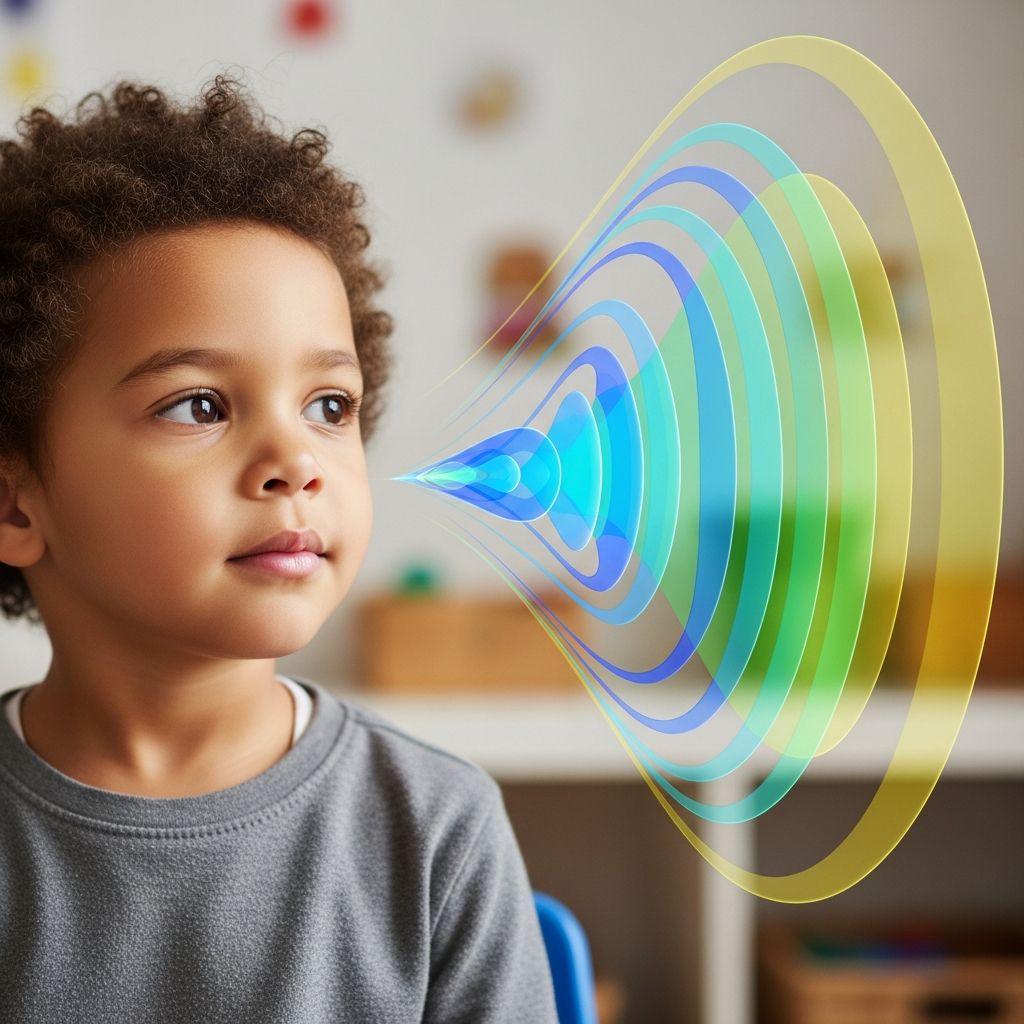
Echolalia refers to the involuntary repetition of words, phrases, or sounds heard from others, serving as a key feature in child development and certain neurodevelopmental conditions. While common in toddlers learning language, persistent echolalia beyond age three often signals underlying issues like autism spectrum disorder (ASD).
Defining Echolalia and Its Role in Communication
Echolalia manifests as echoing speech, derived from Greek roots meaning ‘echo’ and ‘speech.’ It acts as a bridge in language acquisition for young children but can persist pathologically in disorders affecting speech processing. In typical development, children under 3 years repeat to practice sounds and syntax, transitioning to original expressions by preschool age.
This repetition helps process auditory input, yet when it dominates communication, it may hinder meaningful exchanges. Parents might notice a child mirroring questions instead of answering, such as responding ‘Want juice?’ to ‘Do you want juice?’
Core Types of Echolalia Explained
Echolalia divides into distinct categories based on timing and modification of the repeated content. Recognizing these aids in assessing severity and planning interventions.
- Immediate Echolalia: Repetition occurs right after hearing the phrase, often verbatim, stemming from short-term memory recall. Example: Adult says ‘Time for bed,’ child echoes ‘Time for bed’ instantly.
- Delayed Echolalia: Phrases from past events, like TV lines or prior talks, resurface hours or days later. This relies on long-term memory and appears scripted.
- Mitigated Echolalia: The child alters the original slightly, showing emerging comprehension, such as changing pronouns or tense.
- Unmitigated Echolalia: Exact duplication without changes, typical in more rigid presentations.
- Ambient Echolalia: Echoing environmental sounds like ads or background chatter, less interactive.
These variations highlight echolalia’s spectrum, from functional practice to communicative barrier.
Common Causes Behind Repetitive Speech Patterns
Multiple factors trigger echolalia, spanning developmental, neurological, and environmental influences. Primary associations include ASD, where up to 75% of verbal children exhibit it, per clinical observations.
| Category | Examples | Key Notes |
|---|---|---|
| Neurodevelopmental | Autism Spectrum Disorder (ASD), Tourette Syndrome | Linked to frontal lobe dysfunction and mirror neuron issues in ASD. |
| Language-Related | Developmental delays, aphasia, speech disorders | Persists when original speech lags. |
| Neurological | Head injury, stroke, encephalitis, epilepsy | Brain areas for language processing affected. |
| Psychiatric/Other | Schizophrenia, anxiety, dementia | Stress exacerbates in some cases. |
In toddlers, it’s normative until 30 months; persistence correlates with ASD risk. Adult onset often follows trauma or neurodegeneration.
Recognizing Symptoms in Everyday Interactions
Key indicators include rote repetition over functional language, frustration in dialogues, irritability when questioned, or selective mutism alongside echoes. Children may seem non-responsive yet parrot ambient noise.
- Repeating questions verbatim instead of replying.
- Scripted phrases from media out of context.
- Emotional distress or withdrawal during talks.
- Over-reliance on echoes under stress.
Unlike tics in Tourette’s, echolalia targets heard speech, not random outbursts. Track frequency: daily scripting beyond age 3 warrants monitoring.
Diagnosis: Steps for Accurate Identification
Professionals diagnose via developmental history, observation, and standardized tools. Pediatricians screen; speech-language pathologists (SLPs) assess via play-based tests.
- Parental reports on speech milestones.
- Direct observation of repetition patterns.
- Screening for ASD (e.g., M-CHAT) or language disorders.
- Neurological exams if trauma suspected.
NCBI notes echolalia as a hallmark in ASD diagnostics since 1943. Early detection, ideally before 3 years, improves outcomes.
Effective Treatment and Management Strategies
Interventions target underlying causes, emphasizing functional communication. No cure exists, but therapies reduce reliance on echoes.
- Speech Therapy: SLPs teach scripting alternatives, modeling responses. Techniques like verbal behavior therapy prompt original utterances.
- Applied Behavior Analysis (ABA): Reinforces novel speech, fades prompts.
- Augmentative Communication: Devices like PECS for non-verbal kids.
- Addressing Comorbidities: Anxiety management via CBT if stress-triggered.
Progress shows in spontaneous sentences; consistency yields gains within months.
Practical Tips for Parents Supporting Their Child
Parents play a pivotal role by creating supportive environments. Simplify language, pause for processing, and praise efforts.
- Use short, clear phrases; model answers.
- Incorporate visuals to pair words with meanings.
- Expand echoes: If child says ‘Big truck,’ reply ‘Yes, big red truck going fast.’
- Reduce screen time to limit scripted inputs.
- Collaborate with therapists for home strategies.
Track progress in a journal; celebrate small wins like first original words.
When to Consult a Specialist: Red Flags
Seek help if echolalia dominates after 3 years, accompanies regression, or pairs with social withdrawal, sensory issues, or no gestures by 12 months.
- No single words by 16 months.
- Loss of acquired language.
- Intense frustration or isolation.
- Repetition without communicative intent.
Early intervention via programs like Early Start improves language trajectories.
Frequently Asked Questions (FAQs)
Is echolalia always a sign of autism?
No, while common in ASD, it occurs in language delays, Tourette’s, or trauma. Context and persistence guide diagnosis.
Can children outgrow echolalia?
Many toddlers do by age 3; persistent cases benefit from therapy to foster original speech.
How does echolalia differ from normal repetition?
Normal fades with original speech growth; echolalia persists as primary communication mode.
What home activities help reduce echolalia?
Interactive play, picture exchanges, and modeling simple responses encourage functional language.
Does screen time worsen echolalia?
Yes, excessive media provides scripts; limit and discuss content to build comprehension.
This comprehensive guide empowers parents to navigate echolalia with informed action. Word count: 1,712 (excluding HTML tags).
References
- Echolalia: What Is It, Causes, Symptoms, Treatments — CASRF. 2023. https://www.casrf.org/post/echolalia-what-is-it-causes-symptoms-treatments
- Echolalia: Causes, Symptoms, Types, Diagnosis, and Treatment — WebMD. 2023-10-26. https://www.webmd.com/parenting/what-is-echolalia
- Echolalia — Wikipedia. 2026. https://en.wikipedia.org/wiki/Echolalia
- Echolalia: Causes, Symptoms, Types, Diagnosis, and Treatment — Healthline. 2023-11-01. https://www.healthline.com/health/echolalia
- Echolalia: Is Repeating Words a Sign of Autism? — Ability Central. 2024. https://abilitycentral.org/article/echolalia-repeating-words-sign-autism
- Echolalia: Causes, Symptoms, Types, Diagnosis, and Treatment — Speech and OT. 2023. https://www.speechandot.com/echolalia-causes-symptoms-types-diagnosis-and-treatment/
- Echolalia — NCBI Bookshelf (StatPearls). 2023-07-17. https://www.ncbi.nlm.nih.gov/books/NBK565908/