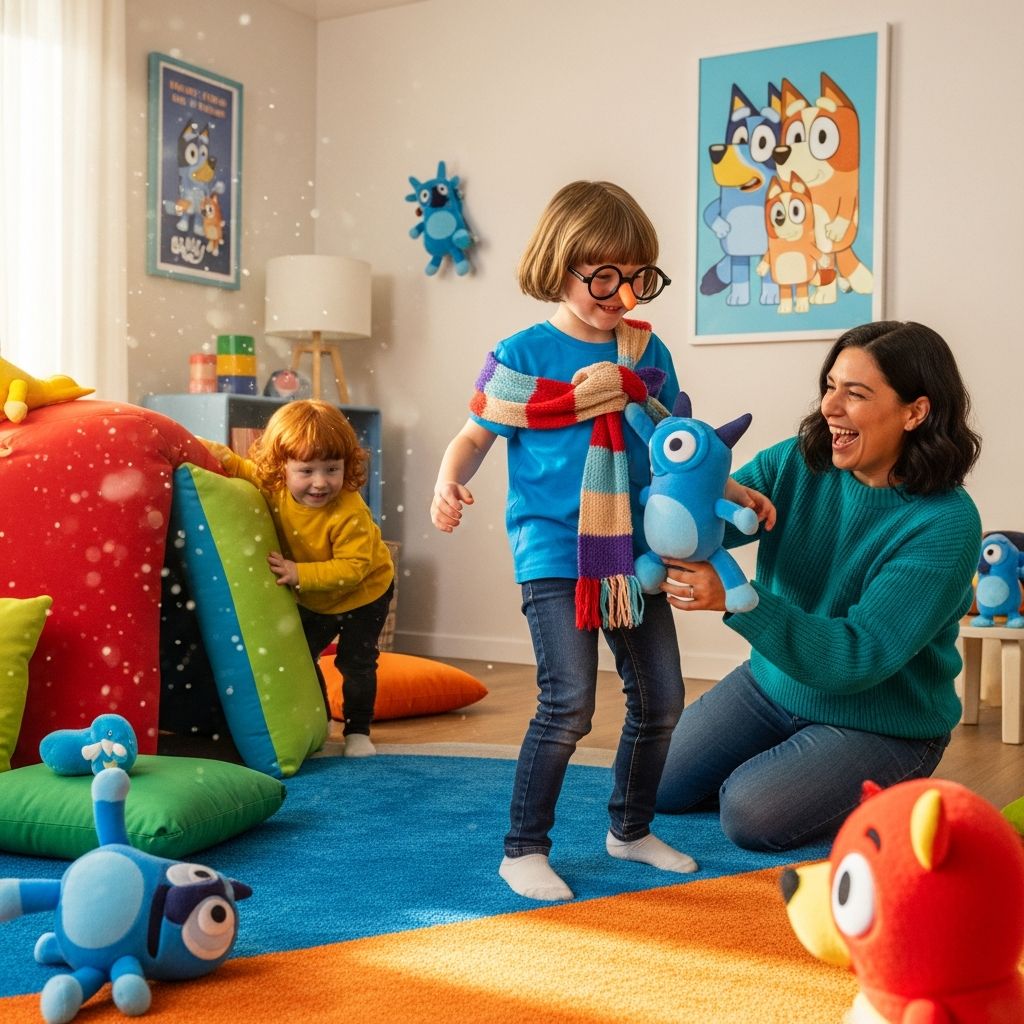
If your kids love Bluey, you already know how a simple object like a balloon can turn into an epic family challenge. This guide uses that spirit of playful chaos as inspiration to help you build your own collection of easy, low-prep indoor games that work in real homes with real kids.
All you need are a few common items, a bit of space, and a willingness to be silly. The goal is not perfection; it is connection. These games help kids move their bodies, practice social skills, and exercise their imaginations while parents join in instead of just supervising.
Why Indoor Games Matter More Than Ever
Active indoor play is not just a way to pass the time. It supports kids’ health, learning, and emotional wellbeing in important ways:
- Physical health: Regular movement helps kids build strength, coordination, and heart health, even when they cannot play outside.
- Brain development: Active play is linked to better attention, memory, and learning in early childhood.
- Emotional regulation: Play gives kids a safe outlet for big feelings and stress, especially during long days indoors.
- Social skills: Turn-taking, following rules, and problem-solving in games help kids practice cooperation and communication.
Indoor games do not have to be elaborate to be valuable. Simple, repeatable activities often work best, especially when they invite kids to help make up the rules.
The Balloon Challenge: Keep It Off the Ground!
Inspired by the classic “keep the balloon in the air” game kids love on Bluey, this version turns your living room into a playful arena where everyone has the same simple mission: do not let the balloon touch the floor.
Basic Rules
- Blow up a balloon (or two) and clear any sharp or fragile items.
- Hit, tap, or nudge the balloon to keep it from landing.
- If it touches the floor, the round ends. Start again and see if you can beat your previous time.
Fun Variations by Age
| Age Group | Suggested Twist | What It Builds |
|---|---|---|
| Preschool (3–5) | Use two hands only, move slowly, and count each hit out loud. | Counting, coordination, turn-taking |
| Early Elementary (6–8) | Play with one hand, or assign each person a small “zone” of the room. | Spatial awareness, self-control, teamwork |
| Older Kids (9+) | Use soft “paddles” (paper plates on sticks), add a second balloon, or play in teams. | Strategy, reaction time, collaboration |
Simple House Rules to Keep It Safe
- No running near furniture with sharp corners.
- Use only soft hands or paddles—no kicking indoors.
- Declare a “no-go zone” around fragile objects or stairs.
- Keep rounds short and take water breaks when kids get very excited.
Balloon games are a proven favorite for indoor play and can keep kids engaged for long stretches with very little setup.
Story-Mode Games: Turn Your Home Into an Adventure
One of the joys of Bluey is how everyday spaces turn into pirate ships, spaceships, or jungle temples. You can borrow that spirit at home by layering simple stories on top of basic movement games.
1. The Invisible Lava Quest
Your floor is not really lava—but in the story, it is.
- Lay down cushions, folded blankets, or pieces of paper as “safe islands.”
- Kids must move from one side of the room to the other without touching the floor.
- Add challenges: hop on one leg, crawl, or balance a stuffed animal on their head.
This kind of imaginative obstacle course encourages coordination and creative problem-solving while kids practice assessing risks in a safe environment.
2. Treasure Delivery Service
Turn a simple relay into a pretend job game.
- Pick a “treasure” (a stuffed toy, block, or plastic cup).
- Create a path with a few stops: couch, chair, doorway, table.
- Each player is a “delivery driver” who must carry the treasure along the path without dropping it.
- Switch up how they carry it: on a spoon, between elbows, or balanced on their hand.
Relay-style games promote physical activity and teamwork, even in small spaces.
3. Quiet Mission: Spy Sneak
When the energy level needs to come down, try a quiet stealth game.
- One adult or older sibling is the “guard” with their back turned.
- Kids start at the far end of the room and try to sneak close to tag the guard.
- When the guard turns around, everyone must freeze.
- If anyone moves, they go back to the start.
This kind of stop-and-go game is similar to classic childhood favorites and helps kids practice self-control and body awareness.
Build-Your-Own Game: Let Kids Make the Rules
Part of the magic on Bluey is that the kids are often the ones inventing the game. When children help design activities, they are more invested and more likely to stick with them.
How to Co-Create a New Indoor Game
- Choose a main object: balloon, pillow, sock ball, cardboard box, or stuffed animal.
- Pick the goal: Keep it in the air, move it across the room, hide it, balance it, or roll it.
- Limit the moves: Only feet, only elbows, only hopping, crawling, or spinning.
- Agree on a win condition: Time how long you last, count successful passes, or simply see if everyone can finish together.
- Test and tweak: Play one short round, then ask, “What should we change to make it sillier or fairer?”
Inviting kids to negotiate rules builds language skills and social understanding, especially around fairness and compromise.
Quick Indoor Game Ideas When You Have 10 Minutes
Not every game has to fill an afternoon. Here are quick options inspired by that same playful, improvisational style:
- Balloon Volleyball: Use a sofa back or a rope between chairs as a “net” and tap the balloon back and forth.
- Color Hunt: Call out a color; kids rush to bring back one object in that color.
- Mirror Moves: One person leads slow, silly movements while the other copies like a mirror.
- Hallway Bowling: Line up empty plastic bottles and roll a soft ball to knock them down.
- Beat & Repeat: Clap a short rhythm and have everyone repeat it, then make the sequence longer each round.
Short play breaks like these can reset moods, release pent-up energy, and support family connection throughout the day.
Adapting Games for Different Spaces and Energy Levels
Not every home has a big playroom, and not every day calls for high-intensity games. You can easily adjust most activities to fit your space and your child’s needs.
Small-Space Adjustments
- Use micro zones like a rug or hallway instead of the whole room.
- Favor games with slow, controlled motions over running.
- Swap jumping for tiptoeing, balancing, or crawling.
- Keep only a few soft objects out at once to reduce clutter and accidents.
High-Energy vs. Calm-Energy Games
| High-Energy Options | Calmer Options |
|---|---|
| Balloon keep-up challenges | Beat & repeat clapping games |
| Obstacle or “lava” courses | Spy sneak / freeze games |
| Relay-style treasure delivery | Storytelling with props or toys |
| Balloon volleyball | Quiet color hunts around one room |
Switching from a high-energy game to a calmer one can help kids wind down before meals or bedtime while still feeling connected and engaged.
Making Indoor Games a Family Ritual
Instead of waiting for boredom emergencies, you can turn indoor games into a predictable family ritual, just like a weekly movie night or special breakfast.
Ideas for Simple Family Rituals
- “Balloon Friday”: Every Friday afternoon, blow up a balloon and let the kids choose which version of the balloon challenge to play.
- “Make-a-Game Morning”: One weekend morning, ask the kids to invent a new game and demo it for the adults.
- Scoreboard of Smiles: Instead of tracking wins, track how many new games you invent in a month.
- Family Game Jar: Write favorite games on slips of paper and draw one when boredom hits.
Research on family routines suggests that shared rituals can strengthen relationships and give kids a sense of security, especially during stressful times.
Frequently Asked Questions (FAQs)
What if my child gets too competitive or upset when they lose?
Before starting, explain that the main goal is to have fun together, not to win. Try cooperative versions of games where the whole family works toward a shared goal, like keeping the balloon up for a certain number of hits. For younger kids, focus on cheering effort (“You kept trying!”) rather than outcomes, which supports healthy emotional development.
How long should indoor game sessions last?A: For preschoolers, 10–20 minutes of focused active play is usually enough before they need a change of pace. Older kids can play longer, but it helps to mix high-energy games with calmer ones and offer breaks for water and rest. Health organizations recommend that young children accumulate several short bursts of active play throughout the day.
Q: Are balloon games safe for toddlers?
Balloons can pose a choking risk if they pop and small pieces are left on the floor. For toddlers, always supervise closely, use high-quality balloons that are less likely to burst, and pick up broken pieces immediately. Alternatively, use a soft beach ball or fabric ball for a similar keep-it-up game.
What if we do not have much space or many toys?
Most of these games rely more on imagination than equipment. A single balloon, a few cushions, or a soft ball is usually enough. Focus on story, movement, and silly rules, and use small zones like hallways or around a dining table.
How can I keep older and younger siblings engaged at the same time?
Give older kids “helper” roles—timekeeper, rule designer, or team captain—while younger kids focus on simple actions. Adjust difficulty by challenging older kids to use their non-dominant hand, add extra balance tasks, or give them a small “handicap” so younger siblings can succeed too.
References
- Physical Activity Guidelines for Americans, 2nd edition — U.S. Department of Health and Human Services. 2018-11-01. https://health.gov/sites/default/files/2019-09/Physical_Activity_Guidelines_2nd_edition.pdf
- 15 Indoor Games to Keep Kids Active and Entertained — Forest Hills Pediatrics. 2022-01-10. https://ffpeds.com/active-indoor-games-for-kids/
- 15 Games to Play at Home with Kids, Ages 3–5 — United Way of Central Florida. 2020-04-15. https://uwcf.org/15-games-to-play-at-home-with-kids-ages-3-5/
- Indoor Activities for the Whole Family During the COVID-19 Pandemic — Gundersen Health System. 2020-05-12. https://www.gundersenhealth.org/health-wellness/pregnancy-kids/indoor-activities-for-the-whole-family-during-the-covid-19-pandemic
- 45 Fun Indoor Activities for Kids Who Are Stuck Inside — Good Housekeeping. 2023-02-01. https://www.goodhousekeeping.com/life/parenting/g31445865/indoor-activities-for-kids/