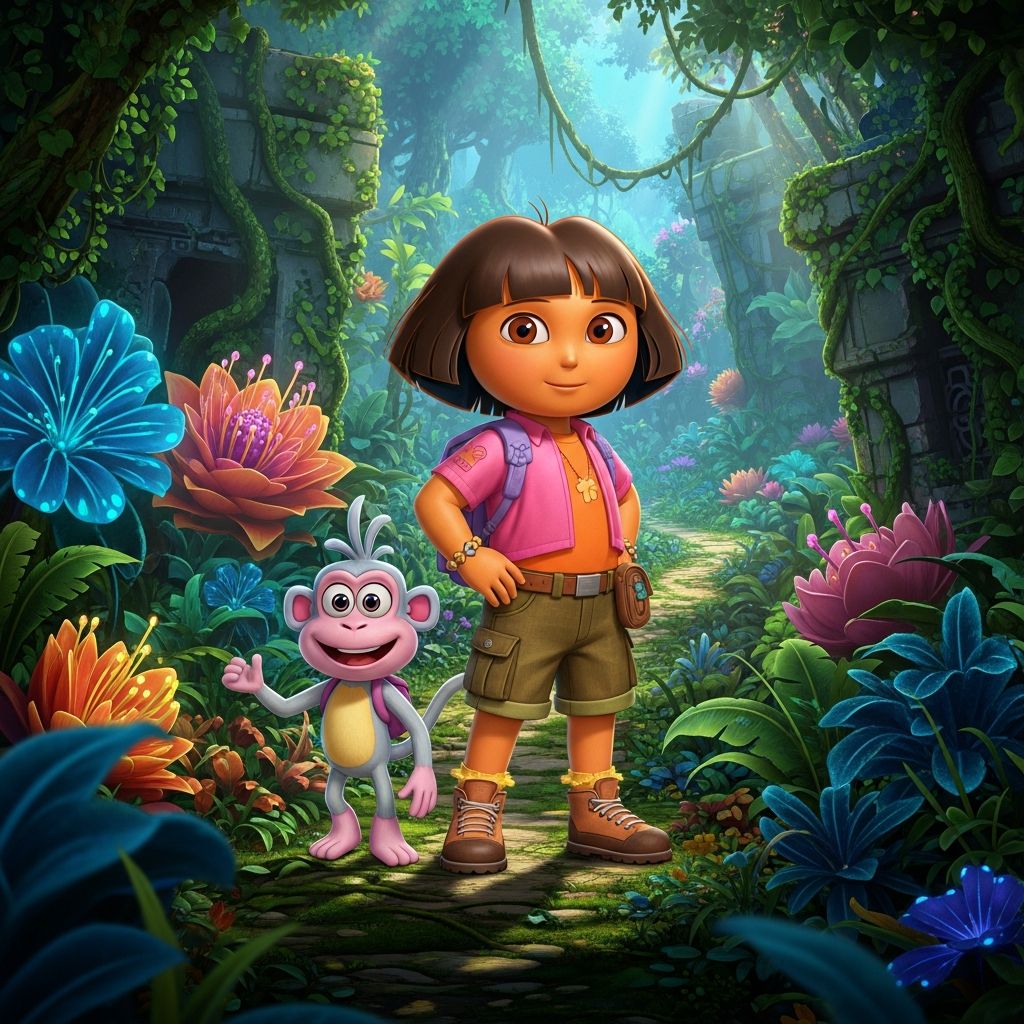
For nearly 25 years, Dora the Explorer has been a defining preschool hero, teaching kids to say “vámonos” while solving gentle puzzles and exploring a colorful world. Today, the character is being refreshed through a CG-animated reboot and a brand-new short film playing before PAW Patrol: The Mighty Movie, tying Dora to another powerhouse preschool franchise.
This new wave of content aims to bridge parents’ nostalgia with kids’ current viewing habits, while still preserving Dora’s core mission: curiosity, kindness, and bilingual learning in bite-size adventures.
From Backpack to Big Screen: Dora’s Ongoing Evolution
Since its launch in 2000 on Nickelodeon, Dora the Explorer quickly became one of the most watched preschool shows worldwide and has been translated into dozens of languages, reflecting its global resonance. The reboot and new short mark another step in this long evolution.
| Era | Style | Typical Runtime | Key Audience |
|---|---|---|---|
| Original Series (2000s) | 2D animation, interactive learning | About 22 minutes | Preschoolers and early readers |
| Live-Action Films (2019–2025) | Live action with adventure-comedy tone | Feature length | Kids, tweens, nostalgic parents |
| CG Reboot & New Short | CGI, faster pacing, theatrical tie-ins | 11–22 minutes for episodes; a few minutes for the short | Today’s streaming-first preschoolers |
What the Dora Reboot Changes — And What It Preserves
The modern Dora series is intentionally framed as a reboot of the original show, following Dora and Boots on rainforest adventures, where they rely on teamwork and tools like the talking Map to overcome obstacles and fend off the ever-mischievous Swiper.
Familiar Foundations
Several elements stay intentionally recognizable for longtime fans:
- Dora and Boots remain the emotional center, encouraging persistence and optimism.
- Map and Backpack still provide structure and problem-solving tools.
- Swiper returns as the kid-friendly antagonist, creating light conflict that preschoolers can easily follow.
- Interactive call-and-response moments invite children to shout answers, repeat words, and feel part of the journey.
Fresh Visuals and Pacing
Where the series moves forward is in style and tempo:
- CG animation gives the rainforest, animals, and magical elements a more cinematic feel, in line with other contemporary preschool hits.
- Faster, tighter storytelling balances learning beats with jokes, music, and light action, matching kids’ modern viewing expectations from streaming and theatrical releases.
- Richer environments make locations more detailed and immersive while keeping visuals bright and approachable.
Dora Meets PAW Patrol: A Strategic Big-Screen Team-Up
The new Dora short debuts in theaters ahead of PAW Patrol: The Mighty Movie, pairing two of Nickelodeon’s biggest preschool brands in a single outing for families. For studios, this is a savvy cross-promotional play; for parents, it’s an easy way to test whether the rebooted Dora resonates with their kids.
Why Pair Dora with PAW Patrol?
The combination works on multiple levels:
- Shared age group: Both properties target preschoolers, focusing on simple missions, teamwork, and clear moral lessons.
- Complementary themes: PAW Patrol leans on rescue missions and civic responsibility, while Dora emphasizes exploration, language, and problem-solving, giving kids two different kinds of “brave” to look up to.
- Big-screen excitement: A short Dora adventure before a feature film mirrors the classic animated-short tradition, making the movie outing feel more special.
Benefits for Parents and Kids
For families deciding whether the reboot is worth committing to at home, a theatrical short is an ideal sampler:
- Kids experience Dora’s voice, humor, and look in a compact format.
- Parents can gauge whether the reboot’s tone, pacing, and educational value fit their family’s preferences.
- The shared event creates a multi-hero outing where children can see different role models cooperate and succeed.
Educational DNA: What Dora Still Teaches
From its beginning, the Dora franchise has been explicitly designed as educational children’s media, emphasizing bilingual language use, spatial reasoning, and social skills. The reboot and short film maintain these goals while adjusting to modern pacing.
Bilingual Learning in a Growing Spanish-Speaking Landscape
Research from organizations like the Pew Research Center and U.S. census data show that Spanish remains the most spoken non-English language in American homes, with millions of bilingual or Spanish-speaking children. Dora’s mix of English and Spanish—or vice versa, depending on the region—aligns with this demographic reality and supports early exposure to a second language.
In the new content, kids can still expect:
- Key vocabulary words repeated and reinforced through context.
- Simple phrases that encourage kids to respond verbally.
- Code-switching moments that normalize moving between languages in everyday life.
Problem-Solving and Early STEM Thinking
Although framed as adventurous fun, Dora’s quests map neatly onto early STEM (science, technology, engineering, math) skills, which are widely recognized as important for school readiness by education bodies like the U.S. Department of Education.
- Sequencing and mapping: Following multi-step routes with Map encourages logical ordering and basic geography concepts.
- Pattern recognition: Repeated structures in episodes help children recognize and anticipate patterns.
- Cause and effect: Dora often explains how particular actions lead to specific results, a key scientific reasoning skill.
Social-Emotional Skills and Cultural Representation
Educational experts frequently emphasize that high-quality children’s programming also supports social-emotional learning—cooperation, empathy, and self-efficacy—which the Dora reboot continues to foreground.
- Teamwork is emphasized in nearly every challenge, modeling how to ask for help and share credit.
- Perseverance is shown when characters make mistakes and try again, reassuring children that failure is part of learning.
- Latina representation remains central: Dora is still a confident, bilingual Latina hero whose cultural background is a strength, not a side note.
How the Reboot Fits Into the Broader Dora Universe
The CG reboot does not exist in isolation. It sits alongside feature-length live-action films like Dora and the Lost City of Gold and the more recent Dora and the Search for Sol Dorado, which reimagines Dora and Diego in a bigger-scale adventure about an ancient magical star and competing archaeologists.
Streaming, Specials, and Cross-Media Tie-Ins
Modern franchises rarely limit themselves to a single format, and Dora is no exception:
- Streaming series on services like Paramount+ bring new episodes directly into homes, sometimes dropping entire seasons on a single day.
- TV premieres on Nickelodeon keep Dora visible on traditional broadcast for households that still rely on cable or live TV.
- Specials and events (for example, themed adventures and anniversary tie-ins) punctuate the regular schedule with bigger, more cinematic stories.
This broad ecosystem makes the new short before PAW Patrol: The Mighty Movie feel less like an isolated experiment and more like another gateway into a larger world of Dora content.
Why Kids Still Respond to Dora in 2025
Children’s media has changed dramatically over two decades, but certain design choices continue to give Dora staying power.
Interactive Storytelling in a Passive Medium
Despite being delivered through screens, Dora repeatedly asks kids to act—to shout, clap, count, or identify objects. Researchers in media and early childhood education have long noted that interactive prompts can increase attention and retention when used thoughtfully in children’s programming.
The reboot and short keep this structure, inviting children to:
- Help Dora find paths or navigate obstacles.
- Repeat words in English and Spanish.
- Celebrate victories with songs or catchphrases that create a sense of shared achievement.
Nostalgia for Parents, Novelty for Kids
For many millennial parents, Dora is part of their own childhood media diet. Reintroducing her in a visual style that matches present-day children’s shows allows them to:
- Share something familiar with their kids.
- Compare values across generations, noticing how themes of friendship, diversity, and persistence have evolved.
- Bond over bilingual moments, especially in families already navigating multiple languages at home.
How to Get the Most Out of the Dora Reboot as a Parent
Screen time guidance from organizations like the American Academy of Pediatrics emphasizes co-viewing—watching alongside children and talking about what they see—as one of the best ways to turn entertainment into deeper learning.
With Dora, parents can easily extend the show into real-world play:
- Turn walks into “explorer missions” where kids search for landmarks, count steps, or follow simple maps.
- Reinforce vocabulary by using Spanish and English words from the show around the house.
- Ask open-ended questions like “What do you think Dora should do?” to encourage reasoning, not just recall.
Future Directions: Where Dora Could Go Next
Given the franchise’s long life and the current momentum around the reboot, several trends seem likely:
- More short-form content tailored for streaming platforms and social media, where brief, tightly edited clips can reach massive audiences quickly.
- Expanded cultural themes that explore broader aspects of Latin American history, folklore, and geography, building on live-action films that already gesture toward ancient civilizations and archaeological adventures.
- Interactive extensions such as games, apps, or augmented experiences that let kids “explore” beyond the TV screen.
Frequently Asked Questions (FAQs)
Q: Is the new Dora reboot meant to replace the original series?
A: The reboot updates Dora with CG animation and modern pacing while retaining her core personality and educational goals. It does not erase the original series; instead, it offers a new entry point for today’s preschoolers alongside the classic episodes that many parents remember.
Q: How is the Dora short connected to PAW Patrol: The Mighty Movie?
A: The short plays in theaters before the PAW Patrol feature, giving families a compact Dora adventure as part of the moviegoing experience. It serves as a cross-promotional bridge between two major preschool franchises under the same corporate umbrella.
Q: Is the new Dora content still educational, or is it mostly action and comedy?
A: While the visuals and pacing have been modernized, the reboot continues to prioritize bilingual vocabulary, simple problem-solving, and social-emotional learning such as teamwork and empathy. The action and comedy are structured around these learning beats rather than replacing them.
Q: What age group is the Dora reboot best for?
A: The primary audience remains preschoolers, typically from about ages 2 to 6, with some slightly older siblings also enjoying the humor and light adventure. The short before PAW Patrol is similarly aimed at young children who can follow straightforward stories with clear stakes.
Q: Do I need to watch the older Dora shows or movies to understand the reboot?
A: No. The reboot is designed so that each episode or short works as a self-contained story. Familiarity with older episodes or live-action films may deepen appreciation for long-term fans, but newcomers can jump in without prior knowledge.
References
- Dora and the Search for Sol Dorado — Wikipedia. 2025-07-10. https://en.wikipedia.org/wiki/Dora_and_the_Search_for_Sol_Dorado
- Dora (TV series) — Wikipedia. 2025-11-13. https://en.wikipedia.org/wiki/Dora_(TV_series)
- ‘DORA’ Season Four to Premiere on Paramount+ on December 19 — NickALive!/Paramount. 2025-11-14. http://www.nickalive.net/2025/11/dora-season-four-to-premiere-on.html
- Digital Media and Learning for Early Childhood — U.S. Department of Education / Technical assistance materials. 2022-09-20. https://www.ed.gov/early-learning
- Beyond the Backpack: Kindergarten Readiness Initiative — Nickelodeon Our World. 2024-04-01. https://www.nick.com/our-world