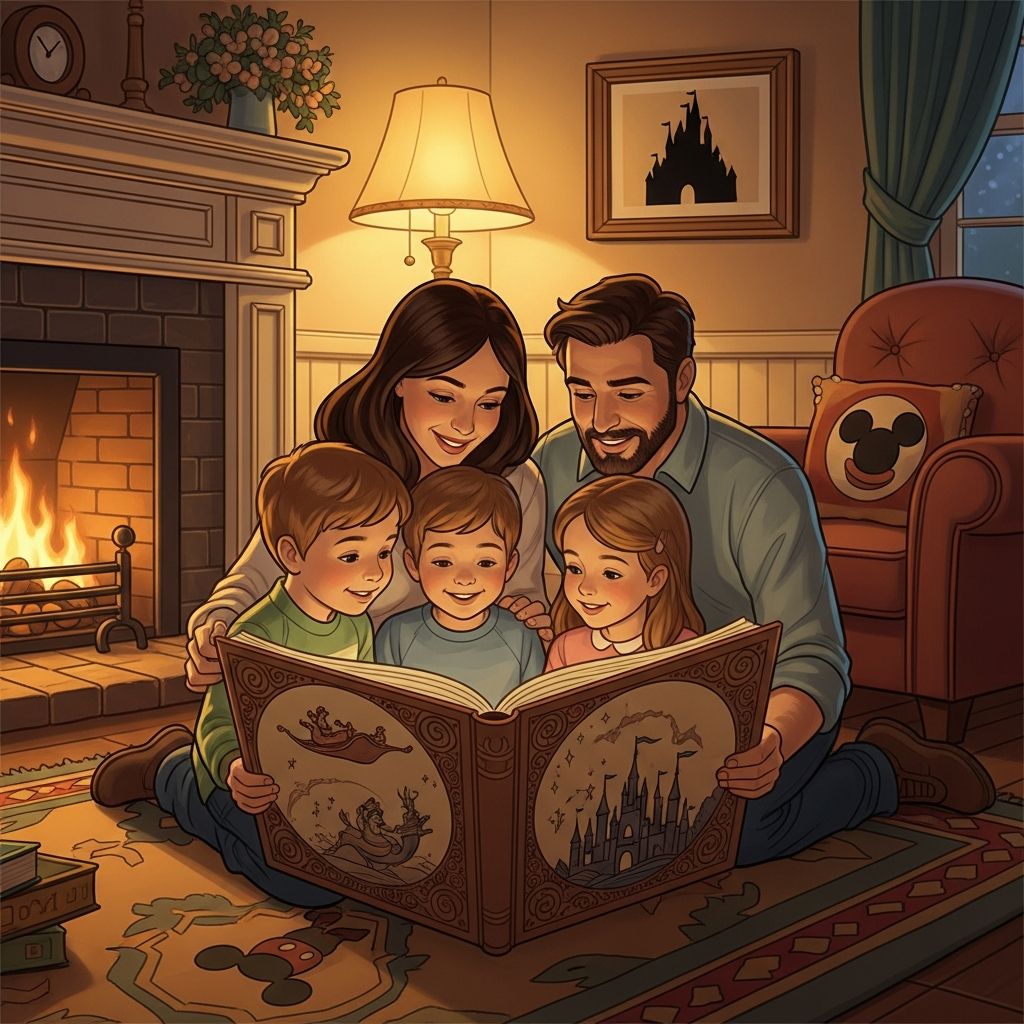
Disney stories have always been about more than catchy songs and colorful animation. The most memorable moments are often a single line of dialogue or narration that captures a big truth in simple words. Those Disney quotes stay with kids and parents long after the credits roll, shaping how families talk about courage, kindness, failure, and dreams.
This guide explores how to use famous lines from Disney movies and from Walt Disney himself as tools for parenting, connection, and everyday inspiration, while also clearing up a few myths about what Walt actually said.
Why Disney Lines Hit So Deep
Stories are one of the most powerful ways humans pass on values, especially to children. Development research shows that narratives help kids understand emotions, social rules, and moral choices in a safe, engaging way. When a character speaks a short, sharp line at a key moment, that sentence becomes a kind of handle kids can grab when they face similar situations in real life.
- They are short and repeatable – Easy to quote at the dinner table or on the way to school.
- They are tied to emotions – Children remember what was said when a character was scared, brave, or joyful, because emotion boosts memory.
- They are acted out visually – Kids do not just hear a line; they see it lived through a character’s choices.
- They feel safe – It is easier to talk about Moana’s doubt or Simba’s guilt than to start with our own.
Parents can lean into this by turning beloved lines into invitations for conversation, not lectures.
Five Big Life Lessons Hidden in Disney Quotes
Many different movies circle the same core ideas: believe in yourself, care for others, keep going when things are hard. Below are five themes families often return to, with examples of the kinds of quotes that express them.
Courage: Doing the Right Thing When It Is Hard
Disney heroes rarely start as fearless. They begin as unsure children, outsiders, or dreamers. Quotes about bravery often show that courage is not the absence of fear, but action in spite of it, a point widely emphasized in child psychology.
- Lines reminding kids that being afraid is normal, and bravery is choosing anyway.
- Speeches where a character stands up to unfairness, even when they might lose.
- Moments where someone admits a mistake publicly and tries to fix it.
These scenes help children see that courage can look like apologizing, asking for help, or defending someone, not only facing dragons.
Kindness and Empathy
From talking animals to space explorers, Disney worlds only work when characters care about someone besides themselves. Many of the most quoted lines boil down to: the way you treat others matters.
- Characters learning to see beyond first impressions.
- Reminders that everyone carries a story you might not see at first.
- Quotes about forgiveness and choosing to stop a cycle of hurt.
Educators often use such movie moments as springboards to talk about empathy and respect in classrooms, because they put complex ideas into simple, concrete images.
Resilience: Failing Forward
Modern child-development experts emphasize the value of a “growth mindset” — the belief that abilities can be developed through effort and learning from mistakes. Disney films have been modeling this for decades through quotes that normalize failure.
- Heroes who admit, in words, that they messed up but will keep trying.
- Mentors who frame setbacks as part of the journey, not the end.
- Lines that shift focus from perfection to persistence.
When a favorite character stumbles and then tries again, kids see that resilience is an everyday skill, not a rare talent.
Identity and Belonging
Many newer Disney and Disney-affiliated stories center on finding your place in the world without losing who you are. Quotes often capture the tension between family expectations and personal calling.
- Characters asserting, in key lines, that they are not property or prizes.
- Moments where someone realizes their value is not based on performance.
- Dialogues about balancing duty and authenticity.
Psychologists highlight that media representation and positive language around identity can support self-esteem and a more secure sense of belonging for children and teens.
Hope and Imagination
Walt Disney saw imagination as central to both childhood and adulthood. Official archives preserve many of his statements about dreaming big and experimenting with new ideas. Those values echo in movie quotes that encourage families to keep picturing better futures.
- Lines that present dreams as fuel for effort, not as shortcuts.
- Quotes linking curiosity with discovery and growth.
- Moments where characters reframe setbacks as part of a larger adventure.
Hopeful lines can help kids cope with uncertainty by focusing on what they can imagine and control, themes that also matter in positive psychology and resilience research.
What Walt Disney Really Said (and Did Not Say)
Many widely shared “Walt Disney quotes” on posters and social media are either paraphrases or words he never actually said. Company historians and the Walt Disney Archives have spent years clarifying what is genuine.
| Famous Saying | Did Walt Say It? | Notes |
|---|---|---|
| “If you can dream it, you can do it.” | No | Disney archivist Dave Smith confirmed this line was not spoken or written by Walt. It was created by Imagineer Tom Fitzgerald for the Horizons attraction at EPCOT. |
| Variations like “If we can dream it, we can do it.” | Not Walt | These appeared in attraction dialogue and graphics, not in Walt’s speeches or writings. |
| Documented quotes in Disney archives | Yes | Authenticated lines are preserved and published by the Walt Disney Archives and D23, based on audio, film, and written records. |
This does not make inspirational misattributed quotes useless; it simply means families can distinguish between Disney-inspired sayings and verified historical quotes. For those curious, the D23 archives showcase many of Walt’s real lines on creativity, risk-taking, and experimentation.
Turning Disney Quotes Into Everyday Parenting Tools
Instead of just smiling at a great line and moving on, parents can deliberately use Disney phrases to open up meaningful discussions. This does not require memorizing scripts — only noticing when a line seems to sit with your child.
Simple Ways to Use Quotes With Kids
- Pause and ask: When a character says something powerful, gently hit pause and ask, “What do you think that means?”
- Connect to real life: “When have you felt like that?” or “Does that remind you of something that happened at school?”
- Use as shorthand: Later, when a similar situation comes up, you can refer back: “Remember when that character decided to be honest, even though it was scary?”
- Let kids lead: If they quote a movie line, respond with curiosity instead of jumping straight to teaching.
This approach aligns with research suggesting that children learn social and emotional skills more effectively when adults use open questions and conversation, not just directives.
Ideas for Family Activities
- Quote-of-the-week board: Write down a line that struck someone in the family and keep it visible on the fridge. Invite everyone to add a doodle or thought about it.
- Story swap: After movie night, ask each person to share a brief true story from their own life that matches one line they remember from the film.
- Creative re-writing: Encourage kids to invent their own twist on a favorite quote, turning it into something that fits their current challenge (friendship, homework, nerves about a game).
- Gratitude tie-in: Use hopeful quotes as prompts at bedtime: “What is one thing today that fits this line?”
Why Stories and Quotes Matter So Much for Children
Decades of research indicate that media stories, including films, influence children’s beliefs about themselves and others. What they watch and hear can shape attitudes toward gender, culture, risk-taking, and problem-solving.
- Role models: Characters who show bravery, kindness, or integrity provide scripts kids may imitate.
- Language for feelings: Quotes give children words to describe complex emotions like guilt, shame, or hope.
- Cultural reflection: Disney’s more recent efforts to include diverse heroes and settings mean more kids can see aspects of their own experiences on-screen, which research links to better representation and belonging.
Of course, no movie line replaces direct guidance or lived example, but the right quote at the right time can support what parents are already trying to teach.
Spotting Misquotes and Urban Legends
Because Disney is globally recognized, inspirational sayings are often incorrectly labeled as “Disney quotes” for extra impact. Media literacy — the skill of evaluating what you see and share — is important for kids and adults.
- Check official sources: The Walt Disney Archives and D23 offer verified quotes from Walt and the studio’s history.
- Look for context: Authentic quotes usually come with a date, place, or recording (speech, film, interview). Vague attributions are a warning sign.
- Teach kids to question: You can model healthy skepticism by saying, “That’s a great line. Let’s see who really said it.”
Archivists such as Dave Smith, who founded the Walt Disney Archives, spent decades tracking down original documents and recordings to preserve an accurate record of Walt’s words. Sharing this with older kids can be a gentle way to introduce them to historical research and fact-checking.
Frequently Asked Questions (FAQs)
Did Walt Disney really say, “If you can dream it, you can do it”?
No. According to Disney archivist Dave Smith, this quote was written by Imagineer Tom Fitzgerald for the Horizons attraction at EPCOT, and there is no record of Walt ever saying or writing it.
Where can I find confirmed quotes from Walt Disney?A: Verified quotes are preserved and shared by the Walt Disney Archives and the official D23 fan club, which rely on original audio, film, and written materials from Disney history.
Q: Are Disney quotes good tools for teaching kids about values?
Yes, when used thoughtfully. Research shows that stories and characters can help children understand emotions, moral choices, and social behavior, especially when adults talk with them about what they watch.
How can I tell if a Disney quote online is authentic?
Look for specific context (who said it, when, in what film or speech) and check reputable sources like official Disney publications, interviews, or archives. Be cautious with quotes that appear only on image memes or unverified lists.
What is the best way to start conversations about Disney quotes with my kids?
Keep it simple and curious. After a meaningful line, ask, “What do you think that means?” or “Have you ever felt like that?” Then listen more than you speak, letting children connect the story to their own experiences.
References
- FINALLY, the Origin of “If You Can Dream It, You Can Do It” — Magic Made by Disney. 2021-04-27. https://magicmadebydisney.com/2021/04/27/finally-the-origin-of-if-you-can-dream-it-you-can-do-it/
- Walt’s Quotes Archives — D23: The Official Disney Fan Club. 2024-01-01 (approximate, ongoing archive). https://d23.com/section/walt-disney-archives/walts-quotes/
- Media and Young Minds — Council on Communications and Media, American Academy of Pediatrics. Pediatrics. 2016-11-01. https://publications.aap.org/pediatrics/article/138/5/e20162591/60325/Media-and-Young-Minds