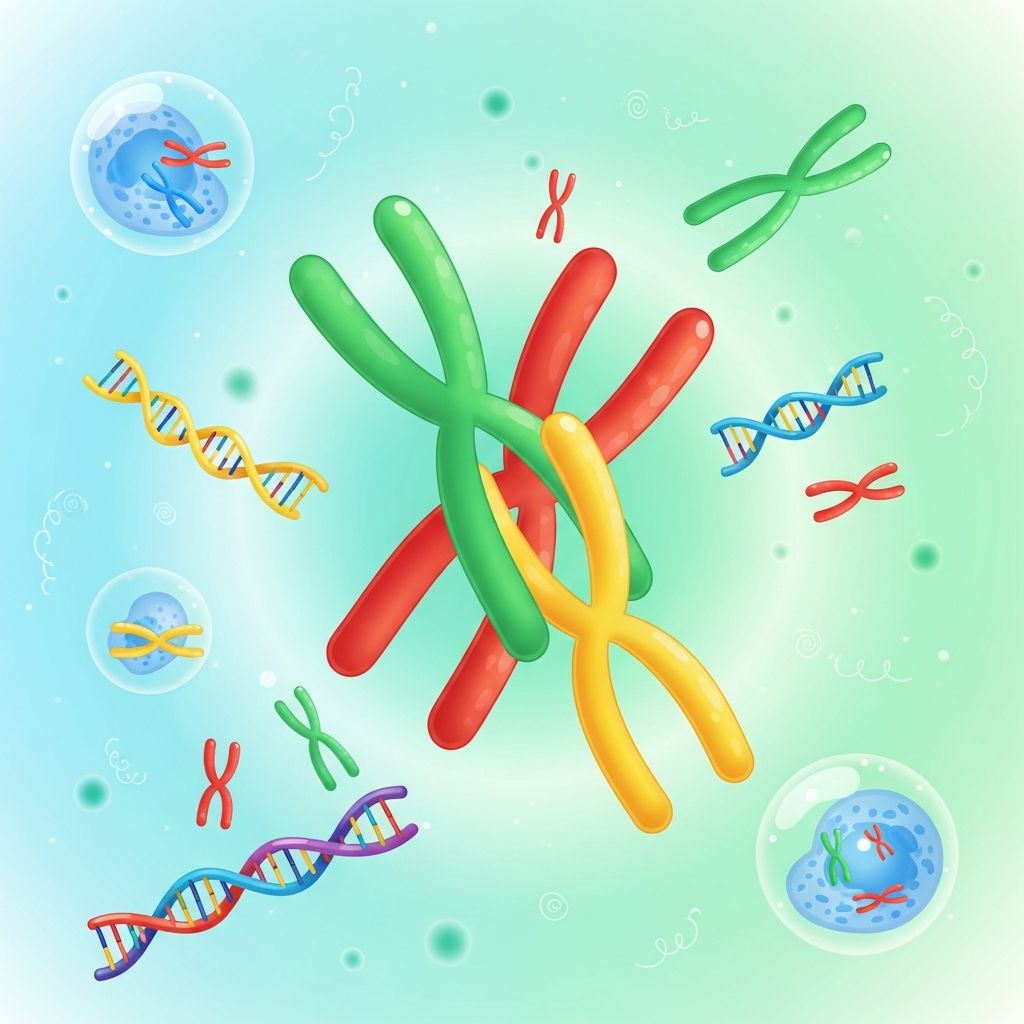
Inside almost every cell of your body are tiny structures called chromosomes. They are so small that you cannot see them without a powerful microscope, but they carry the instructions that help make you who you are.
Big Ideas in This Guide
- What chromosomes are and what they look like
- How chromosomes are related to DNA and genes
- How many chromosomes humans usually have
- Why you get chromosomes from both your mom and dad
- What can happen when the chromosome number is different
- Answers to common questions kids ask about chromosomes
What Exactly Is a Chromosome?
A chromosome is a long, tightly packed piece of DNA wrapped around special proteins called histones. DNA holds your genetic information, which is like a code for building and running your body.
Scientists describe chromosomes as:
- Thread-like or rod-shaped under a microscope
- Made of DNA plus proteins
- Found mainly in the nucleus (the control center) of most plant and animal cells
The word chromosome comes from Greek words meaning “color” and “body,” because these tiny bodies show up clearly when scientists stain cells with colorful dyes.
Where Do You Find Chromosomes?
In humans and many other living things, chromosomes are found in the nucleus of the cell. The nucleus is like the boss’s office inside the cell where important instructions are stored.
Here is where chromosomes show up in your body:
- Most body cells (like skin, muscle, and liver cells) have a full set of chromosomes.
- Reproductive cells (egg and sperm) have half the usual number of chromosomes.
- A few cell types, like mature red blood cells, do not have a nucleus and therefore do not carry the usual set of chromosomes.
DNA, Genes, and Chromosomes: How They Fit Together
It helps to think of DNA, genes, and chromosomes as parts of a very organized library:
| Level | What It Is Like | What It Does |
|---|---|---|
| DNA | The letters in a book | A long chemical code made of four building blocks that stores all genetic information. |
| Gene | A recipe on a page | A segment of DNA that gives instructions for making a specific protein or RNA. |
| Chromosome | An entire book | A package of DNA containing many genes, organized so they can be copied and passed on. |
Each chromosome carries hundreds to thousands of genes arranged in a special order. Each gene has its own spot on a chromosome, called a locus (LOH-kuss).
How Many Chromosomes Do Humans Have?
Most human body cells normally have:
- 23 pairs of chromosomes, for a total of 46 chromosomes
- 22 pairs called autosomes (numbered chromosomes 1 through 22)
- 1 pair of sex chromosomes (XX or XY) that help determine biological sex
You usually get:
- One chromosome in each pair from your biological mother
- The other chromosome in each pair from your biological father
Why Are Chromosomes Paired?
Having chromosomes in pairs gives your body two copies of most genes.
This is helpful because:
- Two copies act as a backup system. If one copy of a gene has a change (mutation), the other copy might still work well enough.
- It allows for genetic variety. The combination of genes from your mother and your father helps make you unique.
Chromosomes and Reproduction: Half Now, Half Later
Most of your cells keep the full set of 46 chromosomes, but your body does something different when it makes egg or sperm cells.
Reproductive cells:
- Contain only 23 single chromosomes (one from each pair)
- Are called haploid, meaning they have just one set of chromosomes
When an egg cell and a sperm cell join, they make a new cell (a fertilized egg) with:
- Two sets of chromosomes again (23 from each parent)
- A total of 46 chromosomes in the new baby’s cells
How Do Chromosomes Fit Inside a Cell?
If you unwound all of the DNA in just one of your cells and stretched it out, it would be about six feet (around two meters) long. Chromosomes help by packing this long DNA very tightly.
To organize DNA, your cells:
- Wrap DNA around histone proteins like thread around spools
- Form a structure called chromatin, which coils and folds even more tightly
- Shape chromatin into visible chromosomes during cell division
When the cell is not dividing, chromosomes are not clearly visible because the DNA is more loosely packed.
What Do Chromosomes Do for Your Body?
Chromosomes have several important jobs:
- Store genetic instructions: They carry the DNA code your cells read to make proteins and other molecules your body needs.
- Pass traits to new cells: When cells divide, chromosomes are copied so that new cells receive the same genetic information.
- Help with growth and repair: As you grow or heal from an injury, cells divide using their chromosomes as a guide.
Because chromosomes contain genes, changes in chromosomes can affect:
- Your appearance, such as eye color or natural hair color
- How your body works, like how well your blood carries oxygen
- Your risk for certain health conditions, such as some genetic disorders
When the Chromosome Number Is Different
Sometimes a person is born with more or fewer chromosomes than the usual 46. This can happen when egg or sperm cells are forming or when early cells in the baby are dividing.
For example:
- Having an extra copy of chromosome 21 causes Down syndrome (also called trisomy 21).
- Some other extra or missing chromosomes lead to different health conditions, and many are not compatible with life.
Doctors and scientists study chromosomes to better understand these conditions and to help plan medical care or support for people who have them.
Interesting Facts About Chromosomes
- The chromosomes in human body cells are usually arranged in pairs and can be displayed in a picture called a karyotype, which shows all the chromosomes lined up and numbered.
- Although humans have 46 chromosomes, other living things have very different numbers. The number alone does not tell you how complex an organism is.
- Chromosomes have protective tips called telomeres that help protect DNA, a bit like the plastic ends of shoelaces help keep them from fraying.
Simple Glossary of Chromosome Words
- Chromosome: A package of DNA and protein found in cells that carries genes.
- DNA (Deoxyribonucleic acid): The chemical that stores genetic information and forms genes.
- Gene: A stretch of DNA that has instructions for making a specific protein or RNA.
- Autosome: Any chromosome that is not a sex chromosome (numbers 1–22 in humans).
- Sex chromosomes: The pair of chromosomes (XX or XY) that help determine biological sex.
- Nucleus: The central part of a cell that holds chromosomes.
- Histone: A protein that DNA wraps around to form tightly packed structures.
Frequently Asked Questions About Chromosomes
Q1: Why can’t I see my chromosomes?Chromosomes are far too small to see with your eyes alone. Even with a microscope, they are easiest to see only when a cell is getting ready to divide, because the DNA is packed very tightly into thick, short shapes.
Q2: Do all my cells have the exact same chromosomes?
Almost all of your body cells have the same set of 46 chromosomes, copied from the original fertilized egg cell. An important exception is reproductive cells (egg and sperm), which carry only 23 chromosomes each.
Q3: Are chromosomes the same as genes?
No. A gene is a shorter piece of DNA that gives one set of instructions, while a chromosome is a much larger structure made up of many genes plus proteins that help organize and protect the DNA.
Q4: Can my chromosomes change during my life?
The number of chromosomes in your cells usually stays the same throughout life. However, the DNA within them can sometimes gain small changes (mutations) when cells divide or when DNA is damaged and repaired. Most changes are harmless, but some can affect health.
Q5: How do scientists study chromosomes?
Scientists can take cells from blood, skin, or other tissues and use special stains to make chromosomes visible under a microscope. They then photograph and arrange them in order by size and shape to look for extra, missing, or changed chromosomes.
References
- Chromosome — National Human Genome Research Institute. 2020-08-17. https://www.genome.gov/genetics-glossary/Chromosome
- Chromosomes Fact Sheet — National Human Genome Research Institute. 2023-03-03. https://www.genome.gov/about-genomics/fact-sheets/Chromosomes-Fact-Sheet
- What is a chromosome? — MedlinePlus Genetics, U.S. National Library of Medicine. 2023-01-30. https://medlineplus.gov/genetics/understanding/basics/chromosome/
- Genes and Chromosomes — Merck Manuals Consumer Version. 2024-05-01. https://www.merckmanuals.com/home/fundamentals/genetics/genes-and-chromosomes
- Chromosomes: Definition, Structure & Function — Cleveland Clinic. 2022-06-17. https://my.clevelandclinic.org/health/body/chromosomes
- Definition of chromosome — NCI Dictionary of Genetics Terms, National Cancer Institute. 2011-02-02. https://www.cancer.gov/publications/dictionaries/genetics-dictionary/def/chromosome
- CHROMOSOME Definition & Meaning — Merriam-Webster Dictionary. 2024-10-24 (entry updated). https://www.merriam-webster.com/dictionary/chromosome