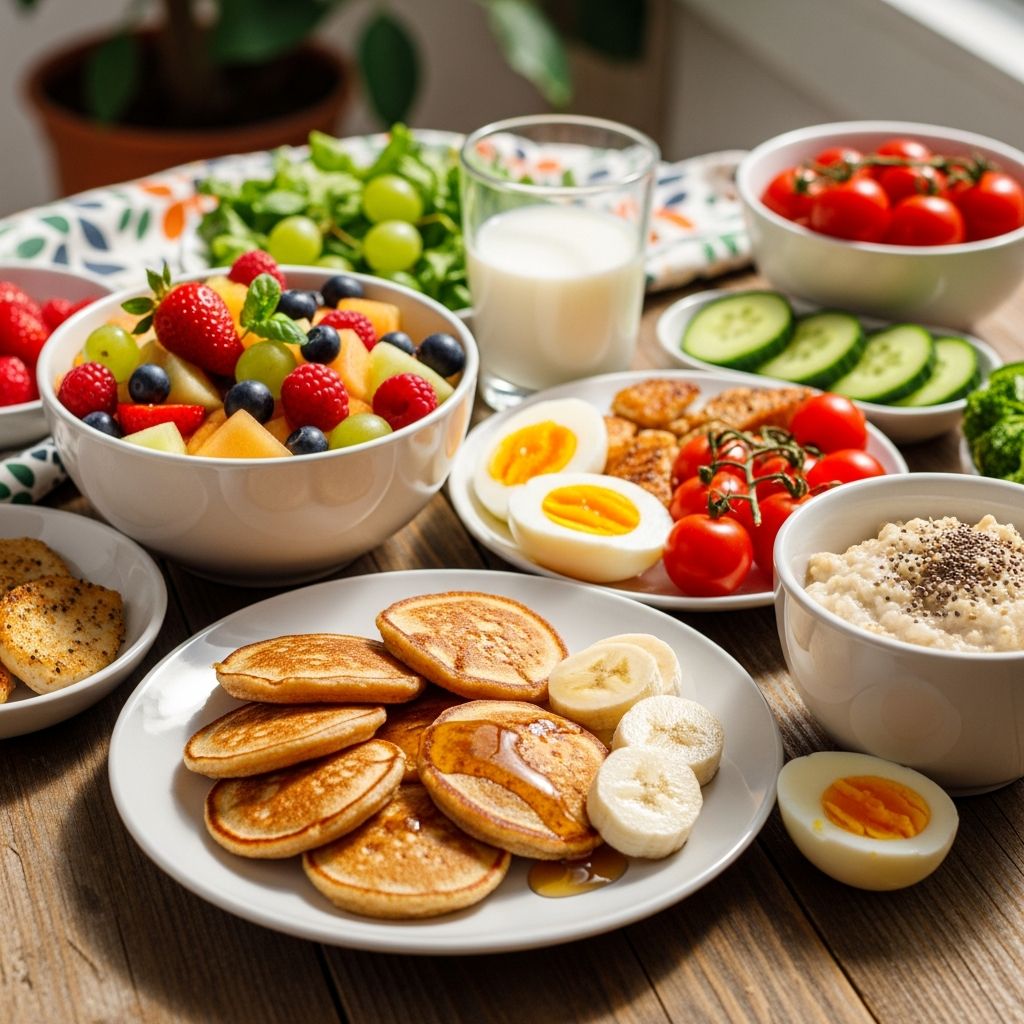
Providing children with balanced daily nutrition is crucial for their physical growth, cognitive development, and immune function. Guidelines from authoritative sources emphasize variety across food groups to meet caloric, vitamin, and mineral needs without excess sugars or fats.
Understanding Caloric and Nutrient Needs by Age
Children’s energy requirements vary by age, sex, and activity level. Toddlers aged 2-3 need 1000-1400 kcal/day, rising to 1800-2200 kcal/day for 11-12 year olds. A general rule: infants require 100 kcal/kg/day, dropping to 80 kcal/kg for 1-3 years, 70 kcal/kg for 4-5 years, 60-65 kcal/kg for 6-8 years, and 35-45 kcal/kg for older kids.
Carbohydrates should supply 50-55% of calories (4 kcal/g), prioritizing complex sources like whole grains, legumes, fruits, and vegetables over simple sugars limited to 5-10% of intake. Proteins at 1.6 g/kg body weight support tissue repair, with essential amino acids from diverse sources reducing chronic disease risks.
Fats comprise 25-35% of calories for ages 2+, focusing on healthy types from avocados, nuts, and fish. Hydration is key: 100 ml/kg for infants 3.5-10 kg, adjusting upward for older children, max 2400 ml/day. Water is primary; limit juices.
| Age Group | Daily Calories (Female/Male) | Fluid Needs Example |
|---|---|---|
| 2-3 years | 1000-1400 kcal | ~800-1000 ml |
| 4-8 years | 1200-1800 kcal | 1200 ml (5 cups) |
| 9-12 years | 1600-2200 kcal | 1500+ ml |
Table adapted from NCBI and Raising Children Network data.
Building a Strong Foundation: Fruits and Vegetables Daily
Fruits and vegetables deliver vitamins, fiber, and antioxidants essential for brain health and growth. CDC recommends 1-1.5 cups fruit and 1-2 cups vegetables daily for young children, scaling up with age.
For 4-8 year olds, aim for 1.5 fruit serves (e.g., 1 medium apple or banana, 1 cup diced no-sugar fruit) and 4.5 vegetable serves (e.g., ½ cup cooked broccoli/carrots, 1 cup salad greens). American Heart Association suggests 1-1.5 cups fruit and ¾-1 cup vegetables for 4-8 year olds, with variety across subgroups weekly.
- Fruit ideas: Berries for vitamin C, citrus for immunity, melons for hydration.
- Veggie picks: Leafy greens like spinach, roots like sweet potatoes, legumes for fiber.
- Tip: Roast veggies or blend fruits into smoothies to boost appeal.
Incorporate at every meal: fruit at breakfast, veggies at lunch/dinner. Limit juice to avoid excess sugar.
Powering Energy: Grains and Complex Carbohydrates
Grains provide sustained energy; half should be whole grains like oats, quinoa, brown rice. Children 4-8 need 4 serves daily (1 slice bread, ½ cup cooked rice/pasta).
Younger kids (2-3 years): 2-3 oz equivalents; 4-8 years: 3-5 oz. Whole grains support digestion via fiber (14g per 1000 kcal).
- Breakfast: Oatmeal or whole-grain toast.
- Lunch: Quinoa salad or whole-wheat wrap.
- Dinner: Brown rice with stir-fry.
Avoid refined grains; check labels for ‘whole grain’ first.
Protein for Growth and Repair
Lean proteins build muscles and enzymes. Recommendations: 3-5 oz for females 4-8, 4-6 oz for males. Include 1.5 serves for 4-8 year olds: palm-sized chicken, ½ cup beans, handful nuts.
Sources: Poultry, fish (twice weekly), eggs, legumes, nuts. Plant proteins lower disease risks. For 6-12 months: Soft chicken bits, pureed beans.
| Protein Source | Serve Size (Kids 4-8) | Benefits |
|---|---|---|
| Chicken/Turkey | 1-2 oz cooked | Lean, B-vitamins |
| Beans/Lentils | ½ cup cooked | Fiber, iron |
| Fish | 2 oz | Omega-3s for brain |
| Eggs | 1 large | Complete protein |
Dairy and Alternatives for Bone Health
Dairy supplies calcium/vitamin D for bones: 1½-2 serves for 4-8 year olds (1 cup milk, ¾ cup yogurt). Ages 1-8: 2 cups; 9-18: 3 cups low-fat.
Alternatives: Fortified soy/almond milk (100mg calcium/100ml). Yogurt for probiotics, cheese in moderation.
- Daily integration: Milk with meals, yogurt snacks, cheese on veggies.
Healthy Fats and Hydration Essentials
Fats at 25-35% calories from avocados, nuts, olive oil, fatty fish. Hydration: 5 cups (1.2L) water for 4-8 year olds, more if active. Introduce water at 6-12 months (4-6 oz).
Avoid sugary drinks; opt for milk/formula till 12 months, then low-fat dairy.
Sample Daily Meal Plans by Age Group
Toddlers (2-3 Years)
- Breakfast: Oatmeal with banana slices, ½ cup milk.
- Snack: Apple quarters, cheese stick.
- Lunch: Veggie puree soup, whole-grain cracker, yogurt.
- Snack: Carrot sticks, hummus.
- Dinner: Baked chicken, sweet potato, peas.
Total: Meets 1000-1400 kcal, balanced groups.
Preschoolers (4-8 Years)
- Breakfast: Whole-grain toast with avocado, orange.
- Snack: Handful almonds, pear.
- Lunch: Turkey wrap with spinach, carrot sticks.
- Snack: Greek yogurt with berries.
- Dinner: Grilled salmon, quinoa, broccoli.
Aligns with 4 serves grains, 4.5 veggies.
School-Age (9-12 Years)
- Breakfast: Smoothie (milk, spinach, berries, oats).
- Snack: Apple, peanut butter.
- Lunch: Lentil soup, whole-wheat roll, salad.
- Snack: Cottage cheese, cucumber.
- Dinner: Stir-fried tofu, brown rice, mixed veggies.
Supports higher calories, activity.
Overcoming Picky Eating and Building Habits
Under-nutrition affects millions; combat with education, availability. Involve kids in cooking, offer variety without pressure. Active play: 60 min/day for 6-17 year olds.
Limit treats; model healthy eating. Consult pros for specific needs.
Frequently Asked Questions
What if my child refuses vegetables?
Hide in smoothies/sauces, pair with dips, grow together. Persistence pays off.
How much milk is too much?
Stick to 2-3 cups/day; excess displaces iron-rich foods.
Are plant milks okay?
Yes, if fortified with calcium/vitamin D.
What’s the best snack combo?
Protein + fiber: Yogurt + fruit, nuts + veggies.
Can supplements replace food?
No; whole foods provide synergistic nutrients.
References
- Nutrition and Hydration Requirements In Children and Adults — NCBI Bookshelf. 2023. https://www.ncbi.nlm.nih.gov/books/NBK562207/
- Dietary guidelines & healthy food for kids: 4-8 years — Raising Children Network. 2023. https://raisingchildren.net.au/preschoolers/nutrition-fitness/daily-food-guides/dietary-guide-4-8-years
- Dietary Recommendations for Healthy Children — American Heart Association. 2024. https://www.heart.org/en/healthy-living/healthy-eating/eat-smart/nutrition-basics/dietary-recommendations-for-healthy-children
- Good Nutrition Starts Early — CDC. 2024. https://www.cdc.gov/nutrition/features/good-nutrition-starts-early.html