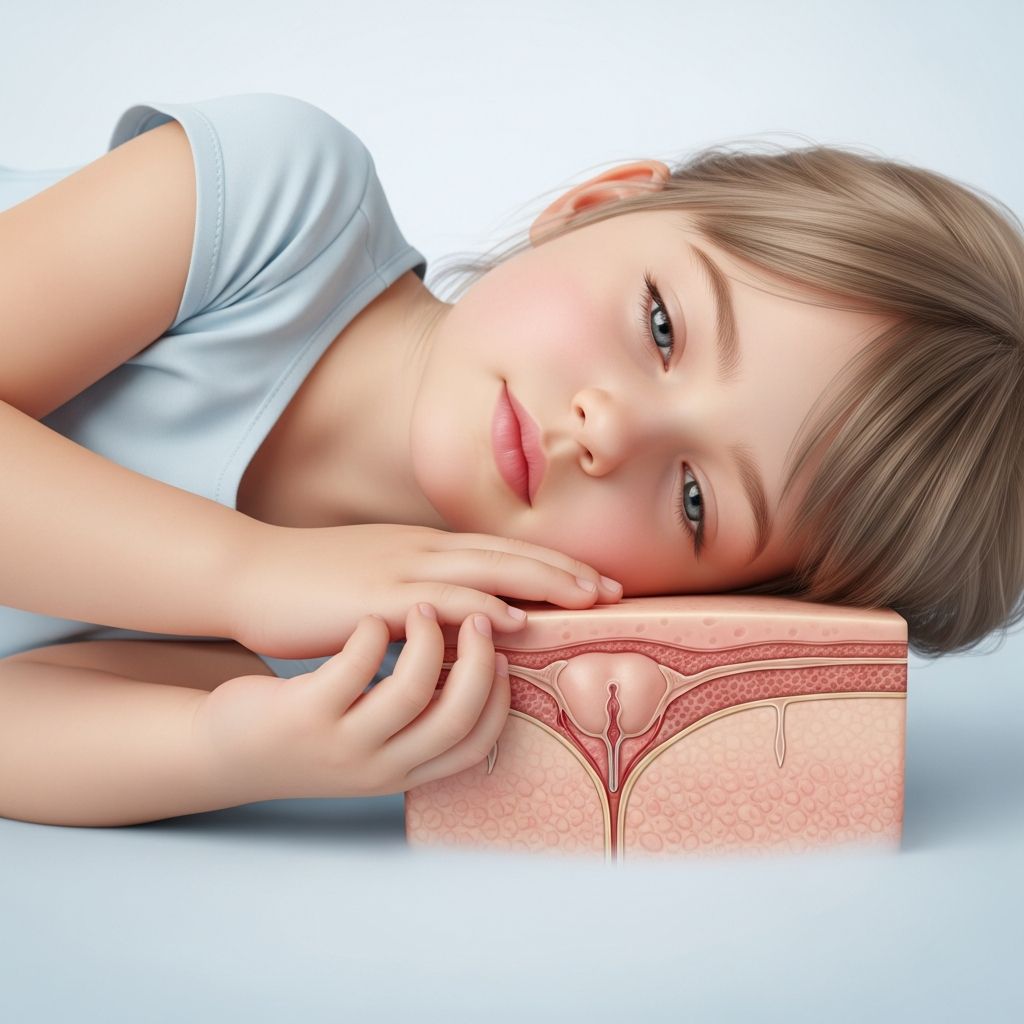
Labial adhesions can sound alarming when you first hear the term, but in most young children this condition is harmless, painless, and often goes away on its own. Understanding what is happening and when medical care is needed can make the situation far less stressful for families.
What Are Labial Adhesions?
Labial adhesions occur when the inner lips of the vulva, called the labia minora, stick together, partially or completely covering the vaginal opening. The fused area is usually a thin, pale or whitish line or membrane of tissue rather than a thick scar.
This condition is sometimes also called:
- Labial fusion
- Labial agglutination
- Synechia vulvae
Labial adhesions are most often seen in girls between about 3 months and 3–6 years of age, when estrogen levels are naturally low.
How Common and How Serious Is It?
Labial adhesions are considered a relatively common finding in young girls, with some estimates suggesting they affect up to about 5% of children in this age group. In most cases they:
- Cause no symptoms
- Are discovered during a routine diaper change or checkup
- Resolve on their own as the child grows and estrogen levels rise
Because most children are not bothered by the adhesions, doctors often recommend simple observation and gentle skin care rather than active treatment.
Why Do Labial Adhesions Happen?
The exact reason some girls develop labial adhesions and others do not is not fully understood, but several factors are known to contribute.
| Factor | How It Contributes |
|---|---|
| Low estrogen levels | In babies and prepubertal girls, estrogen is naturally low, making genital skin thin, delicate, and more likely to stick together when irritated. |
| Chronic irritation | Moisture, urine, stool, or soaps can inflame the vulvar skin. As the irritated tissue heals, the labia minora can adhere. |
| Diapers and tight clothing | Prolonged contact with wet diapers, wipes, or snug clothing can increase friction and irritation in the area. |
| Vulvovaginitis | Vulvar inflammation from poor hygiene, bubble baths, perfumed products, or infections may set the stage for adhesions to form. |
What Do Labial Adhesions Look Like?
Appearance can vary from child to child. Parents often notice something new or different while cleaning or bathing their child.
Typical features include:
- A thin, flat, pale or white line of tissue running between the inner lips of the vulva
- Partial closure of the vaginal opening, usually starting near the back (toward the anus)
- In more extensive cases, almost complete coverage of the vaginal opening with only a small visible hole for urine
- A smooth, “membrane-like” surface rather than a bumpy scar
The clitoris and outer lips (labia majora) usually look normal. In most young girls this finding is painless.
Common Symptoms (When They Occur)
Many children with labial adhesions have no symptoms at all. The condition is often found by a pediatrician or parent simply looking at the area.
If symptoms do appear, they are usually related to urine flow or local irritation:
- Urine that sprays or goes in an unexpected direction
- Dribbling of urine after the child stands up, because urine was trapped behind the adhesion
- Redness or soreness of the vulva
- Recurrent urinary tract infections (UTIs)
- Occasional vaginal discharge or irritation
Severe cases may very rarely cause difficulty starting urination or signs of urinary retention. If your child cannot pee, this is an emergency and needs immediate medical care.
When Should Parents Call the Doctor?
Contact your child’s healthcare provider if you notice any of the following:
- You see a new line or membrane of tissue where the vaginal opening used to be
- Your child’s urine stream looks different, sprays, or consistently dribbles afterward
- She develops repeated UTIs or pain with urination
- There is bright red bleeding, significant pain, or trauma to the area
Go to an emergency department right away if your child seems unable to pass urine, has severe abdominal or pelvic pain, or appears very unwell.
How Labial Adhesions Are Diagnosed
Diagnosis is usually straightforward and does not require invasive tests.
- Medical history: The doctor will ask about toileting, UTIs, symptoms with urination, skin irritation, and hygiene habits.
- Physical exam: A gentle external genital exam is enough to confirm the diagnosis. No internal exam is needed in young children.
- Urine testing: A urinalysis or culture may be ordered if there are signs of a UTI, such as fever, pain with urination, or foul-smelling urine.
Labial adhesions are an isolated finding and are not usually linked to other structural problems of the genitals or reproductive system.
Treatment Options: Observation vs. Active Treatment
The right approach depends mainly on whether the adhesions are causing symptoms.
1. Watchful Waiting (No Active Treatment)
If your child is comfortable, peeing normally, and not having infections, doctors often recommend simply observing the adhesions.
Reasons to use a wait-and-see approach include:
- Up to about 80% of labial adhesions resolve on their own within a year as estrogen levels slowly rise and irritation is reduced.
- Treatment creams can cause temporary side effects and are not always necessary.
- Avoiding unnecessary manipulation of the area helps prevent additional irritation.
During observation, your child’s doctor may simply recheck the area during routine visits to ensure that urination and growth remain normal.
2. Topical Estrogen Cream
When symptoms are present—such as urinary problems or recurrent UTIs—doctors often start with a topical estrogen cream.
Key points about estrogen treatment:
- Applied directly to the line of adhesion, usually once or twice daily for a few weeks
- Works by thickening and strengthening the delicate genital skin so the tissue can separate more easily
- Parents are usually instructed to apply gentle outward pressure along the adhesion, not to forcibly pull it apart
Possible temporary side effects can include:
- Mild breast budding
- Temporary darkening (hyperpigmentation) of the vulvar skin
- Local irritation or redness where the cream is applied
These effects generally disappear after the cream is stopped. Your child’s doctor will give specific instructions on how long to use the cream and how to care for the area.
3. Other Topical Treatments
In some cases, a doctor may prescribe non-hormonal lubricating or barrier creams to help soften the tissue and reduce friction, often after estrogen therapy or when adhesions are mild. The goal is to protect the skin while nature does the rest.
4. Manual or Surgical Separation
Manual or surgical separation is usually reserved for special situations, such as:
- Urinary retention or significant difficulty peeing
- Recurrent UTIs clearly linked to the adhesions
- Failure of appropriate topical therapy
This procedure is done by a trained clinician, sometimes using a mild anesthetic cream or sedation, depending on the child’s age and the extent of the adhesions. After separation, a barrier ointment or estrogen cream may be used for a time to reduce the risk of the labia fusing again.
Can Labial Adhesions Come Back?
Yes. Even after successful treatment, labial adhesions can recur, especially while a child is still in the low-estrogen years of early childhood.
To lower the chance of recurrence, doctors usually recommend:
- Continuing a gentle barrier ointment (such as a bland petroleum-based product) to reduce friction
- Keeping the area clean and dry, without over-washing or scrubbing
- Avoiding perfumed soaps, bubble baths, and scented wipes that can irritate the skin
- Teaching older children to wipe from front to back after using the toilet
As girls approach puberty and begin producing more estrogen, new adhesions tend to become less common and existing ones are more likely to resolve permanently.
Daily Care and Prevention Tips for Parents
Good vulvar care can both prevent irritation and support healing.
- Gentle cleansing: Use warm water and, if needed, a mild, fragrance-free cleanser. Avoid harsh scrubbing.
- Skip scented products: Avoid bubble baths, perfumed soaps, and scented wipes that can inflame delicate skin.
- Frequent diaper changes: Change diapers promptly to limit contact with urine and stool.
- Loose-fitting clothing: Soft cotton underwear and loose pants or dresses reduce friction and moisture build-up.
- Front-to-back wiping: Teach this early to lower the risk of irritation and UTIs.
- Follow your doctor’s instructions: Apply any prescribed cream exactly as directed and attend follow-up visits.
Long-Term Outlook
The long-term outlook for children with labial adhesions is excellent. Research and clinical experience indicate that:
- Most adhesions either stay mild and asymptomatic or go away on their own
- They do not usually affect future menstruation, sexual function, or fertility
- Serious complications are rare when urinary issues and infections are recognized and treated promptly
What matters most is ensuring your child can urinate comfortably, does not have recurrent UTIs, and is not in pain.
Frequently Asked Questions (FAQs)
Q1: Did I do something wrong that caused my child’s labial adhesions?
No. Labial adhesions are usually related to low estrogen levels and minor irritation, not to anything a parent intentionally did. Gentle hygiene and following your doctor’s advice are the most important steps you can take.
Q2: Will labial adhesions affect my child’s ability to have children in the future?
Labial adhesions in childhood do not typically affect future fertility or pregnancy. As estrogen levels rise around puberty, the tissues usually separate and mature normally.
Q3: Can I try to pull the labia apart at home?
Do not attempt to force the tissue apart. This can cause pain, bleeding, and more scarring or irritation. Any separation should be guided by a healthcare professional, often with the help of topical medications.
Q4: How long does estrogen cream take to work?
Many children show improvement over several weeks of consistent use, though the exact timeline varies. Your child’s doctor will usually set a time frame, reassess, and decide whether to continue, stop, or change treatment.
Q5: Do labial adhesions ever occur in older girls or adults?
While most cases occur in infants and prepubertal girls, adhesions can occasionally appear in adults when estrogen is low (for example, after menopause) or after significant irritation. Management strategies are similar but tailored to age and underlying causes.
References
- Labial Adhesions — Nemours KidsHealth. 2023-06-01. https://kidshealth.org/en/parents/labial-adhesions.html
- Labial Adhesions — StatPearls (U.S. National Library of Medicine). 2023-01-09. https://www.ncbi.nlm.nih.gov/books/NBK470461/
- Labial Adhesion: Causes, Diagnosis & Treatment — Cleveland Clinic. 2022-11-17. https://my.clevelandclinic.org/health/diseases/16435-labial-adhesions
- Labial Adhesions (labial fusion or labial agglutination) Overview — American Pediatric Surgical Association. 2021-04-01. https://www.pedsurglibrary.com/apsa/repview?type=682-141&name=72_1884007_PDF
- Labial Adhesions — Children’s Hospital of Philadelphia. 2020-09-15. https://www.chop.edu/conditions-diseases/labial-adhesions
- Labial Adhesions — Nationwide Children’s Hospital. 2022-03-10. https://www.nationwidechildrens.org/conditions/labial-adhesions
- Labial Adhesions — Children’s Hospital Colorado. 2021-07-08. https://www.childrenscolorado.org/conditions-and-advice/conditions-and-symptoms/conditions/labial-adhesion/