Language development forms the cornerstone of a child’s cognitive, social, and emotional growth. From the first coos of a newborn to the complex sentences of a preschooler, each stage builds on the last, influenced heavily by everyday interactions. Parents and caregivers play a pivotal role in this process by creating rich, responsive environments that encourage vocalization, word learning, and conversation skills. Understanding these stages and applying targeted strategies can accelerate progress and prevent potential delays.
Understanding the Foundations of Language Growth
Language acquisition begins at birth, with infants attuned to the rhythms and sounds of speech around them. This preverbal phase lays the groundwork for all future communication. Babies distinguish between different voices and languages within months, responding to tone and inflection long before uttering their first word. Receptive language—comprehending words and phrases—often precedes expressive language, meaning children understand more than they can say.
Key factors influencing development include genetics, environment, and exposure. Bilingual households or those with frequent reading see comparable or even enhanced skills, as children learn to navigate multiple systems early. Nutrition, hearing health, and overall well-being also contribute. Regular check-ins with pediatricians help monitor progress against established benchmarks from authoritative sources like the National Institute on Deafness and Other Communication Disorders (NIDCD).
Key Milestones from Birth to One Year
In the initial year, babies transition from reflexive cries to intentional sounds. By 3 months, they quiet to familiar voices and coo in response. Between 4-6 months, they turn toward new noises, babble strings like ‘ba-ba’, and enjoy sound-making toys. From 7-12 months, recognition sharpens: infants respond to their name, understand simple commands like ‘no’, point to objects, and use gestures or first words like ‘mama’ or ‘dada’. They experiment with intonation, mimicking adult speech patterns.
- Birth-3 months: Recognizes voices, smiles socially, makes pleasure sounds.
- 4-6 months: Babbles vowels/consonants, laughs, responds to tone changes.
- 7-12 months: Imitates sounds, uses gestures (waving bye-bye), says 1-3 words.
These markers indicate healthy progression. If a baby shows no babbling by 12 months or limited eye contact, consult a specialist early.
Progressing Through Toddler Years: 1-3 Years
The second and third years mark explosive growth. At 12-18 months, vocabulary emerges with 4-6 words, expanding rapidly. Children follow simple directions, point to body parts, and use one-word utterances to express needs (holophrastic stage). By 18-24 months, two-word combos appear: ‘more milk’, alongside understanding action words like ‘clap’ or size concepts (‘big ball’).
Around 24-30 months (telegraphic stage), sentences shorten to essentials: ‘want cookie’, omitting articles. By age 2-3, expect 100+ words, 3-4 word phrases, basic plurals (‘shoes’), and questions (‘My ball?’). They grasp spatial terms (‘in/on’), pronouns, and follow two-step instructions. Pronunciation improves, though strangers may struggle with clarity.
| Age Range | Expressive Milestones | Receptive Milestones |
|---|---|---|
| 12-17 months | 2-6 words; imitates speech | Follows gestures/commands; enjoys books |
| 18-23 months | Two-word phrases; points to body parts | Understands ‘no more’, sizes, actions |
| 24-36 months | 50-100+ words; simple sentences | Two-step directions; wh- questions |
Preschool Advancements: Ages 3-5
From 3-4 years, sentences lengthen to 4-5 words, with 1,500+ vocabulary. Children recount events, use ‘who/what/where/why’, and handle multi-step commands. Speech clarifies for most listeners; they grasp time concepts (‘yesterday’) and opposites. By 5, grammar solidifies: complex structures, prepositions, full narratives emerge (mature stage).
- 3-4 years: Clear speech to familiars; rhymes, conversations.
- 4-5 years: 1,600+ words; tells stories; fluent dialogues.
This period prepares children for school, linking language to literacy and social skills.
Practical Strategies to Foster Communication
Daily habits amplify natural development. Respond promptly to cries and babbles, narrating actions: ‘I’m changing your diaper now.’ This builds turn-taking. Read aloud daily—point to pictures, ask ‘What’s this?’—boosting vocabulary by 20% per studies from speech experts.
Sing songs and rhymes to teach rhythm and phonics. Limit screens; opt for interactive play. For multilingual families, consistent exposure to each language works best. Use positive reinforcement: expand utterances (‘Yes, big red ball!’).
Age-Tailored Activities
- 0-12 months: Face-to-face talking, mirror play, black-and-white toys for visual tracking.
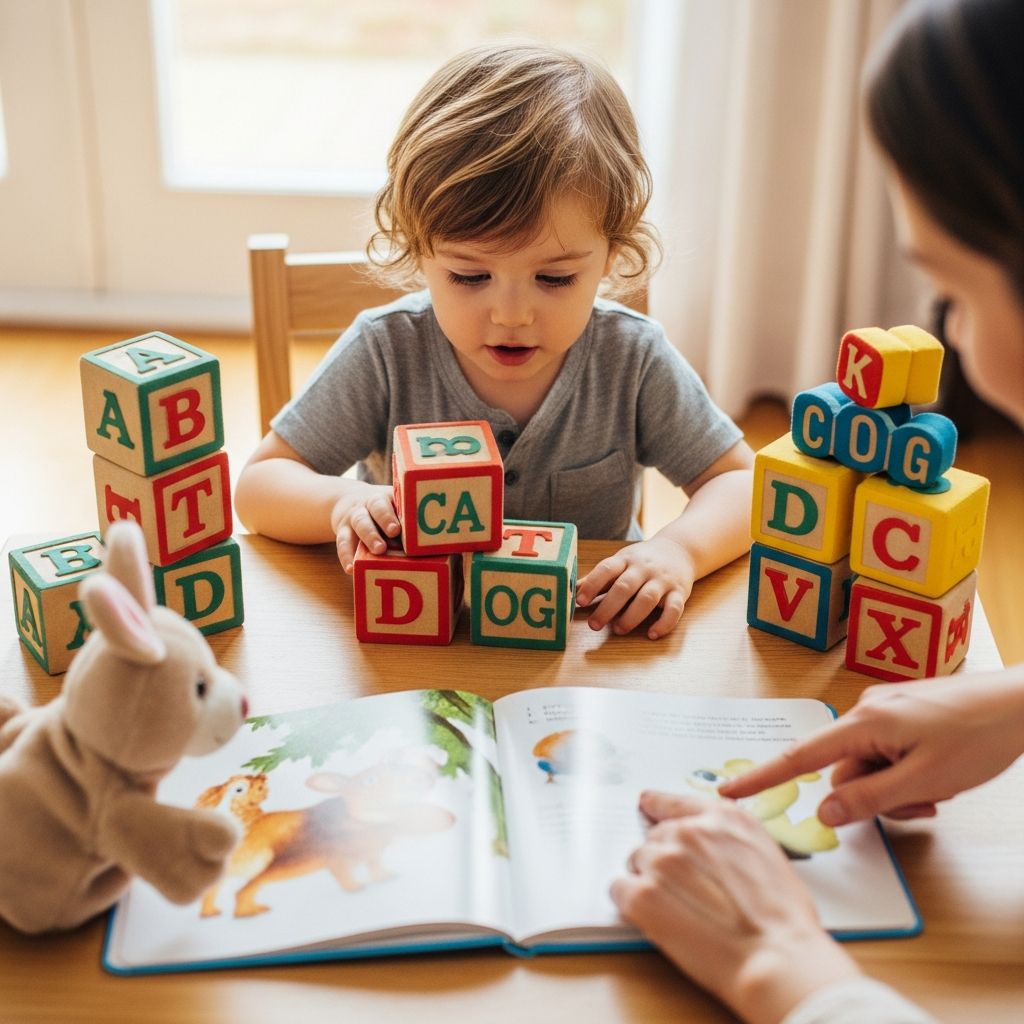
- 1-2 years: Picture books, naming objects, puppet shows for imitation.
- 2-3 years: Simple games (‘Simon Says’), sorting toys by color/shape.
- 3-5 years: Storytelling, role-play, discussions about daily events.
Recognizing and Addressing Potential Delays
Variations exist, but red flags warrant evaluation. By 18 months, fewer than 20 words or no gestures signals concern. At 2 years, no two-word phrases or poor imitation needs attention. Boys often lag slightly, but persistent issues may indicate hearing loss, autism, or disorders.
Early intervention via speech-language pathologists yields best outcomes—90% success if addressed before 3. Free screenings through public health programs track progress. Track via apps or charts aligned with ASHA milestones.
Building a Language-Rich Home Environment
Transform routines into learning: mealtimes for naming foods, baths for body parts. Encourage questions without correction—model instead. Diverse interactions (playgroups, libraries) expose new words. Parental modeling matters: clear, slow speech with enthusiasm inspires mimicry.
Tech aids like educational apps supplement, but human connection trumps. Track bilingual progress separately; code-switching is normal and beneficial.
Frequently Asked Questions
What if my child isn’t talking by 18 months?
Many children catch up, but consult a pediatrician for hearing tests or evaluations. Early therapy can make a big difference.
Does screen time help or hurt language skills?
High screen use correlates with delays; prioritize interactive talk over passive viewing.
How can I support bilingual development?
Use one language per parent or context consistently; children naturally separate them.
Is it okay to correct my child’s grammar?
Recast correctly rather than scold: ‘I goed’ becomes ‘You went!’ to model without pressure.
When should I worry about stuttering?
Brief repetitions are common up to 5 years; persistent blocks or frustration need professional input.
Long-Term Benefits of Strong Early Language
Robust skills predict academic success, better self-regulation, and social competence. Children with advanced vocabularies excel in reading by kindergarten. Investing now yields dividends in confidence and relationships lifelong.
References
- 7 Stages of Language Acquisition in Children — Da Vinci Collaborative. 2023. https://davincicollaborative.com/the-7-stages-of-language-acquisition-in-children/
- SB 210 Language Development Milestones — California Department of Education (.gov). Accessed 2026. https://www.cde.ca.gov/sp/ss/dh/sb210langmilestones.asp
- Age-Appropriate Speech and Language Milestones — Children’s Hospital of Philadelphia (.edu). 2024. https://www.chop.edu/health-resources/age-appropriate-speech-and-language-milestones
- Speech and Language Development from Birth to 12 Months — Great Ormond Street Hospital (.nhs.uk). 2023. https://www.gosh.nhs.uk/conditions-and-treatments-procedures-and-treatments/speech-and-language-development-birth-12-months/
- Speech and Language Developmental Milestones — National Institute on Deafness and Other Communication Disorders, NIH (.gov). 2024-01-16. https://www.nidcd.nih.gov/health/speech-and-language
- ASHA’s Developmental Milestones: Birth to 5 Years — American Speech-Language-Hearing Association. 2025. https://www.asha.org/public/developmental-milestones/