Children learn about the world through their five senses: sight, hearing, touch, taste, and smell. Helping them notice, name, and use these senses intentionally lays the foundation for observation skills, language development, and early science learning.
Why Teach the Five Senses Early?
Talking about the five senses gives young children concrete language for their everyday experiences. When kids connect words like “see,” “hear,” and “smell” with what their bodies are doing, they begin to think more deeply about how they explore and understand the world.
- Supports vocabulary and communication as children describe what they notice.
- Builds curiosity and early science skills by encouraging observation and comparison.
- Strengthens body awareness and self-care habits (for example, protecting eyes and ears).
Overview of the Five Senses
Before focusing on the sense of sight, it helps children to see how all five senses work together. Use simple, child-friendly language and everyday examples to make the ideas concrete.
| Sense | Main Body Part | Everyday Example for Kids |
|---|---|---|
| Sight (Vision) | Eyes | Seeing colors, shapes, letters, and people’s faces. |
| Hearing (Audition) | Ears | Listening to music, voices, or birds outside. |
| Touch (Tactile) | Skin, hands, fingers | Feeling something soft, rough, hot, or cold. |
| Taste (Gustation) | Tongue, mouth | Tasting sweet fruit or sour lemon. |
| Smell (Olfaction) | Nose | Smelling flowers, soap, or dinner cooking. |
Focusing on the Sense of Sight
After introducing all five senses, shift the spotlight to sight. Invite children to touch gently around their eyes and notice eyebrows, eyelids, eyelashes, and the colored part (iris). Keep explanations simple and emphasize that eyes help the brain understand light, color, and movement.
- Ask, “What can you see in this room that you could not know about if your eyes were closed?”
- Compare seeing near and far objects: something close in their hand and something across the room.
- Encourage kids to describe what they see using colors, shapes, sizes, and positions (e.g., above, below).
Simple Language for How Eyes Work
You do not need to teach full anatomy, but a short story about how eyes and the brain work together can capture children’s imaginations. Keep it visual and concrete, and avoid technical detail for young learners.
- Explain that light bounces off objects and enters the eyes, which send messages to the brain.
- Compare the eye to a camera: it takes in an image, and the brain is like a computer that understands the picture.
- Use pictures or a child-friendly model of the eye to show that the eye is round like a ball, with a window in front (the cornea) and a colorful ring (the iris).
Ground Rules for Eye Safety
Whenever you talk about the sense of sight, it is a good moment to teach basic eye-safety habits. Present rules positively and briefly, and repeat them often so they become part of daily routines.
- “We never put sharp things near our eyes.”
- “If something gets in your eye, tell a grown-up—don’t rub hard.”
- “We give our eyes a rest from screens and hold books and tablets at a comfortable distance.”
- “We wear hats or sunglasses outside on very bright days, if a grown-up says so.”
Activities to Explore the Sense of Sight
Hands-on games make the sense of sight real and memorable. Choose activities that match children’s ages, keep sessions short and playful, and repeat favorites so kids can notice new details each time.
1. Color Hunt Around the Room
This activity turns basic color recognition into an active visual search game. It works well for toddlers and preschoolers, and can be adapted for older children by adding patterns or shapes.
- Give each child a color card or colored object (for example, red, blue, green, yellow).
- Ask them to find something in the room that matches their color.
- Have them bring the object back or point to it and describe it with simple words.
- Extend the game with questions like, “Is your object bigger or smaller than your hand?” or “Is it smooth or rough?”
2. Look-and-Remember Tray Game
This classic memory game encourages careful looking and strengthens visual memory. It works in classrooms, therapy sessions, or at home with a small group.
- Place 6–10 small, safe objects on a tray (e.g., spoon, toy car, block, crayon, key).
- Let children look at the tray quietly for about 30 seconds.
- Cover the tray with a cloth and remove one object secretly, or remove the tray completely.
- Ask children to say or draw what they remember was on the tray or which object is missing.
To differentiate, use fewer objects for younger children and more objects or shorter viewing time for older children.
3. I-Spy with Descriptive Clues
I-Spy games push children to use language and visual details together. They can happen anywhere—during car rides, on walks, or in the classroom.
- Start with simple clues: “I spy something red” or “I spy something round.”
- Gradually add more details: “I spy something small, blue, and shiny.”
- Invite children to take turns giving clues and let others guess the object.
- Encourage use of position words like “next to,” “under,” and “above” as children get more confident.
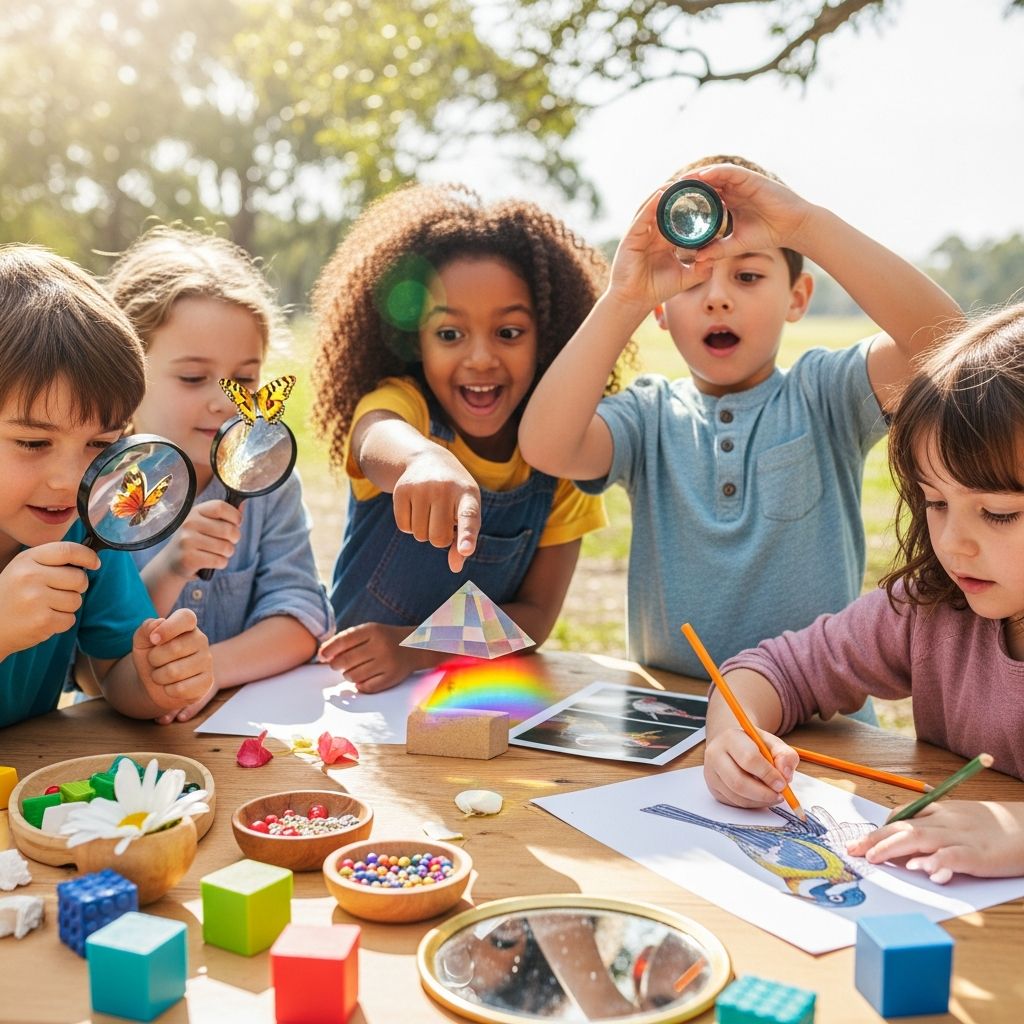
4. Magnifying Glass Exploration
Magnifying glasses help children see that objects they thought they knew well have hidden details. This builds observation and early science thinking.
- Provide a sturdy magnifying glass and a tray of safe items: leaves, fabric, coins, shells, or printed text.
- Ask, “What new things can you see when you look through the magnifying glass?”
- Encourage children to draw what they see up close and compare it to what they see without magnification.
5. Light and Shadow Play
Simple light and shadow activities introduce basic ideas about how light travels and how objects block light. Always supervise closely and avoid shining bright lights directly into eyes.
- Use a flashlight in a dim room to make shadows of hands or toys on a wall.
- Show how moving the object closer or farther from the wall changes the size of the shadow.
- Place transparent, translucent, and opaque objects in front of the light to see differences.
Connecting Sight with the Other Senses
Real-world experiences almost always involve multiple senses at once. Helping children notice when they rely on sight versus when they use another sense strengthens critical thinking.
- Have children compare what they can tell about an object just by looking versus by touching with eyes closed.
- Prepare a small tasting activity and ask which information comes from sight (color, size) and which comes from taste or smell.
- On a walk, ask children to close their eyes for a few seconds and listen, then open their eyes and describe what is different with vision added.
Adapting for Different Ages
The same core ideas about sight and the five senses can be adapted from toddlers up to early elementary years by adjusting language, time, and complexity. The key is to keep activities short, hands-on, and meaningful.
| Age Group | Focus | Sample Sight Activity |
|---|---|---|
| Toddlers (1–3 years) | Simple naming, pointing, and matching. | Point to pictures in a book and name colors and shapes together. |
| Preschool (3–5 years) | Describing details, comparing, simple games. | Color hunts, I-Spy, and look-and-remember tray games. |
| Early Elementary (6–8 years) | More complex observation and recording. | Drawing what they see through a magnifying glass and writing a few describing words. |
Including Children with Vision Differences
When teaching about the sense of sight, it is important to acknowledge that not everyone sees in the same way. This builds empathy and helps children with glasses or visual differences feel respected and included.
- Explain simply that some people see clearly, some see less clearly, and some do not see at all.
- Describe glasses or visual aids as tools that help eyes do their job, just like shoes help feet.
- In group activities, give options that do not depend only on sharp vision, such as touching, listening, or moving.
Sample Mini-Lesson Outline
Educators and parents can combine these ideas into a short, structured mini-lesson. The time can vary from 10 to 30 minutes depending on age and attention span.
- Warm-up chat (2–3 minutes): Ask, “Which parts of your body help you learn about the world?” Introduce the five senses and point to each body part.
- Focus on eyes (3–5 minutes): Talk briefly about how eyes help us see colors, shapes, and movement. Review basic safety rules.
- Main activity (5–15 minutes): Choose one hands-on sight activity such as the tray game or a color hunt.
- Reflection (3–5 minutes): Ask children what they noticed, what was easy or hard, and how the activity would change if they closed their eyes.
Tips for Making Sight Lessons Engaging
Successful lessons about the senses feel like play, not like lectures. Small choices in materials and language can keep children curious and involved.
- Use real, meaningful objects from children’s own environment whenever possible.
- Rotate materials regularly so activities feel fresh, even if the basic game stays the same.
- Encourage children to ask their own questions about how they see and what they notice.
- Take photos (with permission) of children doing the activities and use them later to review what they learned.
Frequently Asked Questions (FAQs)
How early can I start teaching my child about the sense of sight?
You can start using simple sense words with babies and toddlers by narrating what they experience. For example, say, “You see the bright light” or “You see the red ball” while pointing and making eye contact.
Do I need special materials or toys?
No special materials are required. Everyday objects, picture books, household items, and a few basic art supplies are more than enough to create rich activities about sight and the other senses.
How long should sight activities last?
For toddlers, aim for 5–10 minutes. Preschoolers can often stay engaged for 10–15 minutes, especially if they are moving, talking, and choosing objects. Older children may enjoy longer projects that involve drawing or writing.
What if my child has trouble seeing or wears glasses?
Follow the guidance of your child’s eye-care professional and adapt activities so that your child can participate comfortably. Use larger, high-contrast objects and provide alternatives that rely on touch and hearing as needed.
How often should we do five-senses activities?
Short, frequent experiences work best. You might choose one small sight activity and one activity for another sense each week, weaving sense language into everyday routines like meals, walks, and playtime.
Using This Article Responsibly
This content is an original educational guide and does not reproduce text or structure from any specific external article. You are welcome to adapt it for your own teaching or parenting, while continuing to respect copyright and intellectual-property rights when you consult other resources.