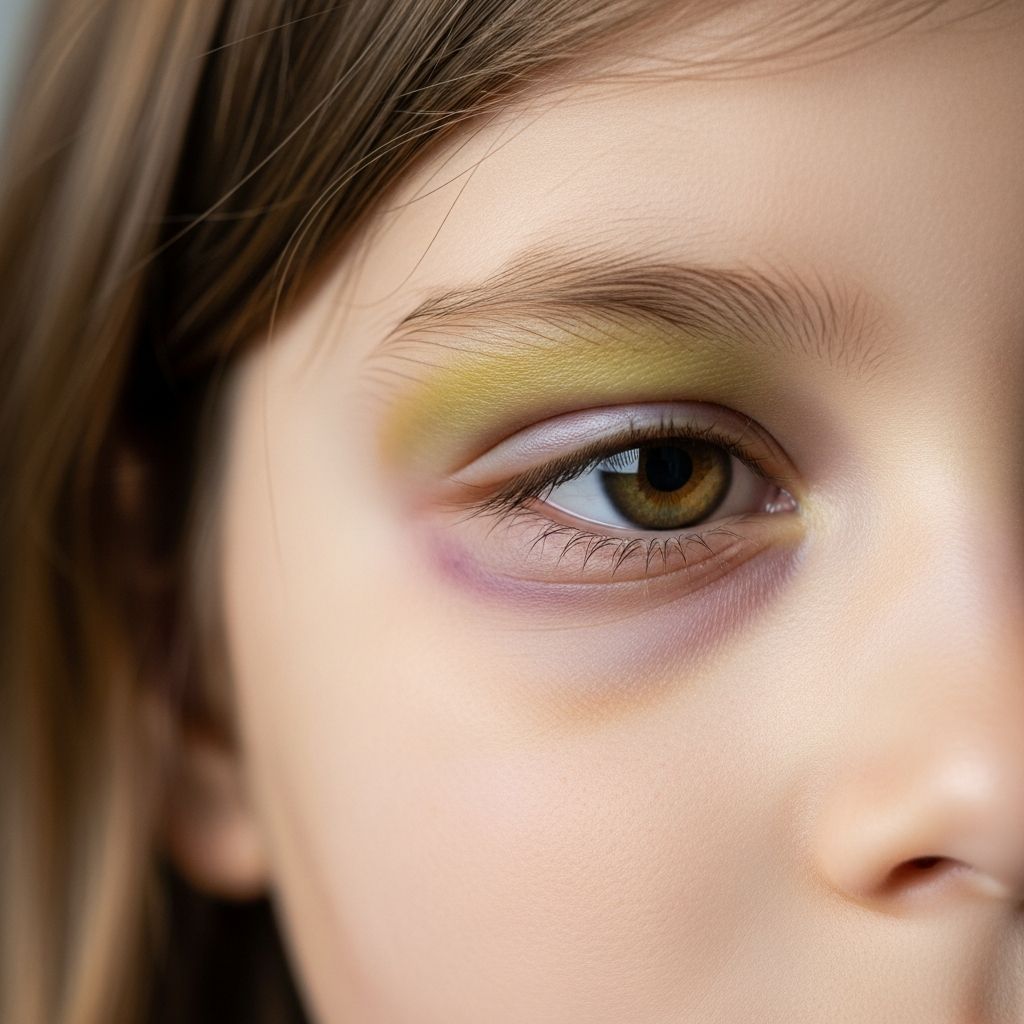
When a child gets hit near the eye, the thin skin of the eyelids can bruise quickly, turning purple or blue and swelling into what many parents call a “black eye.” In medical terms, this is often an eyelid contusion—a soft-tissue bruise around the eye that usually heals well but sometimes signals a more serious eye injury.
This guide explains what bruised eyelids are, what to watch for, how to care for them at home, and when to seek urgent medical help.
What Is an Eyelid Contusion?
An eyelid contusion is a bruise of the tissues around the eye, usually caused by blunt impact, such as a ball, elbow, or fall onto a hard surface. Tiny blood vessels under the skin break and leak blood, causing discoloration and swelling.
In many children, a black eye looks dramatic but affects only the skin and soft tissue. However, because the eyelids sit directly over the eye and surrounding bones, any bruise in this area deserves careful attention to rule out:
- Injury to the eyeball (globe) itself
- Fracture of the bones around the eye (orbital fracture)
- Deeper cuts (lacerations) of the eyelid that may need stitches
Common Causes of Bruised Eyelids in Kids
Children are active and often cannot fully protect their faces during play. Bruised eyelids frequently follow everyday accidents, including:
- Being hit by a ball, toy, or elbow during sports and rough play
- Falls from furniture, playground equipment, bikes, or scooters
- Collisions with doors, tables, or other hard objects
- Accidental hits from siblings or playmates
- Less commonly, physical abuse or intentional injury
Any injury around the eye should be taken seriously, especially in very young children who cannot clearly describe what happened or what they feel.
What Does a Bruised Eyelid Look and Feel Like?
Symptoms can range from mild to alarming in appearance. Typical signs of an uncomplicated eyelid contusion include:
- Swelling of the upper, lower, or both eyelids
- Discoloration—red, purple, blue, or yellow-green as the bruise heals
- Mild to moderate pain or tenderness when touching the area
- Intact skin without obvious cuts or bleeding
- Normal vision—the child can see clearly and does not complain of changes
Sometimes the bruise spreads downward by gravity, so a forehead or eyebrow bump can cause a black eye a day or two later, even when the eye itself was not directly hit.
| Feature | Typical Bruised Eyelid | Possible Serious Eye Injury |
|---|---|---|
| Pain level | Mild to moderate, improves with time | Severe, throbbing, or worsening pain |
| Vision | Normal vision | Blurry, double vision, or loss of vision |
| Eye appearance | Eye itself looks clear and white | Red eye, blood inside the eye, or irregular pupil |
| Eye movement | Moves normally in all directions | Limited eye movement, pain with movement |
| Other signs | No deep cuts, no fluid leaking | Deep lacerations, clear fluid or blood draining, numb cheek or upper lip |
When Is a Bruised Eyelid an Emergency?
Although many eyelid bruises can safely be observed at home, some signs suggest a significant eye or facial injury that needs prompt medical evaluation. Experts advise calling a doctor or going to emergency care right away if a child with an eye-area injury has any of the following:
- Change in vision—blurry vision, double vision, or not seeing as well as usual
- Blood inside the eye (visible behind the clear front part of the eye)
- Severe pain in or around the eye
- Deep cuts on the eyelid or around the eye, especially if the edges are gaping or bleeding heavily
- Penetrating injury—any sharp object that may have entered the eye or eyelid
- Unequal pupils or a pupil that suddenly becomes very large or oddly shaped
- Inability to move the eye normally, or pain when the eye looks up, down, or to the sides
- Marked swelling that the child cannot open the eye at all
- Fluid leaking from a wound, especially clear fluid that might be tears or cerebrospinal fluid
- Signs of broken bone—flattened cheek, numb upper lip or cheek, double vision, or sunken eye
- Head injury symptoms—vomiting, confusion, drowsiness, or loss of consciousness
- Very young age (infant or toddler) where the injury is hard to assess
Parents should also seek urgent care if the cause of the injury raises concern for abuse or if the story of how the injury occurred does not match its appearance.
First Aid for a Simple Eyelid Bruise
For minor injuries where the child is alert, vision is normal, and no deep cuts are present, basic first aid at home can help reduce swelling and discomfort. Recommendations from pediatric and eye-care centers include:
1. Protect the Eye
- Gently check that there is no obvious cut across the eyelid or eyeball.
- Do not press directly on the eye itself.
- Ask the child to close the eye softly, without squeezing, while you apply a cold compress around it.
2. Apply Cold to Limit Swelling
- Use a cold pack, bag of frozen vegetables, or cloth-wrapped ice placed gently over the bruised area for about 10–20 minutes at a time.
- Keep a thin cloth between the cold source and the skin to avoid frostbite.
- Use cold treatments several times during the first 24–48 hours to reduce swelling and discomfort.
3. Elevate the Head
- When possible, keep the child’s head elevated on a pillow while resting or sleeping to help decrease swelling.
- Avoid lying flat for long periods during the first day after injury.
4. Control Minor Bleeding
- If there is a small scrape or superficial cut near the bruise, apply gentle pressure with a clean cloth or gauze for several minutes to stop bleeding.
- Do not press hard over the eyeball. If bleeding does not slow or stop, seek medical care.
5. Use Pain Relief Safely
- Age-appropriate doses of acetaminophen or ibuprofen can help relieve discomfort, as recommended by your child’s health care provider.
- Avoid giving aspirin to children because of the risk of Reye syndrome.
How Bruised Eyelids Usually Heal
Most uncomplicated eyelid contusions improve steadily with time. Typical healing features include:
- Swelling usually peaks within the first 1–2 days and then begins to decrease.
- Bruise color changes from red-purple to blue, then green-yellow as blood is reabsorbed.
- Pain lessens within a few days and may be mild or absent after the first week.
- The bruise often fades significantly within 1–2 weeks, though some discoloration can persist longer in fair or very thin skin.
A black eye can look worse before it looks better, especially as blood spreads under the skin. As long as the child’s vision stays normal, pain does not worsen, and no new symptoms appear, this is usually part of normal healing.
Special Situations: Cuts, Fractures, and Deeper Injuries
Sometimes bruising is only one part of the injury. Medical evaluation is especially important when other injuries are suspected.
Eyelid Cuts (Lacerations)
Cuts on the eyelid require careful assessment because important structures—like the tear ducts and muscles that open and close the eyelid—are located in this delicate tissue.
- Superficial cuts may only need cleaning and close observation.
- Deeper or gaping cuts often need stitches to heal properly and avoid problems such as droopy eyelid or abnormal tear drainage.
- Complex eyelid lacerations may require repair by an ophthalmologist or plastic surgeon experienced in eye-area surgery.
Eye Globe Injury
Even if the bruise is on the eyelid, the impact can injure the eyeball itself. Potential problems include corneal scratches, bleeding inside the eye, or, rarely, rupture of the eye.
Signs that the eye, not just the lid, may be injured include:
- Persistent redness of the white of the eye
- Visible blood collecting inside the eye
- Foreign body sensation that does not improve with blinking
- Sudden vision changes or loss
Fracture of the Bones Around the Eye
A strong blow can break the bones surrounding the eye socket, especially in sports or bicycle accidents.
- Children may have double vision, difficulty moving the eye, or a sunken-appearing eye.
- The cheek or upper lip may feel numb if facial nerves are injured.
- Orbital fractures often need imaging tests and sometimes surgery to prevent long-term problems with vision or eye position.
Preventing Eyelid Bruises and Eye Injuries
No prevention method is perfect, but certain measures can reduce the risk and severity of eye-area injuries in children.
- Use protective eyewear during sports like baseball, basketball, racquet sports, and hockey.
- Ensure helmets fit correctly and are used for biking, scootering, skating, and contact sports.
- Keep sharp or pointed objects—such as tools, skewers, and some toys—out of young children’s reach.
- Supervise risky play areas, such as trampolines and playgrounds.
- Teach safety rules about not throwing hard objects at others’ faces and avoiding rough play around furniture or hard surfaces.
Follow-Up Care and Monitoring
Even after a doctor confirms that a bruise is minor, follow-up may be recommended if there was concern about the eye itself, bones, or complex lacerations.
- Keep follow-up appointments with the pediatrician or ophthalmologist, especially after more serious injuries.
- Watch for any new symptoms such as increasing pain, redness, or changes in vision.
- Follow instructions for eye drops, ointments, or activity restrictions if they were prescribed.
Frequently Asked Questions (FAQs)
How can I tell if my child’s black eye is only a bruise?
A simple bruise usually has swelling and discoloration but no change in vision, no deep cuts, and pain that is mild to moderate and slowly improving. If your child can see clearly, move the eye in all directions without pain, and the eye itself looks clear (not red or bloody), the injury is more likely limited to the eyelid. However, any doubt about vision, bone injury, or deep lacerations warrants an exam by a health professional.
How long does it take for a bruised eyelid to heal?
Most uncomplicated eyelid bruises improve significantly within 1–2 weeks. Swelling often peaks in the first 48 hours, then gradually decreases, while the color of the bruise changes from dark purple or blue to green and yellow as it heals. If the bruise is not improving after several days, or new symptoms develop, contact your child’s health care provider.
Should I put meat, butter, or toothpaste on a black eye?
No. Home remedies such as raw meat, butter, or toothpaste are not recommended and may introduce bacteria or irritants near the eye. Evidence-based first aid focuses on cold compresses, gentle protection, head elevation, and appropriate pain relief.
Can I use eye drops for my child’s bruised eyelid?
Most eyelid bruises do not require eye drops if the eye itself is not injured. Never use prescription eye drops left over from someone else. If your child has redness of the eyeball, pain inside the eye, or vision changes, they should be examined by a doctor or ophthalmologist before any medication is used.
When should my child avoid sports after an eyelid contusion?
Children should avoid contact sports or ball sports until the swelling and pain have resolved and a clinician confirms there is no eye or bone injury. Returning too soon could lead to another hit in the same area, increasing the risk of serious damage.
References
- Eye Injury — Seattle Children’s. 2022-06-01. https://www.seattlechildrens.org/conditions/a-z/eye-injury/
- Ocular & Eyelid Trauma — Riley Children’s Health. 2023-03-15. https://www.rileychildrens.org/health-info/ocular-eyelid-trauma
- Eyelid Lacerations in Children — Nationwide Children’s Hospital. 2021-10-20. https://www.nationwidechildrens.org/conditions/health-library/eyelid-lacerations-in-children
- Eye Injuries: Home Care — Nemours KidsHealth. 2022-09-10. https://kidshealth.org/en/parents/eye-injuries-sheet.html
- Eye Injury – Trauma Service Manual — The Royal Children’s Hospital Melbourne. 2019-05-01. https://www.rch.org.au/trauma-service/manual/eye-injury/
- Eyelid Contusions and Lacerations — MSD Manual Professional Edition. 2023-01-05. https://www.msdmanuals.com/professional/injuries-poisoning/eye-trauma/eyelid-contusions-and-lacerations
- Eye Injuries — Boston Children’s Hospital. 2022-08-12. https://www.childrenshospital.org/conditions/eye-injuries
- Eye Injury: Types, Causes, Prevention & Treatment — Cleveland Clinic. 2023-06-27. https://my.clevelandclinic.org/health/diseases/eye-injury