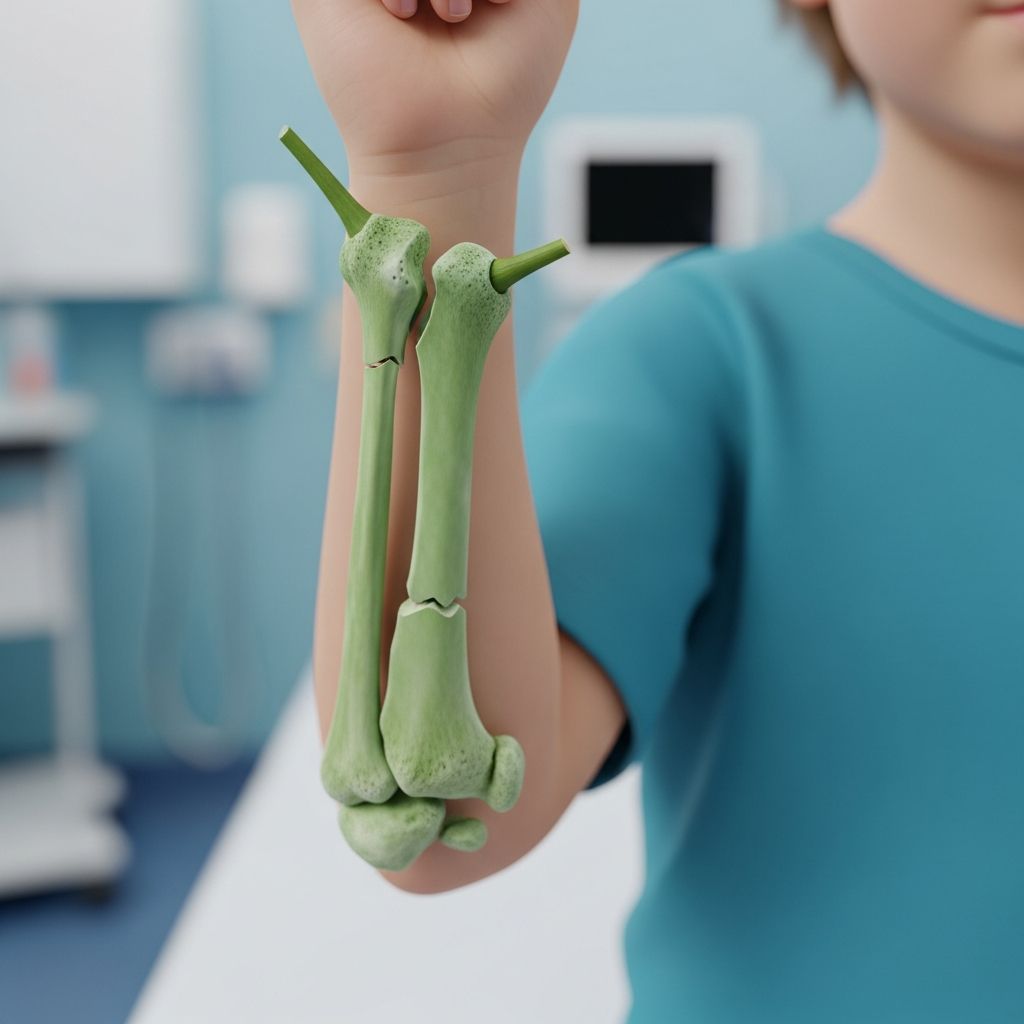
Greenstick fractures represent a distinctive type of bone injury primarily affecting children, where the bone bends and cracks on one side without fully separating. This partial break occurs because young bones are more flexible and elastic than adult bones, much like a green twig that bends before snapping.
Why Children’s Bones Behave Differently
Children’s bones contain higher levels of collagen, making them pliable and less brittle. The periosteum, the tough outer membrane, is thicker and stronger in kids, which helps contain the fracture and promotes faster healing. These properties lead to unique fracture patterns such as greenstick, torus, or buckle fractures, rather than complete breaks seen in adults.
Greenstick fractures most often happen in the long bones of the arms (radius and ulna) or legs (tibia and fibula), commonly from falls on an outstretched hand. They are rare in adults due to the rigidity of mature bones.
Common Triggers Behind These Injuries
The leading cause is a fall on an outstretched arm, known as FOOSH (fall on outstretched hand), which transfers force through the forearm bones. Other frequent scenarios include:
- Bicycle or scooter accidents during play.
- Sports-related impacts, like soccer or skateboarding falls.
- Playground mishaps, such as tumbling from swings or slides.
- Rarely, motor vehicle accidents or direct blows from objects.
Factors like vitamin D deficiency can weaken bones, increasing susceptibility to these partial fractures after minor trauma. Active children aged 5-14 are most at risk, with incidence around 1 in 100 in this group.
Spotting the Signs Early
Symptoms vary by severity but often include immediate pain at the site, preventing full use of the limb. Key indicators are:
- Swelling and bruising around the injury within minutes.
- Tenderness when touched, with the child guarding the area.
- Visible deformity, like a bend or crook in the forearm.
- Limited motion, though slight movement may be possible unlike complete fractures.
- In mild cases, only soreness or stiffness without obvious bend.
Infants may cry inconsolably and refuse to bear weight, while older kids can describe the pain location and intensity. Always suspect a fracture if pain persists after a fall, even if no deformity is apparent.
How Doctors Confirm a Greenstick Fracture
Diagnosis starts with a physical exam, checking for pain, swelling, range of motion, and neurovascular status (pulses, sensation). X-rays are the gold standard, revealing the characteristic bend and cortical break on one side while the other remains intact.
In tricky cases, especially near growth plates, MRI or CT scans provide detailed views if X-rays are inconclusive. Doctors classify the fracture’s stability and displacement to plan treatment.
| Feature | Greenstick Fracture | Complete Fracture |
|---|---|---|
| Bone Integrity | Partial crack, one side intact | Fully separated pieces |
| Common Age | Children under 10 | All ages |
| Pain Level | Mild to moderate | Severe |
| X-ray Appearance | Bent cortex | Clear break line |
Treatment Approaches for Quick Recovery
Most greenstick fractures are stable and heal well with non-surgical care. Treatment focuses on immobilization to allow natural alignment and healing:
- Casting or splinting: A short-arm cast for forearm fractures, worn 4-8 weeks. The bend is often manually corrected first.
- Pain management: Over-the-counter ibuprofen or acetaminophen.
- Elevation and ice: To reduce swelling in the first 48 hours.
Severely displaced fractures may require closed reduction (realigning under sedation) or, rarely, surgery with pins. Follow-up X-rays monitor healing progress.
Healing Timeline and What to Expect
Children’s bones heal rapidly due to robust blood supply and remodeling capacity—often in 3-6 weeks for forearms. Full strength returns in 6-12 weeks with proper care.
Signs of good healing include decreased pain and swelling by week 2. Complications are rare but watch for:
- Increased pain or numbness (compartment syndrome).
- Fever or drainage (infection).
- Cast tightness from swelling.
After cast removal, physical therapy restores strength and flexibility. Growth plate involvement needs monitoring to prevent limb length discrepancies.
Preventing Greenstick Fractures in Active Kids
While not all injuries are avoidable, risks can be minimized:
- Ensure helmets and pads for biking, skating, and sports.
- Supervise playground time and teach safe falling techniques.
- Promote balanced nutrition with calcium and vitamin D for bone health.
- Encourage strength-building activities like tumbling classes.
Regular check-ups catch nutritional deficiencies early.
Growth Plate Concerns with Fractures
Greenstick fractures near the physis (growth plate) risk affecting bone growth if the hypertrophic zone is damaged. The physis has four zones: resting, proliferation, hypertrophy, and calcification, with the latter being vulnerable. Salter-Harris classification guides prognosis; types I-II often heal without issues.
Monitor for angular deformities or shortening post-healing.
Frequently Asked Questions (FAQs)
Can a greenstick fracture heal without a cast?
Very mild, non-displaced ones might, but casting is standard to prevent shifting, as they remain unstable initially.
How long does a child’s greenstick fracture take to heal?
Typically 4-8 weeks in a cast, with full recovery in 2-3 months.
Is a greenstick fracture worse than a full break?
No, they often heal faster and with less intervention due to partial nature and kids’ healing ability.
Should I take my child to the ER for suspected greenstick fracture?
Yes, if there’s deformity, severe pain, or inability to move the limb—prompt imaging prevents complications.
Can greenstick fractures cause long-term problems?
Rarely, if growth plates are involved; most kids recover fully without issues.
References
- Understanding Greenstick and Growth Plate Fractures in Children — Miller Children’s & Women’s Hospital. 2023. https://www.millerchildrens.memorialcare.org/blog/understanding-greenstick-and-growth-plate-fractures-children
- Greenstick Fracture: Symptoms, Causes, and More — Healthline. 2023-10-12. https://www.healthline.com/health/greenstick-fracture
- Greenstick Fracture – StatPearls — NCBI Bookshelf. 2023-07-17. https://www.ncbi.nlm.nih.gov/books/NBK513279/
- Greenstick fractures occur almost exclusively in children — UCLA Health. 2022. https://www.uclahealth.org/news/article/greenstick-fractures-occur-almost-exclusively-children
- What is a Greenstick Fracture and How is it Treated? — Orthopaedic Specialty Clinic. 2023. https://www.osc-ortho.com/blog/what-is-a-greenstick-fracture-and-how-is-it-treated/
- Greenstick Fracture: Causes, Symptoms, and Treatment — ER of Mesquite. 2024. https://erofmesquite.com/blog/greenstick-fracture-causes-symptoms-and-treatment/