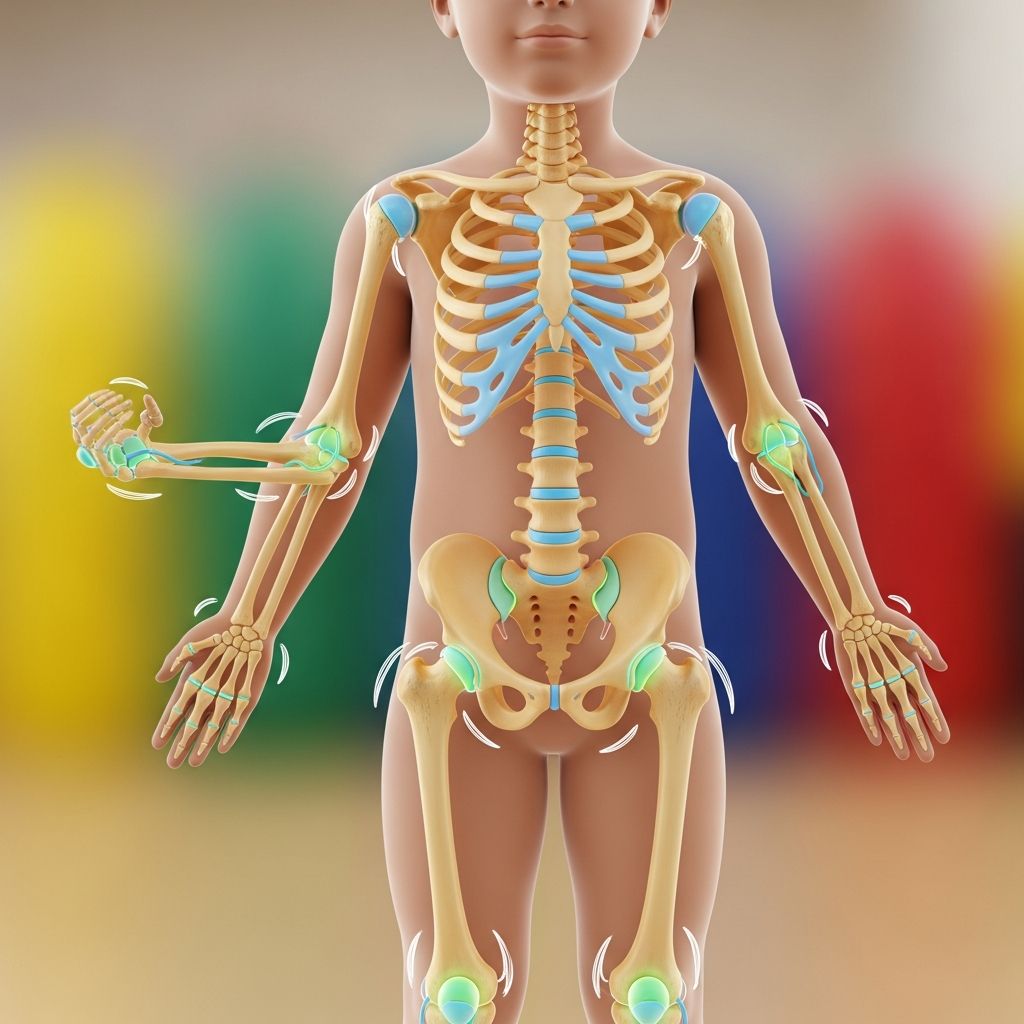
Every time you run at recess, grab your backpack, or wave to a friend, your joints are busy at work. They may be small, but they make a big difference in how you move, play, and do everyday things.
This kid-friendly guide explains what joints are, how they move, why they sometimes hurt, and how you can keep them healthy as you grow.
What Exactly Is a Joint?
A joint is the place where two or more bones meet so that your body can bend, twist, and move. Without joints, your body would be stiff like a statue, and even simple actions like sitting down or turning your head would be impossible.
Main jobs of your joints
- Let you move – so you can bend, straighten, twist, and turn.
- Support your body weight – especially in your hips, knees, and ankles when you stand and walk.
- Help you stay balanced – so you don’t fall when you change direction or jump.
- Protect your bones – by spreading out the force when you land from a jump or bump into something.
What’s inside a joint?
Even though we only see the outside of our bodies, a joint has several important parts working together on the inside:
- Bone ends – the tips of bones that meet at the joint.
- Cartilage – a smooth, slippery covering on the ends of bones that helps them glide easily.
- Synovial fluid – a thick, slippery liquid that works like oil in a machine to keep the joint moving smoothly.
- Joint capsule – a strong, bag-like cover that surrounds the joint and keeps the fluid inside.
- Ligaments – tough bands that connect bone to bone and help keep the joint stable.
- Tendons – strong cords that connect muscles to bones so that when muscles pull, the joint moves.
Different Kinds of Joints in Your Body
Your body has several types of joints, each shaped for a special kind of movement.
| Joint Type | Where You Find It | How It Moves | Everyday Example |
|---|---|---|---|
| Hinge joint | Knees, elbows, fingers, toes | Bends and straightens in one main direction | Kicking a ball or doing a push-up |
| Ball-and-socket joint | Shoulders, hips | Moves in many directions and can rotate | Throwing a ball or dancing |
| Gliding joint | Wrists, ankles, small bones in the spine | Slides or glides over nearby bones | Typing, writing, or rolling your wrist |
| Pivot joint | Neck (between the first two neck bones), forearm | Rotates around another bone | Turning your head or twisting your palm up and down |
| Fixed joint | Skull bones | Does not move | Protects the brain instead of allowing movement |
How Joints Work Together With Muscles
Muscles and joints are a team. Muscles pull on bones through tendons, and joints are the places where that pulling turns into motion.
- Your brain sends a message to the muscle.
- The muscle tightens (contracts) and pulls on a tendon.
- The tendon pulls the bone at the joint.
- The joint moves, letting you kick, jump, or wave.
When muscles on one side of a joint tighten, the muscles on the other side usually relax. This teamwork keeps your movement smooth instead of jerky.
Why Joints Are Especially Important for Kids
Because children are still growing, their joints are changing all the time. Growth plates near the ends of bones are areas of softer tissue that slowly become bone as you get older. That means kid joints:
- Need good nutrition to build strong bones and cartilage.
- Benefit from regular movement to keep them flexible.
- Can be easily injured by doing too much of the same motion or from hard falls.
Common Reasons Kids’ Joints Hurt
Most of the time, joint pain in children is not a sign of something serious, but it is important to pay attention to it.
Very common causes
- Growing pains – achy feelings in the legs, often at night, that go away by morning and are not linked to swelling or redness.
- Minor injuries – twists, bumps, and sprains from sports or active play.
- Overuse – doing the same motion again and again, like throwing, jumping, or running long distances without enough rest.
Less common: health conditions that affect joints
Sometimes joint pain lasts longer or comes with other symptoms. This can be a sign of a medical condition that needs a doctor’s care.
- Childhood (juvenile) arthritis – when the immune system mistakenly attacks the lining of the joints, causing pain, stiffness, and swelling for more than 6 weeks.
- Autoimmune diseases like lupus – where the immune system attacks healthy tissues in many parts of the body, including joints.
- Infections – some germs can get into a joint or trigger swelling that makes joints painful.
If joint pain is caused by one of these conditions, early treatment can help protect the joints and keep kids active.
Warning Signs: When Joint Pain Needs a Doctor
Some signs tell you it is time to talk to a grown-up and see a health professional.
- Pain that lasts for days or weeks instead of going away.
- Morning stiffness – joints feel very stiff or hard to move when you first wake up.
- Swelling, warmth, or redness around the joint.
- Joint pain plus a fever or feeling very tired.
- A rash together with joint pain.
- Trouble walking, using the joint, or playing like you usually do.
- Joint pain after a fall or injury that makes it hard to move or put weight on the area.
If you notice any of these, tell a parent, guardian, teacher, or school nurse. They can help you get checked by a doctor or pediatric specialist.
How Doctors Check Joint Problems in Kids
Pediatric doctors, and sometimes pediatric rheumatologists (doctors who specialize in joint and immune problems in children), use several steps to figure out what is going on.
- Questions – about when the pain started, what makes it better or worse, and if you have other symptoms like fever or rash.
- Physical exam – gently moving your joints, checking for swelling, warmth, redness, or limited movement.
- Blood tests – to look for signs of inflammation or immune system activity.
- Imaging tests – such as X-rays or ultrasound to look at bones and soft tissues inside the joint.
These tests help doctors tell the difference between simple aches and conditions that need special treatment.
Keeping Your Joints Strong and Healthy
Good habits now can help your joints feel better today and stay healthy when you are an adult.
Move your body every day
- Play games that make you run, jump, and stretch, like tag, hopscotch, or dancing.
- Try joint-friendly sports like swimming or cycling that are easy on your knees and hips.
- Avoid sitting still for long periods; take movement breaks from screens.
Eat foods that build healthy bones and joints
- Choose foods with calcium (like dairy, fortified plant milks, or leafy greens) to build strong bones.
- Get enough vitamin D from foods or safe sunlight, as advised by an adult.
- Enjoy a variety of fruits, vegetables, and whole grains that support overall body health.
Protect your joints during play and sports
- Wear the right safety gear, such as knee pads, wrist guards, and helmets, for activities like skating or biking.
- Learn and use proper techniques in sports (for example, how to land from a jump).
- Stop if you feel sharp pain and tell an adult instead of playing through it.
- Give your body time to rest between practices and games to avoid overuse injuries.
What Happens if a Child Has Arthritis?
When people think about arthritis, they often imagine older adults, but children can have arthritis too. Arthritis that starts in childhood is often called childhood arthritis or juvenile idiopathic arthritis (JIA).
What is childhood arthritis?
Childhood arthritis happens when the immune system becomes overactive and attacks the lining of the joints. This can cause:
- Pain and stiffness, especially in the morning.
- Swelling in one or more joints.
- Tiredness, fever, or poor appetite in some children.
In some kids, only a few joints are affected; in others, many joints can be involved. Without treatment, the inflammation can damage cartilage and bone over time, so early care is very important.
How is childhood arthritis treated?
Doctors create a plan to help reduce pain and protect the joints.
- Medicines – to calm inflammation and support the immune system in working more normally.
- Physical and occupational therapy – special exercises and activities to keep joints moving and muscles strong.
- Healthy activity – staying active in gentle ways helps joints stay flexible.
With the right treatment, many children with arthritis can go to school, play with friends, and join activities just like other kids.
Simple At-Home Comfort Tips (With Adult Help)
If your joints feel a little sore after a busy day and an adult has checked that it is nothing serious, these ideas may help you feel more comfortable.
- Rest the sore joint for a short time, then gently move it so it does not get stiff.
- Use an ice pack wrapped in a cloth for a few minutes if a joint is mildly swollen (only with adult supervision).
- Ask an adult before taking any pain medicine like acetaminophen or ibuprofen; never take extra or someone else’s medicine.
- Try stretching or light movement if your muscles around the joint feel tight.
These steps are not a replacement for medical care. If pain or swelling does not get better, you still need to see a health professional.
Fun Ways to Learn About Your Joints
Want to understand your joints better? Try these kid-friendly ideas:
- Movement game: Pick a body part and list all the ways it can move (bend, twist, circle).
- Balance challenge: Stand on one leg and see how your ankle, knee, and hip work to keep you steady.
- Drawing activity: Draw a stick figure and put circles where you think major joints are, then compare with a picture from a book or trusted website.
Frequently Asked Questions (FAQs)
Why do my legs hurt at night but feel fine in the morning?
Many kids get achy legs at night, especially in the thighs, shins, or behind the knees. These are often called growing pains and usually are not serious if there is no swelling or redness and you feel better by the next day. Always tell an adult so they can decide if you need to see a doctor.
Can kids really get arthritis?
Yes. Some children develop a kind of arthritis called juvenile idiopathic arthritis or childhood arthritis. It can cause joint pain, stiffness, and swelling that last a long time. Doctors have treatments that can help protect joints and let kids stay active.
Is it bad to crack my knuckles?
When you crack your knuckles, you are usually popping tiny gas bubbles in the joint fluid. For most healthy kids, this is not known to cause arthritis, but it can bother people around you. If a joint hurts or swells when you crack it, stop and tell an adult.
How can I make my joints stronger?
Joints themselves are not muscles, but you can protect them by keeping the muscles around them strong and flexible. Stay active, eat foods with calcium and vitamin D, use proper sports gear, and give your body time to rest after hard play.
When should I tell a grown-up about joint pain?
Always let an adult know if you have joint pain that is very strong, keeps coming back, lasts several days, or is joined by swelling, redness, fever, a rash, or trouble walking. These are signs you may need to see a doctor.
References
- Health Lesson: Learning About Joints — National Institute of Arthritis and Musculoskeletal and Skin Diseases (NIAMS). 2020-08-01.
- Joint Pain in Children — ColumbiaDoctors Children’s Health. 2023-05-10.
- Joint pain or muscle pain in children — Mayo Clinic Symptom Checker. 2023-03-15.
- Childhood Arthritis — Centers for Disease Control and Prevention (CDC). 2023-09-27.
- Juvenile Idiopathic Arthritis (JIA) — Cleveland Clinic. 2024-02-06.
- Joint Health: A Complete Guide to Lifelong Mobility — Baylor Scott & White Health. 2022-11-18.
- Joint Pain in Children: Care Instructions — MyHealth Alberta. 2022-05-01.