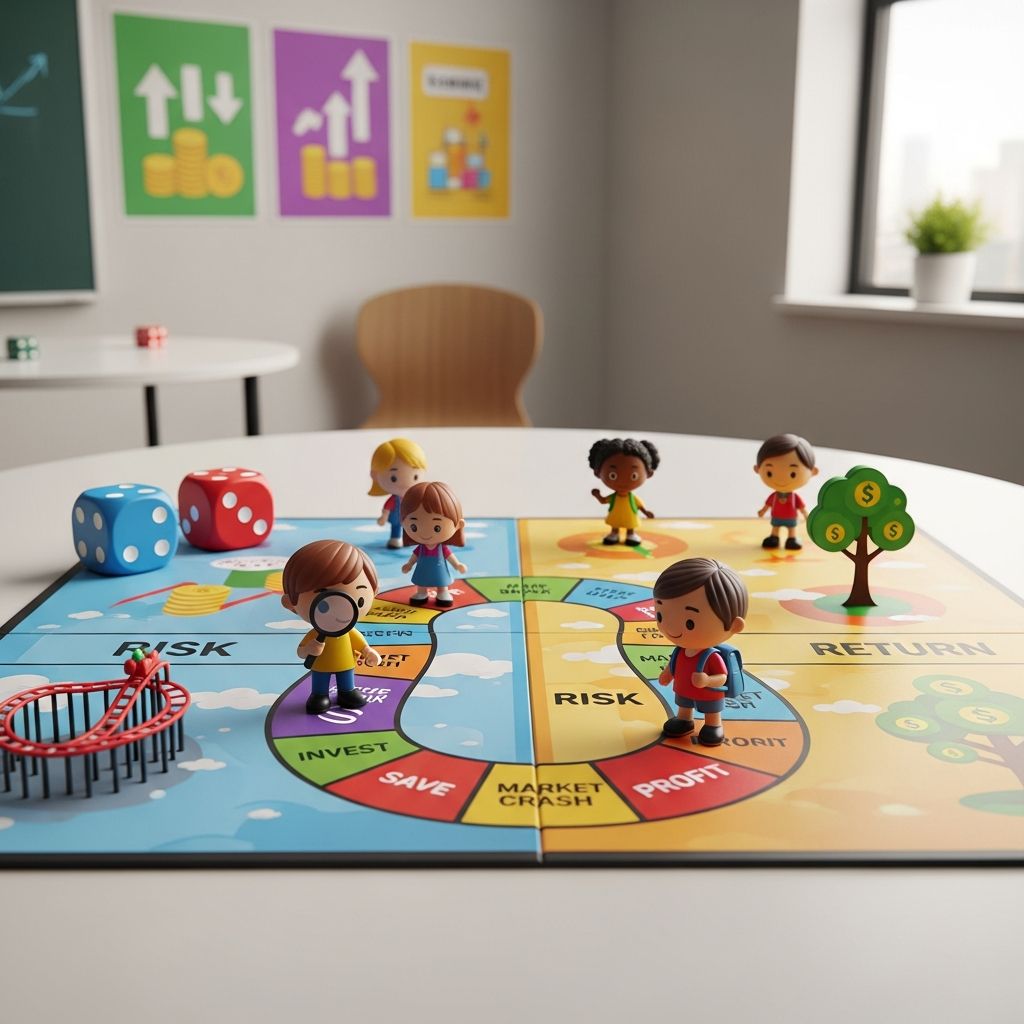
Introducing children to the stock market can be less about making money and more about building financial literacy, critical thinking, and emotional control. A structured “risk versus return” game turns abstract investing concepts into something concrete, playful, and easy for kids to understand.
Why Teach Kids About Investing?
Children are surrounded by brands, products, and technology, but rarely see how companies raise money, grow, or create long-term wealth for investors. Teaching them about investing gives context to the economy they already live in and prepares them for real-world financial decisions as adults.
- It shifts their mindset from instant gratification toward long-term planning and patience.
- It helps them recognize that money can be used as a tool for growth, not only for spending.
- It provides a safe environment to make mistakes and learn from them without real financial consequences.
Key Concept: Risk Versus Return
The core lesson of the game is understanding the trade-off between risk and return. Higher potential returns usually come with a higher chance of loss, while safer choices often grow more slowly but more steadily.
Instead of teaching this idea with charts and formulas, the game lets children feel the impact of different choices. They see how “safe” and “risky” options behave over multiple rounds, learning that there is no guaranteed win, only better or worse choices for a given goal and time frame.
Game Overview
The stock market risk versus return game imitates real investing using imaginary money and a simplified market. Parents or educators act as the “market,” while children act as investors who choose between different investment options over a series of rounds.
- Each child starts with the same amount of play money.
- They choose where to invest before each round: safe, medium, or risky options.
- The adult reveals the outcome of the “market” for that round and updates the account balances.
- After several rounds, everyone reviews results, choices, and lessons learned.
Materials You Need
- Paper or index cards to represent different investments (e.g., safe bond, index fund, hot tech stock).
- Play money or simple point totals written on paper.
- A scoring sheet to track each child’s balance over rounds.
- Dice or a random number method (if you want some outcomes to be random within set ranges).
Designing the Investment Choices
To mirror real-world investing, give each child a few clear options with different levels of risk and return. Label them with plain-language descriptions rather than complicated financial jargon.
| Option | Risk Level | Typical Round Outcome | Teaching Point |
|---|---|---|---|
| Government Bond | Low | Small gain almost every round, very rare loss | Stability, lower but steadier growth over time |
| Index Fund | Medium | Moderate gains in many rounds, occasional mild losses | Diversification, typical long-term stock market behavior |
| Hot Tech Stock | High | Big gains in some rounds, big losses in others | Volatility, possibility of both exciting wins and painful drops |
| Penny Stock / Speculative Bet | Very High | Occasional huge jump, frequent large losses or total wipe-out | Speculation, gambling-like behavior, and why caution matters |
Basic Rules of the Game
- Starting balance: Give each child the same starting amount of play money (for example, 1,000 units).
- Round structure: Announce that there will be a set number of rounds, such as 8 to 12, to imitate years of investing.
- Choice phase: Before each round, each child chooses how to allocate their money among the available options.
- Outcome phase: Reveal the outcome for each investment option: gains, losses, or no change.
- Update balances: Help the children calculate new balances based on outcomes.
- Reflection: After each update, talk briefly about what happened and why.
Creating Market Outcomes
For younger children, you can script the outcomes in advance so that the game illustrates clear lessons, such as the advantage of steady investing or the danger of chasing fads. For older kids, you can add chance using dice or random draws from a prepared list of possible results.
- Low-risk options should almost always show small positive results.
- Medium-risk options should swing between modest gains and small losses.
- High-risk options should include big jumps and big crashes to drive home the meaning of volatility.
Example Round Scenarios
Here is a simple way to structure outcomes over multiple rounds so that patterns emerge:
- Rounds 1–3: The market is generally friendly, with most options rising, though risky options still move more dramatically.
- Rounds 4–5: A downturn arrives, causing risky options to drop sharply and medium options to dip; safe options stay flat or slip a little.
- Rounds 6–8: The market gradually recovers; diversified and steady choices start to look attractive compared to those who “bet big” and lost.
What Children Learn from Different Choices
After a few rounds, children see concrete consequences of their strategies. Those who chose only risky options may have large gains or serious losses, while those who chose balanced portfolios may experience smoother outcomes.
- They realize that risk can lead to exciting wins but also hurts when the market turns.
- They see that consistent, moderate decisions often work better over several rounds than wild swings between extremes.
- They learn that no one can predict each round exactly, which is why planning and diversification matter.
Talking About Emotional Reactions
One of the most important learning points is how investing feels. Children may become excited when they win big at first, or upset when they lose money in a later round. These emotions mirror how real investors often react in the stock market.
- Explain that feeling nervous or excited is normal but should not control decisions.
- Point out how chasing quick wins or panicking after losses can lead to poor long-term results.
- Encourage them to think like long-term owners rather than short-term gamblers.
Risk Profiles and Personal Goals
Another theme in the game is that different people may choose different levels of risk based on their own goals and comfort level. There is no single “right” choice, only choices that are more or less suitable for a particular situation.
- Children who dislike big swings might prefer mostly safe and medium options.
- Children who enjoy volatility may naturally pick more high-risk choices.
- Parents can help them understand that age, time horizon, and future plans all influence how much risk is appropriate.
Connecting the Game to Real Stocks
Once children grasp the basic risk versus return idea through the game, parents can introduce simple real-world examples. Point to familiar companies that make their favorite toys, games, or foods, and explain that owning a share means owning a small piece of that business.
- Discuss how a company that makes more money and grows may increase its stock price over time.
- Explain that even good companies can experience short-term price drops due to market forces.
- Highlight that investing is about owning businesses, not just watching prices bounce up and down.
Setting Expectations About Real Investing
Before any real money is involved, it is important to emphasize that the game simplifies reality. Actual stock markets are more complex, and outcomes are never guaranteed. Children should understand that actual investing involves real risk, serious research, and long-term thinking.
- Stress that the goal is learning, not getting rich quickly.
- Reinforce that losing money is possible and that even careful investors experience bad years.
- Explain that with real money, decisions should be made thoughtfully, often with adult guidance.
Variations and Extensions of the Game
To deepen the learning, parents can extend or modify the basic game once children are comfortable with the rules. These variations help introduce more advanced ideas in a manageable way.
- Add “dividends,” where some investments pay a small bonus each round regardless of price movement.
- Introduce diversification by allowing children to split their money among several options in each round.
- Simulate news events that affect certain types of investments more than others.
Common Mistakes Children Make in the Game
Watching children play the game can reveal instinctive tendencies that are important to address early. Many of these mirror mistakes that adults make in real markets.
- Chasing whichever investment did best in the last round and assuming it will always win.
- Switching strategies too often based on short-term results instead of sticking to a plan.
- Putting all their money into one high-risk option in the hope of a huge payoff.
Using the Game as a Conversation Starter
Beyond the numbers, the game opens the door to ongoing conversations about money, values, and priorities. Parents can tie the lessons to everyday choices such as saving for a toy, deciding how to spend allowance, or planning for future goals.
- Ask children how they felt during big gains and losses and what that taught them.
- Discuss the difference between gambling and investing with a purpose.
- Connect the idea of risk versus return to non-financial areas like studying, sports, or hobbies.
Practical Tips for Parents
Parents do not need to be investing experts to run the game. Keeping explanations simple and honest is more important than providing technical detail. Clear structure and predictable rules make children feel safe enough to explore and ask questions.
- Use small, easy numbers so that children can follow the math themselves.
- Keep the pace lively to maintain attention, but pause for reflection when big changes occur.
- Celebrate thoughtfulness and good questions, not just high balances at the end.
Sample Debrief Questions After the Game
When the final round ends, the learning is just beginning. A short debrief helps children internalize what they experienced rather than focusing solely on who “won.”
- Which investment choices made you feel comfortable or uncomfortable? Why?
- Did your strategy change after a big gain or a big loss? Was that helpful?
- If you played again, what would you do differently?
Frequently Asked Questions
What age is this stock market game appropriate for?
The game works best with school-age children who can add and subtract. Younger kids may just enjoy choosing cards and seeing balances go up or down, while older kids can handle more detail about risk, diversification, and long-term goals.
Do children need prior knowledge of money or math?
They only need a very basic understanding of numbers and the idea that money can increase or decrease. The game itself acts as a teaching tool, gradually introducing more complex ideas as they become comfortable.
Should real money ever be used in this game?
The core version should use imaginary money to keep it low-pressure and safe. Once children clearly understand the concepts and can handle emotions around gains and losses, parents may choose separate, real-world saving or investing activities with small amounts and clear safeguards.
How long should a full game session last?
A simple version with 6–8 rounds can usually be played in 30 to 45 minutes. This is long enough for patterns to appear without children losing interest. For very young players, shorter sessions with fewer rounds may work better.
What if a child becomes upset about losing?
Feeling disappointed is a natural part of the lesson. Parents can acknowledge the emotion, remind the child that it is play money, and ask what might be changed next time. This opens a powerful discussion about resilience, patience, and long-term thinking.
Final Thoughts
A stock market risk versus return game offers a rich way to introduce children to investing, beyond memorizing terms or staring at price charts. By connecting choices, emotions, and outcomes in a safe environment, it gives them tools they can carry into adulthood whenever they face financial decisions or other situations that involve balancing risk and potential reward.