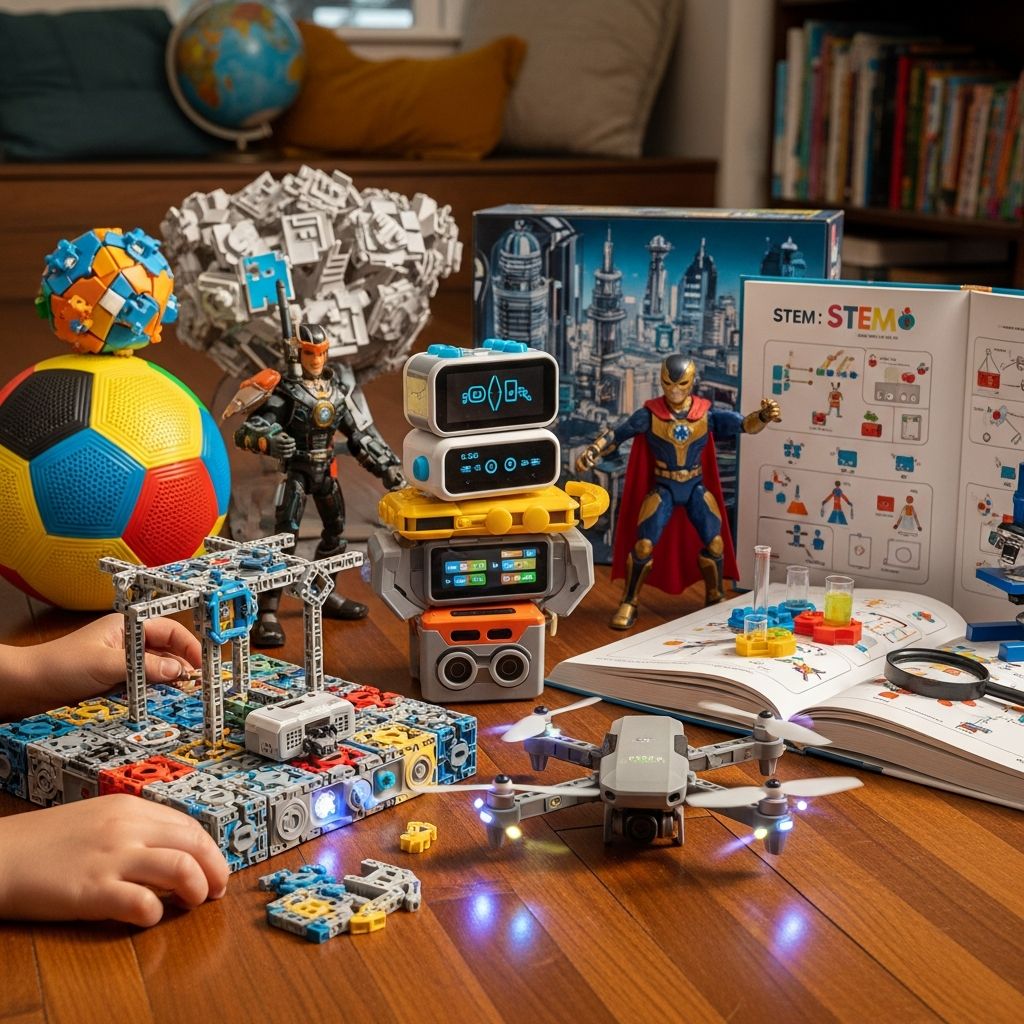
Seven is a big year. Kids at this age are more independent, full of questions, and ready for toys that challenge their minds as much as their muscles. Choosing the right playthings can support school skills, emotional growth, and a lifelong love of learning.
Understanding 7-Year-Old Boys: What Play Really Supports
By age seven, many boys are moving beyond simple pretend play and starting to enjoy strategy, jokes, and projects that take more than a few minutes to finish. The best toys at this age are those that match their growing attention span and their desire to feel capable and “grown up.”
Good toys for this stage usually blend a few elements: hands-on building or tinkering, chances to move their bodies, opportunities to feel successful after practice, and space for creativity. When those pieces come together, play becomes a powerful tool for confidence and learning.
- They are ready for multi-step activities with directions and goals.
- They enjoy friendly competition but still need help handling frustration.
- They like to show what they can do on their own, from reading to building.
Key Skills Great Toys Can Support at Age Seven
When you choose toys with intention, you support important skills without turning play into work. Think of toys as tools that gently stretch your child just beyond what they can already do, then let them come back to familiar favorites for comfort and fun.
Below are some core areas of development and the kinds of toys that tend to support them naturally.
| Skill Area | What 7-Year-Olds Are Practicing | Helpful Toy Types |
|---|---|---|
| Cognitive & STEM | Logical thinking, problem solving, early science and math reasoning. | Building sets, coding games, science kits, puzzles. |
| Social & Emotional | Taking turns, handling losing, reading others’ feelings. | Board games, cooperative games, role-play toys. |
| Physical | Coordination, strength, balance, speed, and endurance. | Sports gear, ride-ons, outdoor challenge toys. |
| Language & Creativity | Storytelling, humor, early writing and drawing. | Art supplies, journals, comic-making kits, joke books. |
| Executive Function | Planning, following steps, staying focused. | Model kits, logic games, construction projects. |
STEM and Building Toys: For Inventors and Problem Solvers
Many seven-year-old boys are natural engineers, even if they do not use that word yet. They stack, test, break, and rebuild as a way to understand how the world fits together. Toys that encourage this kind of experimentation can keep them busy for hours and grow with them over time.
Look for sets that let kids create more than one design and that offer a good balance between guided builds and free-form invention.
What Makes a Strong STEM Toy at Seven?
- Includes real-world concepts like gears, magnetism, circuits, or simple coding.
- Offers clear instructions plus open-ended building possibilities.
- Durable enough to survive repeated assembly and disassembly.
Examples of Engaging STEM and Building Options
- Modular building bricks or tiles that can form vehicles, buildings, and machines.
- Introductory robotics kits with simple programming through an app or control panel.
- Marble runs or ball track sets that allow kids to design their own courses.
- Magnetic construction sets that support 2D and 3D structures.
- Science experiment kits that explore topics like volcanoes, magnets, or simple chemistry.
Creative and Artistic Toys: For Storytellers and Makers
Not every seven-year-old wants to build machines; some want to build worlds, characters, and stories. Creative toys give kids a way to process their feelings, express their ideas, and relax after a long school day. Artistic play also builds fine motor skills and patience.
Variety matters here. A single box of crayons is a start, but combining different materials encourages kids to experiment and find their own style.
Art and Craft Kits that Actually Get Used
- Drawing sets with step-by-step guides for animals, vehicles, or favorite themes.
- Simple sewing, weaving, or beading kits designed for beginner hands.
- Clay or modeling material that air-dries so projects can be displayed.
- Stamp sets, stencils, and sticker collections for kids who like quick, satisfying projects.
Tools for Budding Authors and Comedians
- Blank comic books or story journals where kids can write and illustrate their own adventures.
- Child-friendly joke and riddle collections to fuel emerging humor and reading skills.
- Audio recorders or kid-friendly microphones for making pretend podcasts or radio shows.
Outdoor and Active Toys: For Movers and Adventurers
Seven-year-old boys often have energy to spare and do best when that energy has a healthy outlet. Outdoor toys help them practice balance, coordination, and risk assessment in safe ways. They also offer a natural break from screens and homework.
Focus on gear that invites repeat play and can be used alone or with friends, rather than one-time novelties that lose their charm quickly.
Classic Movement Toys with a Twist
- Upgraded jump ropes, balls, and flying discs sized for school-age kids.
- Beginner-friendly sports sets for soccer, baseball, basketball, or hockey.
- Balance-focused toys like wobble boards, scooters, or beginner skateboards with safety gear.
Backyard Exploration and Adventure Gear
- Bug-catching and nature observation kits with magnifying tools.
- Flashlights and headlamps for supervised evening backyard adventures.
- Simple walkie-talkies for role play and cooperative games.
Board Games and Puzzles: For Thinkers and Strategists
At seven, kids are ready for rules that are more complex than “roll and move.” Strategy games, word games, and puzzles challenge their brains and help them practice patience and resilience. Losing gracefully is a skill that grows over time, and games offer a safe place to learn it.
Family game nights can become a treasured routine and give kids a chance to shine in front of adults, especially with games designed for their age group.
What to Look for in Games for Age Seven
- Clear rules that can be explained in a few minutes.
- Playing time short enough to finish in one sitting, often 15–30 minutes.
- Opportunities for both luck and strategy, so kids feel they have some control.
Game and Puzzle Ideas
- Cooperative board games where players work together toward a shared goal.
- Beginner strategy games that involve planning moves or building patterns.
- Word and spelling games that sneak in reading practice.
- Large, detailed jigsaw puzzles that can be finished in a day or two.
- Portable logic puzzle sets that can be played independently.
Role Play and Imagination: For Heroes, Builders, and Explorers
Imaginative play does not end at preschool; it just becomes more complex. Seven-year-old boys may enjoy acting out scenes from favorite books and shows, creating their own characters, or pretending to take on grown-up jobs. Role-play toys help them explore identity, bravery, and empathy in a safe way.
These toys can also make social play easier, since costumes and props give kids a shared script to follow when they are not sure what to do together.
Dress-Up and Pretend Play Staples
- Simple capes, vests, and hats that can represent multiple characters.
- Play sets for builders, scientists, astronauts, or community helpers.
- Action figures or animals that invite storytelling instead of just battling.
Small Worlds and Building Imaginary Settings
- Modular playsets like space stations, forts, or cityscapes.
- Miniature vehicles and people for building stories around daily life.
- Blocks or construction pieces that kids can use to design their own worlds.
Balancing Screen-Based Toys and Tech
Technology is part of life for many seven-year-olds, and some tech-based toys can genuinely support learning and creativity. The key is choosing tools that invite kids to create rather than simply consume passively. Think of tech toys as one piece of the toy box, not the whole thing.
Parents can set healthy boundaries by pairing screen experiences with offline projects and by being involved in how kids use tech-focused toys.
Tech Toys that Encourage Making, Not Just Watching
- Beginner coding games that teach logic through puzzles and challenges.
- Digital drawing tablets designed for kids, with simple controls and durable screens.
- Science and geography apps used together with physical maps, books, and experiments.
Simple Guidelines for Screen Balance
- Set clear daily screen time limits appropriate for your family.
- Encourage a “create before you watch” rule: build, draw, or read before turning on a device.
- Keep devices out of bedrooms and mealtimes to protect sleep and connection.
How to Choose Quality Toys that Last
It can be tempting to grab whatever is trendy, but the most valuable toys are usually those that stay in rotation for years. A toy has lasting power when your child returns to it often, uses it in new ways, and can share it with friends and siblings without constant fighting or breakage.
Thinking about value in terms of “play hours” instead of price alone can help you make better decisions and avoid clutter.
Quick Checklist Before You Buy
- Is it open-ended? Can it be used in more than one way?
- Will it still be interesting in six months, or is it tied to a very specific fad?
- Is it made from materials that feel solid and safe in a child’s hands?
- Does it support at least one skill your child is currently developing?
- Can it be stored easily without losing pieces?
Signs a Toy Might Not Be Worth It
- It relies on loud sounds or flashing lights more than real interaction.
- It only does one thing and does not invite tinkering or imagination.
- Reviews or product descriptions mention lots of broken parts or frustration.
Gift Ideas for Different Types of 7-Year-Old Boys
Every child is unique. Some seven-year-old boys are happiest outdoors; others live for stories or experiments. Matching gifts to a child’s personality shows that you see and appreciate who they are, not just how old they are.
Use the categories below as starting points and mix items from more than one list if your child has many interests.
For the Budding Scientist
- Beginner microscope or magnifying set.
- Hands-on experiment kits for chemistry, geology, or weather.
- Books and activity sets about space, animals, or the human body.
For the Builder and Engineer
- Advanced building bricks with gears, levers, or motors.
- Marble run systems that can be reconfigured endlessly.
- Intro woodworking or model-building kits with adult guidance.
For the Sports and Outdoors Fan
- New ball or sports equipment sized for kids.
- Obstacle course pieces like cones, hurdles, or agility ladders.
- Protective gear that makes them feel official and safe.
For the Story Lover and Artist
- Graphic novels and early chapter books on favorite topics.
- High-quality colored pencils, markers, and drawing pads.
- Comic-creation kits or story dice for inventing plots.
Frequently Asked Questions About Toys for 7-Year-Old Boys
How many toys does a 7-year-old really need?
Most kids benefit more from a smaller collection of versatile toys than from a crowded playroom. Aim for a mix of a few favorites in each category—building, creative, active, and social—then rotate items in and out so everything gets regular use.
Are gender-specific toys still important at this age?
Interests at seven vary widely, and many boys enjoy toys that are traditionally marketed to all genders. Focus on what your child is genuinely drawn to, whether that is art, science, sports, or storytelling, rather than what the packaging suggests.
How can I avoid toys that create clutter?
Choose sets with storage solutions built in, like boxes, bins, or cases, and avoid toys with dozens of tiny, easily lost pieces unless they offer serious play value. Before buying, consider where the toy will live and how your child will clean it up independently.
What if my child only wants screen-based toys?
Try pairing digital interests with physical play, such as a building set related to a favorite game or an art kit for designing characters. Setting reasonable limits and offering appealing alternatives can gently widen your child’s idea of fun.
How do I know if a toy is challenging enough?
A good guideline is that your child should need a bit of effort to master the toy but not so much that they give up immediately. If they can use it independently after a short demonstration and still feel there is more to explore, the difficulty is probably about right.
Bringing It All Together
Toys for seven-year-old boys work best when they honor who your child is right now while leaving room for growth. A thoughtful mix of STEM kits, creative tools, outdoor gear, and social games can support the skills they are building at home and at school.
Most importantly, toys should invite joy, curiosity, and connection—because when a child feels safe and excited to explore, real learning happens naturally through play.