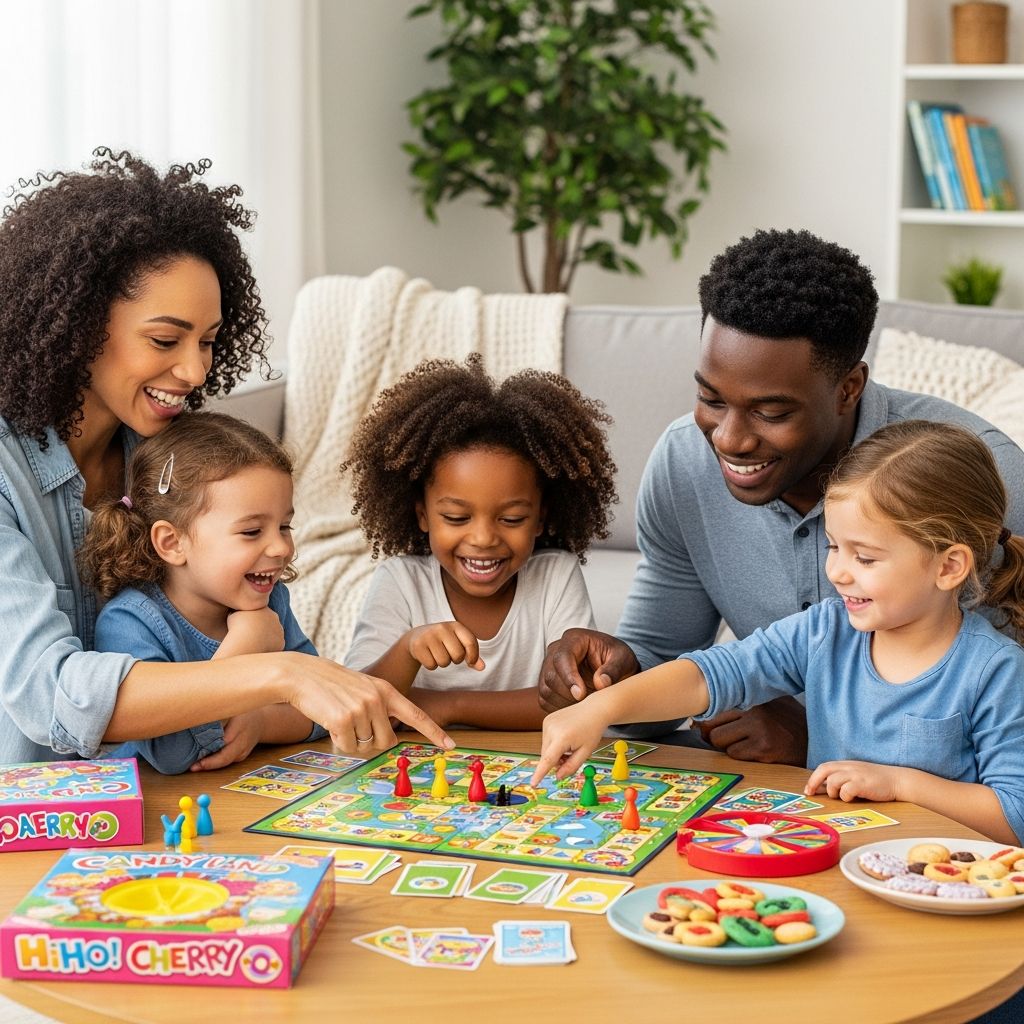
Inviting young children into the world of board games can turn ordinary evenings into memorable family rituals. The right beginner games help kids learn how to follow rules, wait their turn, cope with winning and losing, and think ahead—all while having fun together.
This guide is inspired by a curated list of starter games for children, but everything here is newly written and reorganized to help you choose games that fit your family’s ages, attention spans, and play style.
Why Board Games Are So Powerful for Young Children
Board games do more than fill time. Research shows that structured play can support social, emotional, and cognitive development in early childhood.
- Social skills: Turn-taking and following shared rules help kids practice cooperation and perspective-taking, important foundations of social competence.
- Self-regulation: Waiting patiently, coping with frustration, and staying engaged through a full round are all aspects of self-regulation that games naturally exercise.
- Numeracy and literacy: Many games involve counting spaces, recognizing numbers, or reading simple words, providing informal practice that research links to later academic outcomes.
- Executive function: Planning ahead, remembering rules, and adjusting strategy use working memory and cognitive flexibility, which are core executive function skills.
Well-chosen beginner games make these challenges feel like play, not homework.
How to Choose a Child’s First Board Games
Before you pick a specific title, think about what kind of experience you want the game to provide. Use the checklist below as a quick filter when browsing options.
Key Criteria for Beginner-Friendly Games
- Short play time: Aim for 10–20 minutes so games end before kids lose focus.
- Simple rules: Kids should understand the core idea after one demonstration.
- Low reading requirement: Pictures, icons, and color cues are ideal for pre-readers.
- Clear visual design: Bright, uncluttered artwork and sturdy components help small hands and eyes.
- Room to grow: Look for games that stay interesting as kids get older, perhaps via optional rule variants.
- Emotionally gentle: Avoid needlessly punishing or harshly competitive mechanics at the very start.
Matching Games to Age and Stage
| Age Range | What to Prioritize | Typical Features |
|---|---|---|
| 3–4 years | Taking turns, color/shape matching, very short games | Cooperative games, simple spinners, no reading |
| 5–6 years | Light strategy, counting, basic choices | Dice, set collection, simple movement on boards |
| 7–8 years | Planning ahead, risk/reward, team play | More complex boards, role powers, secret goals |
Cooperative Games: Learning to Win and Lose Together
Cooperative games, where all players work toward the same goal, can be especially helpful for families starting out. Studies on cooperative learning suggest these formats increase prosocial behavior and reduce aggressive responses compared with purely competitive setups.
Benefits of Cooperative Play
- Shared success: Either everyone wins or everyone loses, reducing sibling conflict around outcomes.
- Natural coaching: Adults can talk through choices openly without “spoiling” competition.
- Team language: Phrases like “What should we try?” and “We did it!” reinforce togetherness.
- Practice with disappointment: When the group loses, kids feel supported in handling frustration.
When browsing cooperative games for young kids, look for:
- Visible progress tracks: A shared board or track helps everyone see how close they are to winning or losing.
- Simple turns: One or two actions per turn keeps downtime short.
- Adjustable difficulty: Optional “easy” and “hard” modes let the game grow with your children’s skills.
Competitive Games That Still Feel Friendly
Not all competitive games have to feel cutthroat. Many beginner titles allow players to try to outscore each other without direct attacks or elimination. These “gentle competitive” games are a good bridge once your children are comfortable with basic rules and turns.
What Makes Competition Kid-Friendly?
- No player elimination: Everyone stays involved until the end of the game.
- Hidden scoring: Points aren’t obvious until the final tally, keeping kids engaged even if they’re behind.
- Light interaction: You may block a space or grab a card first, but no one loses everything from a single move.
- Quick rematches: Short play times make it easier to say, “Let’s play again, you might win this time!”
Categories of Great Beginner Board Games
Instead of focusing on specific brand-name games, this section highlights types of games that work especially well as first experiences. Once you know which styles your kids enjoy, you can seek out titles that fit each niche.
1. Matching and Memory Games
Matching and memory games are often the earliest “board game-like” experiences children have. They are ideal for preschoolers because they rely heavily on visual cues rather than reading.
- What they build: Visual discrimination, working memory, and attention.
- Typical structure: Face-down tiles or cards, simple choices like flipping two or finding a picture that matches a card.
- Why they work: Turns are very short, and the rules can be explained in seconds.
To keep these games interesting for adults, look for versions that add a tiny twist—for example, objects that move around the board, or cooperative matching where the group is racing a timer instead of each other.
2. Simple Race and Path Games
Race games, where players move along a track from start to finish, are familiar and intuitive. For beginners, the key is to avoid endless slogging from bad luck.
- What they build: Counting, number recognition, and turn-taking.
- Typical structure: Roll a die or spin, move that many spaces, resolve the space’s effect.
- What to avoid: Very long tracks with constant setbacks, or spaces that send a child “back to start” repeatedly.
Look for path games with multiple routes or small choices each turn, so that kids feel some control even though chance still plays a big role.
3. Set Collection and Card Drafting Games
Set collection games reward players for gathering groups of related items, such as colors, shapes, or icons. These can be surprisingly accessible for early elementary-age children.
- What they build: Planning, basic probability, and flexible thinking.
- Typical structure: On your turn, you take a card or tile that helps complete a pattern or collection.
- Kid-friendly twists: Open display of available choices, very simple scoring (like “three of a kind is good”).
These games often appeal to adults too, making them great “bridge” games families can enjoy for many years.
4. Storytelling and Imagination Games
Some beginner games emphasize creativity instead of winning and losing. Players might roll images, play illustrated cards, or move characters through a lightly structured story.
- What they build: Expressive language, narrative skills, and confidence in sharing ideas.
- Typical structure: Players take turns adding to a shared story or interpreting pictures.
- Why families love them: There is no “wrong” answer, reducing anxiety for shy or perfectionist children.
Studies of narrative-based play indicate it can support vocabulary growth and story comprehension, particularly when adults scaffold gently with questions and prompts.
5. Light Strategy and Puzzle Games
For older beginners (around six and up), light strategy games introduce planning and trade-offs without overwhelming rules. These can be as simple as placing tiles to complete shapes or choosing where to put a token for the best reward.
- What they build: Spatial reasoning, foresight, and problem-solving.
- Typical structure: Two or three possible moves each turn, with obvious short-term benefits but not always obvious long-term results.
- Good starting point: Look for games where a child’s “mistake” doesn’t ruin their chances or take them out of the game.
Making Game Night Work with Real Children
Even the best-designed game can fall flat if expectations are unrealistic. A little planning makes it far more likely that your kids will ask to play again.
Practical Tips for Stress-Free Play
- Start when everyone has energy: Right before bedtime or during a meltdown is a tough moment for learning rules.
- Teach by doing: Instead of a long explanation, walk through one practice round and reset once everyone understands.
- Be flexible with rules: For the first few plays, it is perfectly fine to skip small rules or shorten the game.
- Emphasize effort over outcome: Say things like “You made a clever choice” or “You took turns so patiently,” not only “You won!”
- Use “open hands” for learning: Let everyone see each other’s cards at first so you can coach and discuss decisions.
Handling Big Feelings Around Winning and Losing
It is completely normal for young children to struggle when they lose a game. Emotional self-control grows gradually through experience and adult support.
- Normalize disappointment (e.g., “It’s okay to feel frustrated when you really wanted to win.”).
- Model gracious losing yourself by narrating your feelings calmly.
- Offer concrete next steps: “Do you want a hug, or should we take a break and play again later?”
- Start with cooperative games if competitive losses consistently lead to meltdowns.
Sample Beginner Game Path for Growing Families
Every child is different, but the progression below shows one way families might move from “first games ever” toward more strategic play across a few years.
| Stage | Focus of Games | Example Game Categories |
|---|---|---|
| New to games (approx. 3–4) | Learning turns and rules | Cooperative matching, very short races |
| Early player (approx. 4–5) | Counting and simple choices | Path games with forks, simple set collection |
| Emerging strategist (approx. 5–7) | Planning and light tactics | Gentle competitive games, tile placement |
| Confident gamer (approx. 7+) | Team roles and longer sessions | Family-weight cooperative adventures, basic resource management |
Frequently Asked Questions (FAQs)
What is a good age to start playing board games with kids?
Many families can start simple cooperative or matching games around age three, as long as expectations stay flexible. Younger toddlers can still enjoy “helping” move pieces or roll dice, even if they are not following all the rules yet.
How long should a beginner board game last?
For children under six, aim for 10–15 minutes per game. Older kids can usually handle 20–30 minutes, especially if turns are quick and the game state changes often enough to hold interest.
Are cooperative games better than competitive ones?
Neither is inherently better; both teach useful skills. Cooperative games shine for teaching teamwork and easing kids into structured play, while competitive games can gradually build resilience and strategic thinking. Many families use a mix, starting with cooperation and adding gentle competition over time.
What if my child hates losing and refuses to play again?
Try shorter games, cooperative formats, or variants where the focus is on achieving a shared goal rather than an individual winner. Praise participation and effort, and consider ending on a round where the group succeeds together, so the final memory of game night is positive.
How can I keep adults from getting bored with simple kids’ games?
Look for beginner games that offer optional advanced rules or slight strategic depth. Puzzle-like tile placement, set collection with meaningful choices, or cooperative games that allow for tactical discussion can be fun for both children and adults, even when the rules remain accessible.
References
- The Power of Play: A Research Summary on Play and Learning — The American Academy of Pediatrics. 2018-08-20. https://publications.aap.org/pediatrics/article/142/3/e20182058/38652/The-Power-of-Play-A-Pediatric-Role-in-Enhancing
- Early Mathematics and Later Achievement — Society for Research in Child Development / National Institutes of Health. 2007-01-01. https://www.ncbi.nlm.nih.gov/pmc/articles/PMC2366021/
- The Development of Executive Function in Early Childhood — Center on the Developing Child at Harvard University. 2011-01-01. https://developingchild.harvard.edu/resources/building-the-brains-air-traffic-control-system-how-early-experiences-shape-the-development-of-executive-function/
- Cooperative Learning, Prosocial Behavior, and Social Preference in Children — Child Development (Wiley). 1998-09-01. https://doi.org/10.1111/j.1467-8624.1998.tb06162.x
- The Contribution of Storytelling to Literacy Development — National Council of Teachers of English. 2007-01-01. https://library.ncte.org/journals/lr/issues/v36-2/3215