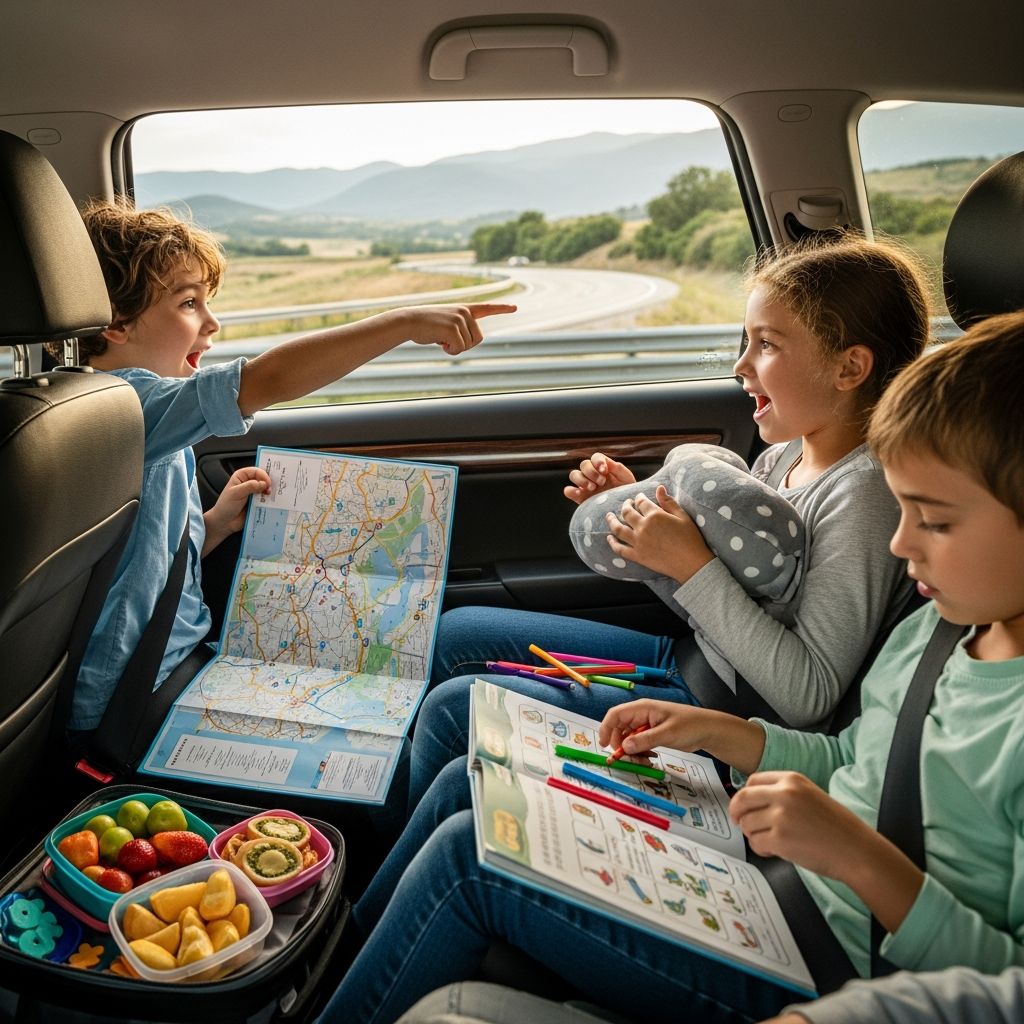
Long drives with children do not have to be a battle over screens or a chorus of “Are we there yet?”. With a bit of planning and a toolkit of simple activities, you can turn car time into relaxing, connected family time that supports language development, imagination, and emotional regulation.
This guide offers practical, low-mess ideas inspired by classic travel games, early childhood best practices, and what we know from child development research about play and boredom.
Why Screen-Free Travel Matters
Short bursts of screen time are not inherently harmful, but relying on devices for every car ride can crowd out other kinds of play that build core skills.
- Language and communication: Talking, telling stories, and playing word games in the car support vocabulary growth and narrative skills, which are tied to later reading abilities.
- Self-regulation: Managing boredom and waiting helps children practice patience and emotional control, part of the “executive functions” linked to school success.
- Family connection: Shared games and conversations in the car create memories and inside jokes that strengthen relationships.
- Reduced motion sickness: Looking out the window and engaging with the environment can be more comfortable for kids prone to carsickness than staring at a small screen.
You do not need to ban screens forever; instead, think of this as building a flexible toolkit so screens are just one of many options.
Planning Your Road Trip Activity Kit
Before you leave, assemble a small, grab-and-go kit that lives in the car. Choose items that are:
- Low mess (no tiny glitter, confetti, or open paint)
- Easy to pass between seats
- Usable without adult help most of the time
- Quiet enough not to distract the driver
| Age Group | Great Travel Materials | Why They Work |
|---|---|---|
| Toddlers (1–3) | Board books, soft toys, chunky crayons, simple lacing cards | Safe to handle, easy to grip, encourage quiet focus and hand skills |
| Preschoolers (3–5) | Stickers, reusable drawing boards, simple puzzles, picture-based games | Support creativity and early problem-solving without needing text |
| School-age (6+) | Word games, travel notebooks, simple strategy games, journals | Tap into reading, writing, and more complex rules and stories |
Classic Car Games That Never Need Batteries
These verbal, no-prop games work whether you are driving across town or across the country and can be adapted for mixed ages.
1. Roadside Detective
One person secretly chooses something they can see outside the car (a bridge, a color, an animal). Everyone else asks yes-or-no questions to figure out what it is.
- For younger kids, limit the choices to colors or big objects like “blue car” or “tree”.
- For older kids, allow abstract clues like “something that helps people get somewhere”.
- Rotate the “mystery chooser” to keep everyone engaged.
2. Silly Categories
Pick a category and take turns naming things that fit until someone gets stuck.
- Simple categories: animals, foods, things that are red.
- Challenging categories: words that rhyme, items you’d pack for camping, book characters.
- Speed round: set an informal time limit to add excitement.
3. Chain Stories
Storytelling in the car boosts imagination and narrative skills.
- One person starts a story with a single sentence, such as “Once there was a family whose car could talk…”
- The next person adds the next sentence, and so on around the car.
- Make “plot twist” cards on sticky notes before you leave (for example: “a dragon appears”, “it starts snowing spaghetti”) and let kids randomly draw and incorporate them.
4. Soundtrack Switch
Use music you already have (radio, downloaded playlists, or CDs) as the basis for games.
- Guess that tune: hum or tap the rhythm of a familiar song; others try to name it.
- New lyrics: pick a song and rewrite the words to fit your trip (“The Wheels on This Van”).
- Freeze sing: everyone sings along; when the driver says “freeze”, everyone has to stop mid-word.
Low-Tech Toys That Travel Well
The best travel toys are reusable, compact, and do not have multiple loose pieces rolling under seats.
Reusable Drawing Surfaces
Drawing and doodling give kids a way to process what they see and feel, and fine-motor practice supports early writing.
- Magnetic or dry-erase boards: Kids can draw, erase, and repeat without stacks of paper.
- Prompt ideas: “Draw the silliest car you can imagine” or “Design a new road sign we don’t have yet.”
- Mini games: Play tic-tac-toe, simple mazes, or “guess what I’m drawing” on the same board.
Simple Craft Activities
Choose crafts that stay contained and do not require cutting or glue while moving.
- Lacing cards or threading shapes: Great for preschoolers to practice hand-eye coordination.
- Sticker scenes: Give kids a small notebook and a sheet of themed stickers to create their own scenes.
- Paper folding: Older kids can fold paper airplanes or simple origami animals during rest stops.
Travel-Friendly Games and Puzzles
Compact, magnetic, or single-board games are easier to manage than full-sized sets.
- Magnetic checkers or simple strategy games designed for travel.
- Compact logic puzzles or brainteaser cards.
- Word puzzle pads for children comfortable with reading.
Activities by Age: Matching Ideas to Development
Children of different ages need different levels of structure and support. Tailor activities so each child can succeed without constant adult intervention.
Ideas for Toddlers
- Object bags: Fill a small fabric bag with a few soft, interesting objects (a small spoon, a fabric square, a soft car). Let your toddler pull them out and name them.
- Point-and-talk: Describe what you see out the window in simple language: “Big truck”, “Yellow house”, “Blue sky”. This kind of responsive conversation supports early language.
- Action songs: Quiet hand rhymes such as pat-a-cake or finger plays that can be done while buckled.
Ideas for Preschoolers
- Color hunts: Choose a color and ask your child to spot as many objects of that color as possible.
- Simple bingo cards: Before the trip, draw or print a few pictures (car, tree, stop sign, dog). Kids mark when they see them.
- Imagination prompts: Ask questions such as “If our car could turn into an animal, what would it be?”
Ideas for School-Age Kids
- Trip journal: Provide a small notebook for drawing, map sketches, or writing about stops along the way.
- License plate challenges: Keep a list of different states or regions you spot; older kids can map them when you arrive.
- Travel research: Give kids a printed map or short brochure about your destination. Ask them to choose one thing they are excited to see and share a “mini report” later.
Calming Ideas for Tense Moments
Even with wonderful activities, kids will get tired, restless, or overwhelmed. Having a few calm-down strategies ready can help everyone reset.
- Breathing games: Ask kids to inhale slowly while you count to three and exhale while you count to three. Turn it into “smell the flower, blow out the candle.”
- Quiet observation: Play the “listening game” by asking “What’s the quietest sound you can hear right now?”
- Comfort objects: A familiar small blanket or stuffed animal can help younger children self-soothe.
- Planned breaks: Stop regularly so kids can move their bodies. Short outdoor play breaks improve mood and attention.
Safety and Practical Tips
Not every activity is safe or practical in a moving vehicle. Keep these guidelines in mind:
- Avoid choking hazards: Skip very small, loose pieces for children under three or any child who still mouths objects.
- Secure heavy items: Anything hard or heavy can become a projectile during sudden stops; pack them low and secure.
- Respect car seat fit: Do not add bulky trays or cushions that interfere with correct harness positioning or safety standards.
- Consider motion sickness: Activities that encourage kids to look out the window (I-spy, counting games) are often better tolerated than close-up reading for those prone to carsickness.
Sample Screen-Free Travel Plan
Here is a simple sample plan for a four-hour drive with two short stops:
- First hour: Warm-up games (I-spy, Silly Categories), casual conversation about the destination.
- Break 1: Bathroom, quick snack, 5–10 minutes of running or stretching.
- Second hour: Individual play with drawing boards and sticker books, optional music sing-along.
- Third hour: Chain stories, Roadside Detective, or bingo cards.
- Break 2: Picnic or walking break, let kids pick one game for the final stretch.
- Final hour: Calmer activities—reading aloud, quiet drawing, or listening to soft music.
You do not need to follow a strict schedule, but thinking in “blocks” can help you rotate activities before kids become frustrated.
Frequently Asked Questions (FAQs)
Q: How much screen time is okay on a long car trip?
There is no single rule that fits every family. Pediatric guidance encourages consistent limits and ensuring screens do not replace sleep, physical activity, or face-to-face interaction. Many families find that planning a few short, scheduled screen blocks (for example, one show between breaks) works better than offering constant access.
Q: What if my child gets carsick when reading or drawing?
Kids prone to motion sickness often feel better when they look out the window instead of focusing on close-up tasks. Prioritize games that involve the outside scenery (I-spy, counting trucks, spotting landmarks) and save reading or detailed drawing for rest stops.
Q: How many activities do I really need to pack?
A small selection used in rotation is more effective than a stuffed bag. Aim for 4–6 versatile items (for example, a drawing board, sticker book, travel game, a small toy, and one surprise activity) and mix in verbal games that require no materials.
Q: How can I involve older siblings without making them feel like babysitters?
Invite older kids to help choose music, suggest games, or design simple bingo cards, but be clear that adults remain responsible for younger children. Offer older children their own age-appropriate activities—like journals or puzzle books—so they also have independent downtime.
Q: Are snacks a good distraction, or will they just make a mess?
Simple, easy-to-grab snacks can help keep energy and mood stable during long rides, but they should not be the only strategy for managing boredom. Choose options that are not sticky or crumbly, offer water regularly, and schedule snack times rather than continuous grazing to limit both mess and tummy aches.
References
- Reading Rockets: Activities for Reading and Writing Fun — WETA Public Broadcasting. 2018-06-01. https://www.readingrockets.org/article/activities-reading-and-writing-fun
- Storytelling, Narrative and the Development of Children’s Literacy — Isbell et al., Early Childhood Education Journal (Springer). 2004-04-01. https://doi.org/10.1023/B:ECEJ.0000030414.40999.a3
- Media and Young Minds — Council on Communications and Media, American Academy of Pediatrics. Pediatrics. 2016-11-01. https://doi.org/10.1542/peds.2016-2591
- Motion Sickness — Centers for Disease Control and Prevention (CDC). 2023-01-10. https://www.cdc.gov/motion-sickness/index.html
- Choking Prevention and First Aid for Infants and Children — HealthyChildren.org, American Academy of Pediatrics. 2021-02-01. https://www.healthychildren.org/English/health-issues/injuries-emergencies/Pages/Choking-Prevention-and-First-Aid.aspx
- Car Seats: Information for Families — HealthyChildren.org, American Academy of Pediatrics. 2022-04-01. https://www.healthychildren.org/English/safety-prevention/on-the-go/Pages/Car-Safety-Seats-Information-for-Families.aspx