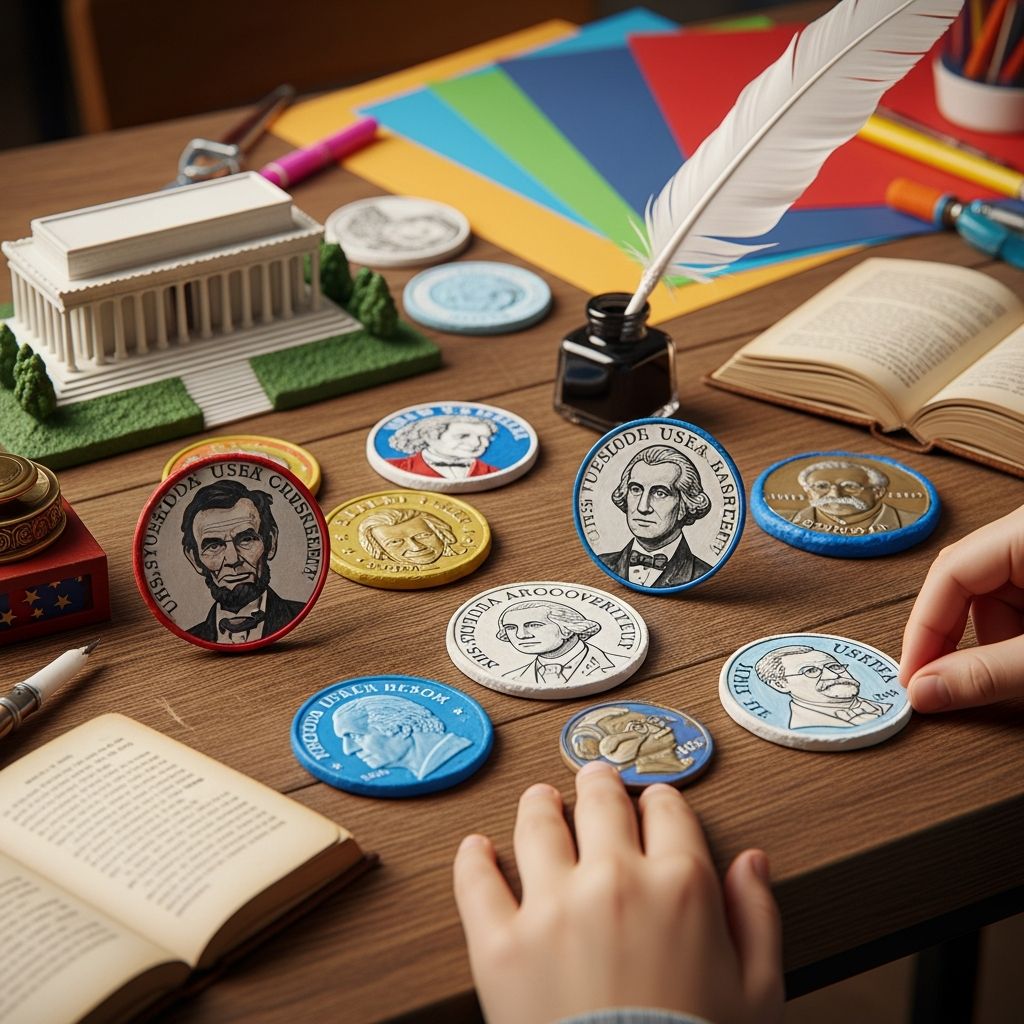
Presidents’ Day is more than a long weekend; it is a chance to help kids connect with the people and stories behind the nation’s highest office in a way that feels playful and accessible. One of the most kid-friendly entry points is the change that rattles around in pockets and piggy banks: coins. By turning ordinary money into imaginative “kid coins,” families and teachers can blend art, math, and history into one engaging activity.
Why Coins Make Presidents’ Day Fun For Kids
Coins are small, familiar, and full of hidden lessons. Children see them almost every day but may not notice the faces, symbols, and dates printed on them. When you slow down and invite kids to look closely, those tiny circles of metal become miniature storytelling tools.
- Coins show portraits of presidents and national symbols that spark questions and curiosity.
- They provide natural opportunities to practice counting, sorting, and simple money math.
- Designing pretend “kid coins” lets children imagine themselves as leaders and artists.
Using coins as a starting point also keeps supply lists simple: paper, crayons, scissors, glue, and a handful of change are enough to create a full afternoon of learning.
Setting The Stage: Talking About Money And Leadership
Before the crafting begins, it helps to frame what kids are about to do. A short, simple conversation makes the activity feel purposeful instead of random.
- Ask kids what they notice on a coin: a face, a word, a number, an image.
- Explain that leaders are sometimes honored by being placed on money because they helped shape the country.
- Invite kids to think about what qualities a person should have to be remembered in that way, such as honesty, kindness, or courage.
This quick discussion sets up the idea that kids will not just copy real coins; they will design their own symbols and values for their pretend currency.
Basic Kid Coin Craft: Paper Portraits
The simplest kid coin project uses paper circles as canvases for original portraits. This is ideal for younger children and busy classrooms because it requires minimal cutting and no special tools.
Materials
- Light-colored cardstock or construction paper
- Small bowls or lids to trace circles
- Pencils, crayons, or markers
- Child-safe scissors
- Glue sticks (optional, if coins will be mounted)
Steps
- Trace several circles on the paper using a bowl or lid.
- Cut out the circles to form blank coins.
- On one side, have kids draw a president they know, such as George Washington or Abraham Lincoln, or a generic leader if they prefer.
- On the other side, ask them to add a symbol that represents something important about that leader—perhaps a book for wisdom, a heart for kindness, or a scale for fairness.
- Label the coin with a pretend value, like 5, 10, or 25, and a made-up year.
For very young children, grown-ups can lightly sketch the head shape, leaving space for eyes, nose, mouth, and hair, and let the kids fill in the details.
Designing Your Own Presidential Seal
Once kids are comfortable drawing portraits, encourage them to create an entirely new coin based on themselves. Instead of copying existing presidents, they imagine what their own leadership might look like.
- Ask, “If you were president, what would be important to you?”
- Help them select up to three symbols for the back of the coin to represent their ideas, such as a tree for nature, a book for learning, or a handshake for friendship.
Have kids write a short phrase around the edge of the coin, like a personal motto or positive message. This turns the project into an exercise in values as well as art.
Classroom Coin Wall: Turning Crafts Into A Gallery
Displaying kid coins together highlights how many different ways there are to think about leadership. A wall full of paper coins becomes an instant Presidents’ Day exhibit.
- Mount each coin on a contrasting background color so it stands out.
- Write the creator’s first name and “Year of Presidency” underneath as a playful label.
- Invite students to present their coins to the class, explaining one symbol and why they chose it.
This presentation component builds confidence and helps children practice speaking clearly about their ideas, just like real leaders do.
Coin Math Corner: Learning With Play Money
After crafting, kid coins can become tools for simple math practice. Instead of being thrown away, they move into the “learning center” of the room or home.
| Age Group | Game Idea | Skills Practiced |
|---|---|---|
| Preschool | Sort coins by color, size, or portrait. | Sorting, matching, noticing details. |
| Early elementary | Play a store game using kid coins as payment. | Counting, simple addition, taking turns. |
| Upper elementary | Assign each coin a value and practice making exact totals. | Addition, subtraction, mental math. |
For older children, you can also introduce basic budgeting challenges, like “Plan a class party using only 100 kid coins,” which prompts them to think about choices and priorities.
Storytelling With Coins: History In Miniature
Coins can inspire creative writing and storytelling. Instead of treating them only as art objects, treat each coin as a character or setting in a story.
- Ask kids to write a short story about the person on their coin facing an important decision.
- Encourage them to include at least one symbol from the back of the coin and explain its meaning within the story.
This fusion of visual art and writing deepens the connection between images and ideas. It also gives quieter students another way to express what they learned about leadership.
Hands-On Coin Rubbings: Observing Real Money Safely
Real coins can be integrated without turning the activity into a long lecture. Coin rubbings focus kids’ attention on details they might miss when simply spending or saving money.
Quick Rubbing Activity
- Place a real coin under a thin sheet of paper.
- Use the side of a crayon or colored pencil to rub gently over the surface.
- Watch as the portrait and lettering appear on the paper.
- Compare the rubbing to the child’s hand-drawn kid coin and ask what is similar or different.
This comparison helps kids notice the way artists use lines, textures, and symbols, and may inspire them to refine their own designs.
Connecting Coins To Real Presidents
To anchor the crafts in real history, briefly introduce a few presidents whose faces appear on common coins. The goal is to highlight simple, age-appropriate facts rather than exhaustively cover their biographies.
- Share one memorable accomplishment or challenge for each featured president.
- Invite kids to guess why that person might have been chosen to appear on money.
For example, you might note that some presidents helped keep the country united during difficult times, while others were key in writing important laws or protecting people’s rights. Kids can then compare those ideas to the values on their own kid coins.
Extending The Project: Coin Collections And Class Currency
Once children are invested in the concept of coins, you can turn the class or household into a small, playful economy that reinforces good habits and behavior.
Ideas For Class Currency
- Create a shared jar where kids earn kid coins for helpful actions, such as kindness or teamwork.
- Allow them to trade coins for simple privileges, like choosing a read-aloud book or leading a game.
- Rotate which child’s portrait appears on the “class coin” each week to celebrate everyone.
This approach transforms Presidents’ Day into an ongoing exploration of responsibility, fairness, and community rather than a single isolated craft session.
Adapting For Different Ages And Abilities
The same basic kid coin idea can be scaled up or down depending on children’s ages and comfort levels with drawing and writing. A few modifications ensure that every child can participate meaningfully.
- For toddlers, focus on coloring pre-cut circles and sticking on simple shapes.
- For elementary students, encourage more detailed portraits and written mottos.
- For older kids, add research tasks, such as reading about a lesser-known president and designing a coin in that person’s honor.
Children who struggle with fine motor skills may benefit from larger circles, thicker crayons, or stencils to guide their drawings.
Safety And Practical Tips For Coin Crafts
Although these projects are straightforward, a few small precautions make the experience smoother and safer for everyone involved.
- Supervise the use of small coins around very young children who might put objects in their mouths.
- Use blunt scissors and remind kids about safe cutting techniques.
- Collect and reuse scrap paper for future crafts to minimize waste.
Labeling each child’s work as soon as it is complete prevents mix-ups later, especially if you are mounting coins for a display or saving them for future math games.
Frequently Asked Questions About Presidents’ Day Kid Coins
Do we need real coins to do these activities?
No. Real coins can be helpful for observation and rubbings, but all of the core projects can be done with paper circles and drawing supplies. This makes the activities flexible for classrooms, virtual learning, and large groups.
How much time should we plan for a kid coin session?
Most families and classes can complete basic kid coin crafts in 30–45 minutes. If you add presentations, math games, or storytelling, it can easily expand into a full lesson or a themed afternoon.
Can these activities be used outside of Presidents’ Day?
Yes. Kid coins work well whenever you are teaching about money, leadership, government, or even personal values. The Presidents’ Day connection simply offers a timely hook, but the underlying lessons remain useful all year.
What if some children do not like drawing faces?
Not every child enjoys portraits, and that is okay. Provide alternate options, such as using simple silhouettes, drawing symbols only, or creating abstract patterns that represent ideas like bravery or honesty.
How can we tie these crafts to reading and writing standards?
Link each coin project to a short writing task, such as describing the meaning of one symbol or explaining what makes a good leader. For younger students, this might mean dictating sentences to an adult; for older students, it can involve full paragraphs or short essays.
Bringing It All Together
Kid coin crafts turn a familiar object into a springboard for creativity, conversation, and learning. By inviting children to design their own currency, explore simple history, and practice math and writing skills, families and teachers can make Presidents’ Day both memorable and meaningful.