Teaching infants sign language opens a bridge to their world long before spoken words emerge, transforming everyday interactions into meaningful exchanges. This approach not only minimizes misunderstandings but also lays a foundation for cognitive and emotional growth, supported by research from pediatric experts and developmental studies.
Why Sign Language Matters for Infants
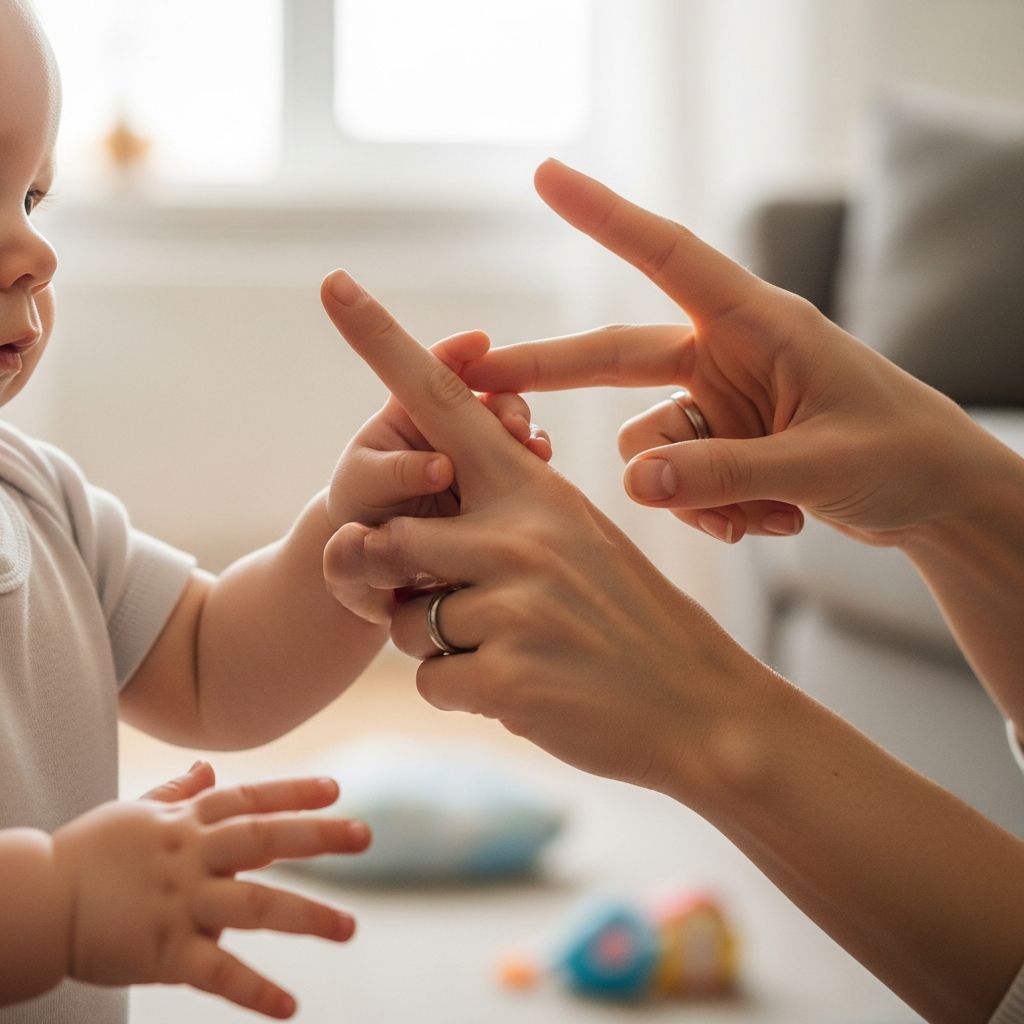
Infants enter the world equipped with an innate desire to connect, yet their vocal abilities lag behind their needs. Sign language for babies—simplified gestures adapted from American Sign Language (ASL)—empowers them to express hunger, tiredness, or joy as early as 6-8 months. According to developmental pediatricians, this early tool decreases frustration by allowing clear expression of requests, fostering smoother parent-child dynamics.
Research highlights multiple layers of advantage. Babies using signs often exhibit fewer tantrums, as they can signal discomfort without crying. A study from the National Institutes of Health noted reduced crying episodes in signed infants, attributing this to heightened parental responsiveness. Beyond behavior, signing engages multisensory learning, combining visual, auditory, and kinesthetic elements to strengthen neural pathways for language acquisition.
Core Benefits Backed by Science
The advantages extend far beyond immediate relief. Here’s a breakdown of key gains:
- Emotional Regulation: Signing reduces distress by bridging the gap between thought and speech, promoting confidence and self-esteem as babies feel understood.
- Cognitive Boost: Gestures accelerate mental processing, creativity, and problem-solving, with signing babies showing advanced vocabulary and sentence complexity earlier.
- Memory Enhancement: Multi-sensory input from signing reinforces recall, aiding retention of concepts like colors or animals through muscle memory.
- Stronger Bonds: Parents attuned to nonverbal cues report deeper connections, enhancing overall family well-being.
Studies on typically developing children indicate an early edge in expressive language, though long-term oral speech parity evens out. For hearing-impaired or developmentally delayed infants, such as those with Down syndrome, benefits are even more pronounced, accelerating overall progress. A PMC-published experiment demonstrated that 6-10-month-olds quickly learned and generalized signs across settings, replacing fussing with purposeful gestures.
Developmental Milestones with Signing
Timing is crucial for optimal results. Parents can introduce signs around 5-6 months, when babies grasp object permanence and imitate movements. By 6-7 months, memory solidifies signs; 8 months brings first independent uses; and by age 2, children combine signs into sentences.
| Age Range | Typical Milestone | Parent Tips |
|---|---|---|
| 5-6 Months | Recognizes and mimics simple gestures | Model 1-3 signs daily during routines like feeding |
| 7-8 Months | Uses single signs reliably (e.g., ‘milk’) | Respond enthusiastically to approximations |
| 9-12 Months | Combines signs with sounds | Expand to 5-10 signs, narrate actions |
| 12-24 Months | Forms sign phrases or sentences | Incorporate into play and reading for fluency |
These milestones align with natural brain development, where signing scaffolds vocal language rather than delaying it. Contrary to early concerns, research like Goodwyn et al. (2000) shows signed infants outperform peers in receptive and expressive speech tests.
Practical Guide: Essential Signs to Teach First
Start small to avoid overwhelm. Focus on high-need concepts tied to daily routines. Below are 10 foundational signs, described for easy adoption:
- Milk: Close fist and squeeze rhythmically near mouth.
- More: Tap fingertips together twice.
- All Done: Wave hands side-to-side palms out.
- Eat: Bring pinched fingers to mouth repeatedly.
- Help: Palm up, raise hand toward opposite shoulder.
- Sleep: Rock head side-to-side with tilted palm.
- Play: Rock hands back-and-forth alternately.
- Water: Tap ‘W’ finger on chin.
- Book: Hold palms together and open like pages.
- Love: Cross arms over chest.
Consistency is key: Sign every time you say the word, exaggerating motions and facial expressions. Praise any attempt, even partial, to build momentum. Michigan State University Extension emphasizes pairing signs with speech to reinforce verbal skills.
Integrating Signs into Daily Life
Weave signing seamlessly into routines for natural learning. During meals, sign ‘more’ or ‘eat’ to anticipate needs. Bath time offers ‘water’ and ‘play’; bedtime routines suit ‘sleep’ and ‘book.’ Reading aloud with signs amplifies literacy: Point to pictures while signing nouns, boosting vocabulary and phonemic awareness.
Group settings like daycare amplify benefits, as peers model gestures. Caregivers report easier transitions and fewer conflicts when all use consistent signs. Track progress in a journal to celebrate firsts, adjusting based on your baby’s cues.
Myths and Realities of Baby Signing
Skepticism persists, but evidence debunks common myths:
- Myth: Signing delays speech. Reality: It accelerates early communication and supports vocal milestones.
- Myth: Only for hearing-impaired kids. Reality: Hearing babies gain equivalent or greater relational benefits.
- Myth: Too complex to learn. Reality: Parents master basics in weeks with repetition.
Debate lingers on persistent IQ or speech gains, but consensus affirms frustration reduction and bonding.
Long-Term Impacts on Learning and Literacy
Baby signing primes literacy foundations. Larger early vocabularies predict reading success, and signs teach grammar intuitively. When paired with books, it heightens engagement, linking gestures to print. IU research links signing to advanced syntax, letter recognition, and comprehension, setting kids up for academic excellence.
Psychologically, empowered communicators develop resilience. ASHA notes gains in temperament and even potty training via clear need-signaling.
Frequently Asked Questions (FAQs)
What age should I start teaching baby sign language?
Begin modeling at 5-6 months, expecting first signs around 8 months. Patience yields results.
Will signing confuse my baby or slow talking?
No—studies show it enhances, not hinders, speech development by providing a communication scaffold.
How many signs should we learn initially?
3-5 high-frequency ones suffice; expand gradually as baby responds.
Can dads or grandparents participate?
Absolutely—consistency across caregivers strengthens learning and bonds.
Is baby sign language the same as ASL?
It’s simplified ASL gestures, preserving core elements for authenticity.
Getting Started: Your Action Plan
Commit to 10 minutes daily practice. Resources like flashcards or apps reinforce without pressure. Observe your baby’s personality—some sign prodigiously, others gradually. The reward? A chattier, calmer home where every gesture speaks volumes.
(Word count: 1678)
References
- Teaching babies sign language — Baylor College of Medicine Blogs. 2022-07-19. https://blogs.bcm.edu/2022/07/19/teaching-babies-sign-language/
- Importance of Teaching Sign Language to Infants — Coastal Kids Pediatrics. N/A. https://coastalkids.com/importance-of-teaching-sign-language-to-infants/
- Baby Sign Language: Benefits & Tips — Bright Horizons. N/A. https://www.brighthorizons.com/article/toddler/baby-sign-language-benefits-and-tips
- Signs of Success: How Baby Sign Language Boosts Early Literacy Skills — Indiana University Blogs. 2025-02-21. https://blogs.iu.edu/earlyliteracy/2025/02/21/signs-of-success-how-baby-sign-language-boosts-early-literacy-skills/
- Enhancing Early Communication through Infant Sign Training — PMC (National Library of Medicine). 2007-06-01. https://pmc.ncbi.nlm.nih.gov/articles/PMC1868823/
- Baby sign language: A helpful communication tool — Michigan State University Extension. N/A. https://www.canr.msu.edu/news/baby_sign_language_a_helpful_communication_tool
- About Baby Signing — ASHA Leader. 2010-11-23. https://leader.pubs.asha.org/doi/10.1044/leader.FTR5.15132010.np