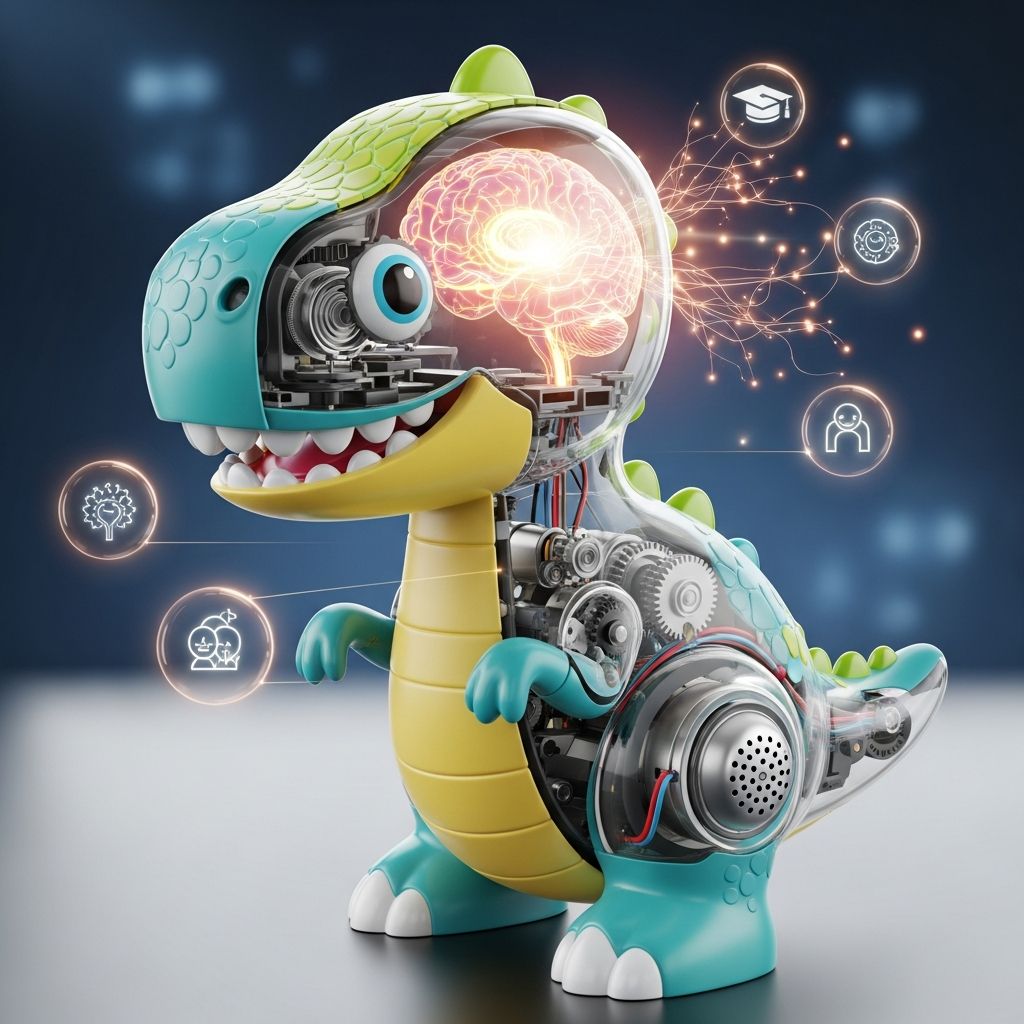
Interactive, internet-connected dinosaur toys promise to be a child’s new best friend, tutor, and playmate all in one bright-green package. These smart companions can answer questions, tell stories, and adapt to a child’s age and interests. But how much of the hype is real, and what do parents need to understand before inviting a talking dino into their home?
From Stuffed Animals to Smart Dinosaurs
Toys have always reflected the technology of their time. Wind-up tin robots gave way to electronic pets, and now AI-powered talking dinosaurs represent the next leap in children’s play. Unlike traditional plush toys, these devices often combine:
- Microphones for voice input
- Speakers for natural-sounding replies
- Wireless connectivity for updates and new content
- On-device software that “learns” from repeated play
At their best, these features aim to turn a toy dinosaur into a responsive partner in conversation, curiosity, and imagination.
How Smart Dino Toys Typically Work
While designs differ across brands, most talking dinosaur toys follow a similar pattern:
- Wake word or button press starts a listening session.
- The child asks a question or gives a command.
- The toy records the audio and either:
- Processes speech on the device, or
- Sends it to a cloud server to interpret and generate a reply.
- The toy responds with voice, sound effects, or lights.
- Some models store basic preferences (name, age, favorite things) to personalize future interactions.
More advanced toys may adjust vocabulary and complexity as the child grows, reflecting research that innovative toy design can support attention, memory, language, and creativity when appropriately matched to developmental level.
What Makes a Toy “Educational” Rather Than Just “Smart”?
Not every connected toy is truly educational. Experts typically describe educational toys as those that intentionally build skills such as language, problem-solving, and creativity through active engagement rather than passive consumption. Key features that distinguish educational smart dinosaurs include:
- Open-ended questions that invite thinking and storytelling instead of yes/no answers.
- Scaffolded challenges (e.g., counting games that get harder) to stretch cognitive skills.
- Rich language input that introduces new words and concepts at a child-friendly pace.
- Encouragement of movement or hands-on tasks (“Can you stomp like a T-Rex?”) for motor and sensory development.
When these elements are present, talking dinosaur toys can become more than a novelty—they can support meaningful learning through play.
Brain Benefits: What the Research Says About Innovative Toys
Research on interactive toys in general, rather than any one dinosaur brand, suggests several potential benefits:
Cognitive and Problem-Solving Skills
Studies of innovative toy design show that toys which demand exploration and decision-making can boost attention, logical thinking, and creativity. Building, solving puzzles, or answering graduated questions helps children learn how to:
- Focus on a task for longer periods
- Experiment with different strategies
- Understand cause and effect
Smart dinosaur toys that ask riddles, give clues, or guide kids through step-by-step challenges draw on these same principles, especially if they adjust difficulty based on the child’s responses.
Language and Communication
Interactive audio toys can support vocabulary growth and early language skills by exposing children to diverse words, sentence structures, and conversational turn-taking. Benefits include:
- Hearing new words in playful context (e.g., dinosaur names, habitats, emotions)
- Practicing asking questions and responding in real time
- Connecting spoken language to stories, songs, and pretend play
However, research consistently emphasizes that no toy can replace the language richness of back-and-forth conversation with adults. Toys work best as a supplement, not a substitute, for human interaction.
Creativity and Imagination
Open-ended toys are especially powerful for imagination. When toys encourage children to invent characters, scenarios, and solutions, they nurture flexible thinking and self-expression. A talking dinosaur can support this by:
- Prompting kids to create their own stories about prehistoric adventures.
- Taking on different roles in pretend play (friend, explorer, scientist).
- Asking children what happens next instead of always providing the answer.
Research on symbolic and pretend play suggests that such imaginative activities help children practice abstract thinking and perspective-taking, laying foundations for later academic learning.
The Hidden Side: Limits and Risks of Smart Dino Companions
Alongside potential benefits, there are important considerations parents should keep in mind.
Too Many Toys, Too Much Noise
One study found that young children in environments with fewer toys showed more sustained attention, deeper play, and better use of imagination than those surrounded by many distracting objects. Constant access to a highly stimulating, talking dinosaur may risk:
- Short, shallow interactions rather than focused play
- Frequent interruptions of independent exploration
- Dependence on electronic prompts for entertainment
Moderation and intentional use are key. The smartest toy can still become a distraction if it’s always on and always talking.
Screenless Doesn’t Mean Risk-Free
Even without a visible screen, internet-connected toys raise questions about privacy and data. Although individual products differ, parents should assume that:
- Voice recordings or transcripts may be stored or analyzed to improve responses.
- Some personal details (age, name, preferences) may be retained for personalization.
- Security practices vary widely between manufacturers.
Regulations in many countries limit how companies can collect and use children’s data, but responsible use still requires parents to review privacy policies and adjust settings appropriately.
Smart Dino vs. Classic Toys: A Quick Comparison
| Feature | Talking Dinosaur Toy | Traditional Non-Electronic Toy |
|---|---|---|
| Language Exposure | Rich, varied vocabulary if well-designed; can model conversation turns. | Relies on caregiver narration and child speech for language input. |
| Cognitive Challenge | Adaptive quizzes and games can scale difficulty over time. | Challenges arise from how the child and adult structure play (e.g., puzzles, blocks). |
| Imagination | May support storytelling, but scripted content can also limit open-ended play. | Highly open-ended; rarely prescribes one “right” way to play. |
| Social Skills | Simulates conversation but cannot fully model real social cues. | Encourages direct interaction with peers and adults. |
| Dependence on Tech | Requires batteries or charging; may stop working if servers shut down. | No power required; longevity limited mainly by wear and tear. |
How to Choose a Smart Dinosaur Toy Wisely
Not all talking dinos are created equal. When you evaluate one, look beyond the flashy box and consider the following factors.
1. Educational Depth, Not Just Gimmicks
Look for features that support genuine learning:
- Age-appropriate questions about numbers, words, or problem-solving.
- Modes that grow in complexity to match your child’s development.
- Opportunities for children to talk, think, and create rather than just press buttons.
2. Safety and Privacy
- Check for physical safety: no sharp edges, secure battery compartment, durable casing.
- Review the privacy policy for how recordings and data are handled.
- Prefer toys that allow you to disable connectivity or microphone when desired.
3. Simplicity of Use
A toy that requires constant adult troubleshooting quickly loses its charm. Consider:
- Clear, child-friendly controls.
- Offline play options when Wi-Fi is unavailable.
- Minimal setup steps for basic functionality.
Making the Most of a Talking Dino at Home
How you use a smart toy often matters more than the brand itself. To maximize benefits and minimize drawbacks:
- Co-play regularly. Sit with your child, listen to the toy’s prompts, and add your own questions and explanations.
- Link toy content to real life. If the dino discusses herbivores, compare it to what’s on your dinner plate.
- Rotate toys. Put the dinosaur away at times so kids also experience quiet, self-directed play.
- Set limits. Treat the smart toy like any other screen-adjacent device and keep daily use within reasonable bounds.
Age-by-Age Ideas for Dino-Fueled Learning
While every child is different, here are general ways a talking dinosaur can support learning at various stages, alongside other toys and activities.
- Toddlers (1–3 years): Simple songs, naming colors and body parts, animal sounds, and gentle call-and-response games.
- Preschoolers (3–5 years): Counting games, basic shape and letter recognition, short storytelling prompts.
- Early school-age (5–7 years): Simple science facts, vocabulary games, cooperative problem-solving challenges.
Throughout, pair the toy with offline play—blocks, books, art supplies—since research shows that a mix of physical and imaginative activities best supports whole-child development.
Frequently Asked Questions (FAQs)
Q: Are interactive dinosaur toys genuinely educational or just marketing hype?
A: It depends on the design. Toys that encourage children to think, talk, and solve problems can support attention, language, and creativity. Those that mainly play pre-recorded phrases without inviting participation are less likely to offer substantial learning benefits.
Q: Can a smart dino help my child learn to talk?
A: Interactive audio toys can expose children to rich vocabulary and model conversational turn-taking, which supports language development. However, adult-child conversation remains far more powerful; toys should complement, not replace, human interaction.
Q: How much time should my child spend with a talking dinosaur toy?
A: There is no universal number, but research suggests that variety and balance in play are crucial. Use the toy in short, focused sessions and ensure plenty of time for free physical play, outdoor activity, and quiet, non-digital toys.
Q: Are internet-connected toys safe from a privacy standpoint?
A: Policies vary widely across manufacturers. Parents should review how the company stores and uses children’s data, adjust settings when possible, and favor toys that function at least partially without constant connectivity.
Q: What if my child prefers their old stuffed dinosaur to the smart one?
A: That is perfectly fine. Studies show that simple toys and environments with fewer distractions can foster deeper attention and imagination. A beloved non-electronic toy can be just as valuable for your child’s development as the most advanced gadget.
References
- The Cognitive Benefits of Innovative Toy Design in Early Childhood Development — Tian, W. Journal of Research in Social Science and Humanities. 2023-11-10. https://www.pioneerpublisher.com/jrssh/article/view/1162
- The Benefits of Educational Toys — ABC Child Development Center. 2024-07-10. https://abccdc.com/abc-west/blog/2024/07/10/the-benefits-of-educational-toys/
- The Benefits of Educational Toys for Infants and Toddlers — Imagination Crossing. 2023-05-15. https://imaginationcrossing.com/the-benefits-of-educational-toys-for-infants-and-toddlers/
- How Toys Help Develop Various Skills in Children — 1st Step. 2023-08-01. https://1ststep.com/blogs/news/how-toys-help-develop-various-skills-in-child
- Less Is More: Toys and Their Impact on Children’s Cognitive and Neurological Development — Jewish Child & Family Services (JCFS). 2018-03-12. https://www.jcfs.org/blog/less-more-toys-and-their-impact-childrens-cognitive-and-neurological-development
- How Toys Affect Child Development — Kids’ Care Club. 2022-04-20. https://kidscareclub.com/how-toys-affect-child-development/
- Children’s only profession: Playing with toys — Ginsburg, G.S., Turkish Journal of Pediatrics (via U.S. National Library of Medicine). 2021-08-23. https://pmc.ncbi.nlm.nih.gov/articles/PMC8430366/