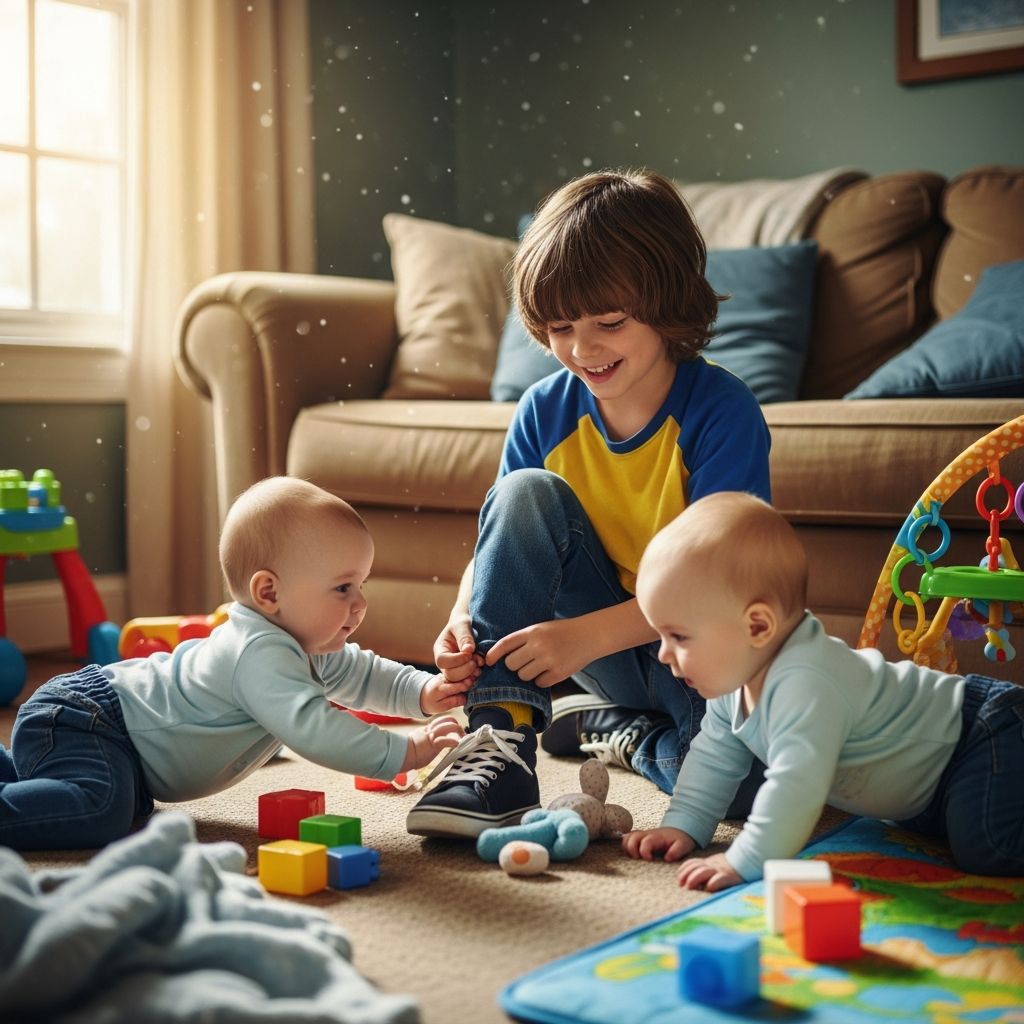
When a six-year-old suddenly has to share parents, space, and attention with two energetic toddlers, the emotional earthquake can shake the whole household. This guide explains why the behavior may become so intense and what you can do to support all your children without burning out.
Why Your Six-Year-Old Is Acting So Different
Your older child is not just reacting to the twins; they are reacting to change, loss of attention, and a new role in the family. Understanding what is underneath the behavior helps you respond with empathy instead of only reacting to the surface drama.
- Perceived loss of place: A child who was once “the baby” or the only child now feels pushed aside by two younger siblings who demand constant care.
- Emotional overload: Six-year-olds can use words, but when feelings are too big, they often revert to physical or provocative behavior.
- Mixed feelings: Your child can love the twins and also resent them. Both can be true at the same time.
- Fear of being replaced: Even if you show love consistently, a young child may secretly fear that you love the little ones more.
When you see kicking, shouting, or hurtful words, think of it as a distress signal: “I feel overwhelmed and I don’t know how to handle this.” That mindset will shape every strategy in this article.
Common Reactions to Twin Toddlers
Many six-year-olds respond to twin siblings with a mix of regression, attention-seeking, and power struggles. Recognizing patterns makes it easier to plan ahead and stay calm.
| Behavior You See | Possible Inner Message |
|---|---|
| Shouting at or pushing toddlers | “I feel invaded and need space.” |
| Angry comments like “I hate the babies” | “I miss having you all to myself.” |
| Sudden clinginess or whining | “Please notice that I still need you.” |
| Refusing to help or sabotaging routines | “I feel powerless and I’m trying to get control.” |
| Exaggerated tears over small issues | “My emotional tank is empty.” |
Seeing the emotional message behind the behavior does not mean excusing hurtful actions. It means you respond with both connection and clear boundaries instead of punishment alone.
Core Principles for This Season
Before focusing on scripts and tactics, it helps to anchor your parenting in a few guiding principles that will keep you steady when things get loud or chaotic.
- Connection before correction: A child who feels seen and valued will cooperate more easily than a child who feels blamed or shamed.
- Feelings are allowed, actions are limited: It is safe to be angry, jealous, or sad; it is not okay to hurt others or destroy things.
- Prevention beats reaction: Proactive routines, transitions, and one-on-one time often reduce outbursts more effectively than any consequence.
- Consistency over perfection: You do not need to respond ideally every time. Doing “good enough” consistently matters more than getting every moment right.
Creating Emotional Safety for Your Six-Year-Old
The more emotionally safe your older child feels, the less they will need to act out to get your attention. Emotional safety is built through everyday moments, not just big talks.
Validate Big Feelings Without Fixing Them
When your child explodes or melts down, start by naming and validating the feeling. This does not mean you agree with the behavior; it communicates that their inner world matters to you.
- Use short, simple reflections: “You really wish it was just you and me again,” or “You’re furious that the twins knocked down your building.”
- Avoid debating feelings: Instead of “You shouldn’t be jealous,” try “Jealousy is a tough feeling. I’m right here with you.”
- Normalize mixed emotions: “You can love them and still be mad at them sometimes. Families are like that.”
Offer Predictable One-on-One Time
A child who knows they will regularly get you to themselves can tolerate daily frustrations more easily. Even short pockets of focused time can have a big impact.
- Choose realistic doses: Ten to fifteen minutes of “special time” a day can be enough if it’s consistent and distraction-free.
- Let your child lead: During this time, follow their play ideas, avoid teaching or correcting, and put your phone away.
- Make it visible: Mark special time on a simple calendar so they can see when it’s coming, especially on days when the twins are particularly demanding.
Setting Firm, Calm Boundaries Around the Twins
Empathy must live beside firm, consistent limits to keep everyone safe. Clear boundaries help your older child feel contained rather than out of control.
Define Non-Negotiable Safety Rules
Young children feel safer when rules are explicit and repeated often. You can keep the list short but enforce it every time.
- Examples of family safety rules:
- “No hitting, kicking, or biting anyone in our family.”
- “We keep our hands and feet to ourselves.”
- “Toys stay on the floor, not thrown at people.”
- State rules in positive language when possible: “We use gentle hands” instead of only “Don’t hit.”
- Repeat them during calm times, not only after an incident.
Respond in the Moment Without Shaming
When your six-year-old crosses a line with the twins, your job is to protect, not to punish harshly. Aim for short, clear interventions that stop the behavior and show how to do better.
- Move close and use few words: “I won’t let you push the babies. I’m moving you back.”
- Physically block if needed: Step between siblings, gently hold your child’s hands if they are lashing out, and guide them to a separate spot.
- Follow up later: Once everyone is calm, briefly revisit what happened and how your child can manage similar feelings next time.
Strengthening the Bond Between Your Children
Although the early years may be rocky, you can lay a foundation for genuine warmth and respect between your older child and the twins. Focus on shared joy and cooperative moments instead of only refereeing conflicts.
Invite Helpful, Not Parentified, Involvement
Many six-year-olds like to feel competent and important, but they are not mini-parents. Offer roles that build pride without overburdening them.
- Give small, specific jobs: Passing a diaper, choosing a song to sing, or selecting a story for everyone.
- Notice effort, not outcome: “You were so gentle when you handed the toy,” instead of “You’re such a good helper, I don’t know what I’d do without you.”
- Respect their limits: If they say “no” to helping sometimes, treat it as information about their bandwidth, not defiance.
Create Positive Shared Rituals
Shared rituals turn the three-way relationship into something special instead of competitive. They don’t have to be elaborate or time-consuming.
- Mini bedtime ritual: Your older child tells one silly fact or makes up a detail about the twins’ day, and everyone giggles together.
- Weekly “big kid show”: The six-year-old performs a dance, magic trick, or drawing “exhibit” for the toddlers to watch.
- Outdoor traditions: A simple “twin parade” where your older child pushes one stroller or walks alongside, helping lead the way.
Dealing With Jealousy, Outbursts, and Regression
At some point, jealousy will spike and behavior may spiral. Preparing a simple response plan helps you keep your cool and stay consistent.
When Jealousy Shows Up as Meanness
Jealousy often hides behind mean words or taunting behavior toward the twins. Treat these as signals, not character flaws.
- Address the feeling and the behavior: “You’re really wishing you had my lap to yourself. I won’t let you shove your brother.”
- Give a safe outlet: Offer a pillow to punch, a scribble page for “angry art,” or a quick run outside to move their body.
- Reinforce belonging: Remind them of their unshakable place in the family, even when siblings annoy them.
Handling Explosive Tantrums
Older kids can have toddler-sized meltdowns when they feel cornered or unheard. Your calm presence is more powerful than lectures.
- Pause and protect: Make sure the twins are safe, then stay close to your older child without arguing.
- Keep words minimal: Simple phrases like “You’re safe, I’m here” or “We’ll talk when you’re ready” reduce escalation.
- Repair afterward: Once calm, briefly reflect (“That was a hard moment”) and talk through more helpful options for next time.
Responding to Regression
When an older child starts baby talk, thumb-sucking, or clinginess, they are often quietly asking, “Do I still get to be little sometimes too?”
- Offer age-appropriate nurturance: Extra snuggles, reading together, or playful “You’re my big kid AND my cuddle buddy.”
- Set gentle limits: You might allow baby talk during a private game but ask for regular speech at the dinner table.
- Reassure with words and actions: Emphasize that growing up does not mean losing your care or affection.
Protecting Your Own Sanity as a Parent
Caring for twin toddlers and a sensitive six-year-old is intense work. Supporting yourself is not a luxury; it is part of safe parenting.
- Lower the bar where you can: Simplify meals, reduce extra commitments, and say “no” to activities that drain more than they give.
- Build micro-breaks into the day: Even three minutes of deep breathing, stretching, or stepping outside can reset your nervous system.
- Seek adult support: Talk honestly with a partner, friend, or professional about how hard this stage feels instead of pretending it’s easy.
When your own stress is lower, it becomes easier to stay regulated in the face of shouting, whining, or sibling clashes.
Sample Daily Rhythm for a Twin + Big Kid Household
Every family is different, but a predictable structure can reduce friction and give your six-year-old a sense of control. Use this sample as inspiration and adapt it to your reality.
| Time | Focus | What Helps the Six-Year-Old |
|---|---|---|
| Morning | Get ready, breakfast, school | Predictable jobs (setting napkins), brief one-on-one chat while twins are strapped in high chairs. |
| After school | Snack, decompression | Ten minutes of “special time” before involving them with the twins. |
| Late afternoon | Free play, twin care | Clear options: play near but not with toddlers, choose a helper job, or have quiet solo time. |
| Evening | Dinner, baths, bedtime | Shared family ritual plus a short, private bedtime check-in with a parent. |
Even a loose rhythm like this can help your child anticipate when they will have your attention and when they will be expected to share you.
Frequently Asked Questions
Is it normal for my six-year-old to say they hate the twins?
Yes, it is common for children to express extreme-sounding thoughts when they feel threatened, jealous, or overwhelmed. Instead of correcting the words right away, acknowledge the feeling behind them and then gently restate boundaries around behavior.
Should I make my older child help with the twins?
Inviting your six-year-old to help can build confidence and connection, but making them responsible for the twins’ well-being is too heavy a burden. Keep tasks optional, simple, and framed as contributions to the family rather than obligations they must perform.
What if my child keeps hurting the toddlers even after consequences?
Repeated aggression signals that your child’s stress level is too high and that they need more support with regulation, not only stricter consequences. Increase supervision, shorten stressful transitions, add more connection time, and consider consulting a child therapist if the behavior persists or escalates.
How can I avoid always taking sides?
When a conflict happens, focus first on safety and then on each child’s feelings instead of assigning blame. You can say things like, “You both wanted the same toy, and it ended in hitting; I’m going to put the toy away until we can figure out a fair plan.”
Will this phase ever end?
Yes, as your children grow, their capacity for empathy, language, and problem-solving will expand. The connection, boundaries, and repair skills you practice now become the building blocks for more peaceful relationships later on.
Welcoming twin toddlers while caring for a sensitive six-year-old is a demanding chapter, but it is also an opportunity to teach all your children about feelings, respect, and love that stretches to fit everyone. With a mix of empathy, structure, and support for yourself, your family can move through this intense season with more connection and less chaos.