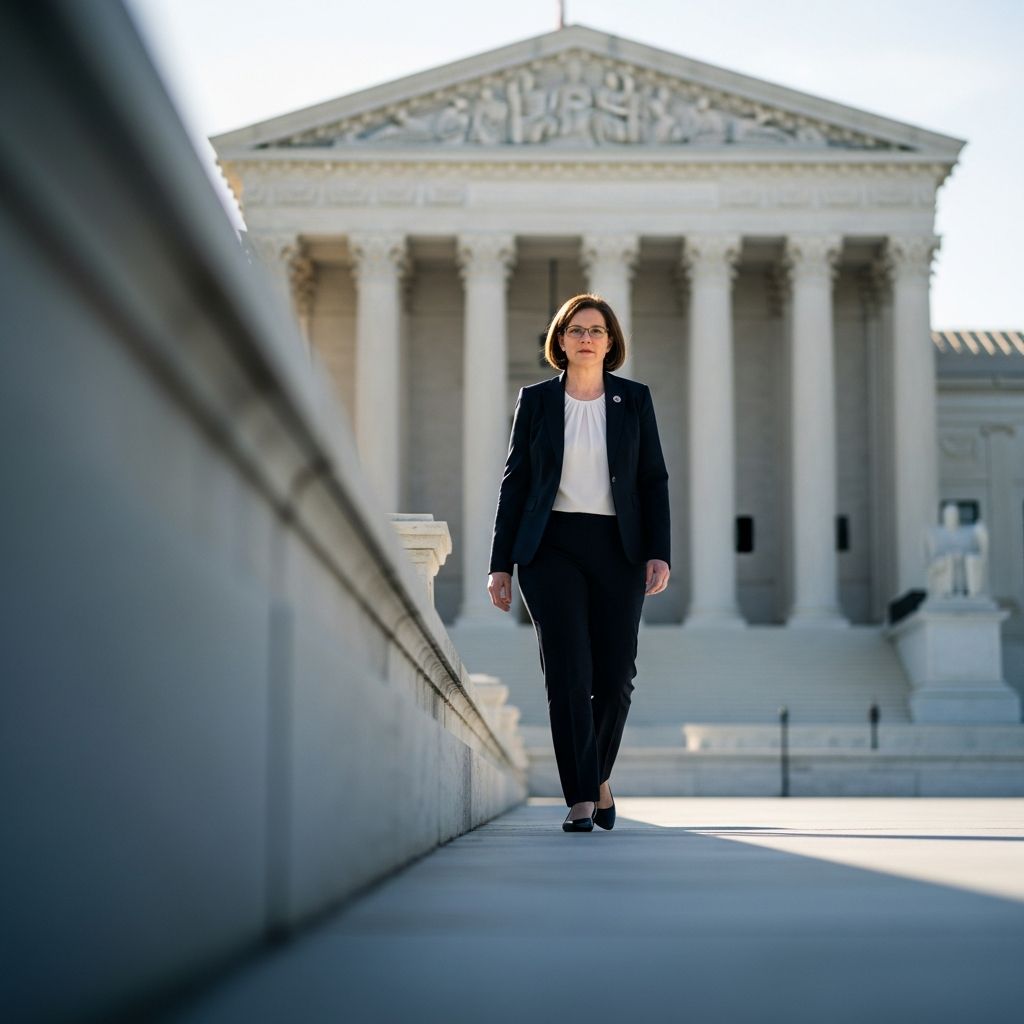
Amy Coney Barrett’s nomination to the U.S. Supreme Court in 2020 marked a pivotal moment in American judicial history, filling the vacancy left by the late Ruth Bader Ginsburg just weeks before a presidential election. President Donald Trump announced her nomination on September 26, 2020, praising her as a brilliant legal mind with a commitment to constitutional principles.
Background and Rapid Nomination Timeline
Born in 1972 in New Orleans to a devout Catholic family, Barrett built an impressive legal career. She graduated from Rhodes College and Notre Dame Law School, clerked for Justice Antonin Scalia, and later became a professor at Notre Dame while serving on the Seventh Circuit Court of Appeals. Her prior confirmation to the appeals court in 2017 had already drawn attention for her conservative views on textualism and originalism—approaches emphasizing the plain meaning of statutes and the Constitution’s original public understanding.
The death of Justice Ruth Bader Ginsburg on September 18, 2020, created urgency. Ginsburg, a liberal icon, had served for 27 years, becoming a symbol of progressive jurisprudence. Trump moved quickly, formally nominating Barrett on September 29, with Senate Judiciary Committee hearings set to begin October 12 under Chairman Lindsey Graham. This compressed six-week process contrasted sharply with the 2016 refusal to consider Merrick Garland’s nomination eight months before an election, fueling Democratic accusations of hypocrisy.
The Senate Judiciary Committee Hearings: Structure and Intensity
The hearings commenced on October 12, 2020, in the Hart Senate Office Building, spanning four days of testimony, questioning, and witness statements. Barrett appeared composed, forgoing notes during intense interrogations. Each of the 22 committee members—12 Republicans and 10 Democrats—had 30 minutes in the first round and 20 in the second on October 13-14.
Democrats pressed on hot-button issues like Roe v. Wade, the Affordable Care Act (ACA), and election-year timing. Barrett deftly responded that it would be inappropriate to prejudge cases or comment on pending litigation, adhering to judicial ethics. Republicans highlighted her qualifications, judicial record, and family life, framing her as a mainstream conservative.
- Day 1 (Oct 12): Opening statements from senators; Barrett’s personal introduction emphasizing her faith, family, and legal philosophy.
- Day 2-3 (Oct 13-14): Rigorous questioning on abortion rights, healthcare, and presidential powers.
- Day 4 (Oct 15): Witness testimonies from legal scholars supporting and opposing her nomination.
On October 22, the committee advanced her nomination 12-0, though Democrats boycotted the vote, allowing Republicans to claim unanimity. The full Senate confirmed her 52-48 on October 26, with only Republican Susan Collins joining Democrats in opposition—the first such confirmation without minority party support since the 19th century.
Political Firestorm and Hypocrisy Charges
The timing ignited partisan warfare. Democrats argued Republicans violated their own ‘Biden Rule’ from 2016, when they blocked Garland citing election proximity. Senate Majority Leader Mitch McConnell prioritized speed to secure a 6-3 conservative majority before potential Democratic gains.
| Key Vote Breakdown | October 22 Committee | October 26 Senate |
|---|---|---|
| Republicans | 12 Yes | 52 Yes (Collins No) |
| Democrats | Boycott (10 No) | 48 No |
| Outcome | Advanced 12-0 | Confirmed 52-48 |
Barrett took oaths on October 27: the constitutional oath at the White House and judicial oath at the Court, solidifying her role.
Judicial Philosophy: Textualism and Originalism
Barrett’s jurisprudence mirrors mentor Scalia’s. Textualism demands judges interpret statutes by ordinary meaning, while originalism ties constitutional meaning to ratification-era understanding. Her Seventh Circuit opinions demonstrated this restraint, authoring decisions on issues from immigration to religious liberty.
Post-confirmation, she contributed to landmark cases like Trump v. CASA Inc. (2025), critiquing universal injunctions as overreaching judicial power, and Corner Post, Inc. v. Board of Governors (2024).
Family Dynamics in the Spotlight
Throughout the hearings, Barrett’s seven children—two biological, five adopted from Haiti—were present, symbolizing her commitment to family amid professional ambition. Her husband, Jesse Barrett, a lawyer, supported her. This portrayal countered narratives questioning working mothers’ capacities, especially for high-stakes roles. Observers noted her children’s poise, with the youngest playfully engaging senators, humanizing the process.
Her Catholic faith, including ties to the People of Praise group, drew scrutiny, but she affirmed it would not influence impartiality.
Public and Media Reactions
Media coverage was polarized: conservatives celebrated a win for originalism; liberals mourned Ginsburg’s legacy and feared rollbacks on rights. Polls showed divided opinion, with 51% approval per Gallup. The hearings drew massive viewership, underscoring the Court’s cultural weight.
Long-Term Implications for the Court
Barrett’s arrival shifted dynamics, enabling conservative majorities on issues like gun rights and regulatory power. By 2026, her tenure has influenced decisions reinforcing limited government. Critics worry about precedents like Dobbs v. Jackson, though she avoided preemptive comments.
Her confirmation exemplified politicized judicial selections, prompting reform calls like term limits.
Frequently Asked Questions (FAQs)
What was the timeline of Amy Coney Barrett’s nomination?
Announced September 26, 2020; hearings October 12-15; confirmed October 26; sworn in October 27.
Why was her confirmation controversial?
It occurred weeks before the 2020 election, contrasting 2016’s Garland block, amid fears for ACA and abortion rights.
How did Barrett handle questions on Roe v. Wade?
She declined to opine, citing judicial canons against prejudging cases.
What is Barrett’s judicial approach?
Textualism for statutes and originalism for the Constitution.
Did her family play a role in hearings?
Yes, her seven children attended, highlighting work-life balance.
Broader Context: Supreme Court Nominations in Election Years
Historical precedents vary: Abe Fortas withdrew in 1968; Barrett succeeded despite parallels. Senate records document evolving norms.
Barrett’s journey reflects tensions between merit, ideology, and politics. At 1500+ words, this analysis draws from official proceedings and timelines, offering insight into a transformative appointment.
References
- Amy Coney Barrett Supreme Court nomination — Wikipedia. 2020-09-26. https://en.wikipedia.org/wiki/Amy_Coney_Barrett_Supreme_Court_nomination
- Justice Amy Coney Barrett — Justia. 2020-10-27. https://supreme.justia.com/justices/amy-coney-barrett/
- Confirmation Hearing on the Nomination of Hon. Amy Coney Barrett — U.S. Government Publishing Office. 2020. https://www.govinfo.gov/app/details/CHRG-116shrg53974/CHRG-116shrg53974
- Nomination of the Honorable Amy Coney Barrett — U.S. Senate Judiciary Committee. 2020-10-12. https://www.judiciary.senate.gov/committee-activity/hearings/nomination-of-the-honorable-amy-coney-barrett-to-be-an-associate-justice-of-the-supreme-court-of-the-united-states
- Video: Amy Coney Barrett Supreme Court Confirmation Hearings, Day 4 — Colorado Public Radio. 2020-10-15. https://www.cpr.org/2020/10/15/video-amy-coney-barrett-supreme-court-confirmation-hearings-day-4/