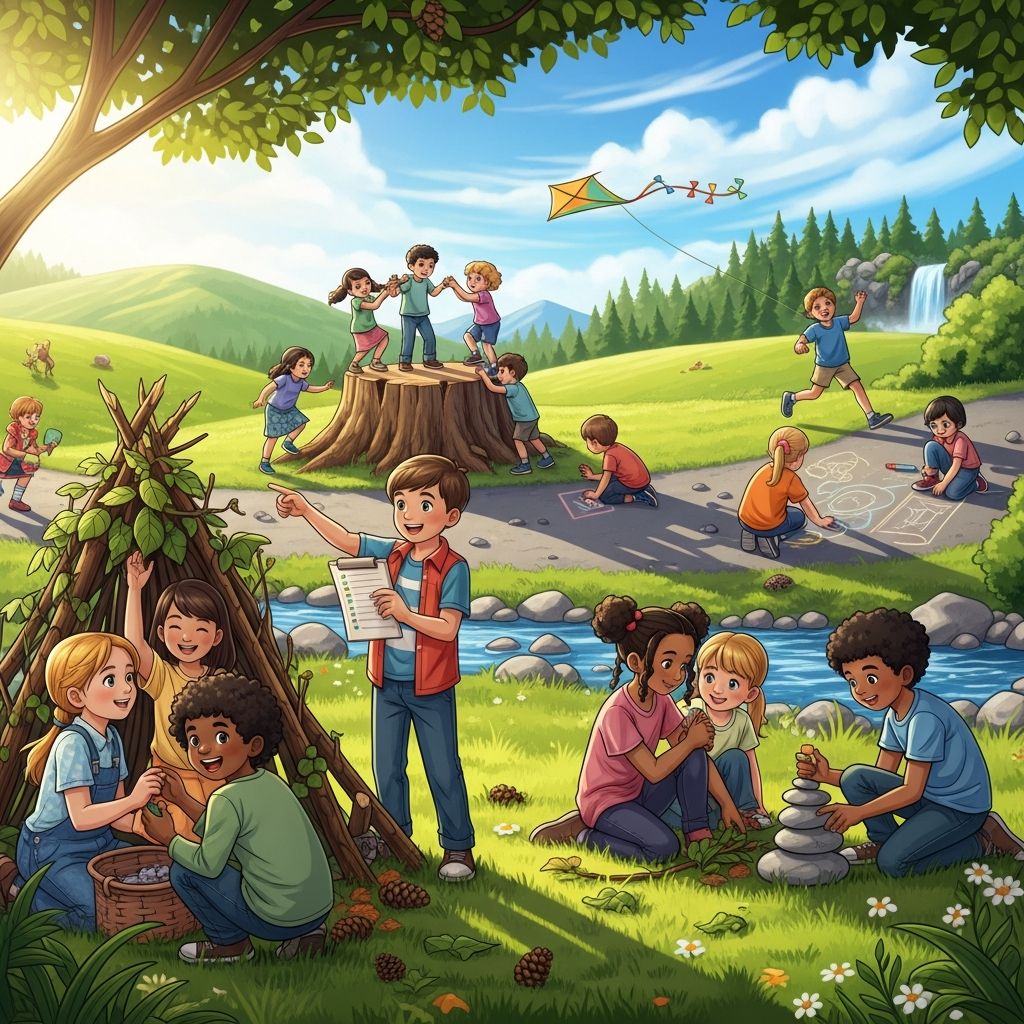
Outdoor play does more than burn off extra energy; it develops coordination, social skills, resilience, and creativity in ways that indoor activities rarely match. A few thoughtfully chosen games can turn any patch of yard, park, or driveway into a playground where kids run, imagine, and cooperate for hours. This guide offers a fresh mix of outdoor games that are easy to set up, flexible for different ages, and adaptable to almost any space.
Why Outdoor Games Matter for Kids
Before diving into specific activities, it helps to understand why outdoor games are so valuable. When children play outside, they practice balance, endurance, and coordination while also learning to negotiate rules, handle minor conflicts, and solve problems on the fly. That combination of movement and social interaction makes outdoor games one of the simplest, most accessible tools for healthy child development.
- Outdoor games promote physical fitness through running, jumping, and throwing.
- Group play supports communication skills, teamwork, and emotional regulation.
- Unstructured outdoor time boosts imagination and independent thinking.
How to Choose the Right Game
The best game is the one that fits your space, the ages of the kids, and the energy level at that moment. A large group of older kids might enjoy strategic team play, while younger children may need simpler, shorter rounds with clear, visual rules. Think of each game in this guide as a flexible template: you can scale difficulty up or down and tweak rules to match your family’s style.
- Consider space: Some games work in tight patios; others need open lawns.
- Match complexity to age: Keep rules simple for young kids and build in strategy for tweens.
- Have backup ideas: If one game stalls, switch to a quicker, high-energy option.
Warm-Up Games to Get Kids Moving
Starting with a warm-up game helps kids transition from indoor mode to outdoor play. These activities are easy to explain, short to play, and perfect for gathering everyone before more complex challenges.
Color Dash Corners
Use chalk, cones, or household objects to mark four “corners” in your yard, each representing a color or simple symbol.
- One player stands in the center and calls out a color or symbol.
- Everyone must run to that corner before the caller counts down from five.
- Change roles frequently so each child gets a chance to be the caller.
This quick game builds listening skills, agility, and spatial awareness, and you can adapt it with themes such as animals, shapes, or weather words for younger kids.
Shadow Follow
On sunny days, shadows become part of the game. One child is the “shadow leader” and moves around the yard while others try to step on the leader’s shadow.
- Set clear boundaries so kids know where they can run.
- Once someone manages to step on the leader’s shadow, that player becomes the new leader.
- Encourage creative movements: skipping, spinning, hopping, or walking backward.
Shadow Follow encourages kids to experiment with movement and body control while staying engaged with their surroundings.
High-Energy Running and Chasing Games
When kids need to burn off serious energy, running and chasing games are the go-to choice. These options keep everyone moving but use simple rules to cut down on confusion.
Safe Island Sprint
In this game, “islands” are safe zones scattered around the yard where players can rest briefly.
- Place cushions, towels, or cones as islands, leaving space between each one.
- One player is the chaser; the others run from island to island.
- Players can only stay on an island for a count of three before they must move.
Safe Island Sprint teaches quick decision-making and helps reduce pileups in one area because kids have to keep moving between safe zones.
Reverse Tag Relay
This twist on tag combines sprinting with team strategy. Instead of one person being “it,” each team has a runner who tries to tag a teammate to send them to the finish line.
- Divide kids into two teams and mark a start line and finish line.
- Each team sends one runner out; that runner tries to tag a teammate waiting near the start to sprint to the finish line.
- The first team to get all teammates across the finish line wins.
Because roles switch quickly, kids learn to balance speed with awareness of where their teammates and opponents are on the field.
Backyard Strategy and Target Games
Not every outdoor game has to be about all-out sprinting. Strategy and target games reward focus and planning, making them ideal for mixed-age groups or kids who prefer more thoughtful challenges.
Circle Toss Challenge
Turn your lawn into a simple scoring board using hula hoops, rope circles, or chalk-drawn rings.
- Lay circles on the ground and assign each one a point value.
- Kids take turns tossing beanbags, soft balls, or rolled socks from a set distance.
- Keep rounds short and encourage kids to add up their own points for a math boost.
Children can redesign the layout after each round, which adds a creative design element to the game.
Garden Grid Tactics
This game uses a grid drawn with chalk or created with string on the grass, like a large checkerboard.
- Assign two teams and give each team a set of markers such as stones and leaves.
- Teams take turns placing one marker on an empty square; the goal is to connect four markers in any direction.
- Older kids can add extra rules, such as “jumping” an opponent’s marker or creating protected zones.
Garden Grid Tactics encourages forward planning and helps kids practice taking turns and handling small setbacks with good sportsmanship.
Nature-Inspired Exploration Games
Nature-based games help kids build a connection to the outdoors beyond playground equipment. These activities encourage curiosity, observation, and respect for the environment.
Backyard Discovery Hunt
Instead of a traditional scavenger hunt that sends kids searching for specific objects, focus on textures, colors, and shapes.
- Create a list of qualities, such as “something rough,” “something that smells good,” or “three different shades of green.”
- Kids explore the yard or park to find items that fit each clue, but they can sketch, describe, or photograph them instead of picking them up.
- Gather afterward to share finds and talk about what surprised them.
This version of a hunt avoids tearing up plants while still inviting close observation of the natural world.
Leaf Lab Architects
In this creative game, kids use natural materials as building supplies for tiny outdoor structures.
- Provide a small area as the “construction zone” and remind kids not to damage living plants or trees.
- Players collect fallen leaves, twigs, stones, and grass to create miniature homes, bridges, or villages.
- After building, kids can give each structure a name and story, turning the game into a gentle storytelling session.
Leaf Lab Architects combines design skills, fine motor practice, and imaginative play, especially appealing to kids who enjoy quieter outdoor activities.
Simple Games for Small Spaces
Not every family has a wide-open yard, and some days the park may not be an option. These small-space games can fit on a balcony, driveway, or narrow strip of grass while still offering plenty of movement.
Line Jump Circuit
Use chalk or tape to draw or mark several parallel lines on the ground.
- Show kids how to jump from line to line with two feet together, then try one-foot hops or side-to-side jumps.
- Create short “circuits” by calling out different jump patterns, such as “forward, forward, back, spin.”
- Encourage kids to invent their own sequences and teach them to others.
Line Jump Circuit builds leg strength and coordination, and kids can adjust difficulty by choosing which lines to jump.
Wall Target Bounce
This game requires a ball that can safely bounce off a wall or fence without damage.
- Mark different height zones on the wall using tape or chalk.
- Kids stand at a set distance and try to hit specific zones with the ball by bouncing it off the ground first or throwing underhand.
- Change the challenge each round, such as “two hits in the low zone, one in the high zone.”
Wall Target Bounce is ideal for a single player but can also support friendly competitions by tracking how many challenges each child completes.
Cooperative Family Challenges
Some of the most memorable outdoor games are the ones that focus on teamwork instead of winning and losing. Cooperative games reduce pressure, making them perfect for siblings of different ages or extended family gatherings.
Family Balance Trail
Create a “trail” across the yard using safe, flat objects like boards laid securely on the ground, rope lines, or chalk paths.
- Everyone tries to walk the entire trail without stepping off the path.
- Add challenges like “freeze for three seconds” or “walk heel-to-toe” along certain sections.
- Older kids can help brainstorm new segments, such as spinning spots or low “tunnels” to crawl under.
Family Balance Trail helps kids practice balance and self-control while encouraging them to work together to extend or improve the course.
Pass the Wave
This circle game focuses on rhythm and coordination rather than speed.
- Everyone stands in a circle, and one person starts a “wave” by clapping or performing a simple motion.
- The next person repeats the motion and adds a new one, sending the combined sequence around the circle.
- If someone forgets a move, the group restarts with a shorter sequence or invents an entirely new wave.
Pass the Wave scales well for all ages because the moves can be big and silly for young kids or more complex for older groups.
Outdoor Games Equipment Guide
Most of the games in this guide rely on basic household items rather than specialized gear. Simple, flexible equipment keeps setup quick and makes it easy to invent new activities on the fly.
| Item | Common Uses | Game Ideas |
|---|---|---|
| Chalk or painter’s tape | Marking boundaries, start lines, and simple grids | Line Jump Circuit, Garden Grid Tactics, sidewalk obstacle paths |
| Hula hoops or rope circles | Targets, safe zones, and stations | Circle Toss Challenge, Safe Island Sprint, relay stations |
| Soft balls or beanbags | Throwing, catching, and target practice | Wall Target Bounce, circle toss games, gentle catch with younger kids |
| Blankets and cushions | Marking islands and making rest spots | Safe Island Sprint, cozy reading or snack areas between games |
| Buckets and plastic containers | Goals, markers, and collecting found objects | Nature hunts, obstacle course tunnels, water play on warm days |
Safety Tips for Outdoor Play
A few basic guidelines will help keep outdoor game time fun and low-stress for everyone. Planning ahead minimizes conflicts and reduces the risk of injury, especially when groups are large or ages vary widely.
- Check the play area for hazards like holes, loose stones, or sharp objects before starting.
- Establish clear boundaries so kids know where they can and cannot go.
- Match the intensity of the game to the weather; on hot days, favor shorter, shaded activities with frequent water breaks.
- Remind kids about fair play and kind language, especially in competitive games.
FAQs about Outdoor Games for Kids
How can I keep younger and older kids happy in the same game?
Choose games that allow for different roles, such as chaser, scorekeeper, or designer. Younger kids can have simpler objectives or shorter distances, while older kids take on more complex tasks, like inventing new rules or tracking points.
What if my child doesn’t like competitive games?
Lean toward cooperative and creative activities such as Leaf Lab Architects, Family Balance Trail, or Backyard Discovery Hunt. In those games, the focus is on completing a shared challenge or telling a story together instead of winning or losing.
How long should outdoor games last?
For younger kids, five to fifteen minutes per game is often enough before interest shifts. Older children may enjoy longer sessions, but it still helps to end on a high note and switch games before energy or enthusiasm crashes.
What if we don’t have a yard?
Many games adapt easily to driveways, apartment courtyards, or small patches of grass at a nearby park. Focus on small-space options like Line Jump Circuit, Wall Target Bounce, and Pass the Wave, which require minimal room but still keep kids active.
How can I encourage kids to invent their own games?
Offer a few basic pieces of equipment and ask open-ended questions like “What could we do with these hoops and a ball?” or “Can you design a course we all have to try?” When kids suggest new rules, take them seriously, test them out, and celebrate successful ideas.
Bringing It All Together
Outdoor games do not need to be complicated, expensive, or perfectly organized to be memorable. With a handful of simple ideas and a willingness to adapt, families can transform everyday spaces into lively play zones where kids learn, laugh, and grow. Start with one or two games from this guide, adjust them for your space and group, and let the next round of outdoor adventures unfold.