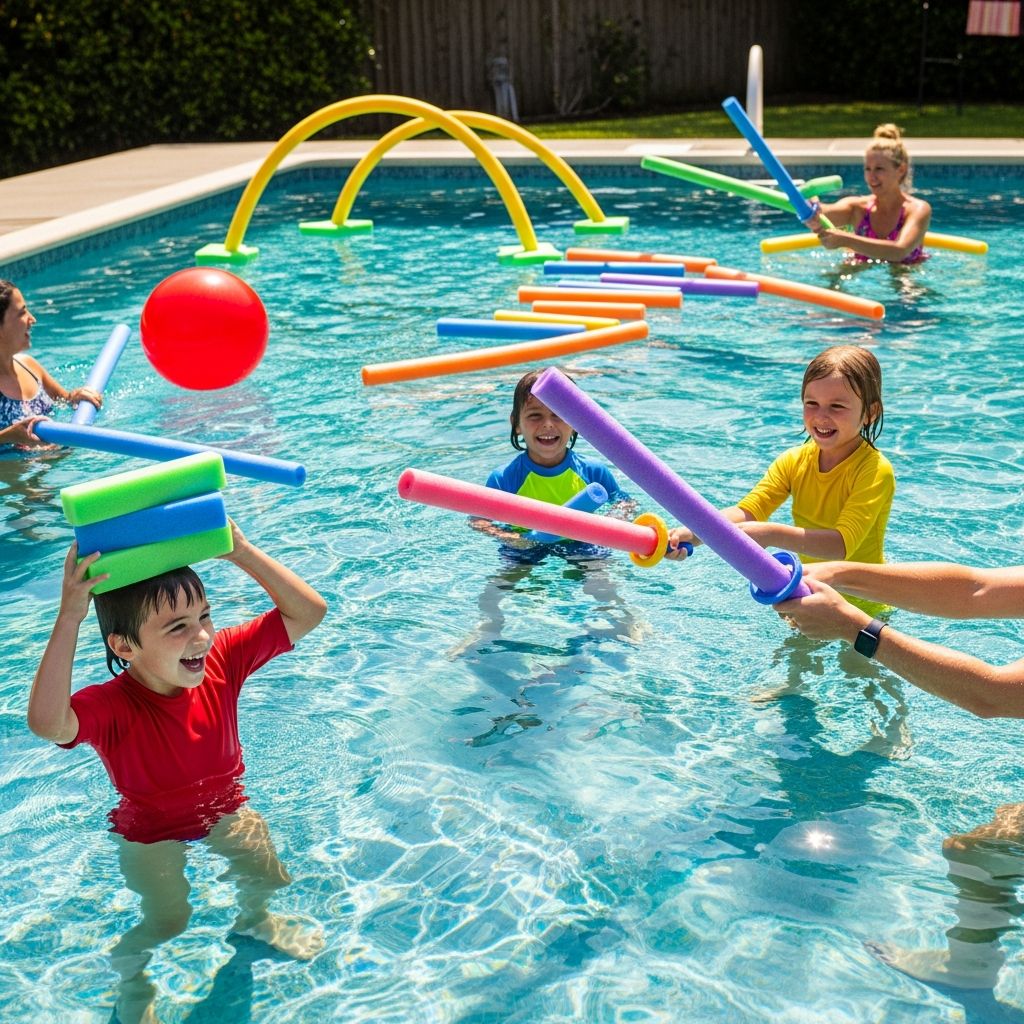
One inexpensive foam noodle can turn an ordinary swim into a day your kids never forget. With a bit of imagination, pool noodles become rockets, race cars, sea creatures, and more—keeping children moving, laughing, and building water confidence while you relax nearby.
This guide shares original, family-friendly swimming games built around the humble pool noodle. You will find ideas for different ages and swim levels, tips to adapt games for small or large groups, and practical notes on safety backed by public health guidance from organizations such as the U.S. Centers for Disease Control and Prevention (CDC) and the American Academy of Pediatrics (AAP).
Why Pool Noodle Games Are Perfect for Families
Before jumping into specific games, it helps to understand why pool noodles are ideal for backyard water play.
- Buoyant support: Pool noodles help beginners stay afloat, which can reduce anxiety and encourage practice of basic skills like kicking and paddling.
- Soft and flexible: The foam material is gentle on skin and unlikely to cause injury during playful bumps or collisions.
- Low cost and durable: Noodles are inexpensive, widely available, and last for many swim seasons when stored out of direct sun.
- Open-ended play: Kids can bend, balance, climb over, ride, or throw noodles, encouraging creativity and problem-solving.
- Suitable in and out of water: Many games work on a wet pool deck or in the yard as well as in the water.
Public health agencies emphasize that water play should combine fun and supervision. Constant adult supervision, life jackets when needed, and teaching children how to swim are key layers of protection.
Safety First: Ground Rules for Noodle Fun
Pool noodle games feel lighthearted, but they still happen in a potentially risky environment. According to drowning prevention guidance, multiple safety layers dramatically reduce risk around water.
- Designate a water watcher: One adult focuses only on supervising swimmers, without phones or distractions.
- Use life jackets for weak swimmers: U.S. Coast Guard–approved life jackets are recommended for young or inexperienced swimmers in and around water.
- Clarify boundaries: Mark shallow and deep areas and explain which games are for each zone.
- No head or neck hits: Ban striking above the shoulders with noodles and demonstrate safe tapping.
- One rider per noodle: For riding and racing games, limit to a single rider to prevent tipping and collisions.
- Check pool rules: If you are at a public pool, ensure games comply with posted safety regulations and lifeguard instructions.
Game Ideas for Young Swimmers (Ages 4–7)
These games focus on gentle movement, simple rules, and lots of positive reinforcement. They are best in shallow water where children can comfortably stand, ideally wearing life jackets if they are not yet strong swimmers.
1. Noodle Sea Horses
Goal: Practice balance and forward movement while riding a noodle “sea horse.”
- Each child straddles a noodle like a horse, with the middle under their hips and ends pointed up.
- Adults set a short path between two walls or markers.
- Kids “gallop” by kicking their legs and holding onto the noodle as they travel.
Skill focus: Balance, kicking, and safe forward movement in water.
2. Rainbow Bridges
Goal: Encourage kids to dip faces in the water and practice gliding underneath a flexible noodle arch.
- A caregiver holds both ends of a noodle in a gentle arch, just below the surface.
- Children take turns sliding or swimming underneath, starting with heads above water and progressing to blowing bubbles or submerging faces.
- Lower the arch gradually as confidence grows.
Skill focus: Water comfort, breath control, experimenting with submersion.
3. Floating Treasure Lines
Goal: Build confidence moving short distances while collecting small floating items.
- Lay one or two noodles on the surface as a “treasure line.” Scatter floating toys nearby.
- Children start at the wall, then move along the line while holding the noodle, picking up one item at a time.
- Repeat until all treasures are dropped into a bucket on the side.
Skill focus: Supported kicking, hand-eye coordination, comfort moving away from the wall.
Active Pool Noodle Challenges for School-Age Kids
Older children usually seek more speed and competition. These noodle challenges encourage aerobic activity, agility, and teamwork—important elements of physical activity recommended for school-age kids.
4. Noodle Relay Circuit
Goal: Combine multiple mini-challenges into a fast-paced team relay.
- Divide swimmers into two to four teams with equal numbers.
- Set up a short course, for example:
- Ride a noodle from the shallow end to mid-pool.
- Duck under a floating noodle twice.
- Push a noodle “log” back to the wall.
- Each player completes the course, passes the noodle to the next teammate, and the first team to finish wins.
Skill focus: Endurance, coordination, teamwork.
5. Island Hoppers
Goal: Cross a section of the pool by stepping from one floating “island” to the next.
- Bend noodles into circles and secure the ends with waterproof tape, or simply use several loose noodles as islands.
- Place them in a staggered line across the shallow end.
- Players must move from one island to the next without letting both feet touch the pool floor between islands.
Skill focus: Balance, strategic thinking, core strength.
6. Noodle Tag Variations
Goal: Add safe tagging tools to classic pool tag games.
- One player holds a noodle and becomes the “tagger.”
- To tag someone, the tagger gently taps another player’s arm or back with the end of the noodle.
- Once tagged, players may:
- Switch roles with the tagger.
- Freeze in place until another swimmer swims under a noodle held above them.
- Join hands with the tagger to form a growing “noodle chain.”
Skill focus: Agility, quick changes of direction, spatial awareness.
Family-Friendly Cooperative Noodle Games
Games that require cooperation rather than competition can be especially helpful for siblings who tend to argue. They encourage communication, patience, and shared problem-solving—all while keeping everyone moving in the water.
7. Floating Construction Crew
Goal: Build a shared floating structure using noodles and imagination.
- Offer a collection of full noodles and a few cut into smaller pieces.
- Challenge the group to build one of the following:
- A floating raft large enough for one person to sit on.
- A “sea wall” stretching from one side of the pool to the other.
- A ring-shaped “harbor” that can corral beach balls.
- Use simple connectors like string, Velcro straps, or pool-safe tape if allowed.
Skill focus: Creativity, communication, planning.
8. Noodle Current
Goal: Work together to move floating objects along a path using only noodles.
- Place a few lightweight toys or balls on the surface.
- Players use noodles as “paddles” to create a current and guide items toward a designated goal (like a corner or a hoop).
- No one may touch the toys with hands or feet—only with the water movement they create.
Skill focus: Teamwork, cause-and-effect thinking, gentle coordinated motions.
9. Bridge Builders
Goal: Build a noodle bridge that stays together long enough for everyone to pass underneath.
- Two or more players hold noodles horizontally across the pool to form a simple bridge.
- Others swim under, one at a time, without touching the bridge.
- After each successful pass, adjust the challenge—raise it higher, lower it, or angle it diagonally.
Skill focus: Cooperation, body control, experimenting with depth.
Skill-Building Water Games Using Noodles
Pool noodle games can also reinforce specific swimming skills, from streamlined glides to rhythmic breathing. For families working toward swim lessons or improving technique, these games are both fun and purposeful.
| Game | Primary Skill | Recommended Zone |
|---|---|---|
| Rocket Glides | Streamlined body position and push-offs | Shallow to mid-pool |
| Bubble Tracks | Breath control and exhaling underwater | Shallow end |
| Sidekick Express | Side-kicking and rotation for strokes | Lane line or wall |
10. Rocket Glides
Goal: Practice pushing off the wall and gliding in a straight, streamlined shape.
- Swimmers hold a noodle straight out in front, arms fully extended and hands shoulder-width apart.
- They place feet on the wall, bend knees, take a breath, and push off, holding a tight, straight body.
- Measure how far each swimmer can glide before needing to kick or stand.
Skill focus: Streamline position, core tension, explosive push-offs.
11. Bubble Tracks
Goal: Encourage kids to exhale in the water instead of holding their breath.
- Child holds onto a noodle at the surface while standing or floating.
- On a signal, they lower face into the water and blow bubbles while walking or kicking along a short route.
- Count slowly or sing a short song to keep them exhaling steadily.
Skill focus: Breath control, comfort with face in the water.
12. Sidekick Express
Goal: Strengthen side kicking, an important foundation for freestyle and backstroke.
- Swimmer hugs a noodle in front or under one arm.
- They lie on one side, ear against shoulder, with the bottom arm extended toward the direction of travel.
- Kick along the wall for several body lengths, then switch sides on the way back.
Skill focus: Rotation, strong flutter kick, body alignment.
Quick-Setup Noodle Games for Big Groups
When you have cousins, neighbors, or party guests crowding the pool, you need games that work with many players and minimal explanation. These options scale up easily and keep energy high.
13. Color Chase
Goal: React quickly to color-based cues while sharing a set of noodles.
- Scatter noodles of two or three different colors around the pool.
- Call out instructions such as “Find blue and freeze!” or “Everyone with green noodles swap with someone!”
- Change cues frequently to keep players moving and listening.
Skill focus: Listening, reaction time, quick changes in direction.
14. Noodle Raft Rally
Goal: Move a group on a shared noodle raft from one side of the pool to the other.
- Link several noodles side by side for a wide base.
- One or two players ride the raft while others push or pull using spare noodles.
- After each trip, rotate riders and pushers.
Skill focus: Team strategy, cooperation, gentle propulsion.
15. Ring and Noodle Rescue
Goal: Practice simple retrieval in a playful way.
- Toss a few floating rings or balls into the water.
- Assign teams and give each team one noodle.
- Players must work together to guide the items back to a designated corner, using only the noodle and gentle pushes of water.
Skill focus: Coordination, communication, controlled movements in crowded water.
Tips to Keep Noodle Games Fresh All Season
Repeating the same game is fun at first, but variety keeps kids engaged and helps them develop new skills over time. These simple tweaks can transform any noodle game into a new challenge.
- Change the tempo: Slow-motion rounds, “silent” rounds, or fast-sprint rounds all feel different while using the same rules.
- Play in reverse: Swim backward, switch directions halfway, or swap roles between riders and pushers.
- Add simple scoring: Track laps completed, items collected, or successful passes under an obstacle.
- Involve kids as designers: Ask children to invent new rules or variations and name their own games.
- Move between shallow and deep areas: Adapt games to be more challenging as swimmers gain confidence and ability.
Frequently Asked Questions (FAQs)
Are pool noodles safe for non-swimmers?
Pool noodles can provide extra buoyancy and support, but they are not a replacement for life jackets or close adult supervision. Public health agencies recommend that young or weak swimmers wear approved life jackets in and around water, even when using noodles.
What age can kids start playing noodle games?
With constant, close supervision and proper flotation, many children around ages 4–5 enjoy simple noodle games in shallow water. Adjust game difficulty based on each child’s comfort, listening skills, and swimming ability rather than age alone.
How many noodles do we really need?
For a small family, 3–5 noodles are usually enough. For larger groups, aim for at least one noodle for every two players so that everyone is involved, either directly or by helping a teammate.
Can these games help my child learn to swim?
Yes. Research on children’s physical activity highlights that playful, varied movement can support development of motor skills and cardiovascular fitness. Games that involve gliding, kicking, and breath control can complement—but not replace—formal swim lessons led by qualified instructors.
How do I store pool noodles so they last longer?
Rinse noodles with fresh water after pool use, allow them to dry fully, and store them in a shaded, dry space. Prolonged direct sunlight can cause the foam to become brittle and crack over time.
References
- Water Safety — Centers for Disease Control and Prevention. 2024-05-15. https://www.cdc.gov/drowning/index.html
- Drowning Prevention — American Academy of Pediatrics. 2021-04-19. https://www.healthychildren.org/English/safety-prevention/at-play/Pages/Water-Safety-And-Young-Children.aspx
- Physical Activity Guidelines for School-Aged Children and Adolescents — U.S. Department of Health and Human Services. 2018-11-01. https://health.gov/sites/default/files/2019-09/Physical_Activity_Guidelines_2nd_edition.pdf
- Swimming and Water Safety — American Red Cross. 2022-06-01. https://www.redcross.org/take-a-class/swimming