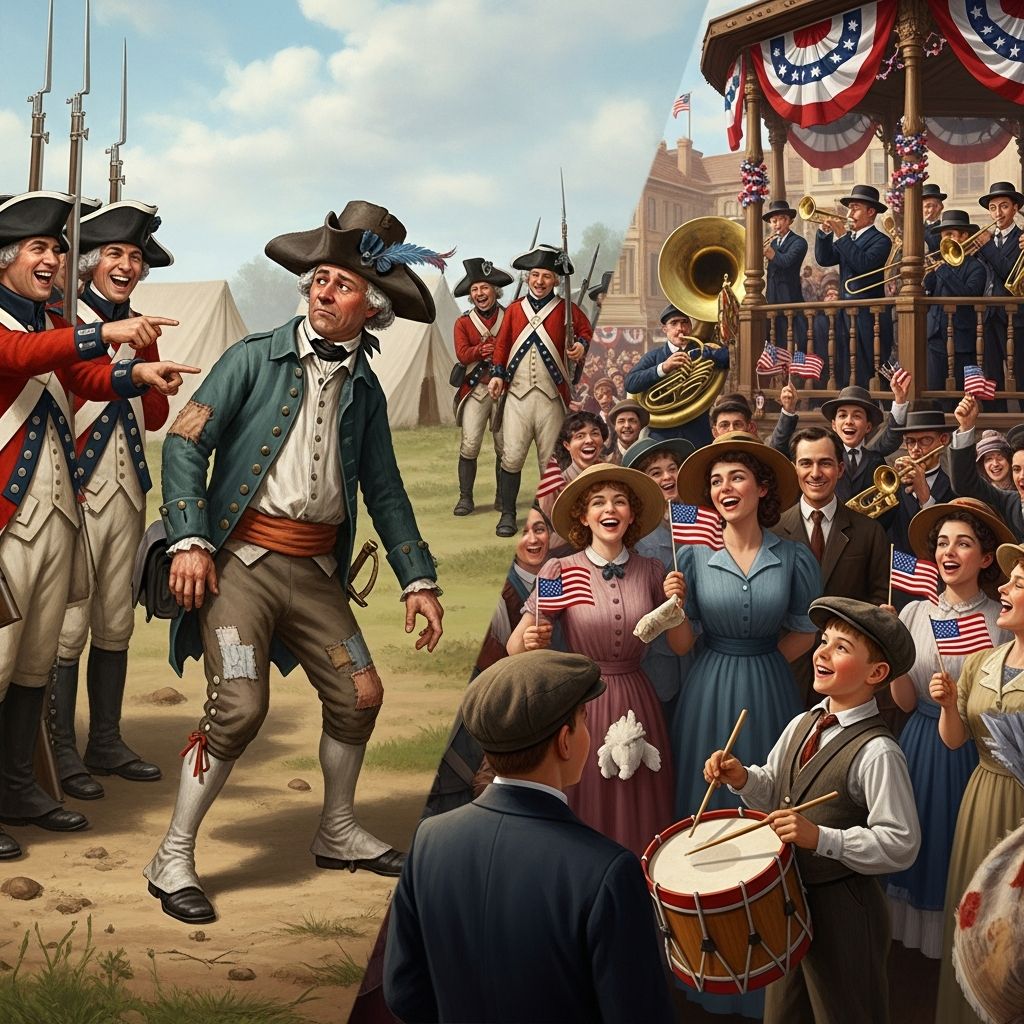
“Yankee Doodle Dandy” is one of those songs many children learn before they understand what any of the words actually mean, yet its history reveals a tangled story of mockery, identity, and national pride. What began as a tune used to laugh at colonial soldiers eventually became a musical shorthand for the American spirit.
Deep Roots: A Tune Older Than America
The melody of “Yankee Doodle” is believed to be older than the United States itself, circulating around Europe long before colonial soldiers ever marched to it. Music historians have suggested links to older Dutch, Irish, and English tunes, illustrating how melodies often travel and transform across borders and generations.
- Some scholars connect the tune to a Middle Dutch harvest song featuring playful nonsense syllables, which may have helped the melody stick in people’s minds.
- Other research points to similarities with an Irish tune known as “All the way to Galway,” indicating that the musical pattern was already popular in the British Isles.
- By the 17th century, variations of this melody were reportedly used in England, sometimes even in political or satirical songs.
This deep European background shows that “Yankee Doodle” did not start as a uniquely American creation; instead, the colonies adopted and reshaped a tune that was already well known across the Atlantic world.
Who Wrote It? The Surgeon, the Soldiers, and the Legends
Because the melody is so old, the question of who “wrote” “Yankee Doodle” really refers to who first paired it with the now-familiar early English verses about colonial troops. The most popular traditional story credits a British army surgeon stationed in New York during the mid-18th century.
- A British doctor named Richard Shuckburgh (or Shuckburg/Schuckburg in various spellings) is widely cited as the author of an early mocking version of the lyrics during the French and Indian War, around 1755–1758.
- According to later accounts, he wrote the verses after seeing the colonial militia, whose rough appearance and mismatched uniforms contrasted sharply with the British regulars.
- Like many folk songs, the exact wording and timing are disputed, and alternative theories suggest that other anonymous soldiers may have shaped the lyrics informally.
Rather than emerging from a single, clearly documented author, “Yankee Doodle” likely evolved as military humor passed among British officers and enlisted men, then morphed further once American colonists claimed it for themselves.
Decoding the Words: “Yankee,” “Doodle,” and “Macaroni”
The most famous lines of the song are packed with words that have shifted dramatically in meaning over time, making them sound nonsensical to modern ears. Understanding those terms helps reveal how the song moved from scoffing at colonists to symbolizing them.
| Word | 18th-Century Meaning | Implication in the Song |
|---|---|---|
| Yankee | A nickname for English colonists in North America, and later especially New Englanders. | Labels the colonial soldiers as provincial Americans rather than polished Europeans. |
| Doodle | A slang term suggesting a simpleton or fool, akin to calling someone a bumpkin. | Frames the “Yankee” as laughably unsophisticated. |
| Macaroni | A fashionable British dandy obsessed with continental style, not just a kind of pasta. | Mocks the idea that sticking a feather in a hat could make a rustic colonist look stylish. |
Put together, the phrase about riding on a pony, adding a feather, and calling it “macaroni” paints the colonial soldier as someone so ignorant of European fashion that he mistakes a token flourish for genuine refinement. The entire verse worked as a kind of inside joke for British troops who prided themselves on their uniforms, horsemanship, and social polish.
Mocking on the March: A British Army Joke
Before the American Revolution, British officers and soldiers reportedly used “Yankee Doodle” as a marching song to poke fun at their colonial allies. The French and Indian War gave them a front-row view of colonial militias whose ragtag clothing and informal behavior contrasted sharply with formal European drill.
- The tune’s bouncy, repetitive rhythm made it easy to sing in columns on the move, reinforcing a sense of superiority among British regulars.
- The verses could be altered or expanded on the spot, allowing soldiers to improvise new jabs at colonial officers, politicians, or even battlefield conditions.
- Early variants referenced the colonists’ unfamiliarity with elite European dances and fashions, echoing the idea that they were out of step with cultured society.
In these pre-Revolutionary years, “Yankee Doodle” functioned more like a running gag than a patriotic anthem, reinforcing a hierarchy in which British soldiers saw themselves as the unquestioned standard of professionalism.
When the Joke Backfires: Colonists Claim the Song
During the American Revolutionary War, the meaning of “Yankee Doodle” began to shift as colonial troops adopted the song and turned its mockery back on the British. Instead of being offended, many American soldiers embraced the caricature, singing the tune in camp and on the march as a symbol of shared identity.
- New verses celebrated American leaders, including George Washington, and mocked British setbacks or missteps.
- Colonial fife-and-drum corps used the melody during parades and battlefield maneuvers, cementing it as a recognizable sound of the revolutionary cause.
- Some accounts describe British troops hearing Americans sing “Yankee Doodle” after battlefield victories, underlining how the insult had been flipped.
This kind of cultural judo—turning an insult into a badge of honor—is a familiar pattern in history, and “Yankee Doodle” offers a clear example of it playing out in real time as the colonies moved toward independence.
“Yankee” as a Name for Americans
The word “Yankee” itself has a complicated linguistic history, and scholars still debate its original roots. By the mid-18th century, however, it had become a common term for colonial Americans, particularly those from New England.
- One theory suggests that “Yankee” grew out of a Dutch nickname such as “Janke,” meaning “little Jan,” which English speakers adapted to refer to Dutch or colonial neighbors.
- Another idea holds that some Indigenous groups adapted the word “English” into something like “Yengees,” which then evolved into “Yankee.”
- Whatever its exact origins, the term was widespread enough by the Revolution that “Yankee Doodle” would have been instantly understood as “that American fellow who thinks he’s fancy.”
Over time, “Yankee” narrowed and widened in meaning depending on region and era—sometimes referring to all Americans, sometimes just northeasterners—but the song helped cement its durable association with the United States.
From Battlefield Tune to Patriotic Standard
Once the Revolutionary War ended and the United States became an independent nation, “Yankee Doodle” remained woven into public life as a musical emblem of the young republic. It appeared at political events, parades, and local celebrations, gradually moving from soldiers’ repertoire to general popular culture.
- Military bands kept the tune alive through ceremonial performances at musters, training camps, and civic occasions.
- Printed songbooks and broadsides carried various text versions, some patriotic, some humorous, reflecting how communities adapted the lyrics to local issues.
- By the 19th century, “Yankee Doodle” was frequently taught to children, helping each generation absorb a musical link to the Revolutionary era.
The song’s durability owes a lot to its simple melody and flexible verses, which can be rewritten to fit new political moments or lighthearted cultural references while still sounding instantly familiar.
Why Children Still Learn It
Today, many people encounter “Yankee Doodle” in childhood as a nursery song long before they learn anything about the Revolutionary War. Classroom performances, music lessons, and holiday concerts often rely on the tune because it is easy to memorize and sing in groups.
- Teachers use the song to introduce topics like the American Revolution, colonial life, and early national identity in a way that feels accessible rather than intimidating.
- Children can quickly learn the melody on simple instruments such as recorders or beginner band instruments, reinforcing basic musical skills.
- Because the lyrics are curious and old-fashioned, they naturally provoke questions, opening the door for discussions about how language and culture change over time.
By the time many students encounter more formal history lessons, “Yankee Doodle” has already provided a memorable, if mysterious, soundtrack to their early understanding of America’s past.
How “Yankee Doodle” Shows Culture in Motion
The story of “Yankee Doodle” offers a miniature case study of how culture is rarely static and often full of paradox. A single song can move between nations, switch sides in a conflict, and pick up new meanings along the way.
- It began as a European melody, acquired satirical military words, and then helped a new country define its sense of self.
- An insult (“Yankee” plus “doodle”) turned into a nickname that many Americans wear with pride, especially in historical or patriotic contexts.
- What once ridiculed colonial fashion now appears mainly as a children’s rhyme, its sharper edges softened by time and repetition.
This evolution illustrates how groups can reframe ridicule into solidarity, using humor, music, and repetition to reclaim narratives that were originally meant to diminish them.
Modern Echoes in Popular Culture
Although “Yankee Doodle” is an old tune, it still appears in modern media, especially around U.S. patriotic holidays and in educational or nostalgic contexts. Films, television shows, and public events sometimes quote or weave the melody into background music when they want to signal a distinctly American setting or mood.
- Marching bands and military ensembles continue to include it in medleys that highlight historical American songs.
- Public performances during national celebrations occasionally pair “Yankee Doodle” with other well-known patriotic tunes to connect the Revolutionary past to the present.
- Educational videos and online resources use the song as a hook to explain aspects of colonial life, etymology, or early American politics.
Even when listeners do not recognize all the historical layers behind it, the melody instantly communicates “this is something about America,” showing how sound can carry cultural meaning across centuries.
Key Facts at a Glance
| Aspect | Details |
|---|---|
| Probable melody origins | European folk and popular tunes, with suggested links to Dutch and Irish music. |
| Early English lyrics | Attributed traditionally to British surgeon Richard Shuckburgh during the 1750s, mocking colonial militias. |
| Original tone | Satirical, portraying colonists as foolish and unfashionable compared with British regulars. |
| Revolutionary War role | Adopted by American troops, with new verses celebrating their cause and leaders. |
| Modern status | Nursery song, teaching tool, and patriotic tune still used in educational and ceremonial contexts. |
FAQs About “Yankee Doodle Dandy”
Is “Yankee Doodle” really a patriotic song if it started as an insult?
Yes, it is widely considered patriotic today, even though British soldiers originally used it to mock colonial troops. The key transformation came when American soldiers embraced the song, rewrote verses, and sang it proudly during the Revolutionary War, changing its emotional meaning from ridicule to resilience.
Was there an actual person named Yankee Doodle?
There is no solid evidence of a real historical figure with that name; the phrase likely started as a generic caricature of a colonial American rather than a specific individual. Over time, “Yankee Doodle” became a symbolic character representing the American everyman, especially in children’s books and illustrations inspired by the song.
Why does the song mention macaroni if it is about soldiers?
In 18th-century Britain, “macaroni” could refer to a flamboyantly fashionable young man, not just a type of pasta. The song jokes that the colonist thinks putting a feather in his hat makes him as stylish as those trend-obsessed dandies, highlighting the supposed gap between rustic America and cosmopolitan Europe.
Is “Yankee Doodle” an official national song of the United States?
It is not one of the official national songs like the national anthem, but it is recognized as an important traditional patriotic tune and is preserved in historical collections of American music. Government archives and cultural institutions treat it as a key example of early American popular and military music.
Why do historians debate the origins of the song so much?
Because the melody and lyrics evolved through oral tradition, many early versions were never formally written down, leaving gaps that later researchers have tried to fill with clues from diaries, songbooks, and newspaper references. Different historians emphasize different bits of evidence, which leads to competing theories about where the tune came from and who first fitted it with English words.