Every family seems to have a ritual around bread crust. Some parents slice it off without thinking. Others insist it stays on the plate, even if it’s left behind. That tiny strip of browned bread looks trivial, but it can quietly shape how kids think about food, effort, and the less pleasant parts of life.
This article explores what is really at stake when we automatically remove the crust from children’s food, and how a few small changes at the table can nurture respect for resources, emotional resilience, and a healthier relationship with eating.
Why Crust Matters More Than It Looks
On the surface, crust removal is a small kindness: make food more appealing, avoid conflict, get through breakfast faster. Underneath, it sends subtle messages about what is worth keeping and what is okay to discard.
Crust becomes symbolic of three big ideas:
- Food as a whole – whether we treat food as something to be honored or edited until it is pure “highlights.”
- Discomfort and effort – whether kids learn to face mild unpleasantness or expect it to be removed for them.
- Consequences and choice – whether children see the impact of their preferences on waste and work.
None of this has to be explained in a lecture. Kids absorb meaning from repeated patterns: what stays, what goes, and what adults are willing to do on their behalf.
The Hidden Cost: Food Waste and Convenience Culture
Food waste is not just an abstract global issue; it starts with what we scrape into the trash at home. In the United States, the USDA estimates that 30 to 40 percent of the food supply is wasted, much of it at the consumer level. Cutting off crusts for years can quietly contribute to that pattern.
When parents routinely discard edible parts of food to match a child’s preference, kids may learn that:
- Perfect comfort is more important than using what we have.
- Unwanted pieces simply vanish without consequence.
- Someone else will absorb the cost of their dislikes.
Research on household food waste finds that convenience, habit, and a desire to please family members often drive wasteful decisions more than hunger or need. Without shaming children, we can still invite them into a more thoughtful way of eating.
Finding a Middle Path Between Waste and Pressure
Many adults grew up hearing, “Clean your plate—kids are starving somewhere else,” a message that often created guilt rather than genuine understanding. Studies now show that pressuring children to finish food can override their internal hunger cues and is linked to less responsive eating and higher risk of overeating later.
A healthier approach balances three ideas:
- Offer reasonable portions so there is less to waste in the first place.
- Do not force bites or demand a clean plate.
- Also do not pre-edit food by removing all “unpleasant” parts, like crust, before it even reaches them.
In other words: serve whole food, respect appetite, and let kids see that not everything needs to be tailored perfectly to their preferences.
Crust as a Lesson in Process, Not Just Taste
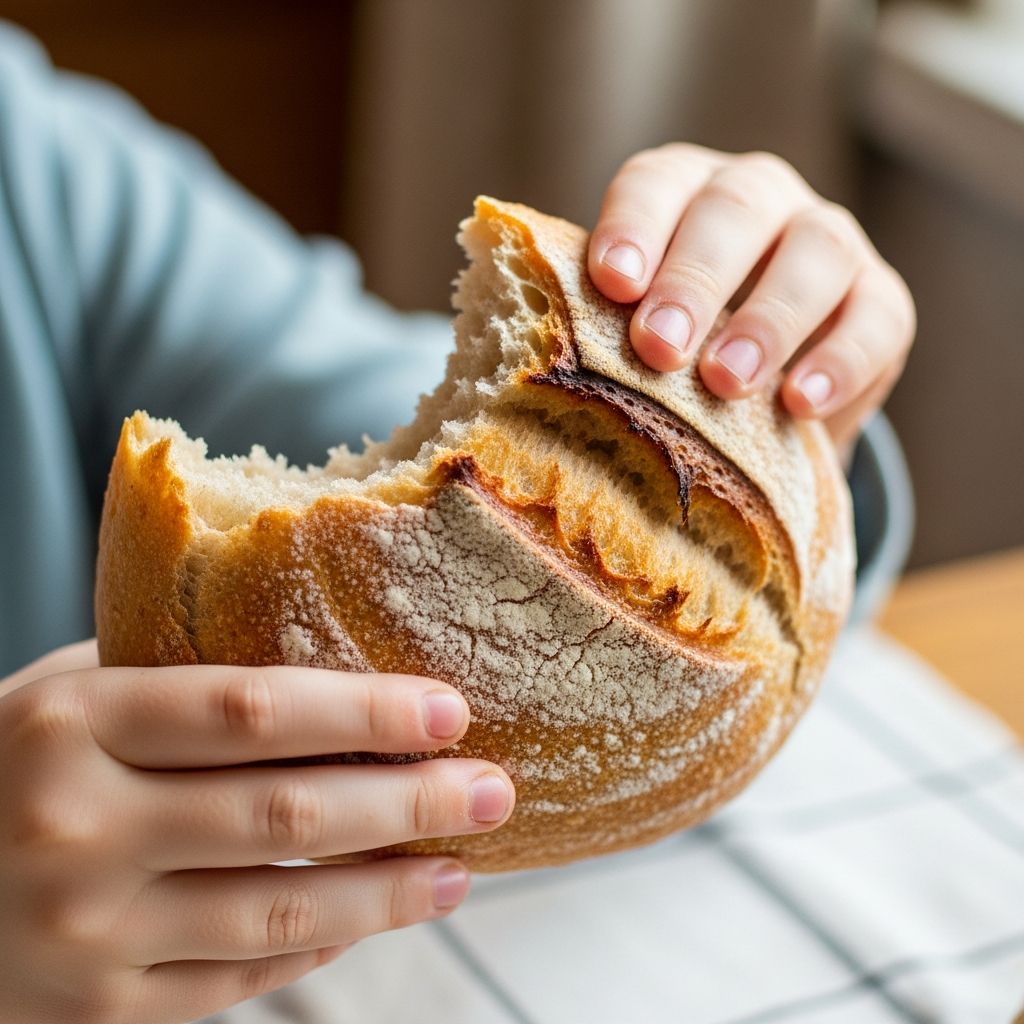
Most young kids assume food simply appears. Bread crust is one of the first visible signs that food has been transformed by work, heat, and time. When children notice and ask about the darker, firmer edge, they are noticing process.
From a scientific perspective, crust forms because of the Maillard reaction, a set of chemical reactions between amino acids and sugars that creates browning and complex flavors during cooking. That reaction is why baked bread smells so appealing—and why the surface browns more than the inside.
Parents do not need to give a chemistry lecture, but they can use crust to highlight simple truths:
- Food changes when we cook it; someone has done work for you to eat this.
- The outside of foods often protects or supports the inside.
- Not every part tastes the same, but every part belongs to the whole.
Over time, conversations like this help kids connect their plate to farms, ovens, and people—not just to their preferences in the moment.
How Small Discomforts Build Emotional Resilience
Refusing crust is rarely about survival; it is about avoiding a minor annoyance. Learning to coexist with small annoyances is a core life skill. Research in developmental psychology shows that children who are allowed to experience and manage manageable frustration tend to develop better self-regulation and coping skills over time.
When adults rush to remove every mildly disliked texture or flavor, kids may miss chances to learn that:
- They can tolerate a bit of discomfort without panic.
- Not liking something does not mean it must disappear.
- Preference and permission are not always the same thing.
Leaving the crust on the bread—but not forcing a child to eat it—sends a calm, consistent message: “This is part of the food. You can decide what to do with it, but I’m not going to erase it for you.”
Respecting Autonomy Without Becoming the Cleanup Crew
Children do need autonomy with food; it is central to learning hunger and fullness, and to avoiding power struggles. The challenge is drawing a boundary between autonomy and adult over-accommodation.
A helpful division of responsibility in feeding, proposed by dietitian Ellyn Satter and widely cited in pediatric nutrition, suggests that:
- Parents decide what, when, and where food is served.
- Children decide whether and how much they will eat.
Within this framework, removing crust on demand moves parents from deciding what is served to customizing every item to a child’s immediate tastes. That small shift can eventually make mealtimes more stressful, not less.
Sample Phrases That Balance Kindness and Limits
Instead of cutting crusts off automatically, parents might say:
- “Here’s your sandwich. You can eat the parts you like.”
- “You don’t have to eat the crust, but I’m not going to cut it off.”
- “If you don’t want the crust, you can leave it on the plate.”
- “We serve the bread as it comes. Your job is to decide what and how much to eat.”
These statements are factual, nonjudgmental, and consistent. Over time, kids learn that preferences are heard—but not always catered to in advance.
Crust, Gratitude, and Seeing the Bigger Picture
Talking about food waste and gratitude does not require guilt or references to distant suffering. It can be local and concrete. Food security research shows that millions of households, including families with children, experience food insecurity each year in the United States. Knowing this, many parents want their kids to treat food with care.
Crust offers simple teaching moments, such as:
- “Someone worked to grow this grain and bake this bread.”
- “We try not to throw away parts that are perfectly good.”li>
- “You get to choose what you eat, but let’s think about what we toss.”
The goal is not to make children finish everything or feel guilty. It is to help them understand that food is valuable and connected to real people and resources.
Practical Ways to Ease Kids Into Eating Crust (Or At Least Respecting It)
Parents do not need to jump from “I always cut crust” to “You must eat every crumb.” Gradual, low-pressure steps tend to work better, especially with sensitive or picky eaters.
| Goal | Low-Pressure Strategy |
|---|---|
| Normalize crust as part of bread | Serve sandwiches with crust intact, without making comments or demands. |
| Reduce conflict | Allow kids to leave crust on the plate; quietly clear it without criticism. |
| Encourage gentle exposure | Invite them to take a tiny nibble occasionally: “You can try one bite if you’re curious.” |
| Use leftovers wisely | Turn uneaten crusts into breadcrumbs, croutons, or use in a recipe so kids see waste reduction. |
| Model behavior | Let children see adults eating crust without complaint or drama. |
When Crust Battles Are Not Really About Crust
Sometimes a child’s strong reaction to crust reflects broader challenges with texture, control, or appetite. In these cases, pushing the issue can backfire.
Crust might be a signal for:
- Sensory sensitivity – some children genuinely struggle with mixed or rough textures.
- Need for autonomy – refusing a tiny part of food can feel like a safe way to assert independence.
- Appetite or mood – a child who is tired, anxious, or not very hungry may fixate on something “wrong” with the food.
If crust refusal comes with extreme distress, gagging, or a very narrow list of accepted foods, it can be worth discussing with a pediatrician or feeding specialist, as extreme picky eating can be linked to sensory processing or oral-motor issues.
Simple Household Guidelines Around Crust
Families can create small, consistent norms that make crust just another part of life, not a battlefield. For example:
- We serve food whole – we don’t usually cut off edible parts like crusts or apple peels.
- You are in charge of your bites – you choose what and how much to eat from what is offered.
- Leftovers get a second life – unused bread or crust becomes breadcrumbs, stuffing, or part of another dish.
- No guilt, no drama – we talk about respect for food, not about being “bad” for leaving something.
Clear principles like these give kids structure and predictability while still honoring their internal cues.
Frequently Asked Questions (FAQs)
Is it wrong to cut crust off sometimes, like for a party or special treat?
No. The concern is not an occasional fun shape or treat, but a long-term pattern where children rarely see or handle food in its whole form. Occasional exceptions do not erase the lessons you build through daily habits.
Could insisting on crust trigger food anxiety or eating problems?
Forcing kids to eat anything, including crust, can increase anxiety and resistance. The goal is to offer crust as normal, allow kids to leave it if they wish, and avoid pressure. Research on responsive feeding consistently supports offering variety without coercion.
Does bread crust have extra nutrients compared with the soft part?
The nutrient content of crust and crumb is similar overall, although browning can slightly increase some antioxidant compounds due to the Maillard reaction. Health-wise, the main value of crust is less about special nutrients and more about reducing waste and normalizing whole foods.
What if my child never grows out of disliking crust?
Many adults still leave certain parts of food behind, and that is acceptable. Your role is to give your child practice seeing whole foods, making choices, and understanding that not everything will be customized—while avoiding power struggles or shame.
How do I talk about food waste without making my child feel guilty?
Keep the tone matter-of-fact and hopeful. You might say, “Food takes work and resources to grow, so we try not to throw away good parts. If you don’t want this, we’ll see if we can reuse it in another way.” Focus on problem-solving, not blame.
References
- Food Waste FAQs — U.S. Department of Agriculture (USDA). 2023-02-14. https://www.usda.gov/foodwaste/faqs
- Responsive Feeding: Promoting Healthy Eating in Young Children — Black MM, Aboud FE. The American Journal of Clinical Nutrition. 2011-12-01. https://academic.oup.com/ajcn/article/94/6/1748S/4597745
- The Maillard Reaction in Food Processing — Martins SIFS, Jongen WMF, van Boekel MAJS. Trends in Food Science & Technology. 2000-09-01. https://doi.org/10.1016/S0924-2244(00)00060-X
- Stress and Child Development — National Scientific Council on the Developing Child, Harvard University. 2014-01-01. https://developingchild.harvard.edu/resources/wp3
- Division of Responsibility in Feeding — Ellyn Satter Institute. 2022-06-01. https://www.ellynsatterinstitute.org/how-to-feed/the-division-of-responsibility-in-feeding
- Household Food Security in the United States in 2023 — Coleman-Jensen A, Rabbitt MP, Gregory CA, et al., U.S. Department of Agriculture, Economic Research Service. 2024-09-04. https://www.ers.usda.gov/publications/pub-details/?pubid=113738