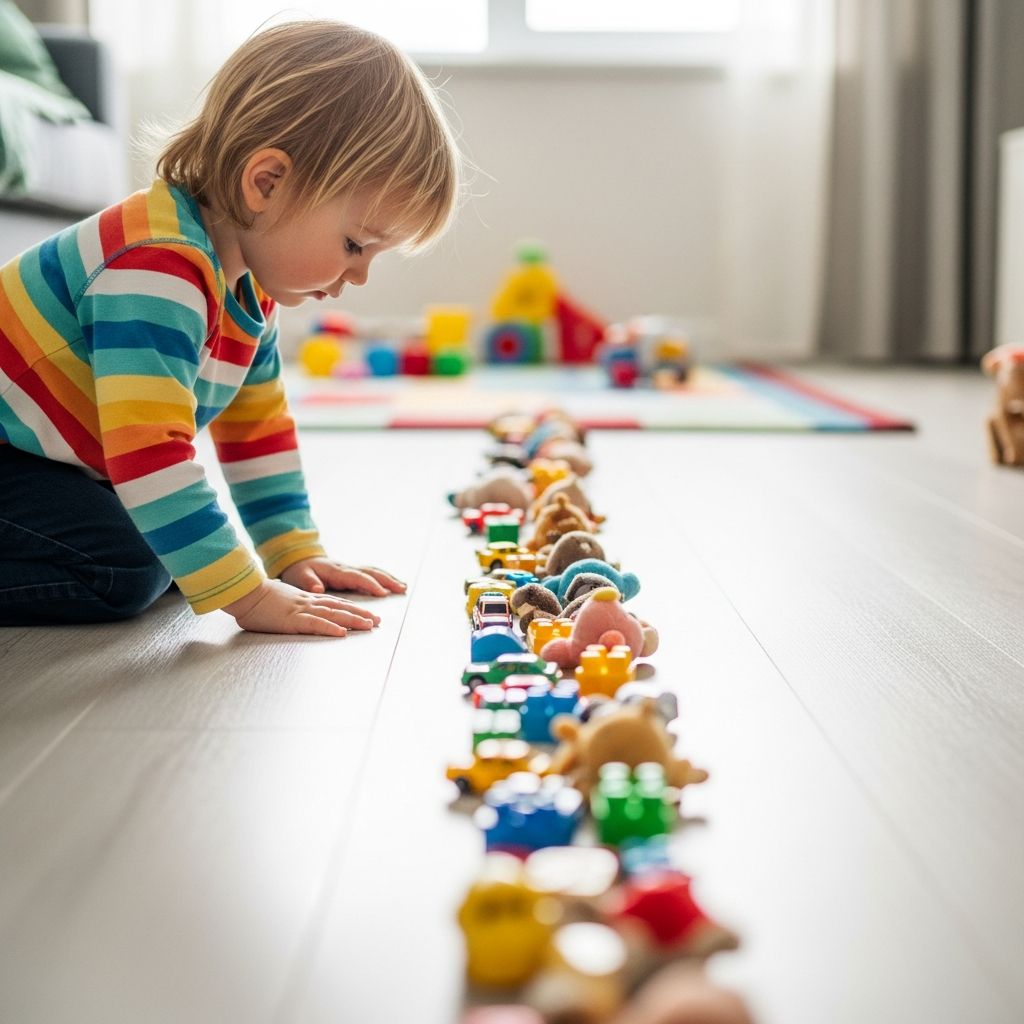
Many toddlers go through a phase where lining up cars, blocks, or stuffed animals becomes their favorite game. For some parents, this is entertaining and adorable; for others, it can trigger anxiety about autism, rigidity, or obsessive behavior. This guide explores what this pattern of play can mean, how to support your child, and when it is worth talking to a professional.
Why Toddlers Love Repetitive Play
Repetition is a powerful learning tool in early childhood. By doing the same action again and again, toddlers gradually gain control over their bodies, refine their problem-solving skills, and build a sense of predictability in a world that often feels chaotic. Lining up toys is one of many repetitive play patterns that can appear between 18 months and 3 years old.
At this age, toddlers are also fascinated by cause and effect. Placing objects in a straight line and seeing the order stay in place can be strangely satisfying. It gives them a way to experiment with shape, orientation, and space using materials they know well, like blocks, small cars, or animal figures.
- Lining up toys can be a way of practicing early math skills, such as sorting, comparing length, and understanding one-to-one correspondence.
- Repetitive sequences often help toddlers feel calmer and more in control, especially during periods of rapid growth or change.
Developmental Skills Behind Lining Up Toys
When a toddler creates a careful row of blocks or cars, several developmental domains are at work. Recognizing these skills can help parents see the behavior as meaningful learning rather than something to worry about automatically.
| Skill Area | How Lining Up Toys Helps |
|---|---|
| Fine Motor | Picking up small objects, rotating them, and placing them precisely in a line strengthens finger and hand control. |
| Visual-Spatial | Arranging toys in a straight or patterned sequence builds awareness of direction, distance, and spatial relationships. |
| Cognitive | Sorting by type, size, or color, and keeping a consistent pattern, encourages early categorization and problem-solving. |
| Emotional Regulation | Repeating a predictable action can be soothing, helping toddlers cope with stress, frustration, or transitions. |
| Early Executive Function | Planning where each toy will go, remembering the pattern, and adjusting if something doesn’t fit lays groundwork for flexible thinking. |
Typical Toddler Behavior: What It Often Looks Like
Lining up toys on its own is usually within the range of typical toddler behavior, especially when it appears alongside a variety of other play styles. Many children move in and out of this phase without any lasting rigidity or difficulty adapting.
For most toddlers, the behavior shows up in ways like these:
- They sometimes line up toys, but also stack, pretend, push cars around, or play with adults and peers.
- They may get briefly upset if the line is disrupted, but can typically recover when distracted or when a caring adult helps them adjust.
- The activity is flexible: the child may change the order, incorporate new toys, or abandon the line to try something different.
- They use eye contact, gestures, words, or sounds to share their creations, even if language is still developing.
When To Pay Closer Attention
While lining up toys can be part of normal development, certain patterns may signal that a closer look is helpful. Behavior that feels extremely rigid or all-consuming may be a sign that your toddler needs extra support or evaluation.
Parents might want to observe more carefully or consult a pediatrician or child development specialist if they notice all or many of the following:
- Lining up toys is almost the only way the child plays, with very little pretend play, exploration, or interaction with others.
- The child becomes intensely distressed if the line is moved, beyond a brief protest, and has difficulty calming down even with gentle help.
- Your toddler rarely tries to share their play (for example, they do not look up to show you the line or seek your reaction).
- There are additional concerns, such as very limited eye contact, lack of response to their name, loss of previously used words, or repetitive body movements.
- Communication seems significantly delayed or different compared with children of a similar age.
Respecting Your Child’s Play While Encouraging Flexibility
Parents often feel torn between letting a toddler enjoy their chosen activity and wanting to prevent rigidity. The goal is not to eliminate lining up toys, but to support more flexible thinking and a broader palette of play experiences.
Here are gentle strategies to balance respect and growth:
- Join before changing: Sit nearby and observe. Comment neutrally on what you see (“You put all the blue cars together”) instead of immediately proposing new ideas.
- Offer small variations: After joining, you might ask, “Should this car go here or here?” or suggest a tiny change, like placing one car facing a different direction.
- Introduce pretend elements: Turn the line into a “parking lot” or a “train at the station,” adding simple stories without disrupting the structure completely.
- Use transitions wisely: Give advance warning before cleanup, and consider taking a photo of the line so your child knows it can be recreated later.
Supporting Language and Social Skills Through Lined-Up Toys
Instead of seeing the line as a barrier to social interaction, parents can use it as a bridge. The toys provide a concrete focus that makes it easier for some toddlers to communicate and share.
- Label what your child is doing (“First car, second car, last car”) to introduce position words and sequencing language.
- Ask simple, open-ended questions: “Which one goes next?” or “Who is at the front of the line?”
- Model turn-taking by asking, “Can I put one car in the line?” and waiting for a yes/no response or gesture.
- Invite siblings to add one or two items, emphasizing respect for your toddler’s basic structure.
Creating a Home Environment That Embraces Order and Creativity
Some toddlers are naturally drawn to order, symmetry, and repetition. Rather than fighting this tendency, families can design everyday routines and spaces that make use of it while still leaving plenty of room for messy, imaginative play.
- Provide toys that can be sorted or arranged, such as blocks, cars, figures, and nesting cups, alongside open-ended materials like playdough or fabric pieces.
- Use simple storage systems (labeled bins or baskets) that appeal to children who like things to “have a place.”
- Alternate structured activities (like lining up blocks by color) with freer creative experiences (like painting or pretend picnics).
- Keep routines predictable—consistent meal, nap, and playtimes can reduce anxiety and decrease the need for extremely rigid play patterns.
Practical Examples of Gentle Redirection
Some moments call for clear limits—such as when your toddler’s lined-up toys block doorways or create tripping hazards. In those cases, you can practice gentle redirection that respects the child’s effort while keeping everyone safe.
- Offer an alternative space: “The cars can make a long line on this mat, not across the hallway.”
- Use visual boundaries like painter’s tape boxes on the floor or a play rug, signaling where lines can be built.
- Turn cleanup into a new pattern: “Let’s line the cars up in the bin” or “Can we make a circle instead of a straight line?”
- Involve your child in deciding: “Should the animals sleep in rows or in little groups tonight?”
When To Seek Professional Input
Trusting parental instincts is important. If something about your toddler’s behavior feels concerning, it is reasonable to ask for guidance instead of waiting and worrying silently. Early conversations do not automatically label a child; they simply open doors to support if needed.
Consider making an appointment with your pediatrician, a developmental pediatrician, or a licensed child psychologist if:
- You notice multiple areas of concern (communication, social engagement, repetitive behaviors, or sensory issues), not just lining up toys.
- Your toddler does not seem interested in sharing experiences with you, even in small ways like bringing you toys or looking for your reaction.
- There has been a loss of skills your child used to have, such as words, gestures, or social responses.
- Daily life is significantly impacted—for example, intense distress over small changes makes routines unmanageable.
Professionals can suggest developmental screenings, early intervention services, or reassurance and monitoring, depending on what they observe.
Frequently Asked Questions
Is lining up toys always a sign of autism?
No. Lining up toys by itself is common in typically developing toddlers and does not automatically mean a child is autistic. Autism evaluations look at a broad picture, including communication skills, social interactions, sensory responses, and patterns of behavior over time. Many children who enjoy arranging toys in lines never receive any developmental diagnosis.
How long does this phase usually last?
The duration can vary widely. Some toddlers move through a lining-up phase in a few weeks, while others return to it off and on for months as a favorite form of play. As long as your child also explores toys in other ways and can tolerate small changes, the timing is usually not a reason for alarm.
Should I stop my child from lining up toys?
In most cases, there is no need to stop the behavior entirely. The aim is to add variety, not to remove something your child finds calming or enjoyable. Setting limits makes sense only when safety, other people’s needs, or daily routines are significantly disrupted.
What if my toddler melts down when the line is disturbed?
Strong reactions are not unusual in young children who are still learning to manage emotions. You can empathize (“You worked so hard on that line”) and then offer comfort and simple solutions, such as rebuilding together or taking a picture. If meltdowns are frequent, prolonged, and difficult to interrupt, bring this up with a pediatrician.
How can I encourage more imaginative play?
Imagination can be gently layered on top of your child’s existing interests. Turn the line into a parade, a train of animals going to the zoo, or a group of cars at a car wash. Offer simple props like scarves, boxes, or toy food to inspire new storylines without taking away the organizing element your toddler enjoys.
Key Takeaways for Parents
Seeing your toddler line up toys is not, by itself, a red flag. It is often a window into how your child thinks, learns, and finds comfort. When parents respond with curiosity, gentle guidance, and attention to the bigger developmental picture, they can support both their child’s unique style and overall growth.
- Lining up toys can reflect emerging skills in fine motor control, spatial understanding, and early logic.
- Varied play, social connection, and flexible responses to change are more important indicators of overall development than any single behavior.
- If concerns persist, professional input is a proactive step that can bring clarity and access to supportive resources.