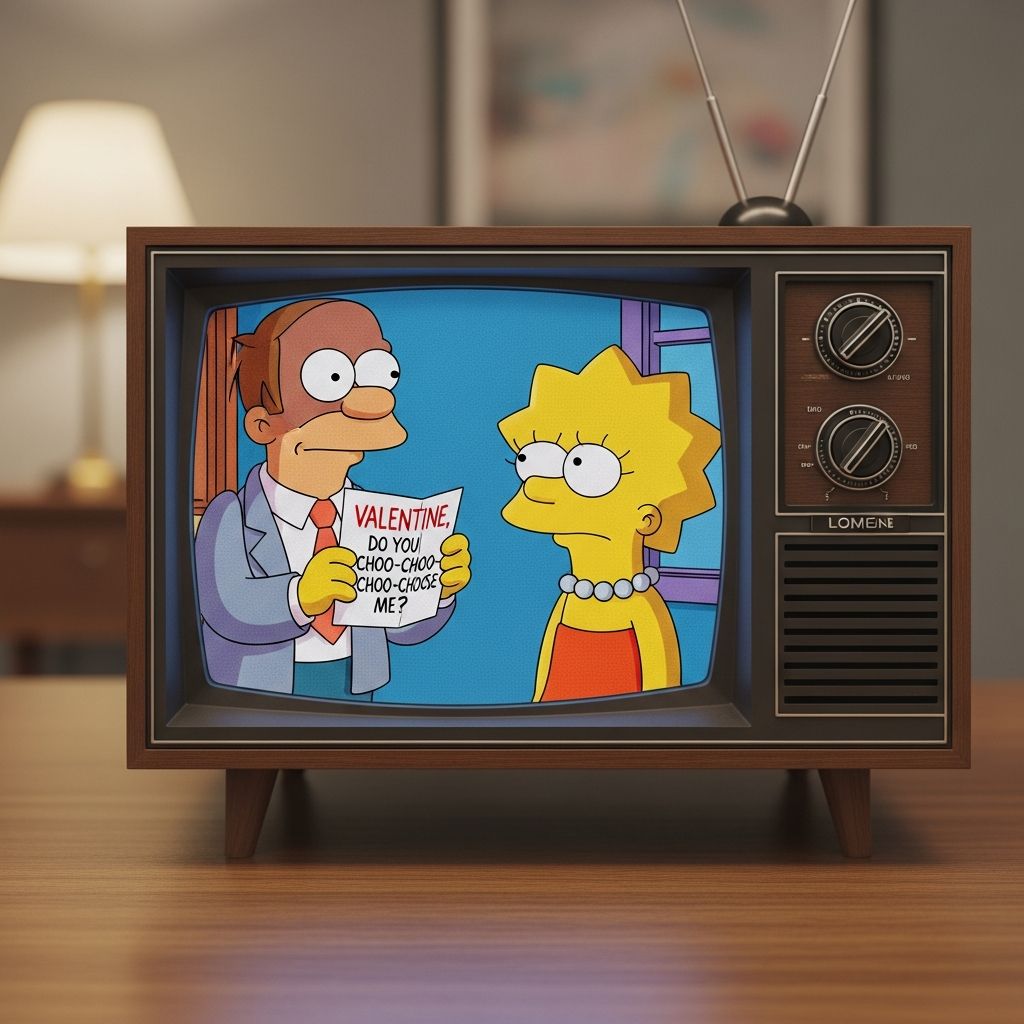
In 1993, The Simpsons aired a Valentine’s Day episode called “I Love Lisa” that looked, on the surface, like a simple classroom-crush comedy. In reality, it became one of television’s most enduring stories about unrequited love, boundaries, and emotional growth in childhood.
Centered on Lisa Simpson and Ralph Wiggum, the episode tackled themes adults often struggle to navigate: pity, unwanted attention, guilt, humiliation, and the painful work of telling the truth when you know it will hurt someone. Decades later, its blend of humor and honesty still feels remarkably modern.
The World Of Springfield On Valentine’s Day
“I Love Lisa” is set in a familiar childhood arena: an elementary school Valentine’s Day card exchange, where personal worth can seem tied to how many cards end up on your desk.
- Lisa starts the day cheerful and confident, expecting the usual pile of Valentines.
- Ralph sits alone, receiving nothing, his isolation visible to everyone in the room.
- Ms. Hoover’s classroom becomes a microcosm of social hierarchy and silent cruelty.
When Lisa sees Ralph’s empty desk, she impulsively offers him a card out of compassion, not attraction. It’s a small decision that spirals into a story about how a kind gesture can be deeply misread.
How One Valentine Turns Into An Obsession
Ralph interprets Lisa’s pity Valentine as a declaration of real affection. From that moment, he dives headfirst into a fantasy of mutual love.
- He follows Lisa around the playground and hallway.
- He starts gifting her presents and making clumsy romantic gestures.
- He constructs a future in his head, convinced they are destined to be together.
Lisa, meanwhile, is trapped between her empathy and her discomfort. She doesn’t want to crush Ralph’s feelings, but she also doesn’t want to be shadowed or claimed by someone she never chose.
Lisa’s Dilemma: Kindness vs. Honesty
The heart of the episode is Lisa’s struggle to balance compassion with self-respect. She has three overlapping fears:
- Hurting Ralph by telling him the truth.
- Being unkind after initially extending a gesture of pity.
- Being dishonest by allowing him to believe a story that isn’t real.
Her guilt intensifies when she benefits from his crush. Ralph gives her tickets to a live Krusty the Clown television special, and Lisa accepts, knowing it will only make him more hopeful.
This dynamic captures something rarely addressed in children’s media: how it feels to be the object of intense, unwanted affection. The show recognizes that attention itself is not always flattering; it can be exhausting and suffocating.
The Krusty Show Meltdown: When Fantasy Shatters On Live TV
The emotional peak of “I Love Lisa” happens during the televised Krusty anniversary special. Ralph, swept up in his own dream, publicly declares his love and promises that he and Lisa will marry someday.
Lisa’s reaction is instant and volcanic. Embarrassed and cornered in front of an audience, she finally snaps. She blurts out that she never liked him that way and only gave him a card because nobody else would.
The scene is painful to watch for two reasons:
- Ralph’s heartbreak is total and visible. His face and posture change in an instant, and the whole of Springfield sees his rejection.
- Lisa’s shame is equally real. She knows she told the truth in the worst possible way and at the worst possible time.
It’s one of the rare moments in mainstream animation where a child’s emotional humiliation is played not just for laughs, but for genuine pathos.
From Humiliation To Growth: Ralph Finds His Voice
After the public rejection, Ralph could have retreated entirely. Instead, the episode gives him an unexpected path: he channels that pain into his role in the school’s President’s Day pageant.
Onstage, Ralph delivers his performance with a newfound seriousness and emotional intensity. His lines resonate because they’re fueled by real heartbreak, not just memorized words.
- He earns respect from classmates who previously mocked him.
- He discovers a place where his feelings can be expressed safely and meaningfully.
- His identity grows beyond “the kid with a crush on Lisa.”
The episode subtly reframes unrequited love not as a dead end, but as a catalyst for self-discovery.
Reconciliation: Redefining The Relationship
After the pageant, Lisa approaches Ralph, recognizing how bravely he performed and how deeply she hurt him.
- She praises his work sincerely.
- She acknowledges, without excuses, that she was cruel.
- She offers friendship—a connection with clear, more realistic boundaries.
The show doesn’t magically restore Ralph’s fantasy or punish Lisa for asserting boundaries. Instead, it lands on a third option: a healthier, less romantic but more truthful bond.
Why “I Love Lisa” Feels So Realistic
Romance in popular media—especially animation—often follows a predictable arc: crush, obstacle, confession, happily-ever-after. “I Love Lisa” refuses that template.
| Typical TV Love Story | “I Love Lisa” |
|---|---|
| Mutual attraction is assumed or guaranteed. | Attraction is one-sided; Lisa never develops romantic feelings. |
| A grand gesture fixes everything. | Ralph’s grand gesture causes public humiliation and forces honesty. |
| The story ends in a relationship. | The story ends in respectful friendship, not romance. |
| Rejection is rare or softened. | Rejection is blunt, painful, and transformative. |
By embracing an uncomfortable truth—that sometimes the most loving thing you can do is say no—the episode models a surprisingly mature emotional literacy for its young audience.
Consent, Boundaries, And Emotional Responsibility
Although the episode predates today’s mainstream conversations about boundaries and consent, its messages align closely with what child development experts now emphasize about healthy relationships.
- Feelings are not obligations. Lisa is not required to reciprocate Ralph’s crush just because he is kind or devoted.
- Kindness can coexist with firmness. It is possible—and necessary—to care about someone’s feelings while also saying, “I don’t want this.”
- Rejection does not erase worth. Ralph is still capable, likable, and worthy of respect, even after being turned down.
Modern guidelines on teaching kids about consent stress the importance of respecting a person’s “no,” recognizing discomfort, and understanding that affection cannot be demanded or owed. While the episode never uses this vocabulary, it dramatizes those principles in a way children can understand.
Why The Story Resonates Across Generations
For viewers who grew up with the episode, “I Love Lisa” often lives in memory as more than a holiday special. It becomes a mirror for their own early encounters with crushes and rejection.
Different audiences tend to latch onto different aspects:
- Kids recognize the sting of being left out—or the anxiety of being overly noticed.
- Teens see more clearly the pressures to “give someone a chance” just because they’re nice.
- Adults appreciate how well the script captures messy, inarticulate feelings with brevity and humor.
The episode also fits into a broader pattern within The Simpsons, where love stories rarely unfold as uncomplicated wish fulfillment. From Homer and Marge’s deeply flawed marriage to Lisa’s future relationships, the show frequently explores how love collides with disappointment, compromise, and self-respect.
What Parents And Caregivers Can Take From The Episode
For adults watching with children, “I Love Lisa” can be a gentle starting point for conversations about emotions and respect. While it is first and foremost a piece of comedy, it opens doors to important topics.
Potential Talking Points
- How do you think Ralph felt when no one gave him a Valentine?
- Why did Lisa give him a card? Was that the right thing to do?
- When does kindness become confusing or misleading?
- How could Lisa have told the truth earlier, in a gentler way?
- Why was Ralph’s performance in the play so powerful?
These questions align with recommendations from child psychology and health organizations, which encourage open family conversations about emotions, boundaries, and respect as kids grow.
Lessons About Unrequited Love From “I Love Lisa”
While told through the lens of an eight-year-old and a class clown, the episode’s emotional beats feel familiar to anyone who has ever liked someone who didn’t like them back—or felt pressured to return affection they didn’t feel.
Key Takeaways
- Unrequited love is common. Having feelings that aren’t returned is a normal part of growing up, not a sign of failure.
- Honesty can hurt but also heal. Lisa’s outburst is painful, but it creates the space for Ralph to grow and for both to reset their relationship.
- Self-worth must stand apart from romance. Ralph’s moment of triumph comes not from “getting the girl,” but from discovering his own talent onstage.
- Friendship can be a real, meaningful ending. The episode doesn’t treat a platonic relationship as a consolation prize; it frames it as a valuable outcome.
Frequently Asked Questions (FAQs)
Q: What season and episode is “I Love Lisa” from?
A: “I Love Lisa” is from Season 4 of The Simpsons. It originally aired in 1993 as the show’s Valentine’s Day episode.
Q: Why is “I Love Lisa” considered such a powerful love story?
A: It’s powerful because it focuses on unrequited love and emotional honesty rather than a neat romantic payoff. The story respects both Lisa’s right to set boundaries and Ralph’s very real feelings, showing how painful but necessary rejection can lead to growth.
Q: Is the episode appropriate for children?
A: The episode was written for a broad audience, like most of The Simpsons, and many kids watch it without issue. However, parents may want to discuss the themes of rejection and embarrassment afterward, especially with younger or sensitive children, to help them process the emotions involved.
Q: Does Lisa ever like Ralph romantically in later episodes?
A: Across the series, Lisa and Ralph occasionally interact, and the show sometimes revisits their dynamic for jokes or brief emotional beats. However, “I Love Lisa” remains the definitive story of their relationship, and Lisa is not portrayed as romantically interested in Ralph.
Q: How does “I Love Lisa” compare to other Simpsons love stories?
A: Unlike episodes about Homer and Marge’s relationship or Lisa’s future partners, “I Love Lisa” stays rooted in childhood emotions. It’s less about long-term partnership and more about the first painful lessons in boundaries, crushes, and respect, which makes it uniquely relatable and tender.
References
- 30 Years Ago ‘The Simpsons’ Told The Greatest Love Story Of a Generation — Fatherly. 2023-02-13. https://www.fatherly.com/entertainment/30-years-ago-the-simpsons-told-the-greatest-love-story-of-our-generation
- This ‘Simpsons’ Episode Was a Masterpiece Based on a Real-Life Story — Collider. 2023-02-14. https://collider.com/the-simpsons-i-love-lisa-real-life-story/
- “The Simpsons” – I Love Lisa (Episode Review) — Jambareeqi. 2018-02-14. https://jambareeqi.com/the-simpsons-i-love-lisa-review/
- The Simpsons, Season Six, Episode Nineteen, “Lisa’s Wedding” — The Avocado. 2019-04-28. https://the-avocado.org/2019/04/28/the-simpsons-season-six-episode-nineteen-lisas-wedding/
- Best Episodes of The Simpsons for Valentine’s Day — Geek’d Out. 2020-02-14. https://geekd-out.com/simpsons-valentines-day/
- Parental Monitoring of Children’s Media Use — American Academy of Pediatrics. 2016-11-01. https://publications.aap.org/pediatrics/article/138/5/e20162591/60524/Media-and-Young-Minds
- Let’s Talk: Discussing Healthy Relationships With Children and Teens — Centers for Disease Control and Prevention. 2022-02-01. https://www.cdc.gov/violenceprevention/pub/teendatingviolence_talking.html