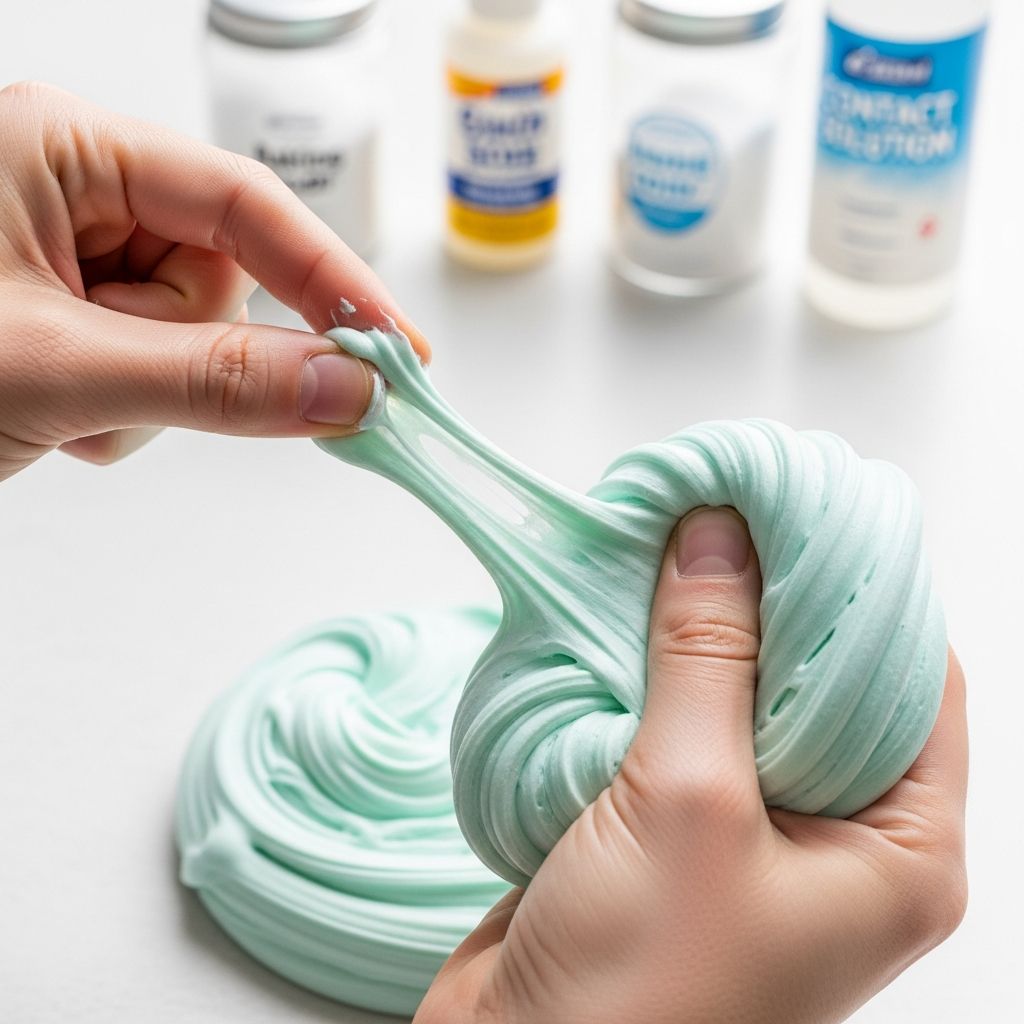
Homemade slime is supposed to ooze, flow, and stretch for what feels like miles. When it snaps, crumbles, or refuses to pull, the fun disappears quickly. This guide explains why slime loses its stretch and how to repair almost any slime texture using simple, kid-safe techniques.
Understanding What Makes Slime Stretchy
Most craft slimes are made from white school glue (a water-based polyvinyl acetate adhesive) plus an activator such as borax solution, contact lens solution with boric acid, or laundry detergent. The activator links glue molecules together into long chains called polymers, which give slime its unique texture.
Stretchy slime sits between a liquid and a solid. Scientists call this a viscoelastic material: it flows slowly like a very thick liquid, but it can also bounce or tear if pulled too fast.
| Component | Role in Slime | Effect on Stretchiness |
|---|---|---|
| Glue (PVA) | Forms the base polymer network | More glue usually means more volume and potential stretch |
| Activator | Cross-links glue molecules | Too little = sticky; too much = rubbery and easy to snap |
| Water | Controls fluidity and softness | More water can soften and increase stretch, but may add stickiness |
| Oils & lotion | Lubricate and plasticize the slime | Help soften stiff slime and improve stretch |
Common Reasons Slime Won’t Stretch
If your slime breaks instead of stretching, one or more of these problems is usually to blame:
- Too much activator – creates a tough, rubbery, easily torn texture.
- Not enough moisture – slime has dried out in open air, especially at low humidity.
- Over-mixing or over-stretching – repeated pulling without resting can make slime feel tight and less elastic.
- Incorrect ingredient ratios – especially if you eyeballed measurements.
- Low-quality or incompatible glue – some craft glues do not form smooth, stretchy polymers.
- Temperature extremes – cold can make slime stiff; strong heat can dry it out.
Safety First: Kid-Friendly Slime Rules
Most stretch-boosting tricks use everyday items like lotion, oil, or extra water. However, some slime recipes use borax powder or borate-containing products as activators. While borax is widely used in household products, health agencies advise limiting children’s direct skin contact and preventing ingestion.
- Always supervise young children when making or playing with slime.
- Keep ingredients and finished slime away from mouths and food.
- Have kids wash hands with soap and water after slime play.
- Store chemicals like borax and detergents out of children’s reach.
- For toddlers who still mouth objects, choose taste-safe sensory play (like cooked pasta or gelatin) instead of traditional slime.
How to Fix Slime That Is Stiff or Snaps
When slime feels like an old rubber band, it usually has too many cross-links or not enough moisture. Try these methods one at a time, testing as you go.
Add a Small Amount of Lotion
Plain, unscented hand or body lotion is one of the easiest ways to soften stiff slime.
- Place the stiff slime in a clean bowl.
- Add half a teaspoon of lotion on top.
- Knead the lotion into the slime with your hands for 1–2 minutes.
- Check the stretch. If it still breaks, add another few drops and knead again.
Lotion acts as a plasticizer—it wedges between polymer chains, allowing them to slide past each other more easily, which improves flexibility and stretch.
Use a Few Drops of Oil
Neutral, skin-safe oils (like baby oil or light cooking oil) can also restore stretch.
- Choose a light oil that will not irritate skin.
- Add just 2–3 drops at first.
- Knead thoroughly before deciding whether to add more.
Too much oil can leave slime greasy and hard to pick up, so always start small.
Rehydrate With Warm Water
If slime has dried out slightly, it may simply need more water.
- Fill a bowl with warm (not hot) water.
- Dip the slime quickly into the water, then remove it.
- Knead the damp slime until the water is absorbed.
- Repeat once or twice if needed, but avoid soaking too long or it can fall apart.
Warm water can temporarily loosen some cross-links and add moisture, which often improves stretch without making the slime overly sticky.
Combine With a Fresh Batch of Soft Slime
If your original slime is extremely over-activated, you can dilute its stiffness by mixing it with a new, under-activated batch.
- Make a small new batch of slime that is slightly sticky.
- Combine equal parts old and new slime.
- Knead until the textures blend into a smooth, stretchy consistency.
This approach averages the cross-link density of the two batches, often leading to a more flexible slime overall.
How to Fix Slime That Is Too Sticky
Slime that flows through fingers and refuses to hold its shape needs a tiny amount of extra activator.
Use Contact Lens Solution Carefully
For recipes that already use contact lens solution (containing boric acid and sodium borate), follow these steps:
- Add 1–2 drops of contact solution onto the slime.
- Knead for 30–60 seconds.
- Only if it is still very sticky, add another drop or two and knead again.
Adding too much contact solution quickly turns stretchy slime into something tough and rubbery, so move slowly and stop as soon as it pulls from your hands.
Dust With Baking Soda (If Your Recipe Uses It)
If the original recipe already includes baking soda, a tiny extra pinch can firm up overly wet slime.
- Sprinkle a very small pinch on top.
- Knead until it disappears.
- Repeat only if absolutely necessary.
Baking soda can support the activation process in borate-based slimes, but overdoing it can create a grainy feel.
Stretch-Boosting Add-Ins for Different Slime Types
Different popular slime styles benefit from slightly different stretch tricks.
Fluffy Slime
Fluffy slime uses shaving cream to add volume and softness. It is naturally airy and may tear more easily if over-activated.
- If fluffy slime is stiff: add lotion or a few drops of oil and knead.
- If it is deflating and losing volume: gently fold in a little more shaving cream, then adjust with activator if it becomes sticky.
- Store in an airtight container because shaving cream can dry out quickly.
Butter and Clay-Based Slimes
Butter slime is usually made by combining finished slime with a soft modeling clay. Over time, the clay can dry out, leaving the slime weak and crumbly.
- Knead in lotion first to soften both the clay and slime.
- If needed, add a few drops of oil until the butter slime spreads smoothly.
- Avoid excess activator; these slimes are already thicker and less elastic than basic glue slime.
Clear Slime
Clear slime shows glitter and confetti beautifully but can be more temperamental.
- Work slowly and avoid intense kneading at first to prevent trapping bubbles.
- Use minuscule amounts of activator when adjusting stickiness.
- If it becomes rubbery, let it rest in a sealed container for a day, then add a few drops of water and massage gently.
Simple, Stretchy Slime Formula (Glue + Saline)
If you want a reliable base slime that tends to be stretchy and easy to fix, this type of recipe is a good place to start. Always adapt quantities to your chosen recipe, but these guidelines help you understand the balance:
- 1 part white school glue
- Small pinch of baking soda (if recommended by the recipe)
- Food coloring (optional)
- Contact lens solution with boric acid, added a few drops at a time
The key to stretch is in the slow addition of the activator. Stir and knead between each small amount. Stop as soon as slime starts pulling together and no longer coats the bowl heavily.
Storage Tips to Keep Slime Stretchy Longer
Even perfectly made slime can turn stiff if stored poorly. Sensory play experts emphasize that air exposure and contamination are the main reasons slime breaks down over time.
- Keep slime in a sealed, airtight container when not in use.
- Store at room temperature; avoid direct sunlight or heaters.
- Have kids play on a clean surface and wash hands first to reduce dirt and crumbs that can roughen the texture.
- If you notice an unusual odor, mold, or color change, discard the slime and make a fresh batch.
Fun Ways to Test Slime Stretchiness
Once you have repaired your slime, try these playful challenges to see how well it stretches.
- Slow pull test: Gently pull slime apart very slowly. Stretchy slime should elongate several times its original length before breaking.
- Table ribbon test: Place one end on the table and pull the other end forward, forming a long ribbon. A smooth, even ribbon means your polymer network is flexible and well-balanced.
- Bubble test: Flatten slime and trap air underneath by folding it. Press gently to see if it puffs into a bubble—this works best with soft, stretchy textures.
Frequently Asked Questions About Stretchy Slime
My slime was perfect yesterday but today it’s stiff. What happened?
Slime slowly loses water to the air and can also tighten as the polymer network settles. Try kneading in a small amount of lotion, oil, or warm water to restore softness and stretch.
Is it safe for kids to handle slime that uses borax or borate-based activators?
Health authorities recommend that borax-containing products be used carefully, kept out of reach of young children, and never ingested. For older kids, occasional supervised play with borate-activated slime followed by thorough handwashing is generally considered acceptable, but always follow product labels and your pediatrician’s guidance.
Why does my slime tear when I pull it fast?
Slime is viscoelastic: it flows slowly but can behave more like a solid when stressed quickly. If you yank it, the polymer chains do not have time to slide, so it snaps. Pulling slowly almost always leads to longer stretches.
Can I fix slime that feels grainy or lumpy?
Graininess often comes from undissolved powder (like baking soda or borax) or dirt. Try kneading thoroughly and adding one or two drops of warm water or oil. If the slime still feels gritty or shows signs of contamination, it is safer to discard and make a new batch.
How long does homemade slime stay good?
With clean play and airtight storage, many families find that slime can last from several days up to a couple of weeks. If it dries out, smells odd, grows visible mold, or irrits skin, dispose of it and start fresh.
References
- Exploring the Properties of Slime — American Chemical Society / ACS Education. 2019-03-01. https://www.acs.org/education/whatischemistry/adventures-in-chemistry/experiments/slime.html
- Polymer Science Learning Center: Slime — University of Southern Mississippi. 2017-06-15. https://pslc.ws/macrog/kidsmac/slime.htm
- Household Products Database: Borax — U.S. National Library of Medicine / NIH. 2021-04-30. https://householdproducts.nlm.nih.gov/chemical/borax
- Borax: health and safety information — European Chemicals Agency (ECHA). 2020-11-10. https://echa.europa.eu/substance-information/-/substanceinfo/100.028.764
- Safe Handling of Slimes and Putty — Royal Society of Chemistry. 2018-10-01. https://edu.rsc.org/download?ac=12625