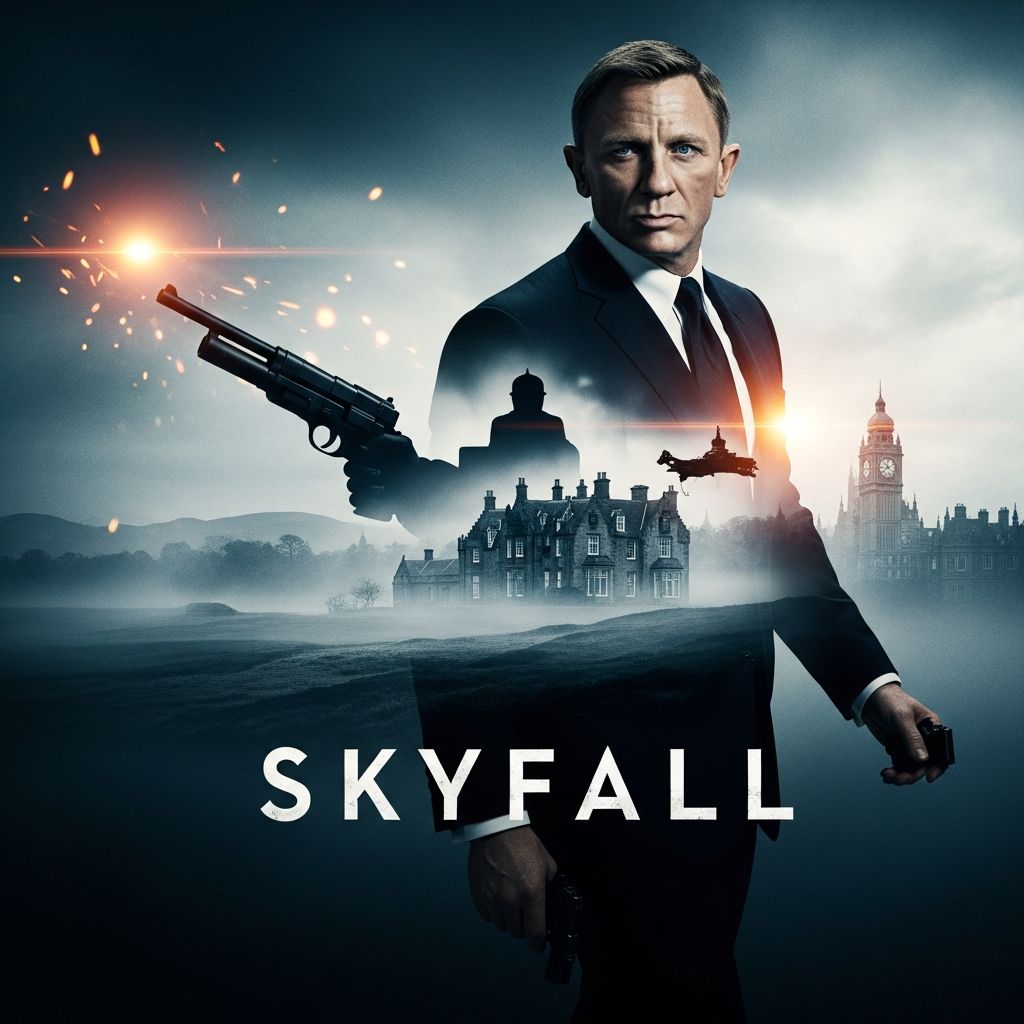
Among the many debates that swirl around the James Bond franchise, one question keeps returning: which film best represents Bond for the modern era? For a growing number of fans and critics, the answer is “Skyfall”, the 2012 installment directed by Sam Mendes and starring Daniel Craig.
Blending large-scale spectacle with character-driven drama, Skyfall manages to feel like both a celebration of Bond’s 50-year legacy and a sharp reinvention of who 007 can be in the 21st century.
The Bond Formula, Broken and Rebuilt
For decades, Bond films followed a familiar rhythm: a pre-credits stunt, a globe-trotting mission, an eccentric villain with a grand plan, and a climactic showdown in a lair that usually explodes. Skyfall keeps some of these elements, but it rearranges and challenges the formula in ways that feel surprisingly fresh.
- Personal stakes replace global doomsday plots.
- M becomes the emotional core instead of just a mission-giver.
- Bond’s weakness is foregrounded rather than hidden behind quips.
- The villain’s plan is targeted revenge, not world domination.
Instead of asking whether Bond can save the world, Skyfall asks whether a scarred, aging agent still has any place in that world at all.
Story in Brief: A Mission That Becomes a Reckoning
Without reproducing the film beat by beat, it helps to outline the broad shape of the story that powers Skyfall:
- A mission in Turkey goes wrong, leaving Bond presumed dead and a list of undercover agents exposed.
- MI6 comes under direct attack in London, putting M and her leadership under intense political scrutiny.
- Bond returns from self-imposed exile, clearly not at his physical best, and is pushed back into service to track the mastermind behind the cyberattacks.
- The villain, Silva, is revealed as a former MI6 operative with a personal vendetta against M, blaming her for his torture and abandonment.
- The conflict ultimately shifts away from high-tech London to Bond’s bleak childhood estate in Scotland, where Bond makes a desperate last stand to protect M and confront his past.
The plot is straightforward, but it is framed to look and feel more complex by tying every major turn to questions of loyalty, aging, and institutional decay.
Bond as a Man, Not a Myth
Earlier incarnations of 007 often portrayed him as nearly invulnerable—always charming, always capable, and rarely introspective. Skyfall turns that on its head by emphasizing Bond’s physical and psychological limits.
Visible Vulnerability
After surviving the failed mission, Bond retreats into a haze of alcohol, pain, and self-destruction, a far cry from the slick playboy image associated with the character. When he returns, medical and field tests show him as slower, weaker, and less accurate—details that the film refuses to gloss over.
- His marksmanship falters.
- His stamina has clearly declined.
- His injuries continue to affect his performance throughout the story.
This approach aligns with a broader trend in modern action cinema: iconic heroes are increasingly depicted with trauma, aging, and moral uncertainty, rather than as flawless symbols.
A Fractured but Enduring Loyalty
Despite his resentment toward M and MI6 for effectively writing him off, Bond returns not out of patriotism alone, but because the work is bound up with his identity. He does not know who he is without the mission. This inner conflict—duty versus self-preservation—adds a melancholy texture to his loyalty that earlier films only hinted at.
M at the Center: A Story About Mothers, Sons, and Sacrifice
One of Skyfall’s most distinctive choices is making M a co-lead. Instead of functioning only as Bond’s boss, she becomes the emotional anchor of the film.
- M faces public hearings about the relevance and ethics of MI6.
- Her past decisions return to haunt her in the form of Silva.
- Her relationship with Bond is framed almost like a stern, distant parent and a damaged child.
This emphasis on intergenerational conflict and surrogate family gives Skyfall a dramatic weight more reminiscent of serious espionage dramas than of the franchise’s campier installments.
Silva: A Villain Built as Bond’s Dark Reflection
Javier Bardem’s Raoul Silva stands out as one of the most memorable Bond antagonists, partly because he is less a cartoonish mastermind and more a painful reminder of what Bond might have become.
Shared Origins, Divergent Paths
Like Bond, Silva once served MI6 in the field, putting his life on the line for queen and country. Unlike Bond, when he was deemed expendable, he broke. His torture, disfigurement, and eventual turn to cyberterrorism underscore the human cost of intelligence work.
| Bond | Silva |
|---|---|
| Loyal to M despite her failures | Consumed by revenge against M |
| Remains in service of the state | Turns his skills against the state |
| Embodies controlled brutality | Embodies theatrical chaos |
This mirroring gives the central conflict a psychological richness that goes beyond good versus evil. The film implicitly asks: how many wrong turns separate a celebrated hero from a bitter, vengeful villain?
Old-School Spies in a Digital Age
A recurring theme across Skyfall is whether analog agents like Bond are obsolete in an era dominated by surveillance, algorithms, and cyberwarfare.
MI6 Under Scrutiny
Government oversight bodies question whether field agents still matter when intelligence can be gathered with satellites and computers instead. This reflects real-world debates following the end of the Cold War and the rise of digital espionage, in which many countries re-evaluated the roles of clandestine services versus technological intelligence systems.
Q vs. 007: Brains and Brawn
The new Q—a young, tech-savvy quartermaster—embodies this changing landscape. In one memorable exchange, he suggests he can do more damage with a laptop before lunch than Bond can in a year with a gun. Yet the film ultimately argues that both forms of power are necessary:
- Q represents data, networks, and remote manipulation.
- Bond represents improvisation, instinct, and moral choice in the moment.
By the climax, digital systems are largely stripped away, forcing the conflict back to a raw, physical confrontation in the Scottish moors.
A Journey Backward: Home, Memory, and the Skyfall Estate
The final act of the film moves away from the high-tech world of London into the wind-scoured isolation of Bond’s childhood home in Scotland. This shift is more than a change of scenery; it is a visual and thematic return to origins.
- The estate, named Skyfall, stands as a crumbling symbol of Bond’s buried past.
- Improvised defenses and booby traps replace the gadgets and sleek cars usually associated with 007.
- The fight is no longer about saving institutions; it is about defending the last remaining pieces of Bond’s personal history.
In narrative terms, this retreat mirrors classic hero myths in which the protagonist must confront buried trauma or unfinished business before being “reborn.” Only after this confrontation—marked by loss and grief—does Bond step into a more familiar, classic status quo at the end.
Visual Storytelling: Why Skyfall Looks So Striking
Skyfall is often singled out as one of the best-looking entries in the entire franchise. Legendary cinematographer Roger Deakins brought a painterly eye to the film’s color, light, and composition, earning the movie an Academy Award nomination for Best Cinematography.
- The neon-lit skyscrapers of Shanghai create a dreamlike backdrop for a near-silent fight sequence, emphasizing silhouettes and reflections.
- The floating lanterns and casino glow of Macau feel almost mythic, turning a simple arrival into a visual event.
- The fiery, smoke-filled finale at Skyfall estate uses silhouettes and stark contrasts to convey chaos and elegy at once.
Deakins’s approach demonstrates how action movies can use color palettes and lighting schemes not only for style, but also to reinforce mood and theme. In Skyfall, modern glass-and-steel cityscapes clash with rugged natural landscapes, subtly echoing the tension between the new world and the old spy.
Celebrating 50 Years While Moving Forward
Released in 2012, Skyfall arrived on the 50th anniversary of the first Bond film, and it is packed with nods to the series’ history while still pointing firmly toward the future.
- Iconic elements—like the Aston Martin, the office layout, and familiar character names—are reintroduced with a fresh twist.
- The ending reorganizes the supporting cast into a configuration that echoes the early films, setting a kind of “soft reset” for whatever comes next.
- At the same time, the emotional consequences of loss and aging are not erased; they become part of Bond’s ongoing burden.
The result is a film that functions both as a tribute and as a manifesto for a darker, more psychologically aware 007.
Why Many Fans Call It the Best Modern Bond
While opinions always vary, several qualities explain why Skyfall frequently appears at or near the top of Bond rankings:
- Balanced tone: It blends serious drama with moments of wit, avoiding both self-parody and relentless grimness.
- Memorable villain: Silva stands out as more nuanced than many past adversaries, with motivations rooted in betrayal rather than mere greed or ideology.
- Emotional core: The relationship between Bond and M gives the story stakes beyond “stop the bad guy.”
- Visual sophistication: The cinematography and production design place it among the most polished entries in the series.
- Thematic resonance: Questions of relevance, aging, and institutional decline mirror real-world conversations about intelligence agencies and national security in the 21st century.
Frequently Asked Questions (FAQs)
Q: Do I need to watch other Bond films before seeing Skyfall?
A: No. Skyfall stands on its own with a self-contained story. Familiarity with earlier Daniel Craig films may deepen your appreciation of his arc, but it is not required.
Q: Is Skyfall more serious than classic James Bond movies?
A: Yes. While it still features action, glamour, and humor, Skyfall leans more heavily into themes of mortality, trauma, and betrayal than many earlier, lighter entries.
Q: How does Skyfall portray MI6 compared to real intelligence agencies?
A: The film dramatizes internal politics and oversight but draws on real post–Cold War debates about the role of human intelligence, technological surveillance, and accountability in democratic societies.
Q: Is Skyfall a good starting point for new Bond viewers?
A: It is an excellent entry point because it combines classic franchise elements with modern filmmaking and deeper character work, giving a clear sense of what James Bond has become in recent years.
Q: Why is the Scottish estate called Skyfall so important?
A: The estate functions as a symbolic return to Bond’s origins, stripping away the gadgets and glamour to confront his past, his fear of loss, and what remains when the job has taken everything else.
References
- Movie Review: “Skyfall” — Literary Analysis. 2012-11-11. https://literaryanalysis.net/2012/11/11/movie-review-skyfall/
- Skyfall Movie Review: Not Just Another James Bond Film — Corey’s Book. 2012-11-29. https://coreysbook.wordpress.com/2012/11/29/skyfall-movie-review-not-just-another-james-bond-film/
- James Bond Retrospective: Skyfall — The Twin Geeks. 2020-04-08. https://thetwingeeks.com/2020/04/08/james-bond-retrospective-skyfall/
- Skyfall (2012) Review — The Action Elite. 2012. https://theactionelite.com/skyfall-2012-review/
- “Skyfall”: The allure of James Bond — Broad Street Review. 2012-11-20. https://www.broadstreetreview.com/articles/skyfall-the-allure-of-james-bond
- Intelligence and Security Committee of Parliament Annual Report 2011–2012 — UK Parliament. 2012-07-12. https://isc.independent.gov.uk/committee-reports/annual-reports/annual-report-2011-2012/