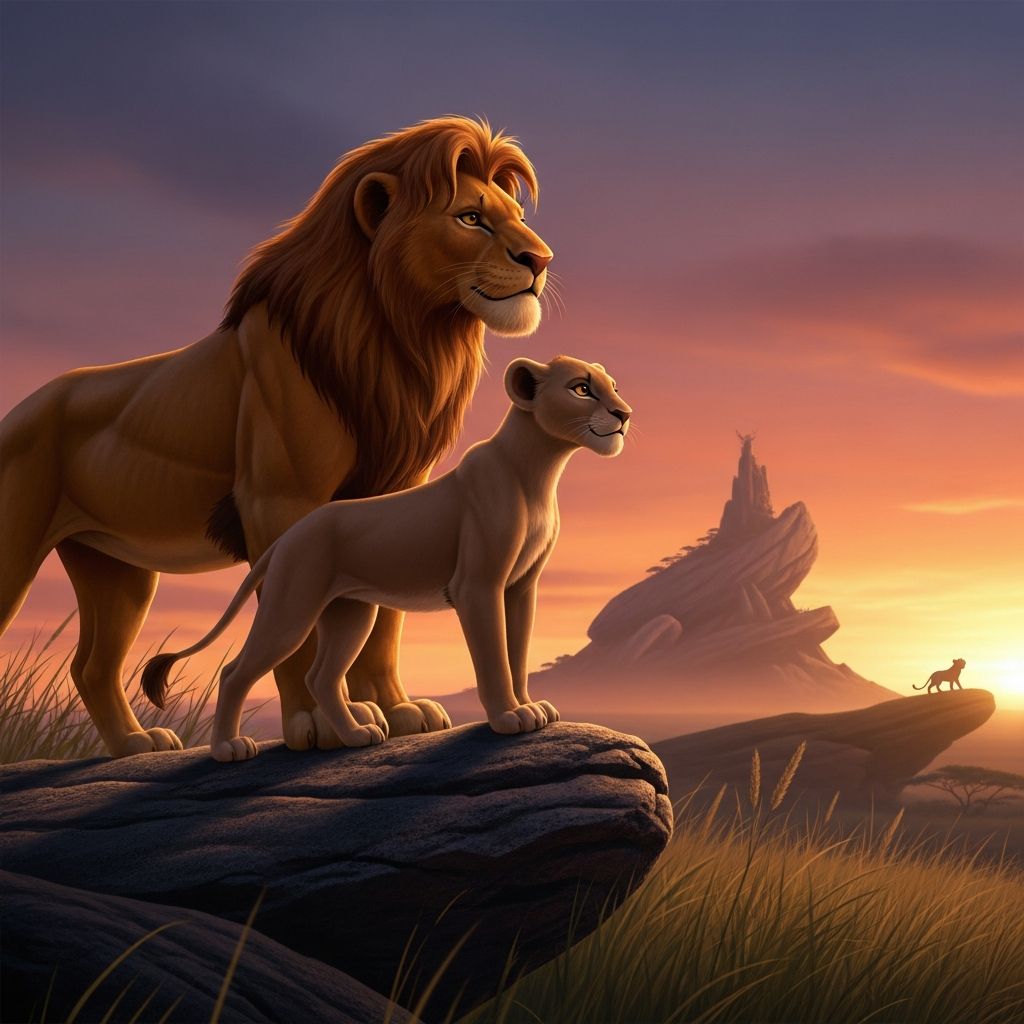
More Than Just a Disney Sequel
When people think of Disney’s The Lion King, they usually picture the original 1994 classic: the sweeping African savanna, the majestic opening of “Circle of Life,” and the tragic arc of Mufasa and Simba. But tucked into the franchise’s history is a direct-to-video sequel, The Lion King II: Simba’s Pride, that has quietly grown into something much bigger than its modest release suggested. What started as a follow-up for younger audiences has, over the years, earned a passionate fanbase and a reputation for tackling surprisingly mature themes with emotional depth and a standout soundtrack.
A Story of Legacy and Division
Simba’s Pride picks up years after the original, with Simba now king and raising his daughter, Kiara, in peace. But that peace is fragile. Simba still carries the weight of his past, and he’s determined to protect his family from the shadow of Scar. To do so, he bans his pride from ever interacting with the Outsiders—Scar’s loyalists, now exiled and led by the vengeful lioness Zira.
This setup turns the sequel into a story about inherited trauma, prejudice, and the cost of holding onto old wounds. Simba isn’t just a hero anymore; he’s a ruler whose fear of history repeating itself shapes his decisions, sometimes in ways that feel harsh or unfair. Zira, meanwhile, is a complex antagonist who sees herself as a protector of Scar’s legacy, raising her son Kovu to be the instrument of revenge.
Kovu: The Reluctant Heir
Kovu is one of the most interesting characters Disney ever created for a direct-to-video sequel. Unlike many Disney villains or antiheroes, he isn’t born evil; he’s raised in an environment that demands he become a weapon. Zira grooms him from cubhood to infiltrate Simba’s pride and destroy it from within, making his journey one of identity, loyalty, and the struggle to choose his own path.
What makes Kovu compelling is that he’s torn between two worlds. On one side is the family that raised him, bound by loyalty and a sense of duty. On the other is Kiara, who represents a different way of living—one based on understanding rather than vengeance. His arc isn’t about becoming a traditional hero; it’s about breaking free from a role he never chose and defining himself on his own terms.
Kiara’s Role as a Bridge
Kiara, Simba’s daughter, is more than just a love interest; she’s the emotional and thematic center of the film. From the start, she’s curious about the world beyond Pride Rock and questions her father’s strict rules. Her relationship with Kovu isn’t just a romance—it’s a deliberate contrast to the hatred that divides the prides.
Where Simba and Zira are locked in a cycle of fear and revenge, Kiara embodies the possibility of reconciliation. She doesn’t deny the past, but she refuses to let it dictate the future. In many ways, she’s the true heir to the “Circle of Life” ideal, showing that leadership isn’t just about strength, but about empathy and the courage to challenge old divisions.
Music That Carries the Weight
One of the most striking things about Simba’s Pride is how much its music does heavy lifting. While the original Lion King is famous for its iconic, almost theatrical songs, the sequel uses its soundtrack to explore internal conflict, loss, and the tension between duty and desire.
Songs like “He Lives in You” and “We Are One” expand on the spiritual and communal themes of the first film, but with a more reflective, sometimes somber tone. The music doesn’t just entertain; it deepens the characters’ inner lives and the stakes of their choices.
“Not One of Us” – A Defining Moment
No song in the sequel captures the emotional core of the story quite like “Not One of Us.” This powerful ensemble piece comes at a turning point: Kovu is publicly rejected by Simba’s pride after being framed for an attack, and the song becomes a chilling expression of exclusion and fear.
The lyrics and arrangement turn a simple exile into a dramatic, almost operatic moment. The pride’s repeated chant of “Not one of us” isn’t just about Kovu; it’s about how groups define themselves by who they exclude, and how easily fear can override compassion. For many fans, this sequence is the film’s emotional peak, and the song has become a standout in Disney’s catalog of ensemble numbers.
How the Sequel Stands Against the Original
Comparing Simba’s Pride to the original Lion King is almost inevitable, but the two films serve different purposes. The 1994 classic is a sweeping coming-of-age epic with a mythic tone, while the sequel is more intimate, focusing on the consequences of that myth and how its legacy shapes the next generation.
Where the original leans into grandeur and spectacle, the sequel often feels more grounded in emotional realism. Simba isn’t just a prince becoming a king; he’s a parent trying to protect his child, sometimes at the cost of his own ideals. That shift in focus gives the sequel a different kind of power—one that resonates more with older viewers who’ve seen how history and family can repeat themselves.
Key Differences at a Glance
| Aspect | Original Lion King | Simba’s Pride |
|---|---|---|
| Tone | Epic, mythic, heroic | Intimate, emotional, conflicted |
| Protagonist’s Journey | Simba: from exile to rightful king | Kiara & Kovu: from division to reconciliation |
| Central Conflict | Good vs. evil, reclaiming the throne | Legacy vs. change, prejudice vs. unity |
| Music Style | Broad, theatrical, celebratory | Reflective, dramatic, ensemble-driven |
| Themes | Responsibility, identity, the Circle of Life | Prejudice, forgiveness, breaking cycles |
Why Fans Keep Returning to the Sequel
Over time, Simba’s Pride has developed a cult following, especially among viewers who first saw it as children and later revisited it as adults. What once seemed like a simple kids’ sequel now reads as a nuanced exploration of trauma, tribalism, and the difficulty of forgiveness.
- Many fans appreciate how the film doesn’t shy away from moral gray areas; Simba and Zira are both flawed, and their choices have real consequences.
- The relationship between Kiara and Kovu is often praised for feeling more emotionally mature than typical Disney romances, built on shared struggle rather than instant attraction.
- The soundtrack, especially “Not One of Us,” has become a fan favorite, frequently shared and discussed online as a standout Disney moment.
Common Questions About the Sequel
Is The Lion King II considered canon?
Within the broader Lion King franchise, Simba’s Pride is generally treated as part of the official continuity, especially in merchandise, games, and later references. It’s not always directly referenced in newer adaptations, but it’s widely accepted as the story of what happens after the original film.
Why does Kovu look different from other lions?
Kovu’s design—especially his dark mane and scar—was meant to visually connect him to Scar, signaling his role as the chosen heir of Scar’s legacy. The scar in particular marks him as someone shaped by violence and expectation, setting him apart from the rest of Simba’s pride.
What happened to the Outsiders after the movie?
The film ends with the Outsiders being welcomed back into the pride, but it doesn’t show their long-term integration. In later spin-offs and expanded universe material, the two groups are generally shown living together, though the scars of the past still influence their dynamics.
Is the music from Simba’s Pride available on streaming?
Yes, the soundtrack for The Lion King II: Simba’s Pride is available on major streaming platforms, including songs like “He Lives in You,” “Love Will Find a Way,” and “Not One of Us.”
Why This Sequel Still Matters
The Lion King II: Simba’s Pride may not have the same cultural footprint as the original, but it holds a special place for those who see it as more than just a follow-up. It’s a story about how the past can trap people, how fear can divide communities, and how the next generation can choose a different path.
Its music, characters, and themes have aged in a way that rewards rewatching, especially for viewers who now recognize the weight of Simba’s trauma, Zira’s grief, and Kovu’s struggle for identity. In an era where Disney often remakes or reboots its classics, Simba’s Pride stands as a reminder that even direct-to-video sequels can offer something meaningful, emotional, and surprisingly timeless.