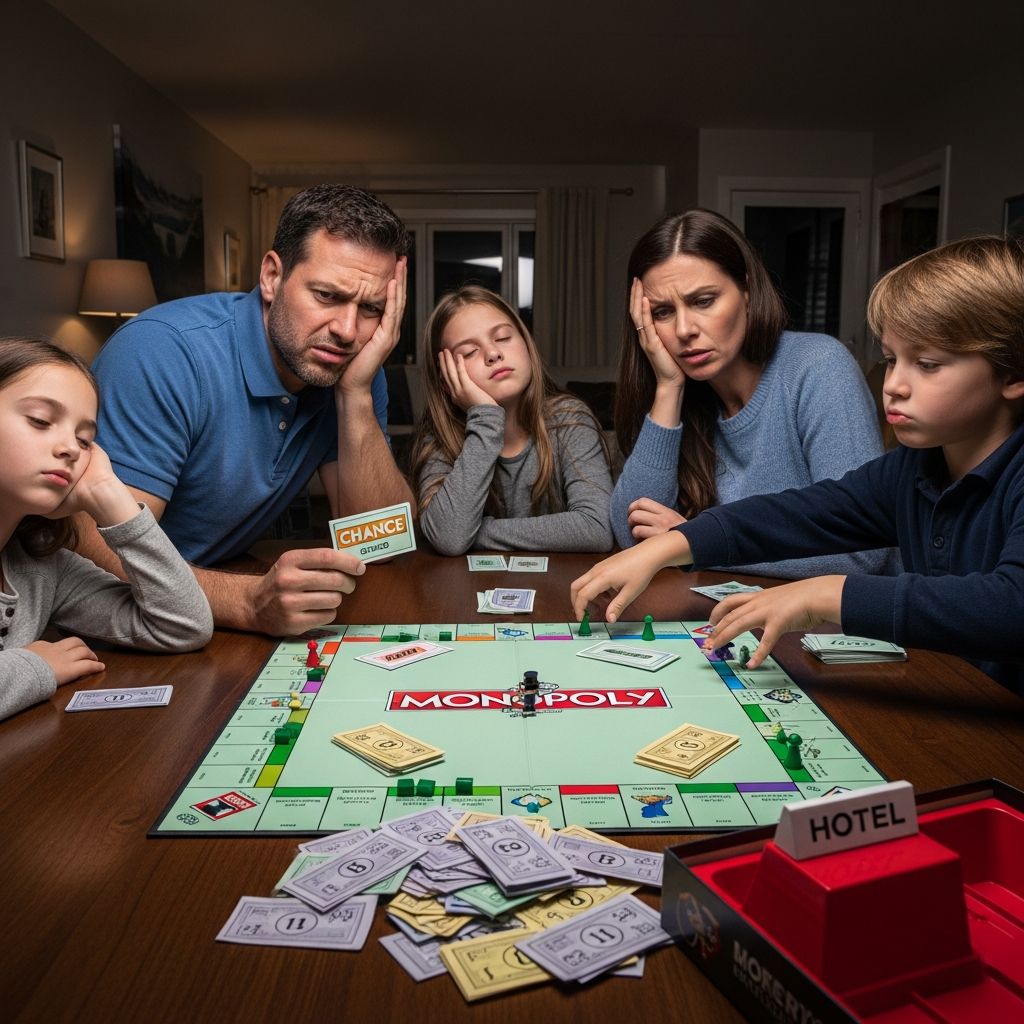
Monopoly is one of the first games many families buy, yet it is also the one most likely to end with slammed doors, hurt feelings, and an abandoned board still littered with paper money. Parents keep returning to it out of tradition and familiarity, but that doesn’t mean it actually works as a wholesome family activity. When the goal is bonding, the design of the game quietly pushes players toward boredom, resentment, and a win-at-all-costs attitude.
This article digs into the hidden flaws in Monopoly’s design, how it shapes kids’ ideas about money and success, and what to play instead if the real goal is laughter and connection rather than financial warfare.
The Myth Of Monopoly As A “Family Classic”
Monopoly’s biggest strength is not that it’s a brilliant game, but that it’s everywhere. It sits on big-box store shelves, appears in movies, and shows up every holiday season in new themed editions. That ubiquity makes it feel like the default, as if “family game night” and “Monopoly” are almost the same phrase.
Familiarity, however, should not be confused with quality. Families reach for Monopoly because they already know the rules, not because it consistently delivers good experiences. When parents think honestly about how these sessions end—someone in tears, a sibling furious about a trade, or everyone giving up two hours in—it becomes clear that the “classic” label hides a lot of predictable misery.
How Monopoly Turns Luck Into A Long, Painful Grind
Almost everything in Monopoly depends on dice. You do not decide where to move; you accept where the dice send you. You cannot meaningfully plan to land on a certain color group or avoid an opponent’s row of hotels. Strategy becomes mostly wishful thinking wrapped in a few obvious decisions like “buy almost everything you land on” and “focus on a full set of properties.”
The problem is not just luck; it is how slowly that luck reveals the winner. In many games, a lucky break ends things quickly, allowing everyone to reset and try again. Monopoly instead stretches the inevitable over countless loops around the board as one player snowballs into a landlord emperor and everyone else slowly bleeds cash. The outcome is obvious long before the game ends, but the rules and social pressure encourage the losing players to keep suffering anyway.
- Each turn mostly repeats the same pattern: roll, move, pay or collect, maybe buy, then wait.
- Players knocked out early sit idle for long stretches while others grind out the final bankruptcies.
- Bad luck early often means hours of playing from behind with no realistic chance of catching up.
Why The Game’s Goal Breeds Resentment, Not Bonding
The official objective of Monopoly is simple: bankrupt everyone else. That means the only way to “win” is to make every other player lose as brutally as possible. Many parents would never describe that as a family value, yet they hand kids a game that rewards ruthlessness and gleeful exploitation of someone else’s misfortune.
Other competitive games still feel friendly because players attack pieces on a board, not each other’s wallets and dignity. Monopoly collapses that distance. The moment a child lands on a hotel and can’t afford the rent, they experience a very personal kind of failure—especially when another player leans in and crows about how much they will collect. It is hardly a surprise that grudges linger long after the board is folded away.
| Design Element | How It Feels In Play | Effect On Family Mood |
|---|---|---|
| Goal: bankrupt everyone else | Encourages targeting the weakest player and celebrating their losses | Fuels resentment, gloating, and lingering hard feelings |
| Elimination of players | Knocked-out kids watch instead of participate | Creates boredom, sulking, and conflict with siblings still playing |
| Slow endgame | Obvious winner keeps squeezing smaller opponents | Makes finishing feel like an exhausting chore, not a victory lap |
The Hidden Messages About Money And Success
Parents sometimes justify Monopoly as a fun way to teach kids about money, investing, and long-term thinking. In reality, it delivers a much narrower and harsher lesson: whoever controls property crushes everyone else. The game does not include wages for honest work, innovation, cooperation, or creativity. Money comes from extracting rent, raiding unlucky neighbors, and clinging to an early advantage until others crack.
Children can easily internalize a few questionable ideas while playing:
- Wealth equals moral superiority. The richest player is constantly praised for “playing well” even when they mostly benefited from good rolls.
- Poverty is personal failure. A child who repeatedly loses may conclude they are “bad with money,” long before they actually understand how finances work.
- Helping others is a mistake. Any generous trade or rent forgiveness usually backfires, teaching kids that kindness has no place in serious competition.
Player Elimination And The Boredom Spiral
Many modern games avoid eliminating players early because designers recognize how quickly boredom leads to drama, especially among kids. Monopoly does the opposite: once a player goes bankrupt, they are done. If that happens thirty or forty minutes in, they may spend more time sulking on the couch than enjoying the evening.
Even those still in the game often disengage. Turns blur together, trades become desperate or spiteful rather than clever, and the mood around the table shifts from excited to tense. Parents may find themselves begging kids to just “finish the game,” which is the opposite of what a fun shared activity should require.
The Rule Confusion That Starts Arguments
Monopoly has spawned an entire culture of “house rules” that most families assume are official. Free Parking jackpots, skipping auctions for unbought properties, money bonuses for landing on Go, and relaxed rules about building houses all fundamentally change how the game plays. Because not everyone grew up with the same modifications, groups frequently spend the first twenty minutes arguing about which version to use.
Even when everyone agrees, vague wording and edge cases trigger conflict. Can someone back out of a trade after realizing they made a mistake? How do you handle a player who “accidentally” forgot to pay rent two turns ago? The game offers few satisfying answers. Parents end up playing referee and rule-writer on the fly, which drains emotional energy that could have gone toward simply enjoying time together.
Why Children Often Take Monopoly Losses So Personally
Kids are still learning how to handle disappointment, especially in front of siblings who might tease them. Monopoly regularly combines three emotional pressure points: losing money, feeling helpless, and being mocked. A single bad roll can wipe out carefully saved cash and properties. When that loss comes with laughter from the winner and no way to bounce back, some children understandably melt down.
From a child’s perspective, Monopoly rarely feels like “just a game.” The visual of sliding stacks of money across the table and mortgaging properties amplifies the sense of failure. Unlike in quick-round games where players can immediately reset and try again, a crushing defeat in Monopoly represents the end of a long investment of time and hope. That is an emotional beating many kids do not want to repeat.
Better Design Principles For Family Games
Families do not need to settle for stressful, drawn-out economic warfare. Over the past two decades, a huge wave of games has emerged that focus on short playtimes, clear choices, and shared excitement instead of protracted punishment. When choosing games, parents can look for a few key traits that dramatically improve the experience for everyone.
- Limited downtime: Turns are quick, and players stay involved even when it isn’t their moment to act.
- Catch-up mechanisms: Trailing players have ways to make meaningful comebacks rather than slogging toward inevitable defeat.
- No early elimination: Everyone plays until the end, so there is no long wait on the sidelines.
- Clear, simple rules: Few edge cases mean fewer arguments and less need for parental arbitration.
- Multiple paths to victory: Kids can try different approaches and feel clever when their own idea works out.
Examples Of Games That Do What Monopoly Tries To Do—But Better
While this article does not rely on one specific source for recommendations, it draws on widely discussed modern board game design ideas to highlight alternatives that fit family needs better than Monopoly. The goal is not to turn every home into a hardcore gaming club but to suggest accessible titles that preserve the thrill of competition without the emotional landmines.
Consider different categories of experiences and what they offer compared to traditional property-trading:
| Goal For The Night | Monopoly’s Approach | Modern Alternative Style |
|---|---|---|
| Light competitiveness | Brutal player elimination and financial domination | Short, scoring-based games where everyone tallies points at the end |
| Teaching money ideas | Narrow focus on rent collection and crushing debt | Games with saving, investing, and trade-offs without humiliating losses |
| Family bonding | One winner, several humiliated losers | Either cooperative play or multiple close contenders at the finish |
- Cooperative adventures: Everyone works together against the game, sharing triumphs and failures without targeting each other.
- Light economic games: Players build small engines or manage resources, but scoring is close and no one gets repeatedly pounded into the ground.
- Quick party-style games: Rounds are short and silly, so no one stays upset for long, even after a loss.
How To Retire Monopoly Without A Revolt
If Monopoly is deeply ingrained as a family tradition, simply banning it might stir up resistance. A better approach is to slowly shift the center of gravity away from it. Parents can keep the box on the shelf as a nostalgic artifact while redirecting energy toward newer, healthier rituals.
Practical strategies include:
- Rotate game choices: Place three different games on the table and let the kids vote. Limit Monopoly to rare “special requests” rather than the default.
- Set time limits: If the family insists on playing, agree beforehand to stop after a fixed duration and tally wealth then, avoiding the miserable late-game squeeze.
- Introduce cooperative nights: Alternate competitive games with nights where the whole family tries to beat a shared challenge.
- Use house rules intentionally: If using custom rules, do so with a clear aim—shorter sessions, fewer arguments, and more chances for kids to catch up.
If You Still Love Monopoly, Play It Differently
Some families genuinely enjoy the drama of cutthroat property wars. If that tension is energizing rather than painful, there is no need to abandon the game entirely. However, even fans can tweak the experience to make it less emotionally damaging for more sensitive players.
Helpful adjustments might include:
- Agreeing that teasing stays light and never targets a person’s intelligence or worth.
- Allowing younger players small advantages, such as an extra starting bonus, to offset inexperience.
- Encouraging bold trades and experimentation rather than punishing every mistake with mockery.
- Ending the session with a quick, silly game that lets everyone reset emotionally before bedtime.
FAQs About Monopoly And Family Game Night
Is Monopoly actually a bad game, or just badly played?
Monopoly is not broken in the sense that its rules fail to function, but it is built around long sessions, heavy reliance on luck, and a win condition that requires grinding opponents into bankruptcy. Those ingredients make the game uniquely likely to create boredom and resentment, especially among children and casual players.
Can Monopoly teach kids useful financial lessons?
Monopoly introduces basic ideas like buying assets and paying rent, yet it frames money primarily as a weapon to crush rivals. It skips over saving, earning a salary, sharing resources, or considering the well-being of others. Families seeking richer, healthier money lessons may want to supplement or replace it with conversations and activities that show more nuanced financial realities.
Why does every game of Monopoly seem to take forever?
The rules allow players to scrape together cash through mortgaging properties and small bursts of income, which delays bankruptcy long after the winner is obvious. Because players must keep circling the board, there is no built-in time limit or natural turning point, so sessions can easily stretch far beyond what kids can comfortably tolerate.
Are there ways to shorten a Monopoly game?
Yes. Common methods include capping the session at a set time and then counting net worth, skipping money on Free Parking, enforcing auctions for any unbought property, and starting with fewer total properties in the deck. These changes speed up the flow but cannot completely remove the game’s harsh focus on bankrupting opponents.
What should replace Monopoly as the “go-to” family game?
There is no single perfect substitute, but families often thrive with a small rotation of cooperative games, fast-paced competitive titles with no player elimination, and simple strategy games that finish in under an hour. The ideal “go-to” game is one your particular family asks to play again because it leaves everyone smiling, not because a familiar box is the only thing on the shelf.
Rethinking What A “Good” Family Game Looks Like
Monopoly’s staying power comes from nostalgia and visibility, not from consistently creating positive experiences. When parents look closely at how its design emphasizes grind, humiliation, and slow-motion defeat, it becomes easier to understand why game night so often falls apart around its board. Families deserve games that encourage clever thinking, healthy competition or cooperation, and emotional safety for everyone at the table.
Retiring or at least demoting Monopoly is not about snobbery; it is about choosing activities that align with the kind of relationships and memories parents hope to build. The next time someone reaches instinctively for that familiar long box, consider asking a different question: not “Who wants to play Monopoly?” but “What should we play tonight that will make us glad we did?”