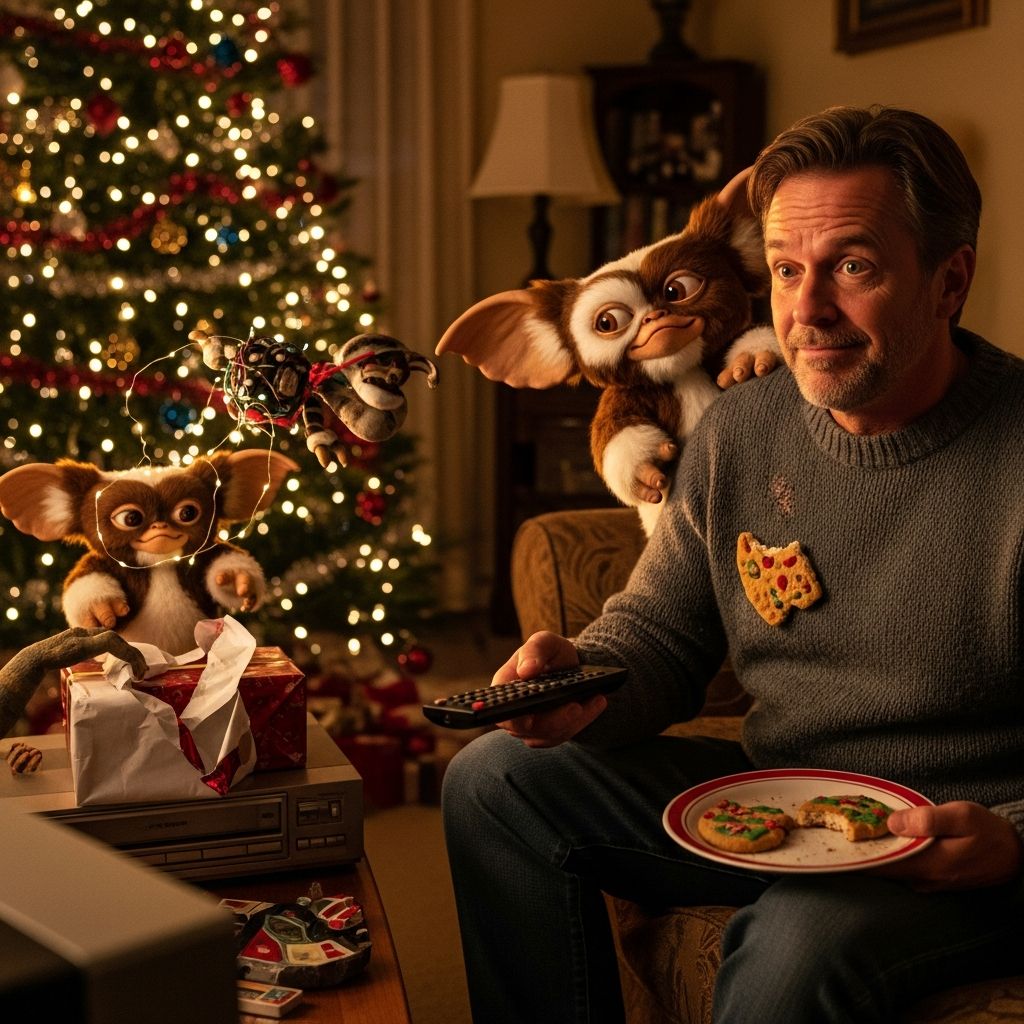
On the surface, Gremlins looks like a mischievous creature feature that just happens to be set at Christmas. Look closer, and it becomes something else entirely: a surprisingly honest, very funny, and oddly heartfelt movie about fathers, sons, responsibility, and what happens when a well-meaning dad brings home the wrong gift.
For modern fathers navigating work, family, and a world that never quite goes according to plan, Gremlins offers more than nostalgic thrills. It is a Christmas movie that understands dads who try hard, fail spectacularly, and keep showing up anyway.
The Offbeat Christmas Classic Dads Never Knew They Needed
When people talk about Christmas movies, they usually reach for sentimental staples: It’s a Wonderful Life, Home Alone, Elf, or animated specials built around Santa. Yet many dads quietly gravitate toward offbeat holiday films like Die Hard or Gremlins, which mix seasonal warmth with chaos, dark humor, and real-world stress.
Gremlins checks a lot of boxes that resonate with fathers:
- A dad who wants to give his kid something special—and totally misjudges the risk.
- A son suddenly saddled with more responsibility than he’s ready for.
- A small town that looks perfect on the surface but hides financial pressure and family tension.
- A Christmas season that feels less like a Hallmark card and more like barely-controlled mayhem.
Instead of a tidy moral wrapped in a bow, the film offers a messier truth: family life is unpredictable, parenting is improvisation, and sometimes the thing you thought would make Christmas magical almost burns the house down.
Rand Peltzer: The Well-Meaning, Frequently Wrong Movie Dad
At the heart of Gremlins is inventor Randall “Rand” Peltzer, one of cinema’s great well-intentioned but unreliable dads. Rather than being cruel, distant, or oblivious, Rand is deeply affectionate—and deeply impractical. He is the dad who believes one grand gesture can fix everything, even when the everyday details are falling apart.
Why Rand Feels So Familiar to Modern Fathers
Rand’s mix of ambition and absent-mindedness will feel familiar to many dads trying to balance work and family.
- He genuinely loves his son. Rand’s entire mission in the opening scenes is to find a unique Christmas gift for Billy, something that says, “You’re special.”
- He believes his work will help his family. Like a lot of parents running a small business or chasing a dream job, he assumes professional success will eventually make everything okay at home.
- He underestimates risk. Rand brings home a living creature with extremely specific care rules—and doesn’t fully grasp the consequences of breaking them.
- He is more visionary than practical. His inventions almost work, but mostly create more mess for other people to clean up.
The result is a portrait of a dad who is neither villain nor saint. He is earnest, flawed, and constantly improvising—much closer to the way fatherhood feels in real life than the hyper-competent superheroes or clownish buffoons that dominate many holiday movies.
The Secret Parenting Manual Hidden in Three Simple Rules
The mogwai Gizmo comes with three famously strict rules: no bright light, no water, and never feed after midnight. On one level, this is creature-feature worldbuilding. On another, it is a parody of the kind of rigid parenting advice modern moms and dads constantly receive: never do this, always do that, or disaster will follow.
| Rule for Gizmo | Unspoken Parenting Parallel |
|---|---|
| Keep him away from bright light | Protect your kids from obvious dangers and overstimulation |
| Don’t get him wet | Prevent situations that multiply your problems (or offspring-level chaos) |
| Never feed after midnight | Set clear, consistent boundaries—even when kids push back |
Every time one of these rules is broken, the consequences feel like an exaggerated version of real parental fears: that a minor mistake will spiral into something you can’t control. The message for dads is not “follow every rule perfectly”—it is that families survive even when you don’t.
From Son to Caretaker: Billy’s Crash Course in Responsibility
While the movie is packed with creature chaos, the emotional engine is Billy’s sudden leap from ordinary young adult to responsible caretaker. Rand hands him Gizmo and, with that, transfers far more responsibility than he fully understands.
For many fathers, this mirrors the confusing season when their own children step into adulthood. Parents must decide how much to guide and how much to let go. Research on emerging adulthood notes that this transition is often uneven, marked by “partial independence” and ongoing family support.
Billy’s experience hits a few key notes dads will recognize:
- He wants to impress his dad and protect his gift.
- He makes understandable but serious mistakes.
- He ends up cleaning up a mess he didn’t fully cause—and couldn’t foresee.
- He proves resourceful and brave in ways his parents never expected.
In other words, he behaves like many teens and young adults: imperfect, but growing up fast when it counts.
Christmas Without the Sugar-Coating
One of the reasons Gremlins sticks with dads is that it shows a Christmas season that feels closer to reality than the flawless glow of many holiday films. The town is charming, but financial strain, corporate power, and family stress simmer underneath the lights and carols.
The Messy Reality of Holiday Expectations
For a lot of parents, Christmas comes with genuine pressure:
- Buying gifts that feel meaningful without wrecking the budget.
- Managing extended family expectations and traditions.
- Protecting kids’ sense of wonder while handling very adult problems.
- Putting on a brave face when work, money, or relationships are fragile.
Studies on holiday stress consistently show that many adults—especially parents—experience significant financial and emotional pressure around Christmas. Gremlins amplifies those tensions through horror-comedy, but the underlying anxieties are familiar: What if you can’t keep everything under control? What if, despite your best efforts, Christmas goes off the rails?
Chaos as a Metaphor for Modern Family Life
When the gremlins finally take over, the movie stops pretending anyone is in control. They overrun the town, wreck property, consume everything in sight, and mock human institutions. On a symbolic level, they look a lot like the parts of life parents can’t domesticate: accidents, bad luck, kids’ wild energy, and the sheer unpredictability of raising humans.
For dads, this can feel strangely comforting. Instead of presenting fatherhood as a test of perfect competence, Gremlins accepts that life with kids will include:
- Broken objects—sometimes sentimental, sometimes expensive.
- Plans that dissolve as soon as they’re made.
- Stress and laughter crashing into each other in the same scene.
- Moments of genuine heroism emerging from everyday people.
The film suggests that being a good dad is not about eliminating chaos, but about responding with courage, creativity, and a sense of humor when it shows up at your front door.
Gizmo vs. the Gremlins: Two Sides of the Parenting Coin
If sassy, destructive gremlins symbolize everything unruly about life, Gizmo stands for the fragile, hopeful side of parenting. He is gentle, wide-eyed, and capable of great bravery—but only when he has the right support.
For fathers, the contrast between Gizmo and the gremlins illustrates a quiet truth: the same environment that nurtures a child’s best qualities can, if neglected or mishandled, unleash their worst impulses. Developmental research often emphasizes how consistent boundaries and secure attachment help children regulate emotions and behavior.
In the movie’s logic:
- Caring for Gizmo requires attention, patience, and respect for limits.
- Creating gremlins only takes a brief lapse in that care.
That exaggerated gap between nurturing and chaos dramatizes how quickly situations can change in family life—and how crucial a steady, engaged adult presence can be.
Why Dads Keep Coming Back to Offbeat Holiday Movies
The enduring appeal of films like Gremlins for dads is not only nostalgia, though the 1980s setting and practical effects certainly help. It is that these movies admit what more traditional Christmas films gloss over: that love and dysfunction, joy and fear, tradition and disruption live side by side in most families.
Compared with other Christmas movie fathers, Rand is unusual. Consider a few popular types of holiday dads:
- The too-busy workaholic who needs a magical wake-up call.
- The grumpy skeptic who must rediscover the Christmas spirit.
- The endlessly competent dad whose only flaw is mild obliviousness.
Rand doesn’t neatly fit any of these categories. He already believes in wonder. He’s not intentionally neglectful or cruel. He is just chronically over-optimistic about his own ideas and deeply under-prepared for the consequences. That blend of faith and failure makes him more human—and perhaps more reassuring—than many polished Christmas patriarchs.
Watching Gremlins as a Dad: A Different Kind of Tradition
As kids, many viewers latched onto the movie’s monsters and mayhem. As adults—and especially as fathers—they pick up new layers. They see Rand trying and missing, Billy stumbling and growing, and a town rediscovering its sense of community under absurdly dire circumstances.
For dads, revisiting Gremlins at Christmas can offer:
- Permission to admit stress. The holidays don’t have to be perfect to be meaningful.
- Space to laugh at parenting failures. Everyone ignores the “rules” sometimes; what matters is how you respond.
- A reminder of why the effort matters. Beneath the chaos lies a genuine desire to make Christmas magical for your kids.
- A shared story with older children. Teens and young adults can relate to Billy’s arc while parents see themselves in Rand.
In a season flooded with polished images, an imperfect, monster-filled Christmas can feel oddly honest—and oddly comforting.
Frequently Asked Questions (FAQs)
Q: Is Gremlins really a Christmas movie or just a horror comedy set in December?
A: It is both. The story is built around a Christmas gift, takes place in a decorated small town, and uses holiday pressures as a backdrop for its chaos. Those seasonal elements are central to the themes of family, responsibility, and unrealistic expectations, which is why many viewers consider it a legitimate Christmas film.
Q: What makes Rand Peltzer different from other Christmas movie dads?
A: Unlike the outright neglectful or magically transformed fathers seen in many holiday stories, Rand is affectionate but impractical from start to finish. He does not need a supernatural intervention to love his family; he needs humility and better judgment. That grounded imperfection is precisely what makes him feel so familiar to many modern dads.
Q: Is Gremlins appropriate to watch with kids as a family Christmas tradition?
A: That depends heavily on the age and sensitivity of your children. The film includes scary scenes, creature violence, and some dark humor. Many parents wait until kids are older tweens or teens before adding it to the holiday rotation and often watch alongside them to talk through anything intense or confusing.
Q: How does Gremlins compare to more traditional Christmas movies about dads?
A: Traditional films often present fathers as either work-obsessed or comically incompetent until a redemptive moment restores holiday harmony. Gremlins replaces that neat arc with something messier: a dad who cares from the beginning, fails in spectacular ways, and never fully gains control—but whose love and effort still matter.
Q: Why do some dads prefer offbeat Christmas movies like Gremlins or Die Hard?
A: Offbeat holiday films lean into the tension, danger, and absurdity that often lurk beneath seasonal cheer. For some fathers, that blend of action, dark humor, and imperfect family dynamics feels closer to their lived experience than purely sentimental stories, making these movies more cathartic and relatable.
References
- Awesome Dad Movies For Any Holiday — Goldberg Jones. 2020-11-17. https://www.goldbergjones-wa.com/everyday-dads/awesome-dad-movies/
- Christmas Movie Dads Need To Do Better — Scary Mommy. 2022-12-05. https://www.scarymommy.com/entertainment/christmas-movie-dads-need-to-do-better
- These Dads Are Doing It Right – Part 19 – Great Dads In Holiday Movies — Art of Fatherhood. 2020-12-21. https://artoffatherhood.net/these-dads-are-doing-it-right-part-19-great-dads-in-holiday-movies/
- The 12 Most Popular Dads of Classic Christmas Movies — Parade. 2020-12-15. https://parade.com/444145/npond/the-12-dads-of-christmas/
- Can You Relate to These Christmas Movie Dads? — Mark Merrill. 2014-12-19. https://www.markmerrill.com/can-you-relate-to-these-christmas-movie-dads/
- Five Greatest Dads of Christmas Movie History — My Merry Christmas. 2018-12-10. https://mymerrychristmas.com/x/five-greatest-dads-of-christmas-movie-history/