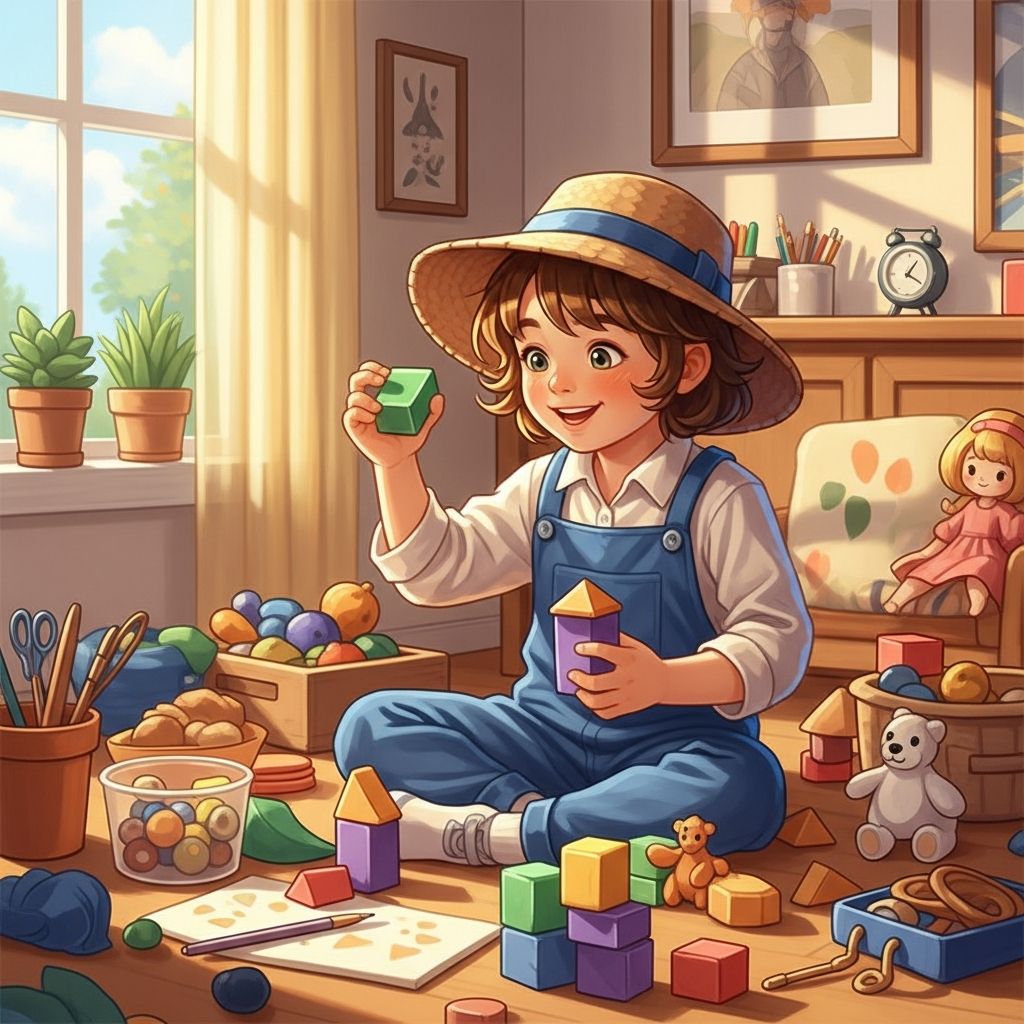
Children are born with a powerful drive to explore, imagine, and invent. When adults protect and nourish this natural impulse through play, creativity becomes the foundation for lifelong learning, problem-solving, and emotional resilience.
This guide explains why creative play matters so much, how it shapes your child’s brain and emotions, and what you can practically do each day to help your child’s imagination flourish.
What Makes Play “Creative”?
Not all play is the same. Some activities train children to follow instructions; creative play invites them to generate ideas, experiment, and express themselves.
Creative play typically includes:
- Imagination – Using pretend scenarios, stories, characters, or worlds that are not literally present.
- Open-ended materials – Objects that can become many things (blocks, boxes, fabric, sticks) instead of single-purpose toys.
- Child-led choices – The child decides what to do, how to do it, and when to change direction.
- Experimentation – Trying, failing, adjusting, and trying again without fear of being “wrong.”
- Self-expression – Using art, movement, building, language, or drama to share inner thoughts and feelings.
Researchers describe this kind of free, child-directed play as essential to healthy brain development and flexible thinking.
Why Creative Play Is a Development Superpower
Decades of research across psychology, education, and neuroscience show that play is not a break from learning; it is a powerful form of learning itself.
| Area of Development | How Creative Play Helps |
|---|---|
| Brain & thinking | Strengthens neural networks for planning, memory, and flexible thinking through open-ended problem-solving. |
| Language | Expands vocabulary and narrative skills as children describe games, negotiate roles, and invent stories. |
| Social skills | Teaches sharing, turn-taking, conflict resolution, and empathy during cooperative or pretend play. |
| Emotional health | Offers a safe way to process fears, frustrations, and big feelings through symbolic play. |
| Physical development | Builds strength, coordination, and fine motor skills in active, hands-on games. |
1. Fuel for Cognitive and Academic Growth
Unstructured play boosts cognitive growth by strengthening the brain’s ability to plan, focus, and adapt. When a child builds a tower that keeps falling, they are experimenting with balance and cause-and-effect. When they invent new rules for a game, they practice flexible thinking and self-control.
Studies highlight that this kind of open-ended exploration strengthens connections in the prefrontal cortex, which supports executive functions such as working memory and problem-solving.
2. A Safe Space for Feelings
Children do not yet have adult language for complex emotions. Play gives them a symbolic language instead. A child might:
- Make a toy figure go to the doctor before their own appointment.
- Use blocks to “rebuild” after a tough day.
- Act out separations or reunions with dolls.
Through these stories, they rehearse coping strategies and gain a sense of mastery. Mental health professionals frequently use play-based approaches because of this natural link between play and emotional processing.
3. Training Ground for Relationships
Play is where children practice being with other people. In cooperative games and pretend scenarios, they learn to:
- Read social cues and adjust behavior.
- Negotiate roles and rules.
- Handle disagreements and repair hurt feelings.
Government and education resources consistently note that play nurtures social skills, empathy, and resilience in everyday interactions.
4. Building Confidence and Agency
In creative play, adults are not providing every answer. The child is the designer, director, builder, or storyteller. That sense of “I can make something happen” is at the heart of healthy self-esteem.
As children experiment and discover that their choices matter, they become more willing to take healthy risks and to persist through challenges—core attitudes that support lifelong learning.
What Gets in the Way of Creativity?
Most parents value creativity, yet modern life often pushes in the opposite direction. Common obstacles include:
- Overscheduled days packed with lessons, sports, and structured activities, leaving little time for free play.
- Screen-heavy routines that consume attention instead of inviting children to invent their own fun.
- Toys that do the work (lights, sounds, single-use features) instead of toys open to imagination.
- Adult pressure for outcomes (a perfect craft, a measurable skill) rather than enjoyment of the process.
- Fear of mess or boredom, which can lead adults to “fix” every quiet moment with entertainment.
The goal is not to remove all structure or screens, but to protect daily pockets of time and space where your child can explore without constant direction.
Principles for Nurturing Creative Play at Home
You do not need a special playroom or expensive materials. What matters most is your attitude and the emotional climate you create.
1. Prioritize Unstructured Time
Unstructured play—where children decide what and how to play—is strongly linked to healthy brain development.
Simple ways to protect it:
- Leave at least one part of the day free of scheduled activities whenever possible.
- Allow “nothing to do” moments without immediately offering screens.
- Resist the urge to rescue your child from boredom right away; boredom often precedes creative breakthroughs.
2. Offer Open-Ended Materials
Think of materials as invitations rather than instructions. Useful items include:
- Blocks, wooden planks, cardboard boxes, and recyclables.
- Scarves, fabric pieces, hats, and simple dress-up accessories.
- Crayons, markers, tape, child-safe scissors, glue sticks, and paper.
- Natural objects like sticks, stones, leaves, and shells.
Research on creative play notes that when materials can be used in many ways, children show more problem-solving and more original ideas.
3. Follow, Don’t Lead
Children learn most from play when they can guide it themselves.
In practice, this can mean:
- Sitting nearby and observing before you join in.
- Asking, “Can I play too? What should I be?” instead of assigning yourself a role.
- Letting go of your expectations about how a toy “should” be used, as long as it’s safe.
4. Ask Questions That Spark Thinking
Swap praise for curiosity. Instead of “What a beautiful drawing!” try questions that invite deeper thought, such as:
- “What’s happening in your picture?”
- “How did you figure out how to make that stay up?”
- “What might happen if we add one more block here?”
This kind of dialogue supports language development and encourages children to reflect on their own thinking.
5. Make Space for Mess and Mistakes
Creativity is inherently messy and uncertain. Children need emotional permission to:
- Try an idea that might not work.
- Change their mind halfway through.
- Start again after something “fails.”
When adults respond calmly to spills, torn paper, or wobbly creations, children learn that experimenting is safe and valued.
Age-by-Age Ideas for Creative Play
Every child is unique, but the kinds of play that support creativity evolve as they grow.
Infants (0–12 months): Sensory Explorers
- Offer safe objects with different textures, shapes, and sounds.
- Sing and use simple finger plays; vary your voice and expressions.
- Place mirrors, high-contrast images, or soft scarves nearby for visual exploration.
Even at this age, babies are building early pathways for curiosity and attention through playful interactions.
Toddlers (1–3 years): Little Experimenters
- Provide stacking cups, blocks, and containers to fill and dump.
- Invite pretend play with stuffed animals, toy kitchens, or simple dolls.
- Use large crayons or washable paint on big paper taped to the table or floor.
Toddlers learn about cause-and-effect and begin simple symbolic play (a block as a car, a spoon as a microphone).
Preschoolers (3–5 years): Storytellers and Builders
- Encourage dress-up and role play (family, shop, doctor, superhero).
- Set out building materials for forts, cities, or imaginary worlds.
- Invite them to dictate stories while you write, then act them out together.
At this stage, research shows that pretend play strongly supports language, self-regulation, and social understanding.
School-Age Children (6+ years): Makers and Designers
- Offer simple tools for making things: cardboard, tape, string, basic craft supplies.
- Encourage collaborative games where children can invent or modify rules.
- Support longer projects (a comic series, a model, a homemade board game).
As children grow, creative play can blend with early STEM thinking—designing, testing, and revising ideas in hands-on ways.
Balancing Screens and Imagination
Digital devices are part of modern life, but they can crowd out the open-ended play that creativity needs. Health and education experts recommend prioritizing active, imaginative play for young children and using screens thoughtfully.
Consider these approaches:
- Set clear daily limits for passive screen time, especially before bed.
- Choose high-quality, age-appropriate content when screens are used.
- Connect digital and physical play (drawing a character they saw, acting out a story, building something inspired by a show).
The key question is whether your child is mostly consuming entertainment or creating ideas of their own.
Helping Anxious or Perfectionist Children Loosen Up
Some children worry about “doing it right” and may avoid new or messy activities. Gentle support can help them rediscover playful curiosity.
- Model mistakes – Say out loud when your own plan changes: “That didn’t work how I expected. Let’s try another way.”
- Focus on process – Comment on effort, choices, and strategies rather than appearance or performance.
- Offer low-pressure invitations – Provide materials without directing exactly what to make.
- Stay nearby – Your calm presence can make experimentation feel safer.
Frequently Asked Questions (FAQs)
How much creative play does my child need each day?A: There is no single number, but many experts encourage ensuring daily periods of free, child-led play—ideally at least 30–60 minutes spread throughout the day for young children, with more time when possible.
Q: Does creative play really help with school success?
Yes. Research links play with stronger language, problem-solving, self-regulation, and social skills, all of which support later academic achievement.
My child just wants screens. How do I shift toward more imaginative play?
Start gradually by setting predictable screen limits, offering appealing hands-on materials, and joining your child in simple pretend or building games so that real-world play feels connected and fun rather than like a punishment.
What if I’m not a very “creative” parent?
Your child does not need you to be an artist or entertainer. They mainly need time, space, basic materials, and a warm adult who is curious about their ideas and willing to follow their lead.
Are organized activities and lessons bad for creativity?
Structured activities can be valuable, especially when they allow room for experimentation. Problems arise only when scheduled obligations leave little or no time for self-directed play.
References
- Supporting Children’s Learning Through Play — ChildCare.gov (Office of Child Care, U.S. Administration for Children & Families). 2022-04-01. https://childcare.gov/consumer-education/support-my-childs-health-development/supporting-childrens-learning-through-play
- The Power of Play: 6 Benefits for Child Development — Edmonton Public Library. 2020-08-10. https://www.epl.ca/blogs/post/importance-of-play-for-kids/
- The Importance of Creative Play for Kids — The Little Gym. 2019-06-15. https://www.thelittlegym.com/blog/the-importance-of-creative-play-for-kids/
- Creative Play: Benefits, Ideas & Strategies for Early Childhood — Structural Learning. 2023-03-21. https://www.structural-learning.com/post/creative-play
- Why Creativity Is Important in Early Years Child Development — MFFY Early Years. 2022-11-02. https://www.mffy.com/blog/why-creativity-is-important-in-early-years-child-development
- Creative Playtime: How It Boosts Early Learning — Little Scholars NYC. 2021-05-18. https://littlescholarsnyc.com/creative-playtime-how-it-boosts-early-learning/
- The Role of Play in Child Development: Benefits and Tips — Pediatricians, Inc. 2023-04-12. https://www.pediatriciansincorporated.com/blog/1203304-the-role-of-play-in-child-development-benefits-and-tips