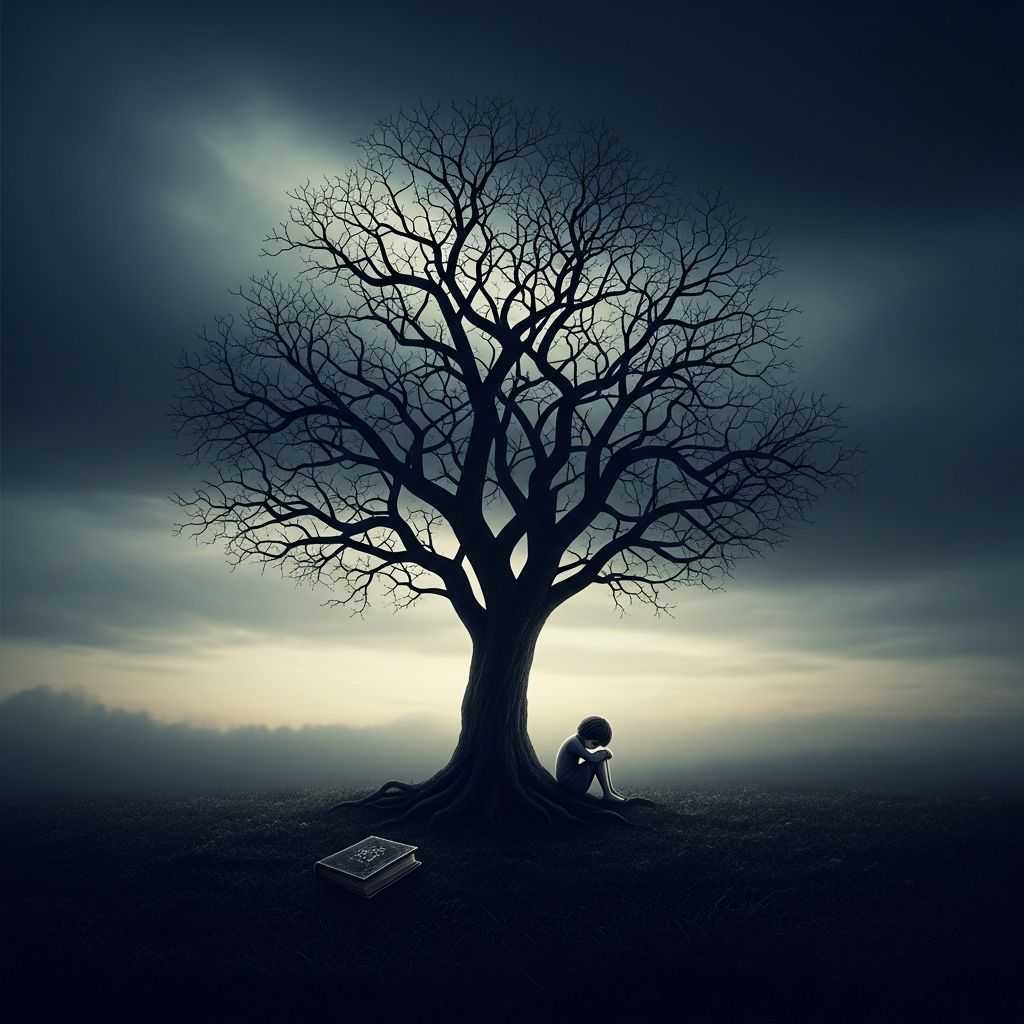
In the final chapter of A Series of Unfortunate Events, the over-the-top villain Count Olaf leaves the story with a strangely literary exit line. He quotes part of Philip Larkin’s notorious poem This Be the Verse, a poem famous for its brutal honesty about how parents damage their children. That choice is not just a clever Easter egg for English majors; it reframes the whole series as a story about how adults fail kids, and how children decide what to do with that pain.
Count Olaf’s Last Words: A Villain Quoting Poetry
In the Netflix adaptation and in the final book, Olaf’s dying words echo the closing lines of Larkin’s poem: a bleak statement that misery is passed from one generation to the next, and a warning not to have children at all. Olaf, who has spent thirteen books trying to exploit and torment three orphans, ends by voicing a worldview that says children are better off never being born.
That one reference does several things at once:
- Links a kid’s series to a very adult poem that famously opens with a profanity-laced complaint about parents.
- Hints at Olaf’s own backstory as someone who likely grew up damaged and unloved.
- Crystallizes a major theme of the series: adults inevitably hurt children, sometimes by accident, sometimes deliberately.
It is a strange, elegant choice: the monstrous guardian of the Baudelaires dies quoting a poem that blames guardians for wrecking their children.
The Poem Behind The Line: Philip Larkin’s “This Be the Verse”
Philip Larkin’s poem This Be the Verse, first published in 1971, is one of the most quoted and controversial poems in modern English literature. It begins with an accusation that parents inevitably harm their children, not always out of malice but because they themselves were harmed when they were young. Larkin suggests a chain of damage: each generation passes along some new layer of misery, like geological strata building up over time.
By the final stanza, the poem turns from diagnosis to a kind of dark prescription: if you want to avoid continuing the chain, do not have children at all. Biographers and critics have often connected this sentiment to Larkin’s own life. He never married or had children, and his letters and interviews show a longstanding distrust of family life and conventional domestic happiness.
When Olaf repeats the poem’s closing idea, he is borrowing more than just words. He is adopting, in a moment of extremity, Larkin’s suspicion that bringing new life into the world is an act tied up with inevitable harm.
Why A Children’s Story Quotes A Poem That Swears At Parents
On the surface, A Series of Unfortunate Events is a gothic comedy about three unlucky orphans chased by a greedy count. Underneath, it is a story about what happens when every adult meant to protect you fails in a different way: corruption, incompetence, distraction, cowardice. The Larkin poem acts like a decoder ring for that hidden layer.
By choosing this specific poem, the story sends several coded messages to adult viewers and older readers:
- Parents are not spared criticism. The series refuses to pretend that adults are always wise, kind, or competent.
- Harm is often inherited. Olaf is not a random monster; he is a product of a damaged past that the story only hints at.
- Literature is a way to talk about painful truths. A single quoted stanza brings in decades of debate about generational trauma, all without a lecture.
For younger viewers, Olaf’s line simply sounds ominous. For adults who recognize the reference, it becomes a dark, wry commentary on the whole project of parenting.
Parents, Damage, and The Chain Of Misery
Modern psychology and public health research increasingly supports the broad intuition Larkin expressed in his poem: what happens to children in their families shapes mental and physical health across a lifetime. Exposure to abuse, neglect, or household dysfunction in childhood—often called adverse childhood experiences (ACEs)—is associated with higher risks of depression, substance use, heart disease, and many other problems in adulthood.
However, the poem’s blunt cynicism only tells part of the story. Where Larkin suggests that misery simply accumulates, contemporary research also emphasizes the power of resilience, support, and intervention. Children who have at least one stable, caring relationship with an adult are far more likely to cope successfully with early adversity.
In that sense, Olaf’s quote is only half-true. Yes, misery can be handed down, but it is also possible to interrupt the chain.
How Fiction Shows Generational Harm
Olaf himself is an exaggerated portrait of what happens when that chain is not broken. Canon materials outside the Fatherly article depict Count Olaf as a serial criminal and arsonist who becomes the Baudelaires’ abusive guardian in order to access their inheritance. He is not just greedy; he is also a failed caregiver, someone who uses his legal role as a guardian to exploit children instead of protect them.
Across the books and episodes, we meet other adults who, in milder ways, pass along harm:
- The polite banker who is too busy to listen carefully to the children.
- Guardians who care but are naive, failing to see danger until it is too late.
- Officials who hide behind rules and paperwork instead of acting to help.
Each adult will claim they meant well. Larkin’s poem would reply that good intentions are not enough to prevent damage.
Where Larkin’s Poem And Lemony Snicket Disagree
It is important to notice that while the series quotes Larkin approvingly, it does not fully endorse his conclusion. Larkin says, in effect, “Parents ruin children; the only solution is to stop having children.” Olaf, who has spent his life exploiting children, happily agrees. The story itself quietly argues something different.
| Aspect | Larkin’s Poem | Lemony Snicket’s Story |
|---|---|---|
| View of parents | Parents inevitably harm their children. | Adults often fail children, but some try hard to do better. |
| Solution to inherited harm | Do not have children. | Recognize harm, act differently, protect the next generation. |
| Fate of children | Trapped in a cycle of increasing misery. | Capable of courage, kindness, and resistance despite harm. |
| Role of love | Implied to be ineffective; hurt dominates. | Love cannot erase tragedy but it matters in how kids respond. |
The Baudelaires inherit loss, danger, and betrayal, but they also inherit skills, stories, and a sense of moral responsibility. Instead of refusing to bring new life into the world, the series shows children who, despite everything, grow into the kind of people who might one day choose to be better parents.
What Olaf’s Final Quote Reveals About Him
Olaf’s choice of last words is revealing. Rather than expressing regret or apologizing, he turns outward and condemns the idea of children altogether. Beneath the bravado, this suggests a few things:
- He sees himself as a victim first. Even in death, he frames the world as something that has hurt him, not something he has hurt.
- He cannot imagine parenting without harm. Since love and care were likely scarce in his own life, he sees only risk in bringing new children into the world.
- He confuses understanding with excuse. Recognizing that misery is inherited, he uses that as a reason to stay cruel rather than a reason to change.
In that sense, the poem becomes a villain’s shield. Olaf uses a literary insight as a way to avoid responsibility. The Baudelaires, by contrast, treat painful knowledge as a reason to act more carefully and more compassionately.
How Parents Can Hear The Poem Without Giving Up
For actual parents, Larkin’s poem can land like a punch: it bluntly says that you will hurt your children no matter what, just as your own parents hurt you. The series, by placing those words in Olaf’s mouth, invites parents to take a different path. Instead of hearing the poem as a command to avoid children, they can hear it as a warning to be more deliberate.
Here are a few practical ways to respond to the poem’s challenge in real life, grounded in research on child development and resilience.
- Notice the patterns you inherited. Reflect on which parts of your own upbringing you do not want to repeat, and name them openly.
- Prioritize secure attachment. A consistent, responsive relationship with at least one adult is a powerful protector against adversity, even when other stresses are present.
- Seek support when needed. Therapy, parenting classes, or community groups can offer tools for breaking harmful cycles before they reach your kids.
- Apologize and repair. Research on family relationships shows that rupture is not the end of the story; honest apologies and efforts to make amends are central to healthy bonds.
The hard truth in Larkin’s poem is that no parent is perfect. The hopeful truth in Snicket’s world is that imperfection does not have to become cruelty.
Why Dark Jokes Belong In Stories For Kids
At first glance, slipping a famously profane poem into a children’s series looks like a stunt. But children’s literature has a long tradition of using dark humor and exaggerated villains to explore real anxieties. From the wicked stepmothers of classic fairy tales to more modern figures like Count Olaf, extreme adult characters make it easier for kids to think about loss, fear, and injustice at a safe distance.
Scholars who study children’s stories note that fantasy and exaggeration let young readers engage with frightening ideas indirectly, helping them process fears that might be overwhelming in realistic form. In that context, Olaf’s lyrical last words are less about teaching kids to hate parents and more about teaching them:
- That adults can be wrong, and that noticing this is not a betrayal.
- That unfairness and suffering exist, even if we wish they did not.
- That courage, cleverness, and solidarity with siblings and friends matter.
By refusing to shield children entirely from darkness, the series treats them as capable moral thinkers, not just passive recipients of comforting stories.
FAQs About Count Olaf, The Poem, And Parenting Themes
Is Philip Larkin’s poem really appropriate for a children’s series?
The full poem includes strong language and a bleak recommendation not to have children, so it is aimed at adults. The series uses only a fragment and never quotes the most explicit lines, turning it into a subtle reference that most younger viewers will miss but that adults can appreciate.
Does quoting the poem mean the story agrees people should not have kids?
No. The poem’s conclusion is voiced by Count Olaf, the most selfish adult in the story. The Baudelaires’ loyalty to each other, and the presence of caring adults elsewhere in the series, suggest that the author values family and sees the possibility of doing better rather than abandoning parenthood.
How does Count Olaf represent failed parenting?
Olaf becomes the Baudelaires’ legal guardian but uses that power entirely for his own gain, exposing them to danger, neglect, and psychological abuse while trying to steal their fortune. He is a caricature of every way a caregiver can exploit a child: physically, emotionally, and financially.
Is there any hope in such a pessimistic-sounding series?
Yes. While the events are grim, the Baudelaires consistently choose kindness, ingenuity, and loyalty. The story acknowledges that adults fail and tragedies occur, but it also honors children’s ability to face hardship without becoming cruel themselves.
What can real parents learn from this dark joke about inherited misery?
Parents can use it as a reminder that their own unresolved pain can spill over into how they treat their children. Instead of giving up, they can seek help, talk honestly about mistakes, and focus on building strong, supportive relationships that buffer kids from the worst effects of adversity.
References
- This Be the Verse — Philip Larkin / Poetry Foundation. 2023-05-01 (page last updated). https://www.poetryfoundation.org/poems/48419/this-be-the-verse
- Adverse Childhood Experiences (ACEs) — Centers for Disease Control and Prevention. 2022-04-06. https://www.cdc.gov/violenceprevention/aces/index.html
- Supportive Relationships and Active Skill-Building Strengthen the Foundations of Resilience — Center on the Developing Child, Harvard University. 2015-07-01. https://developingchild.harvard.edu/resources/supportive-relationships-and-active-skill-building-strengthen-the-foundations-of-resilience/
- Count Olaf Character Analysis — LitCharts. 2019-01-01. https://www.litcharts.com/lit/the-bad-beginning/characters/count-olaf
- Why We Tell the Story: The Functions of Fiction — FalWriting, Falmouth University. 2018-05-25. https://falwriting.com/new-blog/2018/5/25/for-fathers-day-six-great-literary-dads