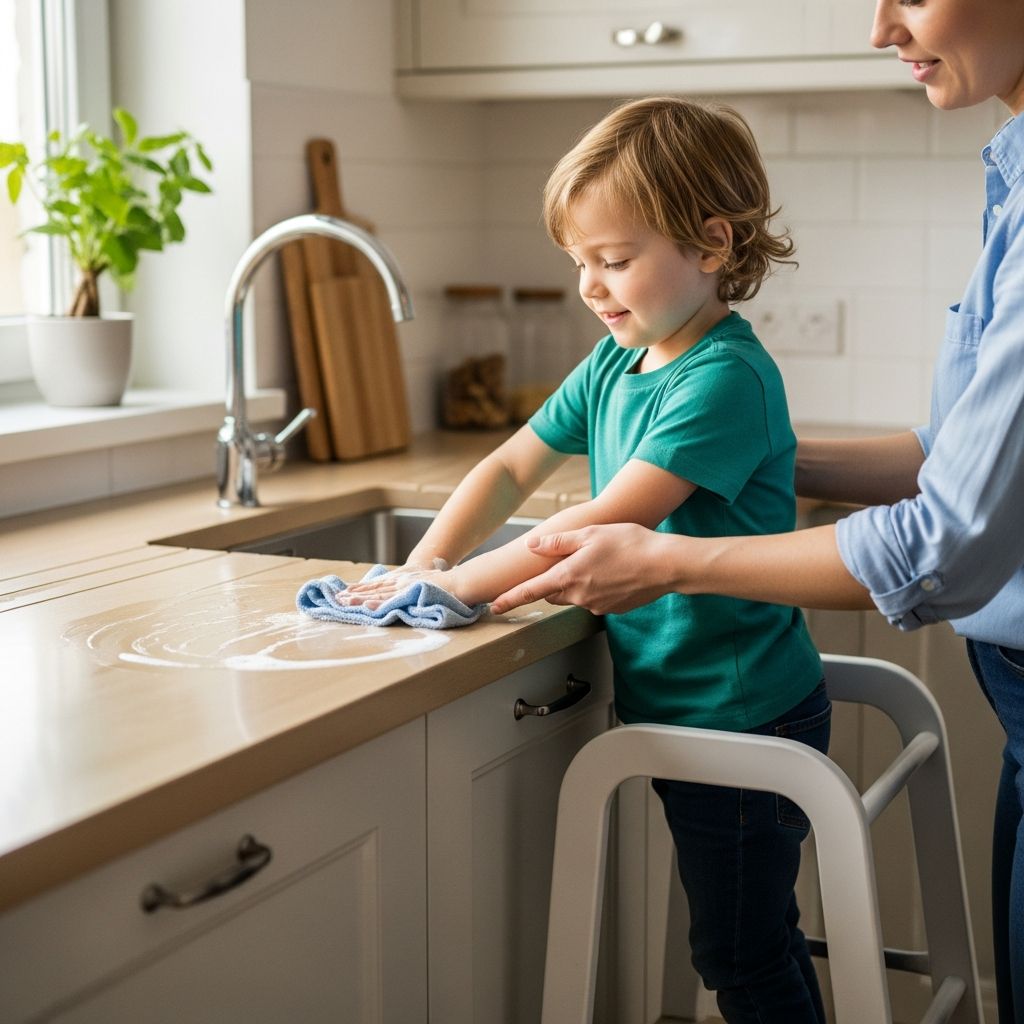
Inviting children to help with household tasks is about far more than getting the dishes done or the toys picked up. Thoughtfully chosen chores give kids daily practice in responsibility, persistence, cooperation, and problem-solving, while also easing the load on parents and strengthening family connection.
Why Chores Matter for Children’s Development
Parents sometimes hesitate to assign chores because it can feel easier to do everything themselves. Yet research and decades of family experience point in the same direction: regular, developmentally appropriate chores can support children’s emotional, social, and cognitive growth.
Core Benefits of Household Chores
- Build a sense of responsibility: Following through on daily tasks teaches children that their actions matter and that others depend on them.
- Develop life skills: Skills like cleaning, laundry, cooking, and basic organizing prepare children for independent living in adulthood.
- Strengthen self-esteem: Completing meaningful tasks helps children see themselves as capable contributors rather than passive recipients.
- Support mental health: Having clear roles and seeing the results of their effort can reduce feelings of helplessness and improve overall well-being.
- Improve executive functioning: Some chores require planning, working memory, and self-control, which are key thinking skills for learning and problem-solving.
- Promote teamwork: Sharing responsibilities shows that caring for the home is a group effort, not one person’s job.
How Chores Support Executive Function Skills
Executive functions are the brain skills that help children plan, remember instructions, manage time, control impulses, and stay focused. Studies have found that children who regularly participate in self-care and family-care chores (for example, making the bed, setting the table, or preparing simple food) may show stronger working memory and better impulse control than peers who do fewer chores.
These kinds of tasks ask children to:
- Remember the steps (for example, “first clear the table, then wipe it”).
- Resist distractions long enough to finish.
- Organize materials and time.
- Adjust when something goes wrong, like a spill or a missing tool.
From Helping to Owning: A Mindset Shift About Chores
Chores work best when they are framed not as punishments or favors to adults, but as everyday ways each family member cares for the shared space and for one another.
Chores as Contribution, Not Punishment
- Avoid assigning chores only when a child misbehaves; this links work with shame or anger.
- Instead, present chores as what everyone does because they belong to the family team.
- Use language like “We all help keep our home comfortable” instead of “You made this mess, so you have to clean it.”
Process Over Perfection
When children are learning, their work will look different from an adult’s. Expect:
- Crumpled towels instead of neatly folded ones.
- Missed spots when they sweep or wipe.
- Slow, uneven progress at first.
Focusing on the effort, not the flawless result, helps children stay motivated and willing to practice. Parents who can tolerate “good enough” work in the early years usually see more consistent, self-driven help later.
Designing a Chore System That Works
A chore system does not need to be elaborate to be effective. It does, however, benefit from clarity, consistency, and collaboration.
Key Elements of a Sustainable Chore System
| Element | Why It Matters | Practical Example |
|---|---|---|
| Clarity | Children are more likely to cooperate when they know exactly what is expected. | Use simple checklists (for example, “After dinner: bring plate, rinse, place in dishwasher”). |
| Consistency | Predictable routines create habits and reduce daily negotiations. | Link chores to existing routines like meals, bath time, or school drop-off. |
| Training | Children need direct instruction and practice to perform tasks safely and effectively. | Demonstrate, do it together, then gradually step back. |
| Choice | Having some say boosts motivation and feelings of control. | Let children choose between two or three tasks they are capable of doing. |
| Review | Occasional check-ins help solve problems and adjust as children grow. | Hold brief family meetings to discuss what is working and what is not. |
Introducing New Chores Step by Step
- Model the task: Do it yourself while your child watches, describing what you are doing in simple language.
- Do it together: Invite your child to complete one part while you handle the rest.
- Supervised practice: Let your child do the task while you are nearby to support and gently correct.
- Independent responsibility: Once they can handle it safely, it becomes their regular job with occasional spot-checks.
Age-Appropriate Chores: From Toddlers to Teens
Most children can start helping in simple ways earlier than adults expect. The key is to match chores to developmental abilities and to adjust over time.
Toddlers and Young Preschoolers (Around 2–4 Years)
At this age, children often love to imitate adults and are eager to be included. Tasks should be simple, short, and closely supervised.
- Putting toys into a basket or bin.
- Placing dirty clothes into a hamper.
- Wiping low surfaces with a small, damp cloth.
- Helping to feed pets with pre-measured food.
- Carrying plastic dishes to the table.
Older Preschoolers and Early Elementary (Around 5–7 Years)
As memory, motor skills, and attention improve, children can handle multi-step tasks with guidance.
- Making their bed in a simple way.
- Clearing their place at the table and wiping it.
- Helping unload the dishwasher (safe items only).
- Watering indoor plants with a small watering can.
- Sorting laundry by color or family member.
Middle Childhood (Around 8–11 Years)
Children at this stage are ready for more responsibility and chores that require planning and follow-through.
- Vacuuming or sweeping common areas.
- Folding and putting away their own clothes.
- Helping prepare simple parts of meals (washing vegetables, stirring, reading a recipe aloud).
- Taking out trash and recycling with supervision.
- Changing bed linens with assistance.
Preteens and Teens (Around 12+ Years)
Adolescents can manage most household tasks with minimal support, making this a key time to solidify independent living skills.
- Doing their own laundry from start to finish.
- Preparing complete simple meals safely.
- Regular yard work, like mowing or raking, if developmentally ready.
- Managing a weekly cleaning task (for example, bathroom or kitchen counters).
- Helping with basic household management, such as planning a grocery list or tracking shared supplies.
Motivation, Rewards, and Natural Satisfaction
Parents often wonder whether to pay children for chores. There is no single correct approach, but it helps to think carefully about the message you want to send.
Intrinsic vs. Extrinsic Motivation
- Intrinsic motivation arises from internal satisfaction, like feeling proud of contributing or enjoying a tidy space.
- Extrinsic motivation is driven by outside rewards, such as money, treats, or extra screen time.
Short-term external incentives can help start a new habit, but relying on rewards alone can reduce children’s internal sense that chores are simply part of family life. Many families find a middle ground, such as:
- Expecting basic chores as non-negotiable family responsibilities.
- Offering optional paid jobs that go beyond usual expectations.
- Using praise that highlights effort and impact rather than giving constant material rewards.
Using Encouragement Effectively
Specific, honest encouragement strengthens motivation more than generic praise. Instead of “Good job,” try statements that describe what you see and the effect it has:
- “You stuck with cleaning the table even though it was sticky. Now it looks and feels better for everyone.”
- “You remembered to take the bin out without a reminder. That really helps the whole family.”
Preventing and Handling Chore Battles
Even in a cooperative home, children will sometimes resist chores. Expect pushback occasionally, especially when kids are tired, stressed, or adjusting to new expectations.
Common Reasons Kids Resist Chores
- The task feels too hard or confusing.
- They do not see peers doing similar work.
- They feel overwhelmed by clutter or the size of the job.
- They believe someone else will eventually step in and do it.
- Chore time consistently replaces all their free time.
Strategies to Reduce Struggles
- Connect before you direct: A brief moment of warmth—eye contact, a touch on the shoulder, or kind words—can make children more receptive.
- Break tasks into smaller steps: Instead of “Clean your room,” try “Put clothes in the hamper, then place books on the shelf.”
- Use routines instead of repeated reminders: For example, “After snack, we always clear the table” becomes a predictable pattern.
- Work alongside them when possible: Doing tasks together can make chores feel less isolating and more communal.
- Offer limited choices: “Would you rather feed the pet or water the plants today?”
Chores and Family Well-Being
When chore systems are running smoothly, the benefits extend beyond individual children. Shared responsibilities can help the entire family function better and reduce stress.
How Shared Work Supports Family Life
- Less parental overload: When children participate, daily tasks are distributed more evenly.
- More time for connection: With chores completed more efficiently, families can free up time for play, rest, and shared activities.
- Stronger sense of belonging: Children who contribute feel that they are important to the household, not just guests.
- Opportunities for conversation: Working side by side often opens space for casual, meaningful talks, especially with older children.
Frequently Asked Questions About Kids and Chores
At what age should I start giving my child chores?
Children as young as toddlers can participate in simple, supervised tasks like putting toys in a basket or placing clothes in a hamper. As children grow and their motor and thinking skills develop, you can gradually increase the complexity and responsibility of their chores.
My child complains that none of their friends do chores. How do I respond?
You can acknowledge their feelings while calmly reinforcing your family’s values: in your home, everyone helps care for the space you share. Emphasize that chores are not punishments but ways to learn independence and contribute to the family team.
Should I pay my child for doing chores?
Many experts suggest treating routine chores as unpaid family responsibilities and, if desired, offering separate opportunities to earn money for extra tasks. This approach helps children internalize that some work is done simply because it is the right thing to do, not only for a reward.
What if my child does a poor job or refuses to finish?
First check whether the task matches their skill level; if not, break it into smaller steps and reteach it. If refusal continues, stay calm, restate the expectation, and follow through with consistent limits, such as delaying screen time or play until the agreed-upon task is done, without shaming or harsh criticism.
How many chores are reasonable?
The right number depends on your child’s age, schedule, and temperament. A useful guideline is to prioritize a small set of daily responsibilities they can reliably manage—such as one self-care task, one room-related task, and one family task—before adding more.
References
- Household chores for children and teenagers — Raising Children Network. 2023-02-09. https://raisingchildren.net.au/preschoolers/family-life/routines-rituals-rules/chores-for-children
- The benefits of chores for your child — Michigan State University Extension. 2017-02-22. https://www.canr.msu.edu/news/the_benefits_of_chores_for_your_child
- The Benefits of Chores — The Center for Parenting Education. 2014-06-01. https://centerforparentingeducation.org/library-of-articles/responsibility-and-chores/part-i-benefits-of-chores/
- The benefits of chores for kids — Bright Horizons. 2024-01-10. https://www.brighthorizons.com/article/parenting/benefits-of-chores
- Research Shows That Household Chores Benefit Children’s Executive Function — Mental Health Center Kids. 2022-08-15. https://mentalhealthcenterkids.com/blogs/articles/research-shows-that-household-chores-benefit-children-s-executive-function
- The benefits of involving kids in household chores — Mabel’s Labels. 2024-01-18. https://mabelslabels.com/blog/2024/01/18/benefits-of-involving-kids-in-household-chores/
- Key to Happy, Successful Kids? Chores. — United Valley Waldorf School summarizing Harvard findings. 2016-05-01. https://www.uvws.org/news/s94a63z7yun3fczjm80xh8fzivafkb