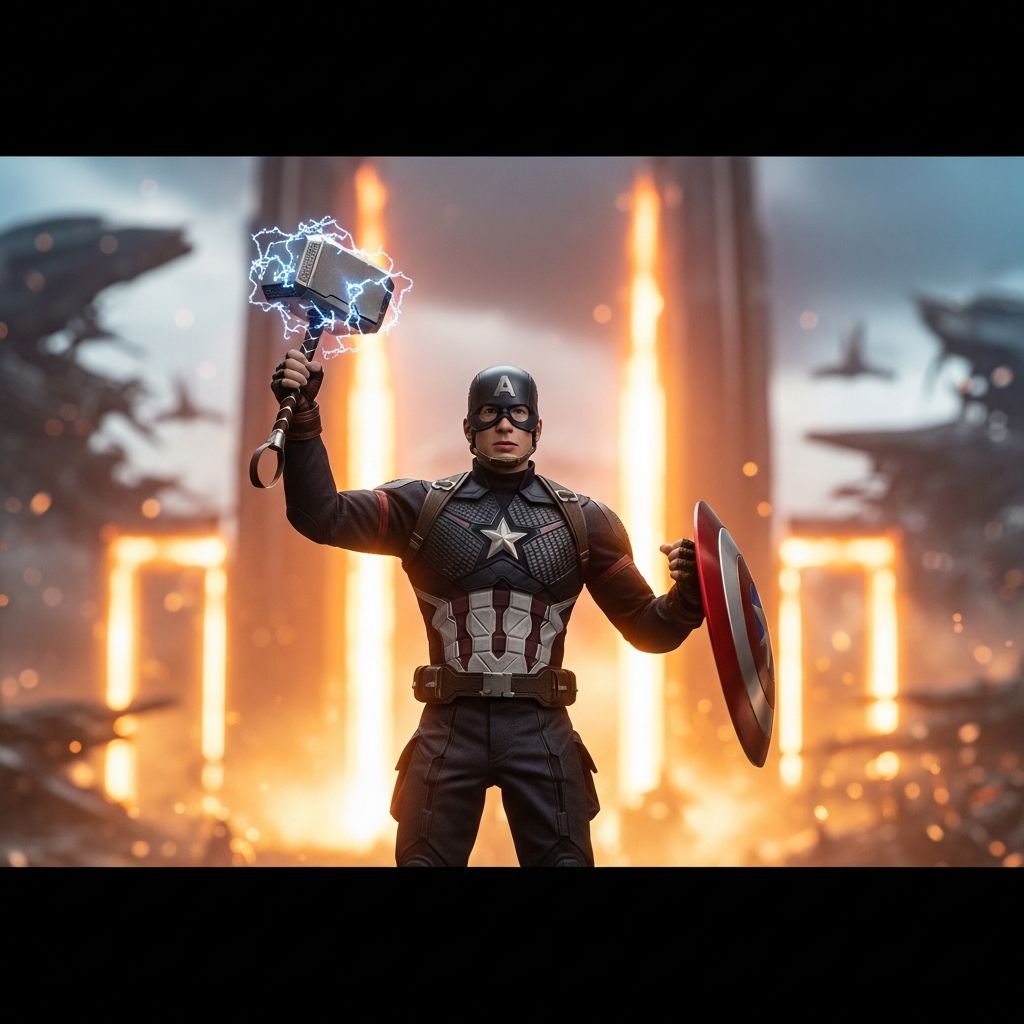
One of the loudest theater moments in Avengers: Endgame arrives when Captain America finally wields Mjölnir, Thor’s enchanted hammer, in the climactic battle against Thanos. That single image condenses a decade of character work, pays off a tease from Avengers: Age of Ultron, and quietly rewrites how the Marvel Cinematic Universe (MCU) thinks about worthiness, identity, and power. Rather than a simple crowd-pleasing trick, it functions as a thematic pivot point that transforms both Steve Rogers and Thor Odinson.
The Long Road to the Hammer
To understand why Steve Rogers lifting Mjölnir matters so much, it helps to rewind to the party scene in Age of Ultron, where the Avengers take turns trying to move Thor’s hammer. Each attempt is a joke about ego, strength, and self-image—until Steve steps up, nudges the hammer a fraction of an inch, and Thor’s expression briefly darkens. The gag lands because it hints that there is more to Steve’s relationship with the magical weapon than anyone is ready to acknowledge.
That moment planted a mystery: was Steve already worthy and simply chose not to embarrass Thor, or did something still hold him back? Endgame answers that question not with exposition, but with timing. Years of choices, sacrifices, and internal conflict come to a head in the final battle, and the hammer responds. The arc is less about physical ability and more about when Steve’s internal story finally aligns with what the hammer demands.
What “Worthy” Really Means
In the comics and films, Mjölnir’s enchantment is often paraphrased as: “Whosoever holds this hammer, if he be worthy, shall possess the power of Thor.” That line invites obvious questions. Does worthiness mean moral purity, brute courage, or loyalty to Asgardian ideals? The MCU’s answer has evolved, but Endgame pushes it away from simplistic good-versus-evil categories and toward a more complex mix of humility, responsibility, and self-knowledge.
When Steve finally calls the hammer to his hand, the film has already shown him at his lowest: beaten down, outmatched, shield shattered, and facing an army he cannot realistically defeat. The worthiness on display is not the confidence of a destined champion. It is the stubborn refusal to surrender and the willingness to stand alone, even when heroism looks futile. Worthiness becomes less about being flawless and more about choosing duty over self-preservation.
Steve Rogers and the Weight of Secrets
One popular reading of the earlier hammer scene argues that Steve could have lifted Mjölnir in Age of Ultron but held back to spare Thor’s pride. Another perspective suggests that Steve’s unresolved guilt about keeping secrets—especially information about Bucky’s past and Tony’s parents—complicated his relationship with truth and loyalty. Either way, Steve is not yet fully at peace with himself in that era of the MCU.
By the time of Endgame, the messy conflicts of Civil War have burned through. Steve has broken with institutions, accepted the consequences of choosing his own moral compass, and carried the cost of that decision for years. The version of Steve who lifts Mjölnir is a man who has stopped pretending that his ideals are universally shared or always rewarded. That hard-earned clarity is part of what makes him feel, finally, fully aligned with the hammer’s enchantment.
Thor’s Journey from Entitlement to Grace
The Mjölnir moment is just as important for Thor. In the first Thor film, losing the hammer is a brutal lesson in humility. Thor begins as an impulsive prince who treats worthiness as his birthright; the enchantment forces him to confront the idea that power can be taken away when misused. Over time, repeated losses—family, home, eye, and ultimately half the universe—strip away his arrogance and leave behind a far more fragile, self-doubting hero.
In Endgame, Thor is wrestling with trauma, guilt over failing to stop Thanos, and a profound crisis of identity. When he sees Steve lift Mjölnir, his reaction is not jealousy but genuine delight. That joy reveals how far he has come. A younger Thor might have felt threatened by someone sharing “his” power; the Thor we see now understands that power is a burden, and that sharing it with someone who can bear it is a relief. The hammer becomes less a symbol of his ego and more a sign of connection and trust.
Table: Steve, Thor, and the Hammer
| Aspect | Thor’s Relationship to Mjölnir | Steve’s Relationship to Mjölnir |
|---|---|---|
| Initial attitude toward power | Sees hammer as proof of royal status and strength. | Sees power as a tool to protect others, not define identity. |
| Key lesson | Must learn humility and that power can be lost. | Must reconcile ideals with messy moral compromises. |
| Response to worthiness test | Devastated when he cannot lift it; later relieved to share. | Initially holds back or fails; later embraces it in crisis. |
| Emotional payoff in Endgame | Finds validation that his judgment of Steve is correct. | Receives confirmation that his values still matter. |
| Symbolic function | Represents legacy and lost heritage. | Represents destiny fulfilled and burden accepted. |
Why the Scene Resonated with Audiences
On a surface level, Captain America catching the hammer is simply cool action cinema: a beloved hero accessing new abilities at exactly the right moment. But the scene would not have triggered such loud, sustained reactions if it were only about spectacle. The power of the moment comes from how it crystallizes a decade-long shared history between characters and viewers alike.
Fans had years to speculate about Steve’s potential worthiness, debate clues from earlier films, and imagine their own versions of the payoff. Endgame delivers on that collective investment while still managing to surprise in its staging and choreography. The move pays off a running character study rather than a throwaway Easter egg, which is why it lingers in cultural memory instead of fading like a lesser visual trick.
Rewriting the Dynamics Within the Avengers
The hammer shift subtly reorders the team’s internal hierarchy. Thor’s thunder and Steve’s moral center temporarily merge, symbolizing a kind of shared command structure where physical might and ethical conviction operate in tandem. For a few crucial minutes, the Avengers are led not by any government, council, or king, but by a partnership between two heroes who have already sacrificed everything.
That partnership also comments on past tensions. Thor arrived on Earth as an outsider, a literal god among mortals, while Steve embodied the ultimate human soldier. Over multiple films, their mutual respect replaced any rivalry. The hammer scene affirms that respect: Thor’s approval is a public endorsement of Steve’s character, and Steve’s use of the hammer is an acknowledgment of the Asgardian legacy he has been entrusted to share.
Power Shared vs. Power Hoarded
One of the MCU’s recurring themes is the danger of hoarding power. Whether it is the Tesseract, the Infinity Stones, or entire weapons programs, the story repeatedly shows that concentrating too much force in too few hands invites catastrophe. The choice to let Steve wield Mjölnir aligns with a counter-message: some powers are safest when distributed among those with proven integrity.
In that light, Thor’s reaction is almost political. He does not cling to a monopoly on divine strength; instead, he embraces a more collaborative model of heroism. Mjölnir becomes a shared responsibility rather than an exclusive badge of nobility. The hammer doesn’t just strike Thanos; it strikes at the idea that authority should always flow from birthright or personal ownership.
Endgame’s Quiet Retcon of Earlier Teases
The MCU rarely leaves potential payoffs on the table, and Endgame retroactively elevates the old party scene from a fun gag to a deliberate setup. Whether Steve was always capable of lifting Mjölnir or only becomes worthy later, the narrative reframes the old near-miss as part of a long, slow burn. What once looked like a throwaway moment now reads like the start of a test both characters needed to pass.
This is a clever way of rewriting audience memory without erasing the original scene. Rather than contradicting what viewers saw, the film invites them to reinterpret it. The earlier joke becomes a kind of dramatic foreshadowing, and the entire arc rewards attentive fans who track character growth across multiple phases of the franchise.
Legacy, Succession, and Passing the Torch
The hammer beat also connects to a broader pattern in Endgame: the passing of mantles. By the end of the film, shields, crowns, and titles are being handed to a new generation. Steve passes his shield to Sam Wilson, Thor offers leadership of the Asgardian people to Valkyrie, and others step into roles vacated by fallen or retired heroes. Mjölnir’s brief time in Steve’s hands foreshadows this larger transfer of responsibility.
Importantly, Steve does not keep the hammer. His worthiness is real, but it remains a momentary gift rather than a permanent rebranding as “the new Thor.” That choice underscores the idea that legacy in the MCU is not about replacing one icon with another identical copy. It is about honoring what came before while allowing each hero to maintain a distinct identity and path.
Symbolic Readings: Myth, Identity, and the American Ideal
On a mythic level, Captain America wielding a god’s weapon fuses different storytelling traditions. Steve is a modern Arthurian figure—chosen not by birth but by character, pulling a metaphorical sword from the stone in front of witnesses who can attest to his worth. Mjölnir acts as a cinematic Excalibur, crowning not a king of England but a symbol of heroic ideals in a globalized blockbuster mythos.
At the same time, the moment complicates the “American” in Captain America. His worthiness is not defined by nationalism or obedience to any government entity. Over the course of the MCU, Steve repeatedly opposes his own institutions when they betray their stated values. By the time he lifts Mjölnir, his identity is anchored less in flags and more in universal concepts like justice, sacrifice, and compassion. The hammer’s acceptance of Steve can be read as an endorsement of that evolution.
How the Scene Rewrites Future Expectations
After Endgame, the rules around who can wield what in the MCU feel more flexible. Viewers have now seen a human hero take up an Asgardian instrument of power, and later stories continue to explore characters picking up unexpected roles and tools. The idea that any weapon or symbol is permanently tied to a single person no longer holds absolute sway.
This has implications for how future heroes will be introduced. Rather than inheriting mantles solely through bloodlines or explicit succession, they might earn their places through the kinds of traits Mjölnir recognizes: courage under pressure, moral clarity, and the readiness to sacrifice. The hammer scene becomes a template for how the universe can validate new champions without relying only on legacy casting or nostalgia.
Bullet-Point Takeaways
- Steve Rogers lifting Mjölnir in Endgame serves as the culmination of a character arc that spans multiple phases of the MCU.
- The concept of worthiness evolves from simple heroism to a nuanced balance of humility, responsibility, and self-awareness.
- Thor’s delighted reaction marks his growth from possessive prince to generous, trauma-scarred hero who can share power.
- The hammer moment reconfigures the internal dynamics of the Avengers, symbolically fusing divine power with human conviction.
- By framing legacy as something shared and passed on, not hoarded, the scene sets expectations for future generations of MCU heroes.
SEO-Friendly FAQs
Why can Captain America lift Thor’s hammer in Endgame?
Captain America can lift Mjölnir in Endgame because he embodies the qualities the hammer rewards: courage, selflessness, and a willingness to sacrifice everything to protect others. The years between Age of Ultron and Endgame refine his character, pushing him through moral conflicts and personal guilt until he reaches a point of hard-earned clarity and humility.
Was Captain America always worthy of Mjölnir?
The films leave room for interpretation, but there are two main schools of thought. One suggests Steve was physically capable of lifting Mjölnir in Age of Ultron and chose not to move it fully, sparing Thor’s feelings. The other argues that unresolved secrets and inner conflict, especially regarding Bucky and Tony, held him back until those issues were confronted over subsequent films.
What does Thor’s reaction to Captain America holding the hammer mean?
Thor’s ecstatic reaction signals pride and relief rather than envy. It shows that he trusts Steve completely and that he no longer defines himself solely by his exclusive claim to godly power. In that instant, the hammer becomes a shared symbol of mutual respect, not a prize to be guarded.
Does Captain America become the new “god of thunder”?
No. When Steve wields Mjölnir, he temporarily channels the hammer’s abilities, including lightning and enhanced striking power, but he does not replace Thor as a divine figure. The moment is framed as a short-lived but crucial collaboration between their legacies, not a permanent transfer of mythic status.
How does the hammer scene connect to the ending of Endgame?
The hammer scene foreshadows Endgame’s overarching interest in legacy and succession. Just as Steve briefly takes up Mjölnir’s power without claiming it forever, he later passes his own shield to Sam Wilson, entrusting a symbol of his identity to someone he believes will honor its meaning. The film uses these moments to argue that icons matter less than the values carried forward by those who inherit them.