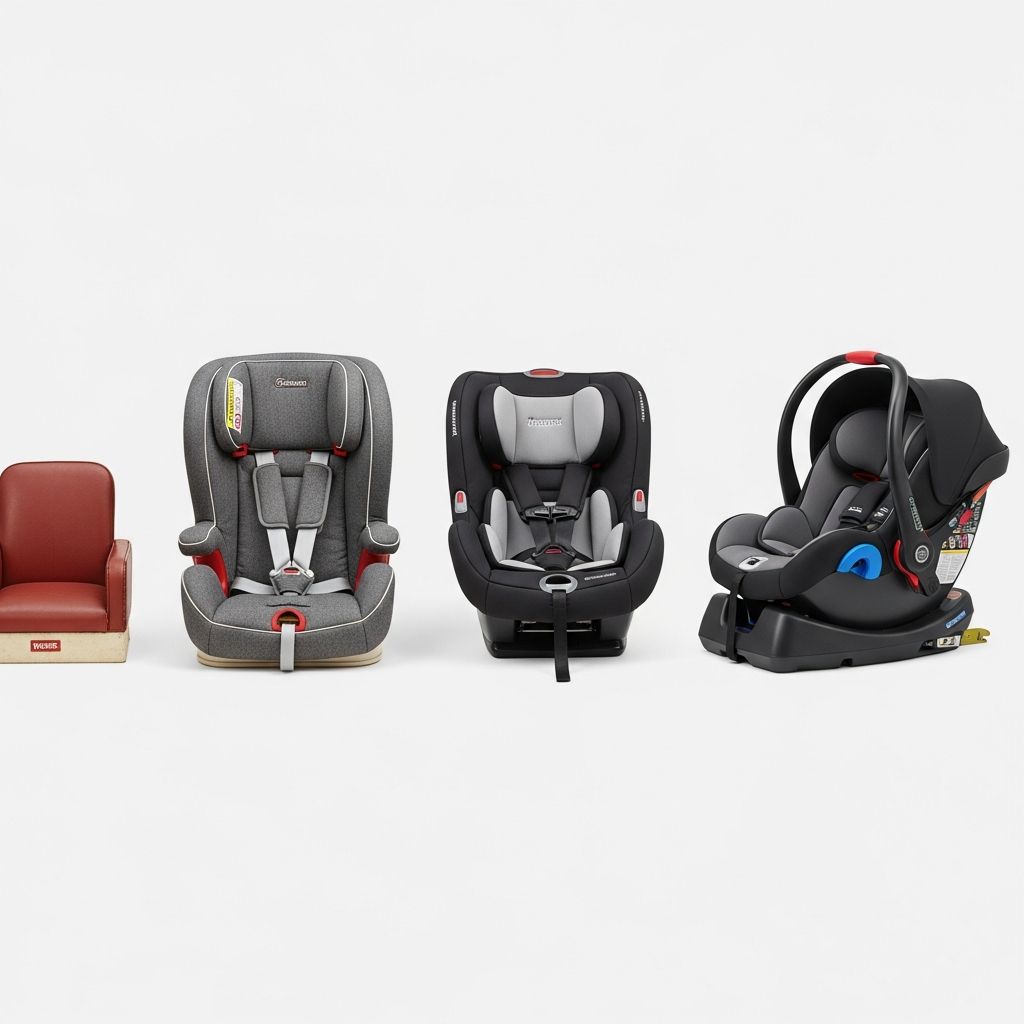
Child car seats have undergone remarkable transformations since their inception, evolving from basic restraints to sophisticated devices that significantly reduce injury risks during crashes. This progression reflects decades of innovation, advocacy, and regulatory changes aimed at protecting young passengers.
Pioneering Designs in the 1960s
The 1960s marked the birth of purpose-built child safety seats, driven by concerned parents and engineers observing the dangers of unrestrained children in vehicles. Prior to this era, children often rode on laps or unsecured in back seats, exposing them to severe risks in collisions amid rising car ownership post-World War II.
In 1962, British journalist Jean Ames introduced the Jeenay car seat, a groundbreaking design intended specifically for safety. This seat featured a three-point harness, utilized the vehicle’s seatbelt for attachment, and was positioned in the rear seat—concepts that became foundational to modern standards.
Shortly after, in 1963, American inventor Leonard Rivkin developed the ‘Guys and Dolls’ seat, inspired by a rear-end collision that nearly injured his son. It was among the earliest rear-facing models with a five-point harness, emphasizing protection against forward impacts.
The decade’s highlight came in 1964 when Swedish professor Bertil Aldman, inspired by astronauts’ rear-facing positions in the Gemini space capsule, created a rear-facing seat. This led to Sweden’s T-standard, mandating rear-facing travel until at least age four—a guideline still influential globally.
- Jeenay (1962): First rear-seat safety-focused seat with harness.
- Guys and Dolls (1963): Early five-point harness rear-facing design.
- Aldman’s seat (1964): Space-inspired, birthed strict rear-facing protocols.
Automaker Innovations and Early Regulations in the 1970s
By the late 1960s, automakers entered the fray, producing seats with genuine crash protection. Ford’s 1968 Tot-Guard featured a protective shell shielding the child’s upper body, secured by the vehicle’s seatbelt. General Motors followed with the Love Seat, a rear-facing model resembling contemporary infant carriers.
Ralph Nader’s 1965 book Unsafe at Any Speed catalyzed broader auto safety reforms, leading to the establishment of the National Highway Traffic Safety Administration (NHTSA) in 1970. This advocacy pressured for child-specific protections.
In 1971, NHTSA issued its first federal standard (FMVSS 213), requiring car seats to be secured with the vehicle’s seatbelt and include a three-point harness for the child. Notably, this did not mandate usage or crash testing, focusing instead on basic securement.
| Model | Year | Key Feature |
|---|---|---|
| Tot-Guard | 1968/1973 | Shielding shell for upper body protection |
| Love Seat | 1968 | Rear-facing infant-style carrier |
Federal Standards and Statewide Mandates in the 1980s
The 1980s brought rigorous advancements. Pre-1981, no standardized crash testing existed, limiting proof of efficacy. Updated FMVSS 213 in the early 1980s introduced mandatory dynamic crash testing, labels, and childproof release mechanisms, elevating manufacturing quality.
Tennessee pioneered child seat laws in 1977, effective 1978, requiring children under four to use approved seats. This spurred a wave; by 1985, every U.S. state had similar legislation.
Usage soared due to the ‘three Es’—education, engineering, enforcement. Campaigns by advocates like Shelness and Tombrello boosted national compliance from low single digits to 46% by 1984, a 500% increase. However, challenges persisted: 20% of children remained unrestrained by 1987, with misuse common.
2000s Advancements: LATCH and Beyond
The 2000s standardized installation ease. In 2002, Congress mandated the LATCH system (Lower Anchors and Tethers for Children) in vehicles and compatible seats, reducing errors from seatbelt routing. This addressed a key misuse factor, as prior methods confused many parents.
Convertible seats emerged, allowing rear-facing for infants transitioning to forward-facing for toddlers, then boosters. Materials improved with energy-absorbing foam, and side-impact protection became standard.
By the 2010s, extended rear-facing recommendations extended to age two or longer, supported by data showing superior neck protection.
Modern Car Seat Technologies and Best Practices
Today’s seats integrate sensors, Bluetooth connectivity for usage alerts, and load legs for stability. NHTSA continues refining FMVSS 213, with 2023 updates enhancing side-impact testing. (Note: Standards from authoritative sources like NHTSA remain pivotal despite age.)
Key practices include:
- Rear-face until at least age two or maximum height/weight.
- Use LATCH for children under 40-50 lbs; switch to seatbelt after.
- Check registration for recalls via NHTSA.gov.
- Professional installation via inspection stations.
Statistics underscore impact: Child fatalities dropped 71% from 1975-2021 due to restraints. Yet, misuse affects 46% of installations, emphasizing education.
Frequently Asked Questions
When was the first car seat law passed?
Tennessee enacted the first U.S. child seat usage law in 1977, effective 1978, for kids under four.
What is LATCH and when was it required?
LATCH provides dedicated anchors for easier, safer installation; mandated in 2002 for new vehicles and seats.
Why rear-facing longer?
Rear-facing supports the child’s head, neck, and spine better in frontal crashes, the most common type.
Are all seats equally safe?
No; choose NHTSA-certified (FMVSS 213 label). Higher crash test ratings from IIHS add assurance.
How has usage changed over time?
From near-zero in the 1970s to over 90% today, thanks to laws and education.
References
- The History of Car Seats — Safe in the Seat. 2023. https://www.safeintheseat.com/post/the-history-of-car-seats
- The History of How the Car Seat Made American Kids Safer — TIME. 2024-10-15. https://time.com/7306364/history-car-seat-made-kids-safer/
- Child Safety Seats: A History — Taproot. 2023. https://taproot.com/child-safety-seats-a-history/
- A Look Back: The History of Car Seats — Wayb. 2024. https://wayb.com/blogs/news/a-look-back-the-history-of-car-seats
- Children’s Car Seats – The Henry Ford — The Henry Ford Museum. 2023. https://www.thehenryford.org/collections-and-research/digital-collections/expert-sets/101263/