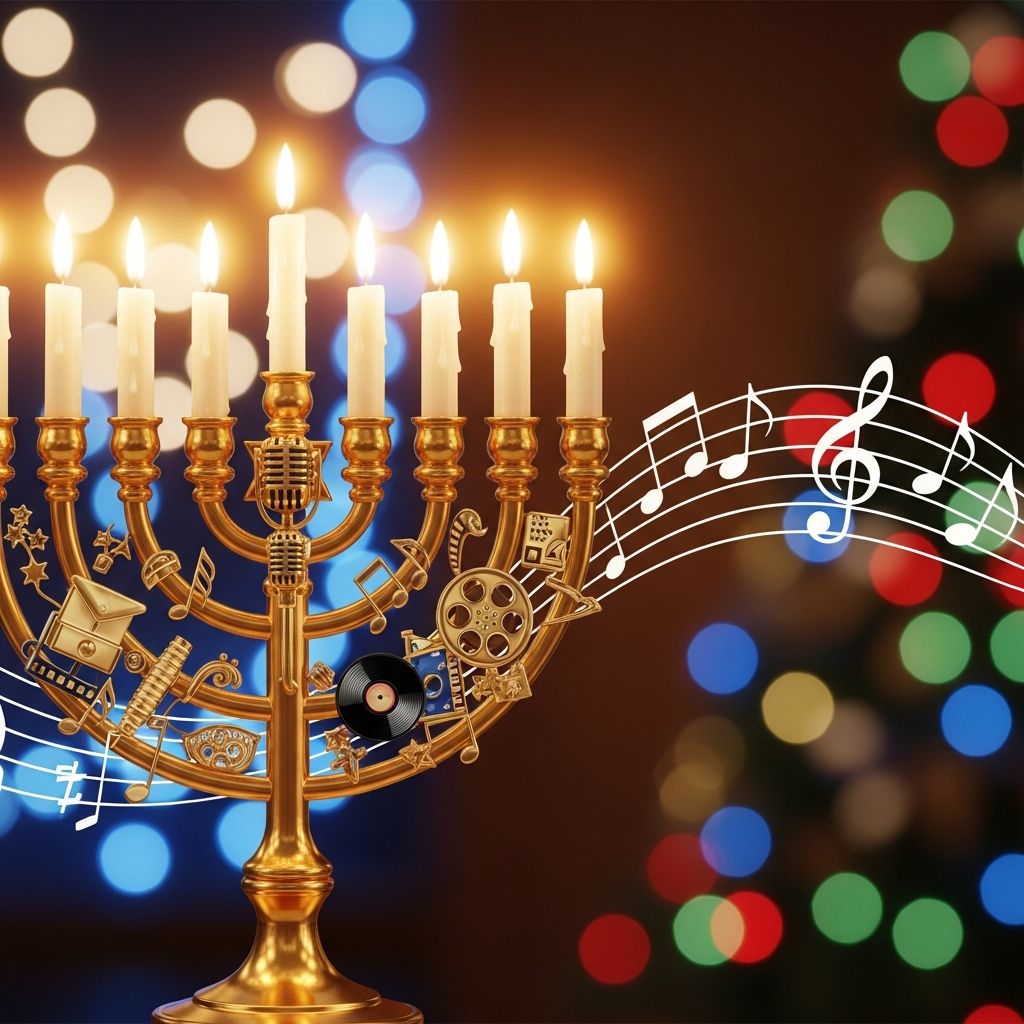
When Adam Sandler first picked up a guitar on live television in the mid-1990s and started listing famous Jews over a simple chord progression, few could have predicted that a three-minute comedy bit would become one of the most recognizable Hanukkah anthems in modern culture.
Yet over the decades, that goofy performance evolved into something bigger: a touchstone for Jewish pride, a seasonal radio staple, and an unexpected answer to the long-standing imbalance between Christmas and Hanukkah in popular media.
Why A Hanukkah Comedy Song Mattered So Much
For years, American holiday entertainment leaned almost entirely on Christmas music, Christmas specials, and Christmas imagery, leaving Jewish kids with little in the way of mainstream pop culture that reflected their own traditions. Sandler’s “Chanukah Song” stepped straight into that cultural gap, turning a joke about famous Jewish celebrities into a surprisingly emotional statement: being Jewish at the holidays could be funny, exuberant, and unapologetically public.
Instead of solemn religious language, the song used playful rhymes and name-drops to signal that Jewish identity belonged on the same loud, festive stage as any Christmas hit, reframing Hanukkah not as a quiet footnote to December but as a worthy subject of pop culture celebration.
The 1990s Late-Night Moment
When the song debuted on a major late-night sketch show in December 1994, Sandler was already known there for comedic music, having performed another holiday-themed tune about Thanksgiving a couple of years earlier. Sitting next to the show’s satirical news anchor with an acoustic guitar, he launched into a deliberately low-key, rambling performance that felt more like a friend riffing at a party than a tightly choreographed TV number.
That casual tone made the bit feel spontaneous and personal, and the audience’s reaction signaled that something about the idea—a light-hearted Hanukkah song centered on inclusion—had hit a nerve beyond a standard comedy sketch.
Breaking Down The Song’s Core Idea
At its heart, the song relies on a deceptively simple structure: a recurring chorus about Hanukkah wrapped around verses filled with lists of public figures who are Jewish, occasionally corrected or updated in later versions. The humor grows from both the surprising names and Sandler’s self-aware delivery, but behind the jokes lies a serious subtext about belonging, visibility, and the relief of realizing you are not alone.
This concept resonates especially with children and teens, who can easily feel like outsiders when Christmas dominates their classrooms, town decorations, and television screens; hearing a crowd cheer for a song that centers their holiday can feel like a rare validation in a season that often looks past them.
Key Themes Embedded In The Lyrics
- Visibility: The core gag—naming Jewish celebrities—doubles as a roll call of representation, revealing how many beloved entertainers share the same background as Jewish viewers.
- Humor as armor: The song uses jokes to defuse the awkwardness that can surround religious difference in largely Christian cultural spaces.
- Community through pop culture: By inviting the audience to laugh and sing along, the song turns a niche experience into a broadly shared moment.
From Sketch to Seasonal Staple
What started as a late-night performance quickly jumped to recorded media; within a couple of years, Sandler included the song on a comedy album, and a single release followed, pushing the track onto mainstream radio and charts. Even as a novelty song, it carved out a spot on year-end playlists, returning annually much like Christmas standards, and proving that there was an audience hungry for Hanukkah-themed content.
The song’s continued presence on radio during the holiday season helped normalize the idea that Jewish music, even in comedic form, deserved airtime alongside traditional and pop Christmas tracks.
How The Song Evolved Over Time
Sandler did not leave the track frozen in 1994; he updated it in later live performances and follow-up versions, adding new names and cultural references as Jewish representation in entertainment became more visible. These sequels, tied to subsequent albums and even an animated Hanukkah film, reinforced the idea that the song was a living document of Jewish celebrity visibility, growing and changing with each decade.
Why Jewish Kids Connected So Deeply
For many Jewish children and teenagers in the 1990s and early 2000s, the song arrived during a time when overtly Jewish characters and storylines were still relatively rare in mainstream family entertainment, especially around the holidays. Hearing a national TV audience erupt in laughter and applause for jokes that centered Jewish identity, rather than gently sidestepping it, sent a powerful message about who was allowed to be loud and joyful in December.
Instead of a hushed acknowledgment of difference, the song offered a gleeful, guitar-driven celebration, making it easier for young viewers to approach their own traditions with pride—even if they experienced that pride through comedy rather than solemn ritual.
Emotional Impact In Simple Terms
| Experience | Typical Holiday Media | What Sandler’s Song Offered |
|---|---|---|
| Religious representation for Jewish kids | Often minimal or background references to Hanukkah. | A full song explicitly centered on Hanukkah, sung to a cheering national audience. |
| Emotional tone | Christmas framed as magical and central; other holidays understated. | Hanukkah framed as funny, communal, and unembarrassed, giving permission to celebrate out loud. |
| Sense of belonging | Jewish kids often feeling like spectators in a Christmas-focused culture. | Reassurance through a public reminder that many admired figures share their background. |
Balancing Silliness and Identity
Part of the song’s enduring charm lies in its refusal to treat identity with excessive gravity; it uses mispronunciations, wrong guesses about who is or is not Jewish, and self-deprecating remarks to build a comedic persona that feels approachable. Yet this levity never entirely erases the serious undercurrent that Jewish identity has historically been contested, misunderstood, or marginalized in broader culture, especially in moments when Christian traditions set the tone.
By laughing at the awkwardness of these dynamics while still centering Jewish experience, Sandler found a way to acknowledge complicated cultural realities without turning a holiday song into a lecture.
Controversies, Corrections, and Cultural Learning
Because the song relies on calling out specific public figures, errors and assumptions occasionally sparked awkward moments, including instances where people were mistakenly identified as Jewish or where the fraction of someone’s Jewish heritage was misstated. Sandler has publicly acknowledged at least one such error after being corrected by the celebrity in question, illustrating how a comedy bit can unexpectedly become entangled with real-life identity politics.
These episodes highlight a broader cultural tension: who “counts” as Jewish, who gets to decide, and how casual jokes about identity can collide with personal and communal sensitivities, even when the intention is affectionate rather than mocking.
What These Missteps Reveal
- Fame and heritage do not always line up neatly, and public assumptions can be wrong in both directions.
- Humor that leans on identity may open doors for representation but also requires ongoing correction and nuance.
- Even a lighthearted list song can push audiences to think more critically about how they label others.
Influence On Later Hanukkah Media
In the years after the song’s debut, more television shows, films, and musical acts began featuring Hanukkah-themed episodes, jokes, and original songs, often blending comedy with cultural commentary in a way that echoes Sandler’s approach. While it would be simplistic to credit a single track for this shift, the popularity of the “Chanukah Song” undoubtedly proved that audiences were receptive to Jewish holiday content framed as both funny and celebratory.
Other artists have created their own updated versions or homages, sometimes rewriting the lyrics with new names or modern references, effectively treating Sandler’s original concept as an evolving template for Jewish pop culture expression.
How The Song Shaped Expectations
| Area | Before The Song | After The Song’s Popularity |
|---|---|---|
| Holiday radio playlists | Dominated by Christmas music; limited Hanukkah presence. | At least one widely recognized Hanukkah novelty track added to seasonal rotations. |
| Comedy about religion | Often cautious or framed as niche content. | Demonstrated that a Jewish-focused holiday bit could become mainstream and commercially successful. |
| Representation in youth culture | Jewish identity often implied or sidelined, especially in December stories. | Clear example of a Jewish-centered joke embraced by broad audiences and younger fans. |
Legacy: A Joke That Became Tradition
Decades after its first performance, the song continues to resurface each holiday season, whether through radio spins, online clips, live performances, or newer reinterpretations by other artists. That persistence is unusual for a novelty track and speaks to the way the song transcended its original purpose as a one-off joke to become a semi-official soundtrack for Hanukkah in mainstream American culture.
Families who grew up with the original now share it with their children, creating an intergenerational tradition that is as much about silliness and shared laughter as it is about representation, effectively turning a comedy sketch into a yearly ritual.
Why The Song Still Resonates
- It offers a rare piece of widely known Hanukkah content that feels joyful rather than defensive or apologetic.
- Its references can be updated, allowing each generation to see a reflection of its own celebrities and cultural touchpoints.
- It models a way for minority traditions to take up space in mainstream conversation without sacrificing humor or authenticity.
Practical Takeaways For Modern Pop Culture
The story of Sandler’s “Chanukah Song” offers useful lessons for creators and audiences who care about representation today, especially around religious and cultural diversity. It suggests that inclusive media does not always have to be solemn or didactic; sometimes the best entry point for broader understanding is a joke that invites everyone into the conversation while still centering the community in question.
As more platforms explore holiday programming that extends beyond Christmas, the success of this song stands as a reminder that authenticity, humor, and specificity can travel surprisingly far when delivered with warmth and confidence.
Key Lessons For Creators
- Lean into specificity: Making a song clearly, loudly about Hanukkah did not limit its audience; it defined its appeal.
- Allow comedy to coexist with respect: Jokes about identity can uplift when their aim is solidarity rather than ridicule.
- Be open to evolution: Updating references over time kept the song culturally relevant and signaled that Jewish visibility is a living, changing story.
Frequently Asked Questions
When did Adam Sandler first perform the “Chanukah Song”?
Adam Sandler debuted the “Chanukah Song” on a major late-night sketch show’s satirical news segment in early December 1994, during his tenure as a cast member. The performance quickly became one of his most memorable musical bits from that era.
Who helped write the song?
Although Sandler is closely associated with the track, he collaborated with other writers from the show’s staff to shape the lyrics and structure, reflecting the team-based nature of sketch comedy writing. Their contributions helped sharpen the song’s blend of casual humor and tightly timed punch lines.
How many versions of the song exist?
There have been multiple official versions and sequels, some tied to albums and others to later performances or projects, each updating the list of names and cultural references to match its moment in time. In addition, various artists have recorded their own reinterpretations, treating the original as a flexible framework rather than a fixed text.
Is the song considered a religious piece?
The song is not a liturgical or traditional religious text; it is a comedic pop-culture artifact that happens to center a Jewish holiday. Its significance lies more in cultural representation and emotional resonance than in ritual or theology.
Why do people still care about it today?
People return to the song each Hanukkah because it fills a persistent gap in mainstream holiday media, offering a catchy, funny, and recognizably Jewish anthem amid a sea of Christmas music. For many, revisiting it has become a seasonal tradition that blends nostalgia with a sense of visibility and pride.