Most Thanksgiving television is loud, glossy, and reassuring; A Charlie Brown Thanksgiving is none of those things. Instead, this half-hour of anxious kids, mismatched snacks, and unspoken loneliness has become one of the strangest and most enduring rituals of the holiday season.
What makes this special so memorable is not the plot itself, but the mood it creates: a blend of melancholy, awkwardness, and gentle hope that cuts through the usual holiday perfection. Rather than selling a fantasy, it quietly acknowledges that Thanksgiving can be confusing, disappointing, and yet deeply meaningful at the very same time.
The Unlikely Origins of a Holiday Staple
When people think of Peanuts holiday specials, Christmas and Halloween usually come to mind first. The Thanksgiving installment came later, and in many ways it feels more experimental and off-balance than its famous siblings. The special doesn’t revolve around a big parade, a dramatic turkey disaster, or a sweeping family reunion. Instead, it hinges on a misunderstanding between kids who barely know how to talk about their feelings.
Charlie Brown never plans a proper feast; he is quietly dragged into hosting by a friend with more enthusiasm than social awareness. The entire story grows from that single pressure point: a boy who doesn’t want to disappoint anyone and a holiday built on expectations he can’t possibly meet. It is a small premise, but it carries an emotional weight that still resonates decades later.
Why the Special Feels So Emotionally Offbeat
Flat animation, muted colors, and sparse backgrounds give the special an unvarnished, almost homemade quality. There are no rapid-fire jokes, no laugh track, and no booming orchestral score telling the audience how to feel. Long pauses and quiet reactions run through the episode, forcing the viewer to sit in the discomfort right alongside the characters.
This stylistic restraint allows the emotional beats to land more sharply. The awkward invitation, the underwhelming meal, the moments when characters sulk or lash out—none of it is softened by visual spectacle. The special feels like a children’s story told in whispers rather than shouts, which is exactly why it lingers in memory.
The Most Misfit Thanksgiving Meal on TV
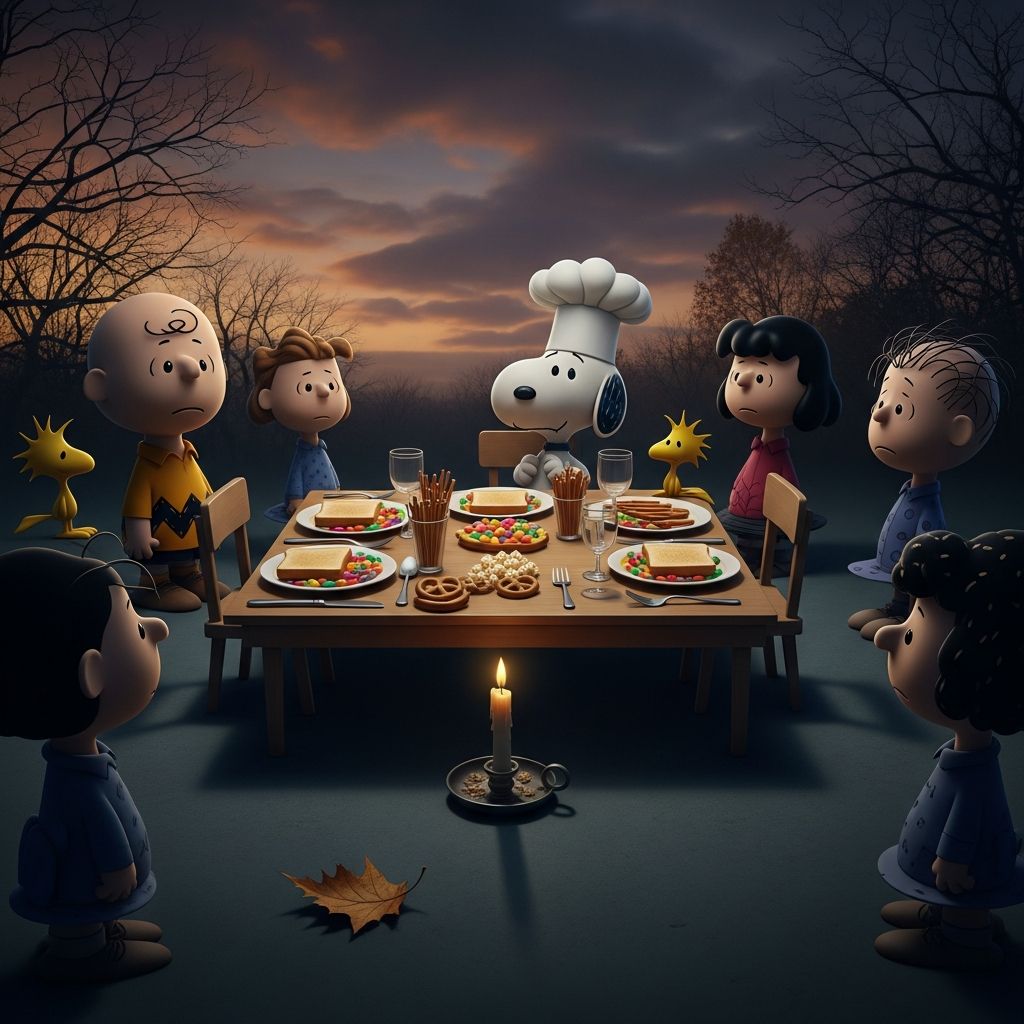
At the heart of the story is one of the oddest televised Thanksgiving dinners ever animated. Instead of turkey and stuffing, the kids are served toast, popcorn, pretzels, and candy—foods that look more like a sleepover snack attack than a carefully planned holiday meal. The table is dressed up, but the menu feels almost defiantly underwhelming.
- Toast cut into neat rectangles, as if precision could make up for a lack of substance.
- Popcorn scattered like confetti, crunchy but insubstantial.
- Pretzels and jelly beans, more reminiscent of Halloween leftovers than a carefully curated feast.
This bizarre spread is more than a joke; it becomes a visual metaphor for what kids can realistically offer one another. The meal is small, clumsy, and nowhere near the adult ideal of Thanksgiving, but it is what they manage with the skills and tools they have.
Expectation vs. Reality at the Holiday Table
One of the most striking aspects of the special is how bluntly it addresses the gap between what Thanksgiving is supposed to look like and what it often actually becomes. Television usually treats this day as a polished, slow-motion commercial: a golden turkey emerging from the oven, a smiling family with no real tension. The Peanuts version undercuts that fantasy almost immediately.
Charlie Brown does not have control over the menu, the guest list, or even the basic logistics of the event. The pressure placed on him is wildly disproportionate to his abilities. Watching him stumble through the preparations captures a very real feeling: the sense that holidays demand more emotional and practical labor than any one person—especially a child—can reasonably provide.
The Strange Comfort of Charlie Brown’s Anxiety
Charlie Brown’s defining trait has always been his low-level sadness: a perpetual, shuffling worry that he will never quite get life right. In the Thanksgiving special, that anxiety is channeled into the fear of being a bad host and a worse friend. He does not admit that he’s overwhelmed; he simply tries harder and feels worse.
For viewers, part of the comfort of this story is seeing that panic acknowledged instead of denied. So many holiday narratives pretend everything is fine after a single heartfelt speech or a minor misunderstanding. By contrast, this special lets the stress breathe. The main character’s unease is not magically cured by the end—it is simply held by the people around him more gently.
Friendship, Miscommunication, and an Accidental Friendsgiving
Long before the term “Friendsgiving” became a social media cliché, this little cartoon showed children accidentally hosting their own alternate holiday. Friends invite themselves over, not out of malice but out of a genuine desire not to be alone, and this unplanned gathering complicates the usual family-first script of Thanksgiving.
The tension among the kids arises mostly from miscommunication. One side assumes a traditional meal; the other assumes that effort alone will be enough. The conflict that follows feels painfully familiar to anyone who has tried to host a holiday without understanding what guests secretly expect. What ultimately rescues the day is not the food but a shift in perspective, as the kids are reminded that they came together to be with each other, not to inspect the menu.
The Quiet Sadness Beneath the Laughter
Despite its jokes and slapstick moments, there is a persistent undercurrent of sadness in this special. The children rarely mention their parents directly, and the adults remain mostly off-screen, leaving the kids to navigate etiquette, emotion, and obligation by themselves. That emotional vacancy gives the story a slightly lonely edge.
Moments that seem light on the surface—a botched football kick, a food fight with lawn chairs—are tinged with a sense that the characters are trying to entertain themselves in the absence of real guidance. The special never spells this out, but the mood is unmistakable. It is a vision of childhood in which kids are constantly improvising their own version of adulthood with limited information.
Snoopy, Slapstick, and the Art of Distraction
To keep the special from tipping entirely into gloom, Snoopy and Woodstock provide elastic, wordless comedy. Snoopy battles folding chairs, dons costumes, and treats cooking like a physical sport. Their antics function as a pressure valve, breaking up the tension that builds around the human characters’ misunderstandings.
Yet even Snoopy’s moments have a bittersweet flavor. His private feast at the end, complete with a “real” Thanksgiving spread that he and Woodstock share only with each other, hints at an odd divide between the dog’s world and the children’s. While the kids make do with snacks, the pet quietly enjoys the kind of meal everyone else seemed to be chasing.
Holiday Lessons Without a Lecture
Most seasonal specials funnel everything toward a single big moral, usually delivered in a polished speech. The Thanksgiving Peanuts story does include an explicit reflection on gratitude and history, but the more interesting lesson is embedded in the messy dynamics of the kids themselves.
- Gratitude appears not as a slogan but as a hard-won emotional shift after hurt feelings.
- Hospitality is redefined: it becomes less about culinary mastery and more about making room for people, even when it means changing long-standing plans.
- Forgiveness is shown as a process, not a snap decision; characters first feel wounded, then defensive, and only later are able to admit their own faults.
By the time the kids end up piling into a car for yet another meal, they haven’t solved all of their problems. What they have done is accept that everyone was trying, however clumsily, to care for one another.
Nostalgia, Reruns, and the Ritual of Rewatching
For many families, returning to this special each November is as much a ritual as carving the turkey. The animation style, the music, and even the dated slang form a kind of emotional time capsule. Viewers who first watched the special as children often reencounter it later as parents, seeing new layers of meaning in the same simple scenes.
The experience of rewatching highlights how holiday media can function as an anchor in time. The story does not change, but the audience does: adults recognize their own hosting fatigue in Charlie Brown, or their younger selves in the impatient guests. The special becomes a mirror that reflects different emotional truths at different stages of life.
Why Its Imperfections Matter Now More Than Ever
In an era when holiday programming is meticulously produced and algorithmically recommended, the rough edges of A Charlie Brown Thanksgiving feel almost radical. The pacing is uneven, the animation is limited, and the jokes land with a subtlety that modern children’s shows rarely attempt. Yet those very imperfections give the special its humanity.
The story suggests that Thanksgiving does not need to be flawless to be meaningful. A crooked table, a mismatched menu, and a family that arrives late can still hold real warmth. For viewers exhausted by glossy depictions of the holidays, there is relief in watching characters stumble, sulk, reconcile, and move on without ever achieving picture-perfect harmony.
Key Themes in A Charlie Brown Thanksgiving
| Theme | How It Appears | Why It Feels Real |
|---|---|---|
| Expectation vs. Reality | A host who cannot deliver the traditional meal, and guests who assume he can. | Reflects the stress many people feel when their holiday plans do not match idealized images. |
| Loneliness in a Crowd | Kids surrounded by friends yet unsure how to express hurt or gratitude. | Captures the way holidays can magnify both connection and isolation. |
| Imperfect Hospitality | A snack-based dinner offered in good faith, even if it disappoints. | Suggests that intention and inclusion matter more than tradition or presentation. |
| Childhood Responsibility | Children handling adult-sized emotional and social tasks. | Highlights how kids often navigate complex situations with limited guidance. |
| Reconciliation | Apologies, perspective shifts, and shared meals across multiple tables. | Shows that healing is incremental rather than neatly resolved. |
What Modern Viewers Can Take Away
Watching the special now, with decades of commercialization layered onto every major holiday, the story carries a quiet counter-message. It points away from elaborate decorations and curated menus and toward the basics: show up, make space, admit when you are wrong, and try again next year. The bar for a meaningful Thanksgiving is set refreshingly low.
There is also something deeply modern about the way the characters navigate overlapping obligations. The kids juggle a planned family meal, a spontaneous gathering, and the emotional expectations tied to both. It resembles the calendar chaos many adults face, but framed in terms a child can understand: you cannot be everywhere at once, but you can try to be honest about where you are needed most.
Simple Ways to Embrace the Spirit (Not the Exact Menu)
Instead of treating the special as a guide to culinary choices—most people will pass on the jelly bean entrée—it can serve as a model for how to handle the emotional side of the holiday. A few practical ideas inspired by its tone and themes:
- Host a low-pressure pre-holiday snack night with friends where the focus is conversation, not presentation.
- Invite someone who might otherwise spend the day alone, even if you cannot offer a perfectly staged meal.
- Talk openly with kids about what the holiday means beyond the food, and ask what they are actually thankful for.
- Allow room for disappointment and missteps, and treat apologies as a normal part of gathering, not a failure.
None of these suggestions require tradition-breaking feats—only a willingness to prioritize connection over performance.
Frequently Asked Questions
Is A Charlie Brown Thanksgiving only meant for children?
No. While the cast is primarily made up of kids and the animation is simple, many of the most powerful themes—anxiety, mismatched expectations, and the pressure to host—speak directly to adults. Parents often find themselves relating more to the overwhelmed main character than to his young guests.
Why does the special feel sad compared to other holiday cartoons?
The special doesn’t avoid uncomfortable emotions. Characters express disappointment, embarrassment, and guilt without having those feelings instantly erased. This willingness to linger in sadness, then move through it toward understanding, creates a more layered and realistic emotional tone.
Is the odd Thanksgiving meal supposed to be funny or serious?
It works on both levels. On the surface, the menu is a visual gag; beneath that, it symbolizes the way kids—and adults—often give the best they can with limited resources or experience. The humor makes the scene memorable, while the symbolism gives it staying power.
What keeps people coming back to this special every year?
Familiar music, simple visuals, and beloved characters all play a role, but the real draw is emotional honesty. Viewers recognize pieces of their own imperfect holidays in the story, which makes it feel like an honest companion rather than a glossy fantasy.
Do you need nostalgia to appreciate it?
Nostalgia certainly adds an extra layer of meaning for those who grew up with the special, but it is not required. New viewers can still connect with its themes of friendship, apology, and imperfect celebration. The pacing and style may feel old-fashioned, yet the core emotions remain surprisingly current.
A Holiday Tradition That Admits Holidays Are Hard
The enduring power of A Charlie Brown Thanksgiving lies in its willingness to concede that holidays do not magically fix anything. Families are messy, friends are flawed, and even the best intentions can turn into hurt feelings. Still, the special insists that these gatherings are worth the effort, not because they are flawless, but because they give people another chance to show up for each other.
That is why the image that lingers is not a perfect turkey on a magazine cover, but a table full of kids sharing toast and candy, trying to figure out what gratitude looks like in real time. It is a reminder that Thanksgiving’s real work happens not in the oven, but in the small, unsteady attempts to understand and forgive one another—year after complicated year.