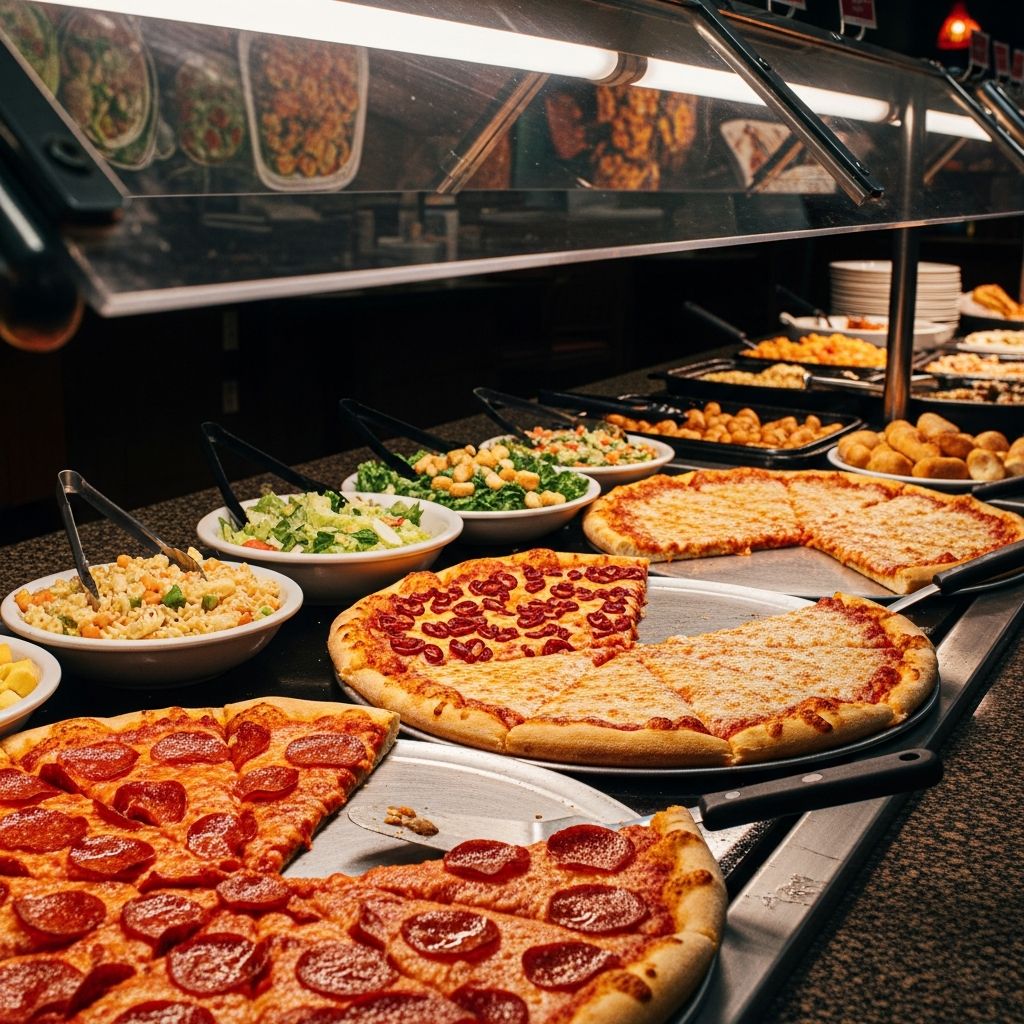
The 1990s Pizza Hut buffet was more than a place to pile plates with unlimited slices and soft-serve. It was a weekly ritual, a parenting hack, a childhood classroom in chaos and freedom. Even long after the red-roof dining rooms have turned into cell phone stores and auto parts shops, memories of those buffets feel strangely vivid and emotional.
This article looks back at that era: how the buffet came to be, what made it feel so special, why it faded, and what its disappearance tells us about family life, eating habits, and the way Americans used to gather around mediocre-but-magical pizza.
The Rise Of The All-You-Can-Eat Red Roof
Pizza Hut began as a small pizzeria in Wichita, Kansas, in 1958, when brothers Dan and Frank Carney borrowed $600 from their mother to open their first store. The distinctive red-roof look followed as the brand grew into a full sit-down chain through the 1960s and 1970s, at a time when casual dining was becoming a core part of American suburban life.
By the early 1990s, Pizza Hut was looking for ways to boost dine-in traffic in the face of growing delivery competition and changing consumer habits. In the summer of 1992, the company rolled out an ambitious experiment: long, self-serve buffet bars lined with pizza, salad, pasta, breadsticks, and dessert for a low fixed price.
The idea was simple but clever:
- Fill dining rooms at lunchtime with office workers and families who wanted something quick but social.
- Standardize the offering so kitchens could crank out basic pizzas without custom orders slowing things down.
- Compete with other buffet-style chains and all-you-can-eat restaurants that were booming in the same era.
By the mid-1990s, buffets had spread to thousands of locations across the United States. They became part of the brand’s identity, right alongside stuffed crust and the iconic red plastic cups.
What The 1990s Pizza Hut Buffet Felt Like
Ask people what they remember about 1990s Pizza Hut buffets and you usually get sensory snapshots rather than menu details. The experience was a carefully choreographed mess that worked precisely because it was loose around the edges.
The Look And Sound Of A Typical Visit
- The glow of neon beer signs and arcades humming in the corner.
- Red-and-white checkered patterns, dark wood booths, and those weighty glass condiment shakers filled with parmesan and chili flakes.
- The clatter of plates as kids lined up, too short to see everything but determined to grab the cheesiest slice.
- Servers hustling to refill pans while parents nursed one more sip of beer or soda, glad that no one at home was asking what was for dinner.
It felt chaotic, but there was an underlying structure: pay once, sit down, get up as often as you want, no questions asked. For a generation raised before app-based delivery and touchscreen kiosks, that combination of freedom and predictability made a deep impression.
Why Kids Loved It
For children, the buffet wasn’t just about volume; it was about agency. You didn’t sit and wait for your parents to portion food onto your plate. You wandered, you chose, you experimented.
- Autonomy: You could put three breadsticks and one lonely cucumber slice on your plate and nobody stopped you.
- Endless refills: Soda in sturdy red cups, plus a chance to try every pizza topping without committing to a whole pie.
- Play disguised as dining: Moving between the buffet, your booth, and the arcade machines felt like recess, not a formal meal.
- Ritual: Many kids came for birthday parties, sports-team celebrations, or after-school rewards, turning the place into a stage for milestones.
Why Parents Quietly Appreciated It
To adults, the buffet offered something equally valuable: a break from the constant mental load of planning, cooking, and cleaning. Sociological research has shown that family meals often place a heavy organizational burden on parents, especially mothers, who typically shoulder the bulk of meal planning and preparation. Buffets temporarily erased that responsibility.
For parents, the buffet was:
- Predictable in cost: One advertised price per person, minimal surprises.
- Low-stress: No arguing with servers about picky eaters or special orders; kids simply chose what they wanted.
- Time-efficient: Food was already made, so there was no long wait that could trigger meltdowns.
- Socially forgiving: Noise and spills blended into the background. You didn’t have to apologize for kids being kids.
Some US states even adjusted liquor regulations for family pizza restaurants, allowing parents to order a beer while kids roamed within sight, a recognition that these spaces were de facto family centers rather than formal bars. In that sense, the buffet was a pressure valve: kids got their chaos; parents got a moment of stillness.
Buffet Culture, American-Style
Pizza Hut’s lunch buffet did not emerge in a vacuum. The concept tapped into a broader American fascination with all-you-can-eat dining that flourished in the late 20th century, from hotel breakfast buffets to large chains like Golden Corral. Researchers note that buffets function as both economic and social spaces: they offer perceived value and also serve as settings where groups can gather without feeling rushed to turn over the table.
| Feature | Pizza Hut Buffet (1990s) | Typical Fast-Food Meal |
|---|---|---|
| Ordering Style | Self-serve, repeat visits | Single order at counter or drive-through |
| Time Spent | Often 45–90 minutes | Usually 5–20 minutes |
| Social Environment | Sit-down, group-oriented | Quick, transactional |
| Perceived Value | Variety and volume for a fixed price | Individual portion for a set price |
The Pizza Hut version added a kid-centric twist: by centering pizza, dessert, and soda, it fused the grammar of children’s birthday parties with everyday family dining. The result was a sense that a normal Wednesday lunch could feel like a small holiday.
Why The Buffets Faded Away
By the 2000s, the glory days of the Pizza Hut buffet were clearly fading. Several forces converged to make the model harder to sustain.
The Shift Toward Convenience And Customization
Beginning in the 1980s, delivery-first pizza chains like Domino’s built their identity around speed and convenience, while Pizza Hut still emphasized dine-in service. As dual-income households became more common and schedules more hectic, Americans increasingly favored takeout and delivery over lingering meals in dining rooms.
At the same time, customer expectations shifted toward customization. Made-to-order pizzas, specialized crusts, and individualized toppings were easier to achieve with direct ordering than with standardized buffet pans. Fast-casual chains like Chipotle and Panera later raised the bar by letting diners personalize meals while still keeping throughput high, putting additional pressure on old-school buffets.
Economics And Food Waste
Buffets are operationally complex. Restaurants must prepare enough food to keep lines stocked while guessing how many customers will show up. When traffic is steady, the numbers can work. When it’s not, waste rises sharply.
Public health and food-policy researchers have noted that buffets can generate a disproportionate amount of food waste compared with made-to-order service, since large quantities are cooked and displayed regardless of final consumption. As margins tightened and scrutiny of waste grew, operators had more incentive to streamline menus and reduce unpredictability.
Health Concerns And The Pandemic Effect
Even before COVID-19, public health agencies highlighted buffets as environments requiring strict temperature control and sanitation to avoid contamination. Concerns about food-borne illness periodically pushed some chains to tighten self-service practices.
The COVID-19 pandemic accelerated this trend dramatically. In 2020, the US Centers for Disease Control and Prevention issued guidance noting that self-service stations like buffets and salad bars posed higher risks of viral spread if not carefully managed. Many operators either suspended buffets or removed them altogether, and a number never brought them back.
While some international Pizza Hut locations retained or revived buffets after restrictions eased, many US restaurants continued leaning into delivery, carryout, and simplified dine-in service rather than reinstalling large self-serve bars.
What Was Lost When The Buffets Vanished
On paper, replacing buffets with delivery and streamlined menus looks like rational business evolution. But emotionally and culturally, something else disappeared along with those heat-lamp-lit pans.
A Training Ground For Social Eating
The buffet taught children unwritten rules about public spaces: how to queue, how to share limited resources, how to bus a table (or at least not leave everything on the floor). It was messy, but it was practice.
Developmental psychologists argue that shared family meals offer children a chance to build social skills, learn norms, and feel a sense of belonging. While any sit-down restaurant can provide that, the buffet’s freedom of movement and low stakes made it uniquely kid-accessible. If you dropped your plate or changed your mind halfway through a slice, no one panicked.
An Off-Duty Zone For Parents
Parents experienced those nights as something close to a sanctioned lapse in responsibility. The house stayed clean, no dishes piled up, and everyone returned home smelling faintly of oregano instead of standing over a sink full of pots.
In an age when modern parents often feel pressure to curate every bite their children eat and every minute of their day, the old buffet model feels almost radical: you paid the price of admission, then largely stopped worrying. Kids could overdo it on pudding and pizza; the consequences were limited to a stomachache and maybe an early bedtime.
A Sense Of Place That Delivery Can’t Replace
When a former Pizza Hut building becomes a phone store or a tax office, the old rooflines remain but the function is gone. The transformation underscores how rare it has become to have third spaces—places that are neither work nor home—designed around unhurried, affordable family hanging out.
Sociologists often describe these third spaces as important for community-building and informal social ties. For many suburbs and small towns in the 1990s, the local red-roof Pizza Hut, especially on buffet day, was exactly that kind of place.
Why Nostalgia For 1990s Pizza Hut Is So Intense
Looking back, no one seriously argues that 1990s buffet pizza was world-class cuisine. The affection comes from what the experience symbolized during a specific cultural moment.
- Timing: It overlapped with a pre-smartphone, pre-app world where gathering in physical spaces was the default, not an optional add-on.
- Ritual: Weekly buffet nights, after-game celebrations, or Book It! reward visits carved grooves into childhood memory.
- Permission to be imperfect: The food, the decor, and the behavior were all allowed to be slightly shabby and over-the-top at the same time.
- Shared experience: Because so many locations looked and operated similarly across the country, very different people can describe the same red cups and steaming pans and instantly understand each other.
In a way, nostalgia for Pizza Hut buffets is really nostalgia for an era when families felt they had time to sit, refill plates, and let a lazy afternoon or evening stretch on without rushing to the next commitment.
What Today’s Families Can Learn From The Buffet Era
Buffets may never return on a large scale, for reasons ranging from food safety to economics. But some of what they offered can still be reclaimed, even in an age of delivery apps and individually boxed meals.
Recreating The Spirit At Home
- DIY buffet nights: Set out simple pizzas, salads, and sides at home and let kids build their own plates without comment or correction.
- One-price, no-questions nights: Order a few large, plain pizzas, announce that tonight “anything goes,” and drop the usual rules about portions and combinations.
- Long-table gatherings: Invite relatives or neighbors and linger at the table even after the food is gone, mimicking that sense of open-ended time.
Supporting Remaining Sit-Down Spots
Some Pizza Hut restaurants in select regions still offer buffets or limited self-serve setups, and other local spots provide similar all-you-can-eat experiences. Choosing dine-in options occasionally, rather than defaulting to delivery, helps preserve the existence of restaurants where families can practice being together in public rather than just eating side-by-side in front of separate screens.
Frequently Asked Questions (FAQs)
Q: Do any Pizza Hut buffets still operate in the United States?
A: Some locations in the United States reportedly still offer buffet-style service or limited all-you-can-eat options, but availability is highly regional and can change over time. The company has focused more on delivery and carryout in recent years, so it is best to check directly with individual restaurants.
Q: Were 1990s Pizza Hut buffets unique compared with other buffets?
A: The basic concept—unlimited helpings for a fixed price—was not unique, but Pizza Hut’s kid-friendly focus on pizza, pasta, salad, and dessert made it feel like a hybrid between a family restaurant and a permanent birthday party. The standardized red-roof design and familiar menu also created a consistent experience across the country.
Q: Why do people remember the experience so vividly if the food was just average?
A: Memory researchers note that emotional context, social connection, and novelty often matter more than objective quality when it comes to what we remember. For many people, Pizza Hut buffets were tied to celebrations, childhood autonomy, and rare moments of parental relaxation, which makes those visits stand out even if the food itself was ordinary.
Q: Are buffets likely to return to their 1990s popularity?
A: Most industry analysts believe a full-scale return is unlikely in the United States because of long-term shifts toward delivery, customization, and heightened awareness of food waste and sanitation. However, niche buffets and regional chains may continue to thrive where local demand and economics make them viable.
Q: What made Pizza Hut’s red-roof buildings so iconic?
A: The red roofs were part of a deliberate architectural branding strategy that started in the 1960s and 1970s, helping drivers recognize locations instantly. As many of these buildings have since been repurposed for other businesses, the distinctive roofline has become a nostalgic visual cue that reminds people of the era of sit-down pizza dinners and lunch buffets.
References
- Pizza Hut. — Pizza Hut Official Site. 2024-01-01. https://www.pizzahut.com
- Fiese BH, Hammons A, Grigsby-Toussaint D. Family mealtimes: A contextual approach to understanding childhood obesity. — National Institutes of Health / Pediatric Clinics of North America. 2011-12-01. https://www.ncbi.nlm.nih.gov/pmc/articles/PMC3199512/
- Wansink B, Painter JE, Lee Y-K. The office candy dish: proximity’s influence on estimated and actual consumption. — International Journal of Obesity. 2006-05-01. https://doi.org/10.1038/sj.ijo.0803250
- Considerations for Restaurants and Bars. — Centers for Disease Control and Prevention (CDC). 2020-05-27. https://www.cdc.gov/coronavirus/2019-ncov/community/organizations/business-employers/bars-restaurants.html