Deciding when to let a child stay home alone is one of the first major independence milestones for families, and it can feel exciting, nerve-racking, and confusing all at once. The goal is not just picking a number for the “right age” but understanding your child’s maturity, your family’s circumstances, and the safety steps that make solo time at home truly manageable.
There Is No Single “Right Age”
Parents often search for a magic age when every child suddenly becomes ready to stay home alone, but the reality is more nuanced. Some children are responsible, calm, and thoughtful at a younger age, while others need more time and guidance before being comfortable without an adult in the house. Local guidelines or recommendations may suggest minimum ages, yet they still depend heavily on individual readiness and context.
In practice, age works more as a starting point than a final answer. A younger child might manage a brief period alone in the afternoon while a teenager might still struggle with judgment or anxiety. What matters most is whether your child can follow rules, handle minor problems, and communicate clearly with you when you are not there.
Key Factors to Weigh Before Leaving a Child Alone
Before you even begin to think about length of time, it helps to walk through several major readiness factors. These tell you more about your child’s real capabilities than the number of birthdays they have celebrated.
- Age and developmental stage: Is your child old enough to understand safety instructions and remember them under mild stress?
- Emotional maturity: Does your child stay relatively calm in new or uncertain situations, or do they panic easily?
- Sense of responsibility: Do they follow household rules when you are home, or do they push limits as soon as your back is turned?
- Problem-solving skills: Can they think through simple problems (like a spilled drink or a low battery on the phone) without melting down?
- Communication habits: Do they usually tell you where they are, what they are doing, and reach out when something feels wrong?
- Home and neighborhood safety: Is your area generally safe and are there trusted neighbors close by if they need help quickly?
- Support network: Are you or another adult reachable by phone, text, or video almost immediately?
The more of these boxes you can confidently check off, the more likely it is that your child is ready for at least short periods at home without an adult. If several answers make you hesitate, it is usually a sign that additional teaching, practice, or time is needed.
Signs Your Child May Be Ready to Stay Home Alone
Readiness to stay home alone shows up in everyday behavior long before the first experiment with solo time. Look for patterns rather than one-time events.
- They follow basic rules like homework before screen time, without constant reminders.
- They can prepare a simple snack and clean up afterward with minimal mess.
- They show caution around hot appliances, sharp tools, and risky activities.
- They are able to entertain themselves without complaining every five minutes.
- They already handle short separations well, such as sleeping in their own room or being at an activity without you right there.
- They know how to use a phone, remember important numbers, and can clearly explain a problem to an adult.
- They express at least some interest or comfort in trying time alone, instead of obvious fear or refusal.
If your child routinely shows these kinds of behaviors, it suggests they have enough self-control and confidence to handle brief periods at home by themselves. If the opposite is true — frequent risky behavior, impulsive decisions, or strong anxiety — then a home-alone trial is likely premature.
Questions to Ask Yourself Before Deciding
Parents know their children better than anyone, but it can still be helpful to run through specific self-check questions. Honest answers will offer a clearer picture than a general feeling of “ready” or “not ready.”
- Does my child usually do what is asked even when no one is watching?
- How do they react to unexpected noises or small emergencies, such as a tripped breaker or a pet accident?
- Is my child frightened by being alone in certain rooms or at night?
- Does my child understand the difference between minor problems and true emergencies?
- Can my child stay busy independently without getting into mischief out of boredom?
- Are there any medical conditions (like severe allergies) that demand near-constant adult supervision?
Your answers are more important than what other families do. One child may thrive during a quiet hour alone after school, while a sibling or neighbor the same age might feel overwhelmed or act impulsively when unsupervised.
Legal and Safety Considerations
In addition to knowing your child, you also need to understand the basic legal and safety framework where you live. Some regions have a recommended or minimum age for children to stay home alone, while others leave it entirely up to parents, as long as the child is not placed in clear danger.
Even when no exact age is written into law, authorities often consider whether a reasonable adult would see the situation as safe. That means it is wise to avoid leaving very young children alone and to keep solo time relatively short at first, especially if there are potential hazards in the home or neighborhood. When unsure, contacting a local non-emergency line, child development agency, or community resource can help clarify expectations where you live.
Home Alone Readiness Checklist
Using a checklist can make the decision more concrete. Go through each of these items and mark whether your child usually meets the standard. More “yes” responses generally indicate greater readiness for short periods alone.
| Readiness Area | What to Look For |
|---|---|
| Rule-following | Follows house rules without repeated reminders or arguments. |
| Basic safety | Handles doors, windows, and appliances cautiously; avoids obvious risks. |
| Emotional stability | Can calm down after being startled or upset and think clearly. |
| Communication | Can call or text a trusted adult and clearly explain what is happening. |
| Judgment | Understands when to say no to friends, strangers, or risky ideas. |
| Self-care | Prepares simple food, uses the bathroom independently, and handles minor messes. |
| Comfort level | Reports feeling okay about the idea of staying alone for a short time. |
If multiple boxes are checked “no,” then staying home alone may need to wait. You can still use the checklist as a teaching roadmap: each “no” becomes a skill to intentionally practice together.
Setting Clear House Rules for Time Alone
Once you believe your child is close to ready, the next step is defining specific rules for when they are home alone. Vague instructions like “behave yourself” are not enough; children make better choices when expectations are simple, concrete, and written down.
- Time limits: Exactly how long they may be alone and what time you expect to return.
- Doors and visitors: Whether they may open the door to anyone, and what to do if someone knocks or rings the bell.
- Phone and online use: Who they may contact, which apps are allowed, and what information must never be shared.
- Cooking and appliances: Which appliances are off-limits (for example, the stove or deep fryer) and what simple foods are okay.
- Friends: Whether any friends are allowed over and under what conditions.
- Going outside: Clear boundaries about staying inside or, if allowed outside, exactly where and when.
Posting a written list in a visible place, such as on the refrigerator or near the main phone, helps your child remember the rules in the moment. It also reassures you that you have clearly communicated your expectations rather than assuming your child will guess correctly.
Essential Safety Skills to Teach First
Even a mature child needs direct instruction on what to do in specific scenarios that might arise while they are alone. Walk through these topics in calm detail before the first solo session and practice them more than once.
- How to call emergency services, give your address, and briefly describe the problem.
- What to do if there is smoke, fire, or a strange smell, including when to leave the house immediately.
- How to handle a power outage or a triggered alarm, if your home has one.
- Whom to contact if you do not answer your phone right away (a neighbor, relative, or close family friend).
- How to respond to phone calls from strangers, salespeople, or wrong numbers.
- What to do if they get hurt lightly (a small cut or scrape) versus more serious injury.
Role-playing these situations makes them feel less alarming. Instead of frightening your child, it usually gives them confidence: they know that even if something goes wrong, they have a plan and people they can reach.
Creating an Emergency Information Sheet
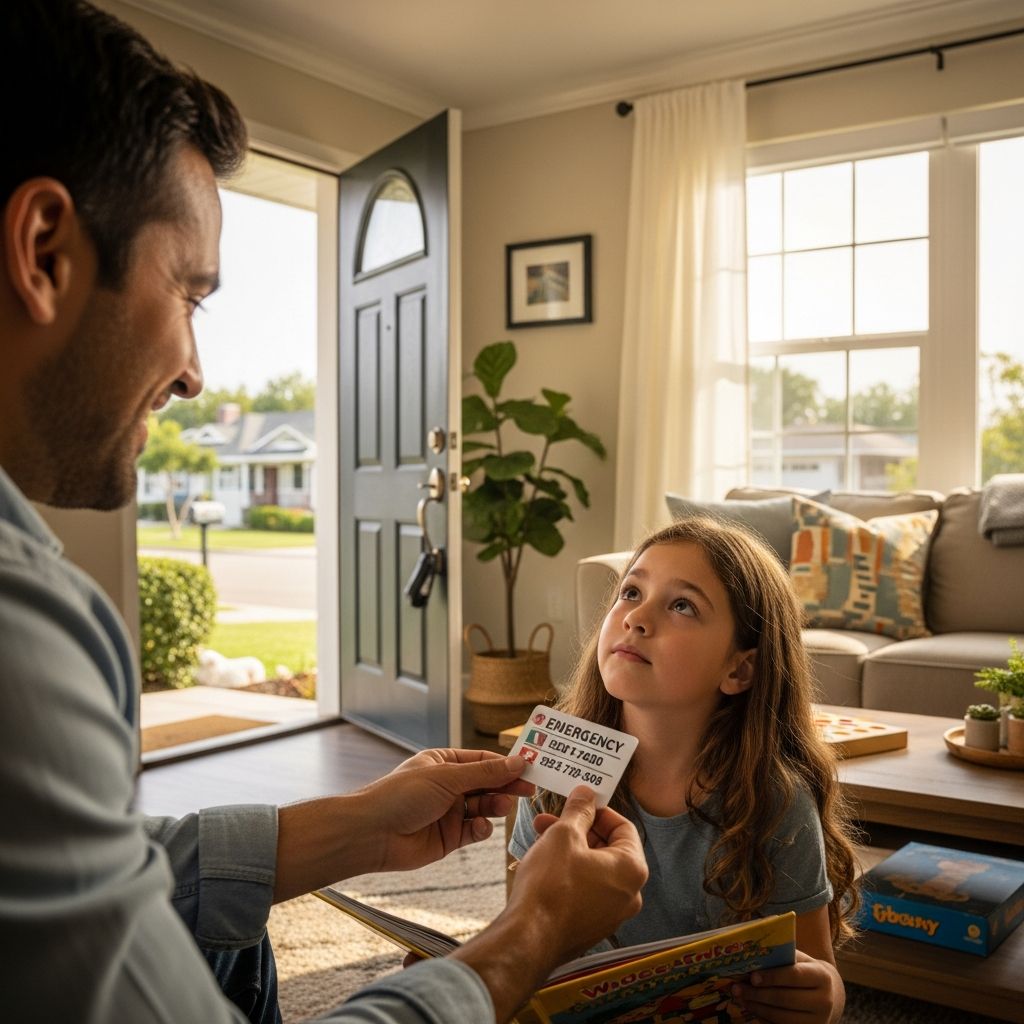
An emergency sheet is a simple document, but it can be invaluable when seconds matter or a child feels flustered. Keeping it near the main phone or posted on a wall ensures the information is available even if a device battery dies or contact lists are hard to find.
- Home address and nearest cross-street, written clearly.
- Parents’ and caregivers’ phone numbers, including work or secondary numbers.
- Trusted neighbors’ names and phone numbers.
- Extended family or close friends who can arrive quickly if needed.
- Doctor or clinic phone number, especially if your child has health concerns.
- Basic instructions like “In a fire: leave the house first, then call for help from outside.”
Introduce the sheet to your child and practice reading from it as if making a real call. Encourage them to keep their own copy in a small notebook or folder if that makes them feel more secure.
Planning a Gradual Transition to Solo Time
Jumping from constant supervision to hours alone can feel overwhelming for both you and your child. A gradual, step-by-step transition builds skills and confidence while keeping risks low.
- Start with very short intervals: Step out to a nearby neighbor or walk the dog around the block for ten minutes while your child stays inside.
- Increase time slowly: Move up to 20–30 minutes, then perhaps an hour, if everything goes smoothly.
- Choose predictable times: Early afternoons or early evenings are usually better than late at night.
- Debrief afterward: Ask what went well, what felt uncomfortable, and whether any rules need adjusting.
- Extend only when both of you feel ready: If your child seems nervous, hold at the current level or step back.
This approach helps normalize being home alone as a skill that is learned and practiced over time, rather than a single test to pass or fail. It also gives you many chances to correct misunderstandings and reinforce positive habits.
Sibling Dynamics: Older Kids Watching Younger Ones
Many families consider leaving an older child in charge of younger siblings. This can work well in some homes, but it adds a layer of complexity to the decision. Being old enough to stay home alone is not always the same as being old enough to supervise another child.
- The older child should genuinely feel capable and willing, not resentful or fearful.
- Siblings should generally get along and be able to resolve minor conflicts without constant intervention.
- The tasks expected of the older child should match their age; for example, ensuring everyone follows house rules, not acting as a full-time parent.
- Parents should have clear rules about whether the older sibling may discipline, and how, to avoid power struggles.
If sibling rivalry is high or the younger child tends to ignore the older one’s directions, then adding a caregiving role might be unfair to everyone involved. In those cases, it is often better to wait or use outside care instead.
Managing Technology, Media, and Boredom
Screen time and boredom can quickly turn solo time from peaceful to problematic if boundaries are not clear. When a child is home alone, it is usually best to limit complicated online activities and focus on safe, simple options.
- Set time limits for television, streaming, and gaming when no adult is home.
- Use content filters or kid-friendly profiles to reduce exposure to inappropriate material.
- Make a list of approved activities your child can choose from, such as reading, drawing, puzzles, crafts, or building sets.
- Encourage them to prepare materials in advance so they are not tempted to explore unsafe or forbidden options out of boredom.
Keeping your child gently occupied reduces the chances of anxious overthinking or curiosity that leads to risky behavior. Some families also leave simple checklists of small chores, which add structure and a sense of accomplishment.
Helping Anxious Children Feel More Secure
Even children who are otherwise responsible may feel nervous about staying home alone. Anxiety does not automatically mean they are not ready, but it does mean you should proceed slowly and respectfully.
- Listen carefully to what worries them most — sounds in the house, strangers at the door, or the idea of a fire.
- Reassure them with concrete plans rather than vague comfort: show them locks, alarms, and emergency exits.
- Offer options like having a neighbor on “standby” or allowing them to call or text you anytime.
- Consider using video calls or quick check-ins during the first few solo sessions.
Over time, many children discover that the house feels less eerie and more familiar when they know what to expect and how to respond. If fear remains intense even after careful preparation, it may be wise to pause and revisit the idea later.
Common Mistakes Parents Make
Good intentions do not always prevent missteps. Knowing some frequent mistakes can help you avoid them as you plan your family’s approach to home-alone time.
- Assuming age alone equals readiness, without considering maturity or past behavior.
- Leaving a child with complicated responsibilities, like cooking full meals, before they are truly prepared.
- Failing to discuss and practice emergency plans before the first solo session.
- Using time alone as a punishment rather than a developmental step toward independence.
- Leaving siblings who constantly argue in charge of each other.
A more thoughtful approach treats staying home alone as a privilege that is gradually earned through demonstrated responsibility and clear communication. This mindset supports safety and also helps your child feel proud when you trust them with more independence.
FAQs About Letting Kids Stay Home Alone
How do I know my child is truly ready?
Readiness shows up in small, daily behaviors such as following rules, keeping calm in minor mishaps, and communicating honestly about problems. If your child handles those situations well and understands clear safety rules, they are likely ready to try very short periods alone with a gradual increase over time.
What is a reasonable first length of time?
For a first trial, many parents choose a very short window, such as 15 to 30 minutes, at a calm time of day when they can return quickly if needed. If both you and your child feel comfortable afterward, the interval can be slowly extended to an hour or more.
Should my child be allowed to cook when home alone?
High-heat cooking, deep frying, and complex recipes are usually better left for times when an adult is present. During solo periods, stick with no-cook or very simple options, such as sandwiches, cold snacks, pre-cut fruits and vegetables, or microwave items that your child has practiced using safely.
Is it okay for them to answer the door or phone?
This depends on your comfort level and your child’s skills, but many families adopt a rule that children do not open the door to anyone when they are alone. For phone calls, some parents prefer that the child let unknown numbers go to voicemail, or answer with limited information and avoid saying they are home without an adult.
What if my child makes a mistake while alone?
Mistakes are part of learning; the crucial part is how they and you respond afterward. Address safety issues firmly, but also use them as teaching moments, revising rules or practicing specific scenarios so your child is less likely to repeat the same error next time.
Should I tell other parents or neighbors that my child is home alone?
Informing a trusted neighbor can be helpful, especially during the first few times, so someone nearby knows to keep an eye out and be available if needed. You do not have to advertise it widely, but having at least one adult nearby who is aware can add a layer of security for both you and your child.
Balancing Safety and Independence
Allowing children to stay home alone, when done thoughtfully, can strengthen their confidence, problem-solving skills, and sense of responsibility. It sends a powerful message: you trust them, you believe in their abilities, and you are willing to guide them into greater independence step by step.
There will never be a perfect, risk-free moment, but by paying close attention to your child’s maturity, preparing them with safety skills, and starting small, you can make this transition in a way that respects both their need for freedom and your instinct to keep them safe.