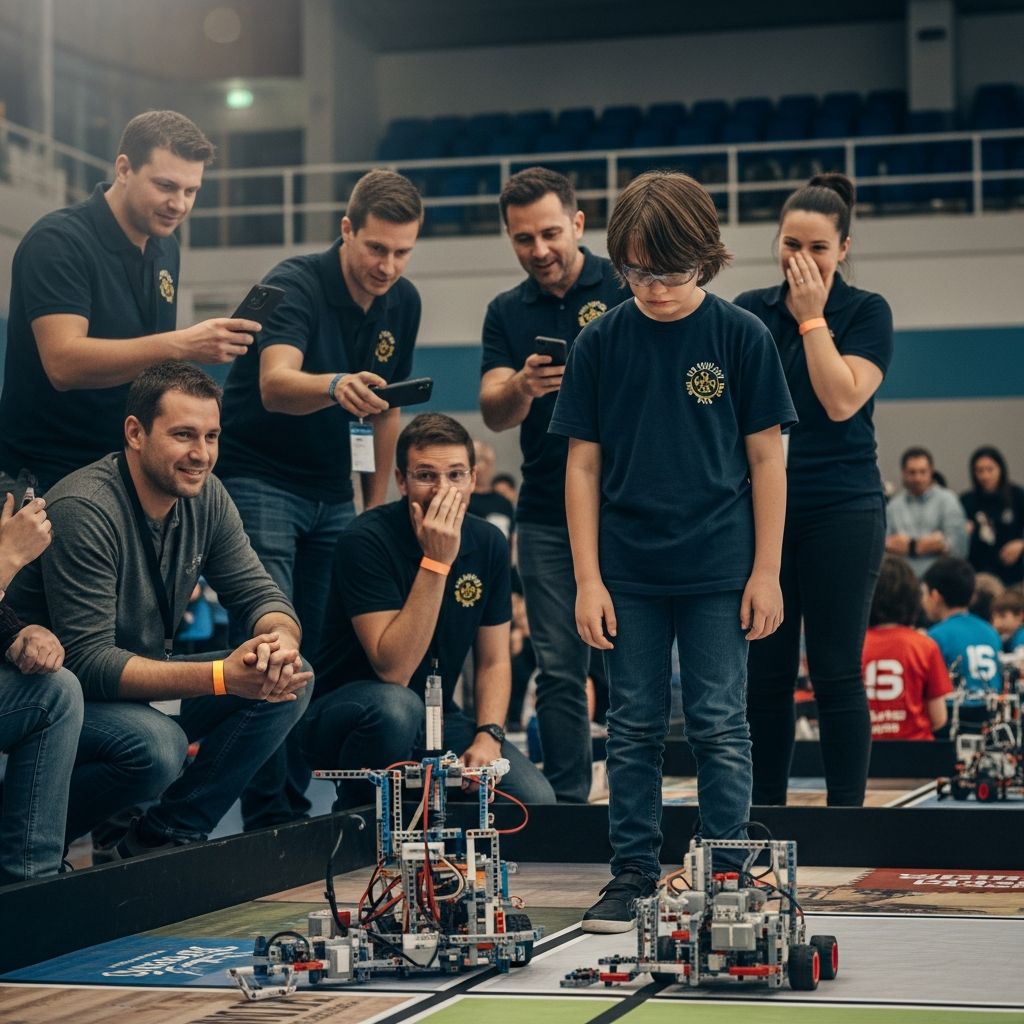
When Jokes Go Viral: A LEGO Robotics Tweet That Sparked a Parenting Debate
A conservative media personality spent a day at his son’s LEGO robotics tournament, posted sarcastic comments about the event on Twitter, and ended up in the center of a fierce public backlash. What he saw as harmless humor about his boredom quickly became a national conversation about parenting, respect for children’s interests, and the power of social media outrage.
This incident is more than just another internet pile-on. It highlights a real tension many parents experience: how to balance their own feelings, sense of humor, or political persona with the responsibility to support their kids in public and online. It also raises questions about what happens when private family dynamics are turned into content for thousands—or millions—of strangers.
What Actually Happened: From Tournament to Twitter Storm
The basic chain of events is straightforward: a father attended his child’s LEGO robotics competition, posted sardonic commentary about the tournament and the other families, and was widely criticized for appearing to mock his son and the kids who were competing.
Coverage from local and national outlets described several key points:
- The dad is a conservative talk radio host with an active presence on social media.
- He spent much of the day at his son’s LEGO robotics tournament and began sharing mocking or dismissive tweets about the event and participants.
- The tweets were framed as jokes but were perceived by many as belittling his own child’s interests and achievements.
- Critics called him a bad or unsupportive parent, while defenders argued he was simply being humorous and that his son wasn’t bothered.
- Major outlets reported that he refused to apologize, insisting that his son was in on the joke and that the outrage was performative.
However one interprets the original intent, the outcome is clear: the tweets turned a kids’ STEM event into a national referendum on what good parenting looks like in the age of social media.
Why Kids’ Interests Matter More Than Parents’ Image
Researchers have consistently found that when parents show genuine interest in their children’s hobbies, academic pursuits, and extracurricular activities, kids benefit in several ways, including higher self-esteem and better academic outcomes. When that involvement is negative or mocking, the opposite can occur.
Supportive engagement can:
- Reinforce a child’s sense of competence and autonomy.
- Encourage persistence in challenging, skill-building activities like robotics or coding.
- Strengthen the parent–child relationship and trust.
By contrast, public mockery—even framed as a joke—can send the message that a child’s passions are embarrassing or trivial. Over time, children may internalize this and become less likely to share their interests or try new activities for fear of being ridiculed.
LEGO Robotics Isn’t Just Play: It’s Early STEM Education
LEGO robotics tournaments may look like playful chaos, but they are also structured competitions that require planning, programming, collaboration, and problem-solving—skills widely recognized as essential in modern education and the future workforce.
Programs using LEGO-based robotics kits and similar tools are designed to:
- Introduce children to basic engineering and coding concepts.
- Develop teamwork, communication, and project management skills.
- Make science and technology feel accessible and fun, especially for younger students.
International organizations and education researchers emphasize that high-quality STEM experiences help prepare children for a labor market where technological skills are increasingly critical. When adults dismiss these activities as pointless or nerdy, they risk undermining efforts to engage kids—especially those who may not see themselves represented in traditional STEM spaces.
| Aspect of LEGO Robotics | Skill Kids Practice | Long-Term Benefit |
|---|---|---|
| Building and designing robots | Engineering and spatial reasoning | Foundation for technical and design thinking careers |
| Programming robot behavior | Computational thinking and coding logic | Preparation for digital and technology-driven jobs |
| Working with a team | Collaboration and communication | Transferable social skills for school and work |
| Competing and presenting solutions | Resilience, public speaking, handling feedback | Confidence and perseverance in challenging settings |
When Humor Hurts: The Line Between Joking and Shaming
Many families tease each other playfully, and some children genuinely enjoy light sarcasm or banter. The problem arises when jokes become public content, stripped of context and consent, and when the subject of the joke is a child who cannot fully control how they are portrayed.
Potential harms of publicly mocking kids’ activities include:
- Public humiliation: Even if the child laughs in the moment, knowing thousands of strangers are reading criticisms of their hobby can be deeply embarrassing.
- Distorted power balance: Parents have far more social power and reach than children; turning that into content can feel like punching down.
- Long digital memory: Posts can be screenshotted and resurface years later, when the child is older and more aware of how they were portrayed.
Psychologists and child advocates have raised concerns about parents oversharing or ridiculing their children online, noting potential impacts on self-esteem and future relationships. Humor in private, mutually understood family contexts is one thing; humor broadcast to a large audience is another.
Social Media Outrage: Protection, Performance, or Both?
The backlash against this father came fast and forcefully, with critics calling him everything from unsupportive to abusive. Major outlets covered the controversy, and some platforms framed it as an example of the internet “defending” a child whose parent had crossed a line.
There are mixed effects to this kind of public outrage:
- Potential positives:
- It signals that many adults believe kids deserve respect and support.
- It may push some parents to think twice before mocking their children online.
- It can highlight broader issues, such as how we treat STEM-oriented kids or “nerdy” hobbies.
- Potential negatives:
- It can harden defensive attitudes, making individuals less likely to reflect or change.
- The discussion may shift from the child’s wellbeing to a political or culture-war battle.
- The child may become even more publicly exposed as the story spreads.
In this case, coverage from local news and radio noted that the father refused to apologize and maintained that his son wasn’t harmed and that critics misunderstood the family dynamic. That raises another key question for parents: does the fact that a child laughs along in the moment mean that public ridicule is harmless?
How Parents Can Show Up at Activities They Don’t Understand
Many parents have sat through lengthy events—chess tournaments, robotics meets, band competitions—without fully understanding what is happening. Boredom or confusion is normal; how we respond is the important part.
Parents who want to be supportive without pretending to be thrilled by every minute can try:
- Leading with curiosity: Ask your child to explain what they are doing, what the rules are, and what they are proud of.
- Focusing on effort: Even if you don’t grasp the technical details, you can praise persistence, teamwork, and problem-solving.
- Separating your feelings from their experience: You can be honest that the event is long or confusing without belittling the activity itself.
- Saving snark for adults-only spaces: If you really need to vent, do it privately with trusted adults, not to thousands of followers.
Evidence from family and education research emphasizes that the quality of parental involvement—warm, respectful, and autonomy-supportive—matters more than the parent’s subject-matter expertise.
Public Persona vs. Private Parenting
For parents who are public figures, influencers, or highly active on social media, there is an added complication: their brand is often built on strong opinions and sharp jokes. That creates pressure to turn every situation, even a child’s competition, into content.
Key tensions include:
- Audience expectations: Followers may expect constant sarcasm or trolling, even when the subject is family life.
- Family consent: Children rarely have full awareness of what it means to be featured or mocked in front of a large audience.
- Long-term impact: A joke that drives engagement today may damage trust or cause embarrassment years later.
Ethicists and child advocates increasingly argue that parents should treat children’s images and stories as sensitive data, not raw material for content, in line with broader concerns about children’s privacy and digital footprints.
What This Story Reveals About How We Value STEM Kids
It is telling that the flashpoint for this controversy was a robotics tournament—in other words, an academic and technical competition, not a stereotypically popular sport. Children who gravitate to robotics, coding, or similar activities may already feel out of step with peers who prioritize more traditional status symbols.
When parents mock these pursuits, it can reinforce old stereotypes that STEM interests are socially undesirable or laughable. Yet global education and labor organizations repeatedly emphasize the importance of STEM literacy for future economic and social participation.
In that context, showing up for kids at robotics events is not just about being a good parent in the moment; it is about backing a pathway that may shape their future education and career.
Frequently Asked Questions (FAQs)
Q: Is it ever okay to joke about my child online?
Humor can be fine when it is kind, your child understands and genuinely enjoys it, and the content does not embarrass or expose them to ridicule. Before posting, ask yourself: Would I still feel comfortable with this post if my child’s peers, teachers, or future employer saw it? If the answer is no, it is better to keep that joke offline.
Q: My child loves something I find boring. How do I support them honestly?
You do not have to pretend to love the activity itself. Focus on what it means to your child—how hard they have worked, what skills they are building, and how proud they feel. You can say, “I don’t really get all the rules, but I love seeing how excited you are,” instead of mocking the event.
Q: Does social media outrage actually help kids in situations like this?
Outrage can highlight problematic behavior and signal social norms—that mocking children publicly is not acceptable. However, it can also escalate conflict, entrench defensiveness, and further publicize the child involved. The most constructive responses focus on principles (respect, privacy, support) rather than personal attacks.
Q: What should parents consider before posting about their kids’ activities?
Consider consent, privacy, and long-term impact. Ask: Has my child agreed to be shared in this way? Could this be used to tease them later? Does it highlight their strengths or their vulnerabilities? Many experts recommend erring on the side of protecting your child’s dignity and leaving out details that are mocking, shaming, or overly personal.
Q: Are robotics and similar competitions really beneficial for children?
Yes. Research on STEM education shows that hands-on programs like robotics clubs can improve problem-solving, persistence, and interest in science and technology. These experiences help build skills that are valuable in school and increasingly important in the job market.
References
- Dad Gets Blasted on Twitter After Mocking His Son’s Robotics Tournament — Fatherly. 2019-01-22. https://www.fatherly.com/news/jesse-kelly-twitter-mock-son-lego-robotics-tournament
- Dad Tweet Sparks Outrage On Twitter, Buzzfeed Goes After Houston Radio Host — iHeartMedia / KPRC. 2019-01-22. https://ksskradio.iheart.com/content/2019-01-22-dad-tweet-sparks-outrage-on-twitter-buzzfeed-goes-after-houston-radio-host/
- ‘I’m not sorry’: Houston radio host who mocked robotics tourney stands by tweets — Houston Chronicle. 2019-01-22. https://www.chron.com/news/houston-texas/houston/article/I-m-not-sorry-Houston-talk-radio-host-stands-13549901.php
- STEM Education for the Future of Work — OECD. 2019-05-28. https://www.oecd.org/education/stem-education-for-the-future-of-work.htm
- Twitter Schools Dad Who Mocks His Son’s LEGO Robotics Tourney — Diply. 2019. https://diply.com/twitter-schools-dad-who-mocks-his-sons-lego-robotics-tourney-vi/
- Children’s Privacy in the Digital Age — UNICEF Office of Global Insight and Policy. 2021-03-01. https://www.unicef.org/globalinsight/stories/childrens-privacy-digital-age