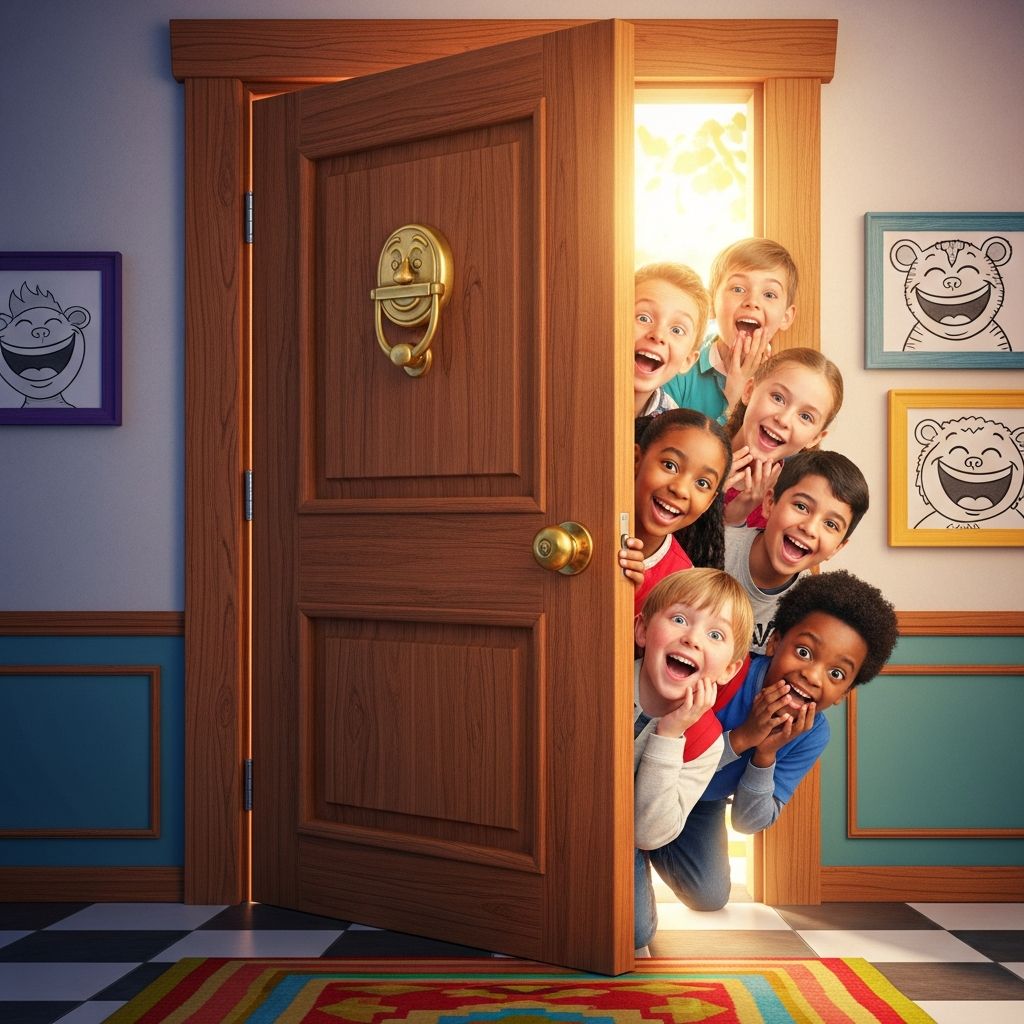
Knock-knock jokes remain a timeless favorite among children, delivering quick bursts of giggles through clever wordplay and surprise twists. These simple yet brilliant jests foster creativity and sharpen young minds while bringing families together in shared amusement. In this guide, explore a treasure trove of **hilarious knock-knock jokes** tailored for kids, uncover their fascinating origins, and learn how to craft your own for maximum fun.
The Enduring Charm of Knock-Knock Jokes in Family Life
Nothing beats the infectious joy of a well-timed knock-knock joke shared around the dinner table or during a car ride. These jokes thrive on anticipation, building suspense with the classic “Who’s there?” before unleashing a punny punchline. For children, they introduce puns and homophones in an engaging way, boosting vocabulary and listening skills without feeling like a lesson. Parents appreciate how they require no props, making them ideal for spontaneous play. Studies on humor development show that such interactive jokes help kids aged 5-10 process language nuances, enhancing cognitive growth through laughter.
Beyond education, knock-knock jokes build social bonds. When a child delivers a zinger and hears peals of laughter, it boosts confidence and encourages storytelling. In classrooms or playdates, they serve as icebreakers, turning shy moments into uproarious ones. Customize them with family names or pets for personalized hilarity that strengthens connections.
Unveiling the Origins: From Shakespeare to Modern Mania
The roots of knock-knock jokes stretch back centuries, with the earliest hints appearing in William Shakespeare’s Macbeth around 1606. In Act 2, Scene 3, a drunken porter responds to knocking with “Knock, knock! Who’s there?” followed by playful banter involving the word “Buff,” marking the first recorded use of this rhythmic structure. Though not a full joke, it laid the rhythmic foundation for what evolved later.
Fast-forward to the 20th century, when knock-knock jokes exploded in popularity. By 1929, they featured in children’s games described in Henry Bett’s The Games of Children, involving rhythmic knocking and responses. The true boom hit in 1934 with the first published example in newspapers: “Knock knock. Who’s there? Rufus. Rufus who? Rufus the most important part of your house.” Popularity peaked in 1936 during the U.S. presidential election, fueled by radio host Dick Redmond’s jokes playing on Republican vice-presidential candidate Frank Knox’s name, sparking a national craze. Stations like WKBO in Pennsylvania aired them regularly, and even businesses ran contests, cementing their place in pop culture.
By the 1950s, knock-knock jokes went global, adapting to languages worldwide—from “Toc-Toc” in French to “Klop-klop” in Dutch. Critics called them simplistic, but their resilience endures, revived in shows like Rowan & Martin’s Laugh-In. Today, they symbolize innocent fun, with March 7 celebrated as National Knock-Knock Jokes Day in some circles.
Classic Knock-Knock Jokes to Get the Giggles Going
Start with these evergreen favorites that never fail to delight young audiences. Perfect for ages 4 and up, they rely on familiar words and silly surprises.
- Knock knock.
Who’s there?
Boo.
Boo who?
Don’t cry, it’s just a joke! - Knock knock.
Who’s there?
Lettuce.
Lettuce who?
Lettuce in, it’s cold out here! - Knock knock.
Who’s there?
Owls say.
Owls say who?
That’s correct, owls say who! That’s their favorite question. - Knock knock.
Who’s there?
Atch.
Atch who?
Bless you! - Knock knock.
Who’s there?
Wooden shoe.
Wooden shoe who?
Wooden shoe like to know!
These classics introduce basic puns, teaching kids about sound-alikes like “boo hoo” and “lettuce.” Share them in sequence to build momentum.
Animal-Themed Knock-Knock Jokes for Young Animal Lovers
Kids obsessed with pets and zoos will roar with these creature-inspired zingers. They combine adorable imagery with wordplay for double the fun.
- Knock knock.
Who’s there?
Cow says.
Cow says who?
No, silly—a cow says moo! - Knock knock.
Who’s there?
Fish.
Fish who?
You didn’t think I was a human, did you? - Knock knock.
Who’s there?
Dog.
Dog who?
Dog gone it, open the door! - Knock knock.
Who’s there?
Monkey.
Monkey who?
Monkey around with me! - Knock knock.
Who’s there?
Rooster.
Rooster who?
Rooster you awake yet?
Animal jokes tap into children’s natural fascination with wildlife, making learning sounds and behaviors playful.
Foodie Knock-Knock Jokes for Snack-Time Chuckles
Mealtime madness ensues with these tasty treats of humor. Ideal for picky eaters or baking days.
- Knock knock.
Who’s there?
Apple.
Apple who?
Apple a day keeps the doctor away! - Knock knock.
Who’s there?
Juice.
Juice who?
Juice tell me the truth! - Knock knock.
Who’s there?
Pizza.
Pizza who?
Pizza your heart! - Knock knock.
Who’s there?
Banana.
Banana who?
Banana split, so open up! - Knock knock.
Who’s there?
Candy.
Candy who?
Candy come out to play?
Food puns link to everyday life, helping kids associate humor with routine activities.
Silly School and Everyday Life Knock-Knock Jokes
Relate to recess, homework, and daily adventures with these relatable rib-ticklers.
- Knock knock.
Who’s there?
Spell.
Spell who?
W-H-O! - Knock knock.
Who’s there?
Radio.
Radio who?
Radio not, it’s too loud! - Knock knock.
Who’s there?
Bed.
Bed who?
Bed you can’t guess! - Knock knock.
Who’s there?
Time.
Time who?
Time to open the door! - Knock knock.
Who’s there?
Harry.
Harry who?
Harry up and answer!
Advanced Puns for Older Kids and Clever Twists
For tweens ready for brain-teasers, these escalate the wordplay with homophones and idioms.
- Knock knock.
Who’s there?
Figs.
Figs who?
Figs the doorbell, it’s broken! - Knock knock.
Who’s there?
Needle.
Needle who?
Needle little help opening the door! - Knock knock.
Who’s there?
Robin.
Robin who?
Robin you, hand over the candy! - Knock knock.
Who’s there?
Amarillo.
Amarillo who?
Amarillo nice guy! - Knock knock.
Who’s there?
Egg.
Egg who?
Eggcited to see you!
These challenge comprehension, promoting critical thinking through layered meanings.
How to Invent Your Own Knock-Knock Jokes Like a Pro
Empower kids to create originals by following this simple formula: Choose a short name or word with a pun potential, build the response around a sound-alike phrase, and deliver with timing. Start with familiar objects—e.g., Knock knock. Who’s there? Shoe. Shoe who? Shoe-tally awesome!
Tips for success:
- Keep it short: Aim for 5-8 words per line.
- Test puns: Use homophones like ‘pair’ and ‘pear.’
- Add visuals: Act out with gestures.
- Theme it: Match holidays or seasons.
Family joke nights amplify creativity—track favorites in a shared notebook.
Knock-Knock Jokes by Age Group: A Handy Guide
| Age Group | Best Joke Style | Example Count | Why It Works |
|---|---|---|---|
| 4-6 Years | Simple animals/food | 20+ | Basic words, repetition |
| 7-9 Years | School/everyday | 30+ | Relatable scenarios |
| 10-12 Years | Advanced puns | 25+ | Wordplay challenges |
This table helps select age-appropriate humor for maximum engagement.
Frequently Asked Questions About Knock-Knock Jokes
Are knock-knock jokes good for child development?
Yes, they enhance language skills, timing, and social interaction, supporting cognitive growth in early years.
Why did knock-knock jokes become popular in 1936?
A radio craze tied to politician Frank Knox’s name during the U.S. election turned them into a nationwide fad.
Can adults enjoy knock-knock jokes too?
Absolutely—their simplicity offers nostalgic fun and stress relief for all ages.
How many knock-knock jokes are in this article?
Over 25 curated examples, plus tips to generate endless more.
What’s the origin of “Knock knock. Who’s there?”
Traced to Shakespeare’s Macbeth in 1606, evolving into modern form by the 1930s.
Using Knock-Knock Jokes for Family Bonding and Events
Incorporate them into game nights, birthdays, or road trips. Create joke jars for drawing prompts or chains where each person adds a line. At parties, host contests with prizes for the funniest original. They adapt to virtual calls too—perfect for distant relatives. Research highlights how shared laughter releases endorphins, improving mood and relationships.
For educators, integrate into lessons: math with counting knocks or English with pun analysis. The versatility makes them a staple in parenting toolkits.
References
- Shakespeare and a Presidential Election: The History of the Knock Knock Joke — Griffin Newspaper. 2020-10-15. https://www.griffinnewspaper.com/post/shakespeare-and-a-presidential-election-the-history-of-the-knock-knock-joke
- The History of Knock-Knock Jokes — Word Connection. 2021-10-31. https://www.word-connection.com/blogs/the-history-of-knock-knock-jokes
- 8 Moments in Knock Knock Joke History — Mental Floss. 2015-12-30. https://www.mentalfloss.com/article/55962/8-moments-knock-knock-joke-history
- Knock-Knock Joke — Wikipedia (drawing from historical records). 2024-01-15. https://en.wikipedia.org/wiki/Knock-knock_joke
- Knock Knock! Who’s There? Metafolklore, Jokes, and Shakespeare — Library of Congress Folklife Blog. 2024-04-15. https://blogs.loc.gov/folklife/2024/04/knock-knock-whos-there-metafolklore-jokes-and-shakespeare/
- The History of the Knock Knock Joke — Sommore. 2021-02-10. https://sommore.com/2021/02/10/the-history-of-the-knock-knock-joke/