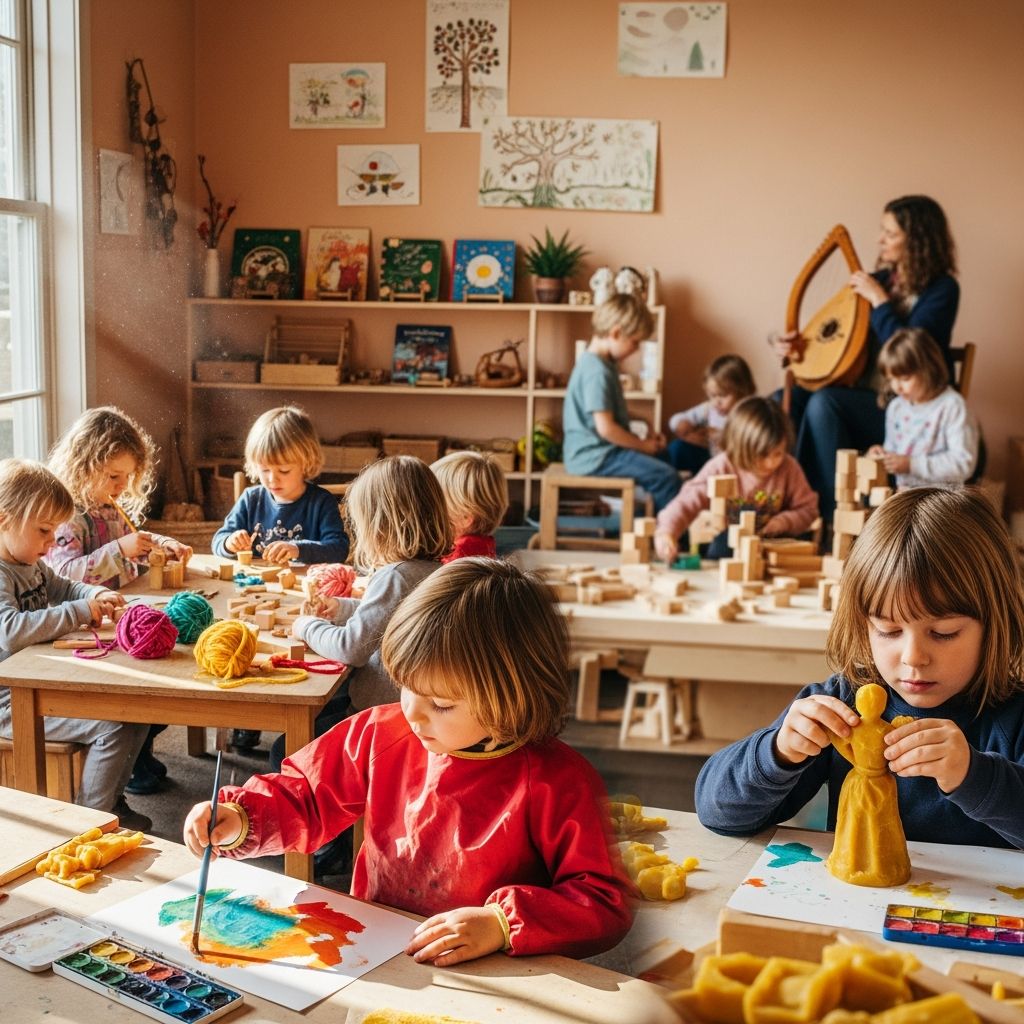
Waldorf education, rooted in the philosophy of Rudolf Steiner, offers a distinctive path for child development by integrating intellectual, artistic, and practical elements into daily learning. This method prioritizes holistic growth over rote memorization, fostering confident, creative individuals ready for lifelong learning.
Origins and Core Philosophy
The foundation of Waldorf education traces back to 1919 when Rudolf Steiner established the first school for factory workers’ children in Stuttgart, Germany. Steiner’s anthroposophy—a worldview blending spiritual and practical insights—guides this approach, viewing humans as beings of body, soul, and spirit. Unlike conventional systems focused on standardized outcomes, Waldorf aims to awaken each child’s physical, emotional, cognitive, social, and spiritual potentials through tailored, experiential methods.
Central to this philosophy is the “head, heart, and hands” triad, engaging thinking, feeling, and doing. Education becomes a rhythmic process where arts infuse every subject, promoting deeper retention and personal connection. Teachers hold significant autonomy, observing children closely to adapt lessons, ensuring development aligns with innate rhythms rather than external benchmarks.
Understanding Developmental Stages
Waldorf divides childhood into three seven-year epochs, each demanding unique pedagogical strategies. This structure mirrors natural human growth, from sensory immersion to abstract reasoning.
- Birth to Age 7 (Early Childhood): Children learn primarily through imitation and play in a sensory-rich environment. Activities like baking, crafting, and nature exploration build foundational skills without formal academics, emphasizing rhythm, nurturing, and free play to support emotional and physical health.
- Ages 7-14 (Middle Childhood): Imagination drives learning as feelings awaken. Teachers introduce academics through stories, arts, and movement, delaying intensive reading and writing to around age 7. Rhythmical daily schedules include main lesson blocks, fostering moral imagination and rhythmic thinking.
- Ages 14-21 (Adolescence): Critical thinking emerges, with lessons challenging students to form judgments. Emphasis shifts to analytical skills, ethics, and real-world preparation through projects, sciences, and humanities, balancing idealism with practical application.
This phased approach ensures teaching matches developmental readiness, preventing burnout and sparking intrinsic motivation.
Daily Life and Curriculum Design
A typical Waldorf day pulses with rhythm: morning verses, main lessons (3-4 weeks on one topic like math or history), artistic pursuits (painting, music, eurythmy—a movement art), and practical work (gardening, woodworking). No textbooks in early years; “main lesson books” handmade by students capture learning artistically.
Curriculum integrates subjects holistically. For instance, history blends with mythology, math with geometry drawing, and science with nature observation. Multilingualism starts early, often with two foreign languages taught conversationally. Assessments rely on qualitative observation, portfolios, and teacher reports, minimizing standardized tests to reduce pressure.
| Grade Level | Key Focus Areas | Sample Activities |
|---|---|---|
| Preschool-K | Imitation, play, rhythm | Fairy tales, puppetry, seasonal festivals |
| Grades 1-4 | Imaginative stories, foundational skills | Form drawing, recorder music, knitting |
| Grades 5-8 | Rhythmic thinking, moral tales | Geodesic models, Greek mythology, choir |
| Grades 9-12 | Critical analysis, ethics | Debates, lab sciences, apprenticeships |
This table illustrates progression, ensuring age-appropriate engagement.
Role of Arts and Nature
Arts are not extracurricular but core, with every child learning instruments (flute, lyre), painting wet-on-wet, and eurythmy to embody language rhythms. Nature immersion—through gardening, hikes, and seasonal celebrations—cultivates reverence and environmental stewardship.
Practical skills like sewing, metalwork, and cooking build perseverance and joy in creation, countering screen-heavy modern life. Research supports such kinesthetic learning for better retention and emotional regulation.
Teacher-Child Relationships
Main lesson teachers often stay with a class for 8 years, forming deep bonds. This continuity allows nuanced understanding of each child’s pace, strengths, and needs. Class guardians and parent councils foster community, with festivals uniting families.
Teachers model behaviors worth imitating, prioritizing warmth over authority. Professional development emphasizes child study circles, ensuring responsive, artistically attuned instruction.
Benefits for Modern Learners
- Creativity Boost: Arts integration sparks innovation; studies show Waldorf graduates excel in flexible thinking.
- Emotional Resilience: Rhythm and storytelling build inner strength and empathy.
- Academic Readiness: Delayed academics lead to strong later performance, with low remediation rates in college.
- Social Skills: Mixed-age and collaborative settings teach cooperation and leadership.
- Well-Being: Reduced testing stress correlates with lower anxiety.
Comparing Waldorf to Traditional Education
| Aspect | Waldorf | Traditional Public |
|---|---|---|
| Class Structure | Often same teacher multi-year, mixed abilities | Single-grade, subject specialists |
| Learning Style | Holistic, arts-infused, experiential | Standards-based, test-driven |
| Assessment | Observation, portfolios | Standardized tests, grades |
| Technology | Minimal, especially early years | Integrated daily |
| Goals | Whole-child freedom, creativity | Academic/career readiness |
Waldorf prioritizes process over product, differing from mainstream’s outcome focus.
Potential Drawbacks and Considerations
Critics note delayed academics may challenge transitions to test-heavy systems, and spiritual elements (non-dogmatic) might not suit all families. Costs (often private) and limited availability pose barriers. Parents should visit, observe classes, and assess fit.
Finding and Choosing a Waldorf School
Over 1,200 schools worldwide exist; associations like AWSNA provide directories. Visit during main lessons, query teacher training (must include Steiner pedagogy), and review parent handbooks. Public charters offer tuition-free options in some areas.
Frequently Asked Questions
What age do children start formal reading in Waldorf?
Typically around age 7, after building phonetic awareness through stories and play, aligning with developmental readiness.
Is Waldorf religious?
No, it’s non-sectarian; anthroposophy informs pedagogy but respects diverse beliefs, focusing on universal human development.
How does Waldorf handle technology?
Screens are avoided in early years to protect imagination; introduced thoughtfully in high school for discernment.
Do Waldorf students perform well academically later?
Yes, many excel in college and careers, with strong creative problem-solving skills.
Can Waldorf fit special needs children?
Individualized support through observation often benefits diverse learners, though specialized therapies may supplement.
References
- The Foundational Principles of a Waldorf Education — Wonderschool. 2023. https://www.wonderschool.com/blog/family-resources/what-is-a-waldorf-school
- Waldorf education — Wikipedia. 2024-01-10. https://en.wikipedia.org/wiki/Waldorf_education
- Engaging Young Minds with the Waldorf Method — Brightwheel. 2023. https://mybrightwheel.com/blog/waldorf-teaching-method
- Holistic Education: Embracing the Waldorf Approach to Learning — Kimberton Waldorf School. 2024. https://www.kimberton.org/nurturing-the-whole-child-the-waldorf-approach-to-literacy-and-learning/
- What is Waldorf Education? — Waldorf Education (AWSNA). 2025-01-01. https://www.waldorfeducation.org/what-is-waldorf-education/
- AWSNA Principles for Waldorf Schools — Waldorf Education (AWSNA). 2024. https://www.waldorfeducation.org/about-waldorf-education/awsna-principles/
- Principles of Waldorf Education — International Waldorf School. 2023. https://www.internationalwaldorfschool.nl/our-school/basic-principles/