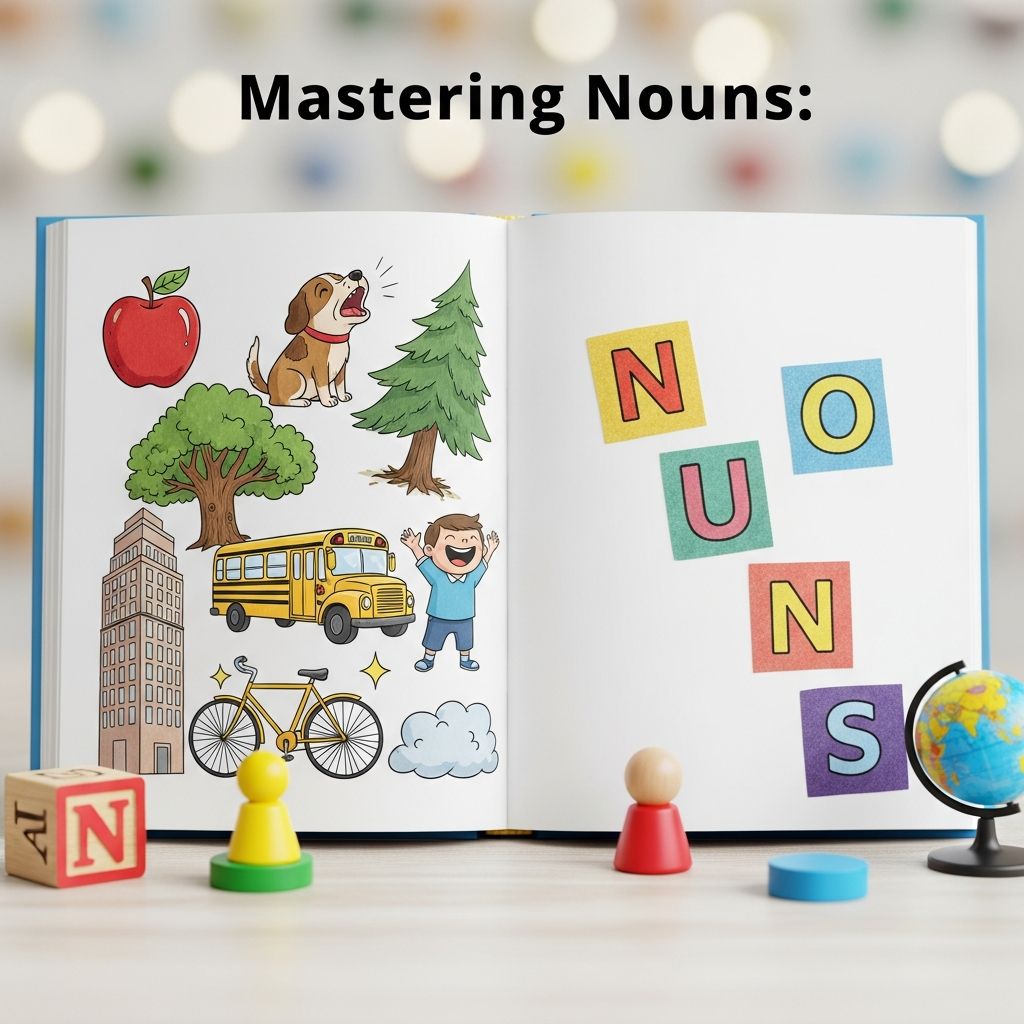
Nouns are the naming words of English. They label the people, places, things, and ideas that fill every sentence, making them one of the first and most important topics to teach in grammar.
What Is a Noun?
A noun is a word that names a person, place, thing, or idea. If you can point to it, talk to it, visit it, or think about it, the word for that “something” is almost always a noun.
In simple terms, nouns answer questions like “Who?” and “What?” in a sentence. They often work with verbs, pronouns, and adjectives to tell complete stories and share information.
- Person: teacher, friend, cousin, firefighter
- Place: library, park, school, kitchen
- Thing: pencil, bicycle, computer, pillow
- Idea: honesty, courage, freedom, friendship
Why Nouns Matter in Everyday English
Without nouns, sentences would feel empty because nothing would have a name. Verbs show actions and states, but nouns tell us who is acting and what is involved.
Understanding nouns helps children write clearer sentences, describe their experiences in detail, and build a strong base for later grammar topics like pronouns, subject-verb agreement, and sentence structure.
- Nouns allow writers to be specific instead of vague.
- They make stories and explanations easier to picture.
- They help students expand vocabulary in a structured way.
Big Picture: Main Families of Nouns
There are many ways to sort nouns, and each category highlights a different feature. For teaching, it helps to group them into a few large “families” and then explore each one with examples and short activities.
Below is a quick overview before going into details.
| Noun Type | What It Focuses On | Simple Example |
|---|---|---|
| Concrete vs. abstract | Whether you can experience it with your senses | apple vs. kindness |
| Common vs. proper | General names vs. specific names | city vs. Paris |
| Countable vs. uncountable | Whether it can be counted as separate units | three books vs. some water |
| Singular vs. plural | One item vs. more than one | child vs. children |
| Collective | Groups treated as single units | team, flock, class |
Concrete and Abstract Nouns
Concrete nouns name things you can detect with at least one of your five senses: sight, hearing, touch, taste, or smell. Abstract nouns label ideas and feelings that you cannot physically touch or see, even though they influence daily life.
Presenting these side by side helps learners understand that not all important “things” in language are objects in the room; some are thoughts, qualities, or states of mind.
Concrete nouns
- People: doctor, neighbor, singer, child
- Places: beach, station, classroom, café
- Objects: notebook, window, spoon, suitcase
- Animals: rabbit, dolphin, eagle, turtle
- Food: bread, orange, pasta, chocolate
Abstract nouns
- Emotions: joy, anger, fear, relief
- Qualities: honesty, bravery, patience, beauty
- Concepts: justice, freedom, time, culture
- States: childhood, sleep, poverty, health
Mini-activity: Ask children to list ten things in the room (concrete nouns) and five things they feel or hope for (abstract nouns). Then highlight which group belongs to which category.
Common and Proper Nouns
Common nouns are general names for people, places, and things, while proper nouns are exact names. Proper nouns usually begin with capital letters, even in the middle of a sentence.
Common and proper pairs are a simple way to show how nouns move from general to specific, which strengthens both writing and reading comprehension.
Common nouns
- People: girl, uncle, singer, driver
- Places: town, museum, island, store
- Things: phone, ball, tree, chair
Proper nouns
- People: Maria, Ahmed, Sofia, Lucas
- Places: Central Park, London, Lake Tahoe
- Organizations: Red Cross, NASA, UNICEF
- Titles: Monday, April, Halloween, Christmas
Mini-activity: Write a list of ten common nouns and let students invent matching proper nouns. For example, “dog” becomes “Shadow,” and “school” becomes “Riverside Elementary.”
Countable and Uncountable Nouns
Countable nouns are items you can count individually: one, two, three, and so on. Uncountable nouns are substances, ideas, or collections that are not normally separated into individual units in everyday speech.
This distinction matters because it affects which numbers and quantifiers you can use. Countable nouns work with words like “many” and “a few,” while uncountable nouns take “much” and “a little.”
Countable nouns
- Objects: bottle, key, plate, ticket
- Living things: cat, tree, flower, student
- Items: coin, letter, toy, star
Uncountable nouns
- Substances: water, sand, air, sugar
- Topics: music, information, homework, traffic
- Concepts: happiness, knowledge, luck, weather
Mini-activity: Give learners a mixed list of words and ask them to label each one as countable or uncountable. Then have them add a suitable quantifier such as “a few,” “several,” “some,” or “a little.”
Singular, Plural, and Collective Nouns
Every noun has at least one basic form that refers to a single person, place, thing, or idea. Many nouns also have a plural form for “more than one,” often created by adding a final “-s” or “-es,” though there are many irregular patterns.
Collective nouns are special because they look singular but refer to groups, such as a team or a flock. They help writers talk about collections as if they are single units.
Singular and plural forms
- Regular plurals: cat → cats, book → books, river → rivers
- -es plurals: bus → buses, dish → dishes, fox → foxes
- Irregular plurals: child → children, foot → feet, mouse → mice
Collective nouns
- People: team, class, committee, crowd
- Animals: herd, flock, pack, swarm
- Things: bunch, pile, stack, set
Mini-activity: Ask children to rewrite sentences by changing singular nouns to plural and adjusting verbs. Then introduce one or two collective nouns and have them create original sentences using those words.
Concrete Examples for Learning Nouns
Lists of nouns are helpful, but children often remember them better when the words connect to real-life situations. Organizing nouns into familiar themes makes practice more meaningful and easier to recall.
The table below shows sample nouns grouped by everyday topics that work well for reading passages, writing prompts, or classroom games.
| Theme | People | Places | Things & Ideas |
|---|---|---|---|
| School | teacher, student, principal | classroom, library, cafeteria | desk, textbook, homework, knowledge |
| Home | parent, sibling, guest | kitchen, bedroom, garden | sofa, blanket, dinner, comfort |
| Nature | hiker, farmer, ranger | forest, riverbank, meadow | tree, stone, cloud, silence |
| Community | doctor, firefighter, neighbor | hospital, station, market | medicine, ladder, fruit, safety |
Simple Strategies for Teaching Nouns
Teaching nouns does not have to mean endless worksheets. Blending quick games, real objects, and student-generated examples keeps lessons lively and helps different types of learners.
Here are classroom-tested ideas you can adapt for younger children, older learners, or even self-study.
Label the world around you
- Invite learners to walk around the room with sticky notes and label as many nouns as they can see.
- For older students, ask them to label each item as concrete, abstract, common, or proper in a notebook instead of on the object.
Noun scavenger hunt
- Give each student or group a checklist such as “3 people nouns, 3 place nouns, 5 thing nouns, 2 idea nouns.”
- Set a time limit and let them search a book, a short article, or the classroom environment to complete the list.
Color-coding sentences
- Provide short sentences on strips of paper and ask students to highlight nouns in one color and verbs in another.
- Extend the task by asking them to add one more noun to each sentence without changing its meaning too much.
Common Noun Mistakes and How to Fix Them
Even confident writers can stumble over nouns, especially when working with plurals, mass nouns, or capitalization. Turning these trouble spots into quick mini-lessons helps learners avoid repeating the same errors.
This section highlights a few frequent issues and offers simple remedies you can weave into everyday practice.
Confusing countable and uncountable nouns
- Problem: Using a number with an uncountable noun, such as “two informations.”
- Fix: Replace the noun with a countable phrase like “two pieces of information” or “several facts.”
Irregular plural forms
- Problem: Adding “-s” to nouns that change form, such as “childs” instead of “children.”
- Fix: Create a small “irregular plural” chart and revisit it regularly through games and writing tasks.
Missing capital letters for proper nouns
- Problem: Writing names of people, places, days, and months with lowercase letters.
- Fix: Ask students to circle all the words that should start with capital letters in a paragraph and correct them as a warm-up activity.
Frequently Asked Questions About Nouns
Are names of days and months nouns?
Yes. Names of days, months, and holidays are proper nouns because they refer to specific periods or celebrations. They always begin with a capital letter, even when they appear in the middle of a sentence.
Can one word be more than one type of noun?
Many words change category depending on how they are used. A word like “light” can name a physical object (a lamp) and act as an uncountable noun when referring to brightness in general.
Is a group name like “family” singular or plural?
Words such as “family,” “team,” and “class” are collective nouns. In everyday English they usually take singular verbs, but some varieties of English allow plural verbs when the group members are being emphasized.
How early should children learn about abstract nouns?
Young learners can start noticing abstract nouns as soon as they talk about feelings and qualities. Keeping explanations concrete—such as linking “bravery” to a story character—makes these invisible ideas easier to grasp.
What is the easiest way to spot nouns in a sentence?
One quick test is to see whether the word can fit after a small group of words like “a,” “an,” or “the,” or whether it can be counted. If the word names someone or something, it is very likely a noun.
Bringing It All Together
Nouns give names to everything talked about in speech and writing, from favorite toys and favorite people to far-away places and invisible ideas. When learners recognize different types of nouns, they become better at choosing the right words for each situation.
Through themed lists, mini-activities, and careful attention to tricky areas like plurals and capitalization, anyone can move from simply spotting nouns to using them skillfully in stories, reports, and everyday communication.